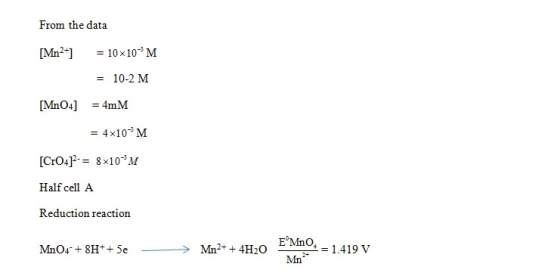
We consider two half cells:
Half cell A comprises a platinum electrode immersed in an
aqueous solution containing Mn2+ (10 mM) and MnO4- (4
mM) ions at pH=4.
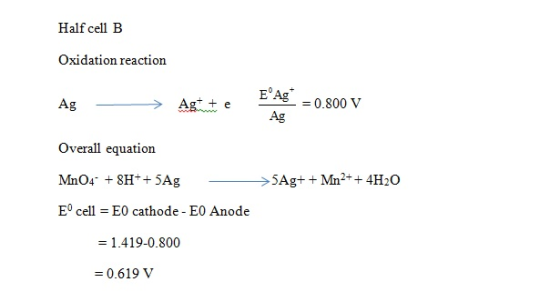
Half cell B is constructed with a silver electrode immersed in an
aqueous potassium chromate solution (8 mM) in the presence
of solid Ag2CrO4. The pH of this half cell B is pH=9.
Both half cells are connected with a salt bridge. The voltage of
the cell is measured at 25°C: it is 0.573 V. Use the following
standard reduction potentials:
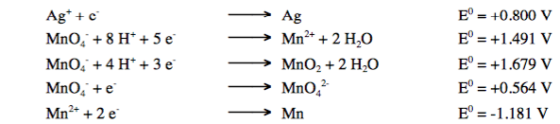
a. Calculate the solubility product of silver
chromate.
b. Explain, why the given pH values are essential
for this problem.
c. Determine – through calculation – the standard
reduction potentials for
MnO2 +4H+ +3e- ?? Mn2+ +2H2O
and
MnO42- +4H+ +2e- ?? MnO2 +2H2O
Homework Answers
![Use Nemst equation 0.059, [products] E cell-E log reactants 2+ 0.573-0.619-log 0.059, AgMn](http://img.homeworklib.com/questions/1acddaa0-7556-11eb-9660-e3b98bde9a37.png?x-oss-process=image/resize,w_560)
 (410 101) 0.059 3410)(10) Ag 1-6.42 10 M Ksp [Ag ][CrO4 (6.42x10): (8x10 )](http://img.homeworklib.com/questions/1ba1d000-7556-11eb-8b31-450197f60b96.png?x-oss-process=image/resize,w_560)
Add Answer to:
We consider two half
cells:
Half cell A comprises a platinum electrode immersed in an
aqueous...
A voltaic cell contains two half-cells. One half-cell contains a zinc electrode immersed in a 1.00...
A voltaic cell contains two half-cells. One half-cell contains a zinc electrode immersed in a 1.00 M Zn(NO3)2 solution. The second half-cell contains a titanium electrode immersed in a 1.00 M Ti(NO3)3 solution. Zn2+(aq) + 2 e− → Zn(s) E⁰red = −0.762 V Ti3+(aq) + 3 e− → Ti(s) E⁰red = −1.370 V (a) Using the standard reduction potentials given above, predict the standard cell potential of the voltaic cell. _____ V (b) Write the overall balanced equation for the...
Given the following standard half-cell potentials: MnO2(s) + 4H+ (aq) + 2e– → Mn2+(aq) + 2H2O(l)...
Given the following standard half-cell potentials: MnO2(s) + 4H+ (aq) + 2e– → Mn2+(aq) + 2H2O(l) E° = 1.23 V NO3 – (aq) + 4H+ (aq) + 3e– → NO(g) + 2H2O(l) E° = 0.96 V N2(g) + 5H+ (aq) + 4e– → N2H5 + (aq) E° = –0.23 V Which of the following reactions is nonspontaneous under standard state conditions?
A voltaic cell contains two half-cells. One half-cell contains a chromium electrode immersed in a 1.00...
 A voltaic cell contains two half-cells. One half-cell contains a chromium electrode immersed in a 1.00 M Cr(NO_3)_3 solution. The second half-cell contains a nickel electrode immersed in a 1.00 M Ni(NO_3)_2 solution. Cr^3+(aq) + 3 e^- rightarrow Cr(s) E_red^degree = 0.744 V Ni^2+(aq) + 2e^- rightarrow Ni(s) E_red^degree = -0.257 V Using the standard reduction potentials given above, predict the standard cell potential of the voltaic cell. Write the overall balanced equation for the voltaic cell. (Include states-of-matter under...
1. How do I read the half reaction table? 2. If im asked for the best...
 1. How do I read the half reaction table?
2. If im asked for the best reducing agent from Cu+, Ag+, F2, and
Fe3+, where do I look first in the table? before the arrow or after
the arrow?
3. Sometimes a value that has originally a positive (V) from the
table it will have the negative sign in a homework problem, and
viceversa, so the question is, how do I use the positive and
negative signs in respect to...
1. How do I read the half reaction table?
2. If im asked for the best reducing agent from Cu+, Ag+, F2, and
Fe3+, where do I look first in the table? before the arrow or after
the arrow?
3. Sometimes a value that has originally a positive (V) from the
table it will have the negative sign in a homework problem, and
viceversa, so the question is, how do I use the positive and
negative signs in respect to...
A voltaic cell contains two half-cells. One half-cell contains a titanium electrode immersed in a 1.00...
A voltaic cell contains two half-cells. One half-cell contains a titanium electrode immersed in a 1.00 M Ti(NO3)3 solution. The second half-cell contains a nickel electrode immersed in a 1.00 M Ni(NO3)2 solution. Ti3+(aq) + 3 e− → Ti(s) E⁰red = −1.370 V Ni2+(aq) + 2 e− → Ni(s) E⁰red = −0.257 V Write the overall balanced equation for the voltaic cell. (Include states-of-matter under the given conditions in your answer.)
A voltaic cell contains two half-cells. One half-cell contains a gold electrode immersed in a 1.00 M Au(NO3)3 solution....
 A voltaic cell contains two half-cells. One half-cell contains a gold electrode immersed in a 1.00 M Au(NO3)3 solution. The second half-cell contains a magnesium electrode immersed in a 1.00 M Mg(NO3)2 solution. Au ** (aq) + 3 e Au(s) Ered = +1.498 V Mg2+ (aq) + 2 + Mg(s) Ered = -2.372 V (a) Using the standard reduction potentials given above, predict the standard cell potential of the voltaic cell. (b) Write the overall balanced equation for the voltaic...
A voltaic cell consists of two half-cells. One half-cell contains a chromium electrode immersed in 1.00...
A voltaic cell consists of two half-cells. One half-cell contains a chromium electrode immersed in 1.00 M Cr(NO3)3 solution. The second half-cell contains a cobalt electrode immersed in 1.00 M Co(NO3)2 solution. Cobalt plates out on the cobalt electrode as the voltaic cell runs. The beginning voltage of the cell is +0.467 V at 25°C. The standard electrode potential (standard reduction potential) of chromium at 25°C is −0.744 V. (a) Write a balanced half-reaction equation for the reaction occurring at...
need help for half cell potentials pls calculate step by step (NOTE - Remember that the...
 need help for half cell potentials pls calculate step by step
(NOTE - Remember that the positive electrode is attached to the red wire and the negative electrode is attached to the black wire.) Electrode Systems Used Anode (oxidation) Negative Cathode (reduction) Positive Measured Potential (V) Positive (Ecu) Copper and silver Cu() - Cu2+ + 2e" Ag+ +1e Ag) 0.432 V Zinc + Silver Zn cs + 2n**+ Zé dat + leº nAg (s) 1.484 V Copper & Zinc Zn(s)...
need help for half cell potentials pls calculate step by step
(NOTE - Remember that the positive electrode is attached to the red wire and the negative electrode is attached to the black wire.) Electrode Systems Used Anode (oxidation) Negative Cathode (reduction) Positive Measured Potential (V) Positive (Ecu) Copper and silver Cu() - Cu2+ + 2e" Ag+ +1e Ag) 0.432 V Zinc + Silver Zn cs + 2n**+ Zé dat + leº nAg (s) 1.484 V Copper & Zinc Zn(s)...
A voltaic cell consists of two half-cells. One half-cell contains a chromium electrode immersed in 1.00...
 A voltaic cell consists of two half-cells. One half-cell contains a chromium electrode immersed in 1.00 M Cr(NO3)3 solution. The second half-cell contains a nickel electrode immersed in 1.00 M NI(NO3)2 solution. Nickel plates out on the nickel electrode as the voltaic cell runs. The beginning voltage of the cell is +0.487 V at 25°C. The standard electrode potential (standard reduction potential) of chromium at 25°C is -0.744 V. (a) Write a balanced half-reaction equation for the reaction occurring at...
Show all steps please :) A galvanic cell is prepared using the following two half-cells: (i)...
 Show all steps please :)
A galvanic cell is prepared using the following two half-cells: (i) MnO4 (0.273 M), Mn2+ (0.167 M), and H+ (1.0 M), and (ii) Fe2+ (0.247 M) and Fe3+ (0.389 M). The standard reduction potentials for the two half cells are: Mnoa + 8H+ + 5e – Mn2+ + 4H20 E° = 1.507 V Fe3+ + e- Fe2+ E° = 0.770 V a) Calculate the voltage for this galvanic cell. b) Write the balanced equation for...
Show all steps please :)
A galvanic cell is prepared using the following two half-cells: (i) MnO4 (0.273 M), Mn2+ (0.167 M), and H+ (1.0 M), and (ii) Fe2+ (0.247 M) and Fe3+ (0.389 M). The standard reduction potentials for the two half cells are: Mnoa + 8H+ + 5e – Mn2+ + 4H20 E° = 1.507 V Fe3+ + e- Fe2+ E° = 0.770 V a) Calculate the voltage for this galvanic cell. b) Write the balanced equation for...
 A voltaic cell contains two half-cells. One half-cell contains a chromium electrode immersed in a 1.00 M Cr(NO_3)_3 solution. The second half-cell contains a nickel electrode immersed in a 1.00 M Ni(NO_3)_2 solution. Cr^3+(aq) + 3 e^- rightarrow Cr(s) E_red^degree = 0.744 V Ni^2+(aq) + 2e^- rightarrow Ni(s) E_red^degree = -0.257 V Using the standard reduction potentials given above, predict the standard cell potential of the voltaic cell. Write the overall balanced equation for the voltaic cell. (Include states-of-matter under...
 1. How do I read the half reaction table?
2. If im asked for the best reducing agent from Cu+, Ag+, F2, and
Fe3+, where do I look first in the table? before the arrow or after
the arrow?
3. Sometimes a value that has originally a positive (V) from the
table it will have the negative sign in a homework problem, and
viceversa, so the question is, how do I use the positive and
negative signs in respect to...
1. How do I read the half reaction table?
2. If im asked for the best reducing agent from Cu+, Ag+, F2, and
Fe3+, where do I look first in the table? before the arrow or after
the arrow?
3. Sometimes a value that has originally a positive (V) from the
table it will have the negative sign in a homework problem, and
viceversa, so the question is, how do I use the positive and
negative signs in respect to...
 A voltaic cell contains two half-cells. One half-cell contains a gold electrode immersed in a 1.00 M Au(NO3)3 solution. The second half-cell contains a magnesium electrode immersed in a 1.00 M Mg(NO3)2 solution. Au ** (aq) + 3 e Au(s) Ered = +1.498 V Mg2+ (aq) + 2 + Mg(s) Ered = -2.372 V (a) Using the standard reduction potentials given above, predict the standard cell potential of the voltaic cell. (b) Write the overall balanced equation for the voltaic...
 need help for half cell potentials pls calculate step by step
(NOTE - Remember that the positive electrode is attached to the red wire and the negative electrode is attached to the black wire.) Electrode Systems Used Anode (oxidation) Negative Cathode (reduction) Positive Measured Potential (V) Positive (Ecu) Copper and silver Cu() - Cu2+ + 2e" Ag+ +1e Ag) 0.432 V Zinc + Silver Zn cs + 2n**+ Zé dat + leº nAg (s) 1.484 V Copper & Zinc Zn(s)...
need help for half cell potentials pls calculate step by step
(NOTE - Remember that the positive electrode is attached to the red wire and the negative electrode is attached to the black wire.) Electrode Systems Used Anode (oxidation) Negative Cathode (reduction) Positive Measured Potential (V) Positive (Ecu) Copper and silver Cu() - Cu2+ + 2e" Ag+ +1e Ag) 0.432 V Zinc + Silver Zn cs + 2n**+ Zé dat + leº nAg (s) 1.484 V Copper & Zinc Zn(s)...
 A voltaic cell consists of two half-cells. One half-cell contains a chromium electrode immersed in 1.00 M Cr(NO3)3 solution. The second half-cell contains a nickel electrode immersed in 1.00 M NI(NO3)2 solution. Nickel plates out on the nickel electrode as the voltaic cell runs. The beginning voltage of the cell is +0.487 V at 25°C. The standard electrode potential (standard reduction potential) of chromium at 25°C is -0.744 V. (a) Write a balanced half-reaction equation for the reaction occurring at...
 Show all steps please :)
A galvanic cell is prepared using the following two half-cells: (i) MnO4 (0.273 M), Mn2+ (0.167 M), and H+ (1.0 M), and (ii) Fe2+ (0.247 M) and Fe3+ (0.389 M). The standard reduction potentials for the two half cells are: Mnoa + 8H+ + 5e – Mn2+ + 4H20 E° = 1.507 V Fe3+ + e- Fe2+ E° = 0.770 V a) Calculate the voltage for this galvanic cell. b) Write the balanced equation for...
Show all steps please :)
A galvanic cell is prepared using the following two half-cells: (i) MnO4 (0.273 M), Mn2+ (0.167 M), and H+ (1.0 M), and (ii) Fe2+ (0.247 M) and Fe3+ (0.389 M). The standard reduction potentials for the two half cells are: Mnoa + 8H+ + 5e – Mn2+ + 4H20 E° = 1.507 V Fe3+ + e- Fe2+ E° = 0.770 V a) Calculate the voltage for this galvanic cell. b) Write the balanced equation for...
Most questions answered within 3 hours.
-
Where is the error in this code sequence?
String s1 = "Hello";
String s2 = "ello";...
asked 10 months ago -
Financial data for Joel de Paris, Inc., for last year
follow:
Joel de Paris, Inc.
Balance...
asked 10 months ago -
Consider this reaction:
Al2(SO4)3 (aq)+ BaCl3
(aq) Al2Cl6 (aq)- +
3BaSO4(s) . What is the...
asked 10 months ago -
Suppose that Savneet is considering increasing her
recent random sample from 20 car rentals to 40...
asked 10 months ago -
Trucks arrive at an unloading terminal at an average rate of 120
per hour.
Trucks arrive...
asked 10 months ago -
Why are methanol and ethanol completely soluble in water while
octanol is not very little soluble....
asked 10 months ago -
A facilities manager at a university reads in a research report
that the mean amount of...
asked 10 months ago -
When the CuSO4 is rehydrated by adding water to the anhydrous
compound, is this an endothermic...
asked 10 months ago -
A ray of sunlight is passing from diamond into crown glass; the
angle of incidence is...
asked 10 months ago -
A block of mass 0.249 kg is placed on top of a light, vertical
spring of...
asked 10 months ago -
how do the kidneys compensate in the presences of acidosis
a) trigger hyperventilate
b) reserve acid...
asked 10 months ago -
Question 501 pts
The rental rate of capital to the firm increases. Which of the
following...
asked 10 months ago