
Homework Answers
Add Answer to:
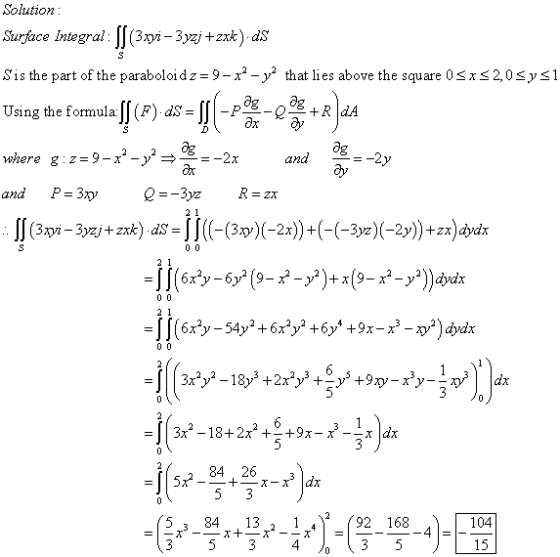
(1 point) Evaluate the surface integral || (3x yi – 3yzj + zxk) · dS. JJ...
1. Evaluate the line integral S3x2yz ds, C: x = t, y = t?, z =...
 1. Evaluate the line integral S3x2yz ds, C: x = t, y = t?, z = t3,0 st 51. 2. Evaluate the line integral Scyz dx - xz dy + xy dz , C: x = e', y = e3t, z = e-4,0 st 51. 3. Evaluate SF. dr if F(x,y) = x?i + xyj and r(t) = 2 costi + 2 sin tj, 0 st St. 4. Determine whether F(x,y) = xi + yj is a conservative vector field....
please just the final answer for both Evaluate the surface Integral || 5. ds for the...
 please just the final answer for both
Evaluate the surface Integral || 5. ds for the given vector fleld F and the oriented surface S. In other words, find the flux of F across S. For closed surfaces, use the positive (outward) orientation. F(x, y, z) = yi - xj + Szk, S is the hemisphere x2 + y2 + y2 = 4, 220, oriented downward 26.677 X Evaluate the surface integral llo F.ds for the given vector field F...
please just the final answer for both
Evaluate the surface Integral || 5. ds for the given vector fleld F and the oriented surface S. In other words, find the flux of F across S. For closed surfaces, use the positive (outward) orientation. F(x, y, z) = yi - xj + Szk, S is the hemisphere x2 + y2 + y2 = 4, 220, oriented downward 26.677 X Evaluate the surface integral llo F.ds for the given vector field F...
Problem 3 (8 marks) Evaluate the surface integral JJz"(x+y*)dS , where S s the part of the plane ...
 Problem 3 (8 marks) Evaluate the surface integral JJz"(x+y*)dS , where S s the part of the plane z 3 inside the paraboloid z = x2 + y2.
Problem 3 (8 marks) Evaluate the surface integral JJz"(x+y*)dS , where S s the part of the plane z 3 inside the paraboloid z = x2 + y2.
Problem 3 (8 marks) Evaluate the surface integral JJz"(x+y*)dS , where S s the part of the plane z 3 inside the paraboloid z = x2 + y2.
using this formula 2. Evaluate the surface integral F. dS, where F(x, y, z) = xi+yj+zk...
 using this formula
2. Evaluate the surface integral F. dS, where F(x, y, z) = xi+yj+zk is taken over the paraboloid z=1 – x2 - y2, z > 0. SA errom bove de SS (-P (- Puerto Q + R) dA dy
using this formula
2. Evaluate the surface integral F. dS, where F(x, y, z) = xi+yj+zk is taken over the paraboloid z=1 – x2 - y2, z > 0. SA errom bove de SS (-P (- Puerto Q + R) dA dy
(1 point) Verify that the Divergence Theorem is true for the vector field F = 3x´i...
 (1 point) Verify that the Divergence Theorem is true for the vector field F = 3x´i + 3xyj + 2zk and the region E the solid bounded by the paraboloid z = 9 - x2 - y2 and the xy-plane. To verify the Divergence Theorem we will compute the expression on each side. First compute div F dV JE div F= Waive av = f II Σ dz dy dx where zi = MM y1 = y2 = MM мм...
Evaluate the surface integral ∫∫S F·ds for the given vector field F and the oriented surface S.
Evaluate the surface integral ∫∫S F·ds for the given vector field F and the oriented surface S. In other words, find the flux of F across S. For closed surfaces, use the positive (outward) orientation. F(x, y, z) = xyl + yzj + zxk S is the part of the paraboloid z = 2 = x2 - y2 that lies above the square 0 ≤ x ≤ 1, 0 ≤ y ≤ 1, and has upward orientation_______
2. Evaluate the surface integral [[Fids. (a) F(x, y, z) - xi + yj + 2zk,...
 2. Evaluate the surface integral [[Fids. (a) F(x, y, z) - xi + yj + 2zk, S is the part of the paraboloid z - x2 + y2, 251 (b) F(x, y, z) = (z, x-z, y), S is the triangle with vertices (1,0,0), (0, 1,0), and (0,0,1), oriented downward (c) F-(y. -x,z), S is the upward helicoid parametrized by r(u, v) = (UCOS v, usin v,V), osus 2, OSVS (Hint: Tu x Ty = (sin v, -cos v, u).)...
Evaluate the surface integral | Fds for the given vector field F and the oriented surface...
 Evaluate the surface integral | Fds for the given vector field F and the oriented surface S. In other words, find the flux of F across S. For closed surfaces, use the positive (outward) orientation. JJS F(x, y, z) = xi - z j + y k S is the part of the sphere x2 + y2 + z2 = 49 in the first octant, with orientation toward the origin
Evaluate the surface integral F dot dS for the given vector field F and the oriented...
 Evaluate the surface integral F dot dS for the given
vector field F and the oriented surface S. In other words,
find
the flux of F across S. For closed surfaces, use the positive
(outward) orientation.
24. F(x, y, z) = -xi - yj + z’k, S is the part of the cone z = x2 + y2 between the planes z 1 and 2 3 with downward orientation
Evaluate the surface integral F dot dS for the given
vector field F and the oriented surface S. In other words,
find
the flux of F across S. For closed surfaces, use the positive
(outward) orientation.
24. F(x, y, z) = -xi - yj + z’k, S is the part of the cone z = x2 + y2 between the planes z 1 and 2 3 with downward orientation
evaluate JJ. (< –Y) A. ) Integrate f(x, y, z) = x2 + y2 + 22...
 evaluate JJ. (< –Y) A. ) Integrate f(x, y, z) = x2 + y2 + 22 over the cylinder x2 + y2 < 2,-2 <2<3 (IL dx dy dz Feraluate
 1. Evaluate the line integral S3x2yz ds, C: x = t, y = t?, z = t3,0 st 51. 2. Evaluate the line integral Scyz dx - xz dy + xy dz , C: x = e', y = e3t, z = e-4,0 st 51. 3. Evaluate SF. dr if F(x,y) = x?i + xyj and r(t) = 2 costi + 2 sin tj, 0 st St. 4. Determine whether F(x,y) = xi + yj is a conservative vector field....
 please just the final answer for both
Evaluate the surface Integral || 5. ds for the given vector fleld F and the oriented surface S. In other words, find the flux of F across S. For closed surfaces, use the positive (outward) orientation. F(x, y, z) = yi - xj + Szk, S is the hemisphere x2 + y2 + y2 = 4, 220, oriented downward 26.677 X Evaluate the surface integral llo F.ds for the given vector field F...
please just the final answer for both
Evaluate the surface Integral || 5. ds for the given vector fleld F and the oriented surface S. In other words, find the flux of F across S. For closed surfaces, use the positive (outward) orientation. F(x, y, z) = yi - xj + Szk, S is the hemisphere x2 + y2 + y2 = 4, 220, oriented downward 26.677 X Evaluate the surface integral llo F.ds for the given vector field F...
 Problem 3 (8 marks) Evaluate the surface integral JJz"(x+y*)dS , where S s the part of the plane z 3 inside the paraboloid z = x2 + y2.
Problem 3 (8 marks) Evaluate the surface integral JJz"(x+y*)dS , where S s the part of the plane z 3 inside the paraboloid z = x2 + y2.
Problem 3 (8 marks) Evaluate the surface integral JJz"(x+y*)dS , where S s the part of the plane z 3 inside the paraboloid z = x2 + y2.
 using this formula
2. Evaluate the surface integral F. dS, where F(x, y, z) = xi+yj+zk is taken over the paraboloid z=1 – x2 - y2, z > 0. SA errom bove de SS (-P (- Puerto Q + R) dA dy
using this formula
2. Evaluate the surface integral F. dS, where F(x, y, z) = xi+yj+zk is taken over the paraboloid z=1 – x2 - y2, z > 0. SA errom bove de SS (-P (- Puerto Q + R) dA dy
 (1 point) Verify that the Divergence Theorem is true for the vector field F = 3x´i + 3xyj + 2zk and the region E the solid bounded by the paraboloid z = 9 - x2 - y2 and the xy-plane. To verify the Divergence Theorem we will compute the expression on each side. First compute div F dV JE div F= Waive av = f II Σ dz dy dx where zi = MM y1 = y2 = MM мм...
 2. Evaluate the surface integral [[Fids. (a) F(x, y, z) - xi + yj + 2zk, S is the part of the paraboloid z - x2 + y2, 251 (b) F(x, y, z) = (z, x-z, y), S is the triangle with vertices (1,0,0), (0, 1,0), and (0,0,1), oriented downward (c) F-(y. -x,z), S is the upward helicoid parametrized by r(u, v) = (UCOS v, usin v,V), osus 2, OSVS (Hint: Tu x Ty = (sin v, -cos v, u).)...
 Evaluate the surface integral | Fds for the given vector field F and the oriented surface S. In other words, find the flux of F across S. For closed surfaces, use the positive (outward) orientation. JJS F(x, y, z) = xi - z j + y k S is the part of the sphere x2 + y2 + z2 = 49 in the first octant, with orientation toward the origin
 Evaluate the surface integral F dot dS for the given
vector field F and the oriented surface S. In other words,
find
the flux of F across S. For closed surfaces, use the positive
(outward) orientation.
24. F(x, y, z) = -xi - yj + z’k, S is the part of the cone z = x2 + y2 between the planes z 1 and 2 3 with downward orientation
Evaluate the surface integral F dot dS for the given
vector field F and the oriented surface S. In other words,
find
the flux of F across S. For closed surfaces, use the positive
(outward) orientation.
24. F(x, y, z) = -xi - yj + z’k, S is the part of the cone z = x2 + y2 between the planes z 1 and 2 3 with downward orientation
 evaluate JJ. (< –Y) A. ) Integrate f(x, y, z) = x2 + y2 + 22 over the cylinder x2 + y2 < 2,-2 <2<3 (IL dx dy dz Feraluate
Most questions answered within 3 hours.
-
Where is the error in this code sequence?
String s1 = "Hello";
String s2 = "ello";...
asked 10 months ago -
Financial data for Joel de Paris, Inc., for last year
follow:
Joel de Paris, Inc.
Balance...
asked 10 months ago -
Consider this reaction:
Al2(SO4)3 (aq)+ BaCl3
(aq) Al2Cl6 (aq)- +
3BaSO4(s) . What is the...
asked 10 months ago -
Suppose that Savneet is considering increasing her
recent random sample from 20 car rentals to 40...
asked 10 months ago -
Trucks arrive at an unloading terminal at an average rate of 120
per hour.
Trucks arrive...
asked 10 months ago -
Why are methanol and ethanol completely soluble in water while
octanol is not very little soluble....
asked 10 months ago -
A facilities manager at a university reads in a research report
that the mean amount of...
asked 10 months ago -
When the CuSO4 is rehydrated by adding water to the anhydrous
compound, is this an endothermic...
asked 10 months ago -
A ray of sunlight is passing from diamond into crown glass; the
angle of incidence is...
asked 10 months ago -
A block of mass 0.249 kg is placed on top of a light, vertical
spring of...
asked 10 months ago -
how do the kidneys compensate in the presences of acidosis
a) trigger hyperventilate
b) reserve acid...
asked 10 months ago -
Question 501 pts
The rental rate of capital to the firm increases. Which of the
following...
asked 10 months ago