The activity of an enzyme requires a glutamic acid to display its −COOH functional group in...
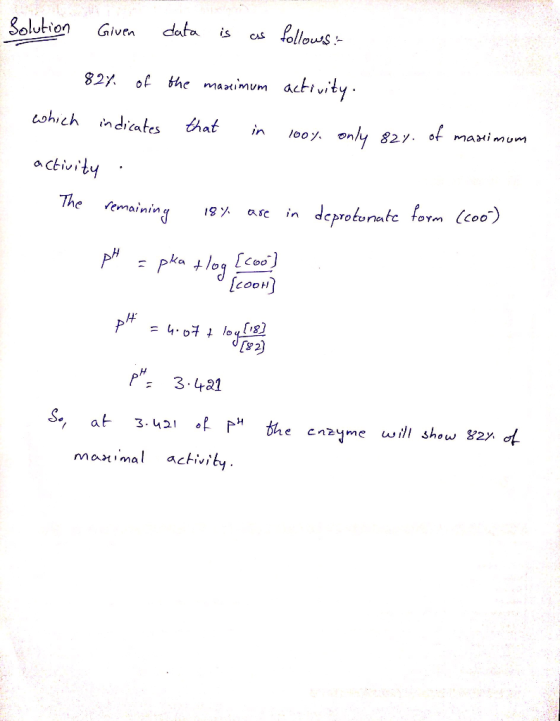
The activity of an enzyme requires a glutamic acid to display its −COOH functional group in the protonated state. Suppose the pKa of the −COOH group is 4.07. At what pH will the enzyme show 82% of maximal activity?
Homework Answers
Add Answer to:
The activity of an enzyme requires a glutamic acid to display
its −COOH functional group in...
The activity of an enzyme requires a cysteine to display its -SH side chain in the...
The activity of an enzyme requires a cysteine to display its -SH side chain in the deprotonated state. The pKa of the -SH group is 8.3. At what pH will the enzyme show 65.0% of maximal activity?
Suppose you are researching a special enzyme named "Generic Enzyme." Generic Enzyme has an amino acid...
Suppose you are researching a special enzyme named "Generic Enzyme." Generic Enzyme has an amino acid side chain functional group that must be in the protonated form for the enzyme to be active. You have just purified Generic Enzyme and found that 1 in every 4 individual Generic Enzyme molecules is active. Your special Generic Enzyme is at a pH of 7.75. Generic enzyme has a phenolic hydroxyl group which is responsible for its catalytic activity. What is the pKa...
A 15 ml aliquot of 0.1M glutamic acid is titrated with 0.1 M fully protonated NaOH....
A 15 ml aliquot of 0.1M glutamic acid is titrated with 0.1 M fully protonated NaOH. Write two dissociation reactions that result when 30.00mL of NaOH is added and their dissociation constants. Then, calculate the pH of the solution. The pKa values of glutamic acid are 2.19 (- alpha COOH), 9.67 (NH3+), and 4.25 (side chain -COOH). What are the steps to complete this question?
Note that the pKa of gamma-carboxyl group of glutamic acid is: 4.3. Calculate the pH at...
 Note that the pKa of gamma-carboxyl group of glutamic acid is: 4.3. Calculate the pH at which the gamma-carboxyl group of glutamic acid is 3/5 dissociated. What is the concentration of [H^+] in solution at this pH? Show your calculations to receive full credits.
Suppose you have a peptide composed of 4 amino acids bonded together: glutamine, glycine, glutamic acid,...
Suppose you have a peptide composed of 4 amino acids bonded together: glutamine, glycine, glutamic acid, and the novel amino acid friendsamine, which has an ionizable side group with a pKa of 5.9. At pH 7.0, this peptide has a net charge of -2. What is the charge on the protonated form of the friendsamine side group? Explain how you determined the charge on the protonated friendsamine side group
What percent of glutamic acid with a pKR of 4.25 has a protonated r-group at a...
What percent of glutamic acid with a pKR of 4.25 has a protonated r-group at a pH of 3.9 ? a. 50% b. 31% c. 74% d. 69%
1. (a) Draw the structure of L-glutamic acid and show its one letter and three letter...
1. (a) Draw the structure of L-glutamic acid and show its one letter and three letter code. (1 pt) (b) Show the calculation for its isoelectric point. (HINT: Check the pKa of the R group also.) (2 pt) (c) Draw the forms of glutamic acid at pH 1, 6 and 10. (3 pt) (d) To which electrode would glutamic acid migrate in electrophoresis at pH 7 buffer, the anode (+) or cathode (-)? (1 pt) (e) MSG (monosodium glutamate) is...
We have seen that amino acid residues Asp52 and Glu35 are required for lysozyme?s catalytic activity:...
We have seen that amino acid residues Asp52 and Glu35 are required for lysozyme?s catalytic activity: • Assume that the side chain pKas are the usual valuesof 3.90 for Asp and 4.07 for Glu. At pH 5.0 (the pH optimum for lysozyme) what proportion of enzyme molecules have both Asp52 and Glu35 in the correct ionization state? • Are the pKa values likely to be correct? What change in pKa might be present within lysozyme?
Enzyme X exhibits maximum activity at pH = 5.25. X shows a sharp decrease in its activity when th...
Enzyme X exhibits maximum activity at pH = 5.25. X shows a sharp decrease in its activity when the pH goes much lower than 4.35. One likely interpretation of this pH activity is that: A) a Glu residue (pKa = 4.25) on the enzyme is involved in the reaction. B) a His residue (pKa = 6.0) on the enzyme is involved in the reaction. C) the enzyme has a metallic cofactor. D) the enzyme is found in gastric secretions. E)...
Enzyme X exhibits maximum activity at pH = 5.25. X shows a sharp decrease in its...
Enzyme X exhibits maximum activity at pH = 5.25. X shows a sharp decrease in its activity when the pH goes much lower than 4.35. One likely interpretation of this pH activity is that: A) a Glu residue (pKa = 4.25) on the enzyme is involved in the reaction. B) a His residue (pKa = 6.0) on the enzyme is involved in the reaction. C) the enzyme has a metallic cofactor. D) the enzyme is found in gastric secretions. E)...
 Note that the pKa of gamma-carboxyl group of glutamic acid is: 4.3. Calculate the pH at which the gamma-carboxyl group of glutamic acid is 3/5 dissociated. What is the concentration of [H^+] in solution at this pH? Show your calculations to receive full credits.
Most questions answered within 3 hours.
-
Where is the error in this code sequence?
String s1 = "Hello";
String s2 = "ello";...
asked 11 months ago -
Financial data for Joel de Paris, Inc., for last year
follow:
Joel de Paris, Inc.
Balance...
asked 11 months ago -
Consider this reaction:
Al2(SO4)3 (aq)+ BaCl3
(aq) Al2Cl6 (aq)- +
3BaSO4(s) . What is the...
asked 11 months ago -
Suppose that Savneet is considering increasing her
recent random sample from 20 car rentals to 40...
asked 11 months ago -
Trucks arrive at an unloading terminal at an average rate of 120
per hour.
Trucks arrive...
asked 11 months ago -
Why are methanol and ethanol completely soluble in water while
octanol is not very little soluble....
asked 11 months ago -
A facilities manager at a university reads in a research report
that the mean amount of...
asked 11 months ago -
When the CuSO4 is rehydrated by adding water to the anhydrous
compound, is this an endothermic...
asked 11 months ago -
A ray of sunlight is passing from diamond into crown glass; the
angle of incidence is...
asked 11 months ago -
A block of mass 0.249 kg is placed on top of a light, vertical
spring of...
asked 11 months ago -
how do the kidneys compensate in the presences of acidosis
a) trigger hyperventilate
b) reserve acid...
asked 11 months ago -
Question 501 pts
The rental rate of capital to the firm increases. Which of the
following...
asked 11 months ago