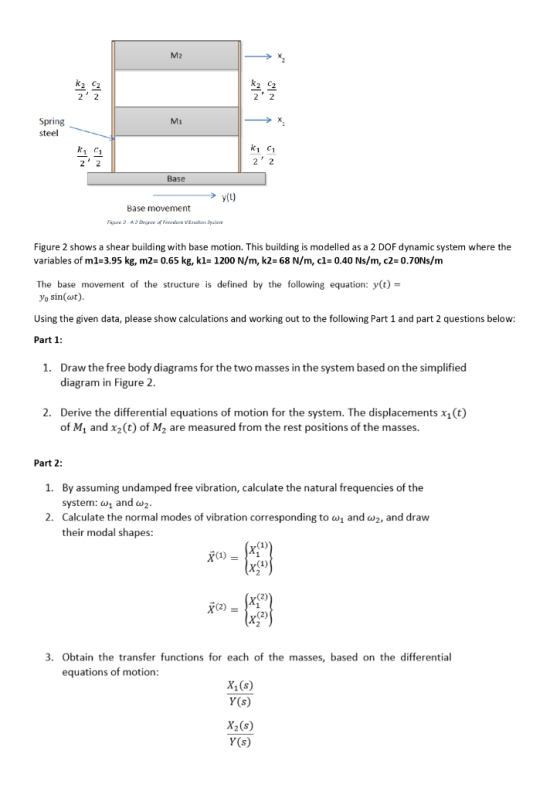
Please answer the questions for Part 1 and Part 2 showing all steps, using the provided data values.
Many thanks.
Homework Answers


Add Answer to:
Please answer the questions for Part 1 and Part 2 showing all
steps, using the provided...
Homework 7: Undamped, 2-DOF System 1. A system with two masses of which the origins are...
 Homework 7: Undamped, 2-DOF System 1. A system with two masses of which the origins are at the SEPs is shown in Figure 1. The mass of m2 is acted by the external force of f(t). Assume that the cable between the two springs, k2 and k3 is not stretchable. Solve the following problems (a) Draw free-body diagrams for the two masses and derive their EOMs (b) Represent the EOMs in a matrix fornm (c) Find the undamped, natural frequencies...
Homework 8: Modal and Direct Solution Approaches Figure 1 shows a system with two masses. The two...
 Homework 8: Modal and Direct Solution Approaches Figure 1 shows a system with two masses. The two coordinates of which the origins are set up at the unstretched spring positions are also shown in Fig. 1. The system is excited by the force f(t) 1. (a) Draw the FBDs for the system and show that the EOMs can be written as (b) Find the undamped, natural frequencies and the corresponding mode shapes of the system for the given system parameters...
x2(t) m2 2 Two masses, m1 and m2, are connected with a spring, k. A force,...
 x2(t) m2 2 Two masses, m1 and m2, are connected with a spring, k. A force, f (t), is applied on the first mass. Both masses experience viscous damping, c1 and c2, through the surface that they sit on. The equations of motion that describe the system dynamics are m2 (t)--CzX2 (t)-k(X2(t)-x,(t)) The initial conditions are: x1(0) - a x(0)b (0) = c Assuming zero initial conditions, rearrange the two equations of motion to find the response for X1(s) and...
 Figure 1 shows a system with two masses of which the origins are set up for the springs of \(k_{1}, k_{2}\), and \(k_{3}\) to be unstretched. The system is excited by the base motion of \(x_{b}(t)\).(a) By drawing the FBDs of the two masses and applying the Newton's \(2^{n d}\) Law of Motion, find a matrix equation of motion.(b) Find the undamped, natural frequencies and the corresponding mode shapes of the system for the given system parameters of \(k_{1}=k_{2}=k_{3}=100 \mathrm{kN}...
Governing equation of motion and modal transformation
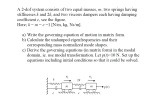 A two DOF system consists of two equal masses, m, two springs having stiffnesses k and 2k, and two viscous dampers each having damping coefficient c, see the figure.Here; k = m = c =1 [N/m, kg, Ns/m].a) Write the governing equation of motion in matrix form.b) Calculate the undamped eigenfrequencies and their corresponding mass normalized mode shapes.c) Derive the governing equations (in matrix form) in the modal domain, ie. use modal transformation. Let p(t)=10 N. Set up the equations...
Find the response X1 (t) and X2 (t) please don't skip steps. se is given by...
 Find the response X1 (t) and X2 (t)
please don't skip steps.
se is given by Eq. (E.9) of Example 5.1: 3k (2 (E.8) Comparison of Eqs. (E. 1) and (E.8) shows that the motion of the system coincides with the sec- ond normal mode only if X1-0. This implies that (from Eq. E.2) h(0)=-x2(0) X1(0)=-x2(0) and (E.9) Free-Vibration Response of a Two-Degree-of-Freedom System 5.3 Find the free-vibration response of the system shown in Fig. 5.5(a) with k1 30, k2...
Find the response X1 (t) and X2 (t)
please don't skip steps.
se is given by Eq. (E.9) of Example 5.1: 3k (2 (E.8) Comparison of Eqs. (E. 1) and (E.8) shows that the motion of the system coincides with the sec- ond normal mode only if X1-0. This implies that (from Eq. E.2) h(0)=-x2(0) X1(0)=-x2(0) and (E.9) Free-Vibration Response of a Two-Degree-of-Freedom System 5.3 Find the free-vibration response of the system shown in Fig. 5.5(a) with k1 30, k2...
4. (14 points) For a linear 2-DOF model of a vehicle E(r) moving on a uneven road, (a) describe the base excitation y(t) when the vehicle is moving to the right at speed v; (b) derive equations o...
 4. (14 points) For a linear 2-DOF model of a vehicle E(r) moving on a uneven road, (a) describe the base excitation y(t) when the vehicle is moving to the right at speed v; (b) derive equations of motion for the vehicle model; (b) build a Simulink model based on the equations of motion, using the blocks given below, with y() as the input and xi() and x2) as outputs. m2 x1(r) yt)input du/dt 1/s Derivative Integrator Sum Signal Generator...
applied to the masesdthe displacements I1 and sg of the mases For the system in Figure...
 applied to the masesdthe displacements I1 and sg of the mases For the system in Figure 5.49, the inputs are the forcesfi and f2 applied to the masses and the outputs are the displacements x and x2 of the masses a. Draw the necessary free-body diagrams and derive the differential equations of motion b. Write the differential equations of motion in the second-order matrix form. c. Using the differential equations obtained in Part (a), determine the state-space representation 15. Repeat...
(1 point) This is the second part of a three-part problem. Consider the system of differential...
 (1 point) This is the second part of a three-part problem. Consider the system of differential equations y y = = 741 +242, -4y + y2. Verify that for any constants C and c2, the functions y(t) = gest+cze3t, yz(t) = -cest – 2c2e3t, satisfy the system of differential equations. Enter c as c1 and C2 as c2. a. Find the value of each term in the equation y' = 7y1 + 2y2 in terms of the variablet. (Enter the...
Problem 1: The system in Figure 1 comprises two masses connected to one another through a...
 Problem 1: The system in Figure 1 comprises two masses connected to one another through a spring. The block slides without friction on the support and has mass mi. The disk has radius a, mass moment of inertia I, and mass m2. The disk rolls without slipping on the support. The springs are unstretched when x(t) = x2(t) = 0. 2k 3k , m Figure 1: System for Problem 1 (a) Derive the differential equations of motion for the system...
 Homework 7: Undamped, 2-DOF System 1. A system with two masses of which the origins are at the SEPs is shown in Figure 1. The mass of m2 is acted by the external force of f(t). Assume that the cable between the two springs, k2 and k3 is not stretchable. Solve the following problems (a) Draw free-body diagrams for the two masses and derive their EOMs (b) Represent the EOMs in a matrix fornm (c) Find the undamped, natural frequencies...
 Homework 8: Modal and Direct Solution Approaches Figure 1 shows a system with two masses. The two coordinates of which the origins are set up at the unstretched spring positions are also shown in Fig. 1. The system is excited by the force f(t) 1. (a) Draw the FBDs for the system and show that the EOMs can be written as (b) Find the undamped, natural frequencies and the corresponding mode shapes of the system for the given system parameters...
 x2(t) m2 2 Two masses, m1 and m2, are connected with a spring, k. A force, f (t), is applied on the first mass. Both masses experience viscous damping, c1 and c2, through the surface that they sit on. The equations of motion that describe the system dynamics are m2 (t)--CzX2 (t)-k(X2(t)-x,(t)) The initial conditions are: x1(0) - a x(0)b (0) = c Assuming zero initial conditions, rearrange the two equations of motion to find the response for X1(s) and...
 Figure 1 shows a system with two masses of which the origins are set up for the springs of \(k_{1}, k_{2}\), and \(k_{3}\) to be unstretched. The system is excited by the base motion of \(x_{b}(t)\).(a) By drawing the FBDs of the two masses and applying the Newton's \(2^{n d}\) Law of Motion, find a matrix equation of motion.(b) Find the undamped, natural frequencies and the corresponding mode shapes of the system for the given system parameters of \(k_{1}=k_{2}=k_{3}=100 \mathrm{kN}...
 Find the response X1 (t) and X2 (t)
please don't skip steps.
se is given by Eq. (E.9) of Example 5.1: 3k (2 (E.8) Comparison of Eqs. (E. 1) and (E.8) shows that the motion of the system coincides with the sec- ond normal mode only if X1-0. This implies that (from Eq. E.2) h(0)=-x2(0) X1(0)=-x2(0) and (E.9) Free-Vibration Response of a Two-Degree-of-Freedom System 5.3 Find the free-vibration response of the system shown in Fig. 5.5(a) with k1 30, k2...
Find the response X1 (t) and X2 (t)
please don't skip steps.
se is given by Eq. (E.9) of Example 5.1: 3k (2 (E.8) Comparison of Eqs. (E. 1) and (E.8) shows that the motion of the system coincides with the sec- ond normal mode only if X1-0. This implies that (from Eq. E.2) h(0)=-x2(0) X1(0)=-x2(0) and (E.9) Free-Vibration Response of a Two-Degree-of-Freedom System 5.3 Find the free-vibration response of the system shown in Fig. 5.5(a) with k1 30, k2...
 4. (14 points) For a linear 2-DOF model of a vehicle E(r) moving on a uneven road, (a) describe the base excitation y(t) when the vehicle is moving to the right at speed v; (b) derive equations of motion for the vehicle model; (b) build a Simulink model based on the equations of motion, using the blocks given below, with y() as the input and xi() and x2) as outputs. m2 x1(r) yt)input du/dt 1/s Derivative Integrator Sum Signal Generator...
 applied to the masesdthe displacements I1 and sg of the mases For the system in Figure 5.49, the inputs are the forcesfi and f2 applied to the masses and the outputs are the displacements x and x2 of the masses a. Draw the necessary free-body diagrams and derive the differential equations of motion b. Write the differential equations of motion in the second-order matrix form. c. Using the differential equations obtained in Part (a), determine the state-space representation 15. Repeat...
 (1 point) This is the second part of a three-part problem. Consider the system of differential equations y y = = 741 +242, -4y + y2. Verify that for any constants C and c2, the functions y(t) = gest+cze3t, yz(t) = -cest – 2c2e3t, satisfy the system of differential equations. Enter c as c1 and C2 as c2. a. Find the value of each term in the equation y' = 7y1 + 2y2 in terms of the variablet. (Enter the...
 Problem 1: The system in Figure 1 comprises two masses connected to one another through a spring. The block slides without friction on the support and has mass mi. The disk has radius a, mass moment of inertia I, and mass m2. The disk rolls without slipping on the support. The springs are unstretched when x(t) = x2(t) = 0. 2k 3k , m Figure 1: System for Problem 1 (a) Derive the differential equations of motion for the system...
Most questions answered within 3 hours.
-
Where is the error in this code sequence?
String s1 = "Hello";
String s2 = "ello";...
asked 11 months ago -
Financial data for Joel de Paris, Inc., for last year
follow:
Joel de Paris, Inc.
Balance...
asked 11 months ago -
Consider this reaction:
Al2(SO4)3 (aq)+ BaCl3
(aq) Al2Cl6 (aq)- +
3BaSO4(s) . What is the...
asked 11 months ago -
Suppose that Savneet is considering increasing her
recent random sample from 20 car rentals to 40...
asked 11 months ago -
Trucks arrive at an unloading terminal at an average rate of 120
per hour.
Trucks arrive...
asked 11 months ago -
Why are methanol and ethanol completely soluble in water while
octanol is not very little soluble....
asked 11 months ago -
A facilities manager at a university reads in a research report
that the mean amount of...
asked 11 months ago -
When the CuSO4 is rehydrated by adding water to the anhydrous
compound, is this an endothermic...
asked 11 months ago -
A ray of sunlight is passing from diamond into crown glass; the
angle of incidence is...
asked 11 months ago -
A block of mass 0.249 kg is placed on top of a light, vertical
spring of...
asked 11 months ago -
how do the kidneys compensate in the presences of acidosis
a) trigger hyperventilate
b) reserve acid...
asked 11 months ago -
Question 501 pts
The rental rate of capital to the firm increases. Which of the
following...
asked 11 months ago