
Homework Answers
Add Answer to:
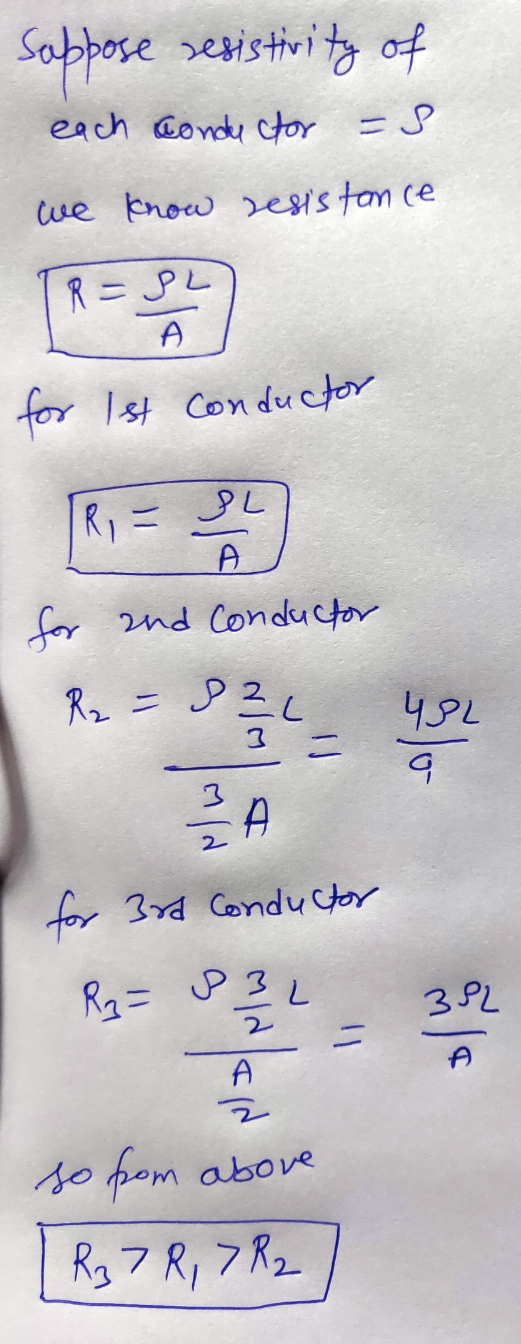
The figure 4 below shows three conductors made from the same material and have different cross-sectional...
[VI] The figure shows three wires, made of the same material, with their cross-sectional areas and...
 [VI] The figure shows three wires, made of the same material, with their cross-sectional areas and lengths. The resistance of each wire is as labeled in the figure. Which of the following statements is correct? L 1.5L L/2 AR A/2 R A/2 O Ri=R2 = R3 OR] >R2>R3 OR1 = R2>R3 OR2>R1 = R3
The resistance ratio of two conductors that have equal cross-sectional areas and equal lengths is 1:7....
 The resistance ratio of two conductors that have equal cross-sectional areas and equal lengths is 1:7. What is the ratio of the resistivity's of the materials from which they are made? Find the ratio of the greater resistivity to the lower one. (Express your answer to one significant figure.)
The figure below shows four heat conductors made of the same type of material. Choose the...
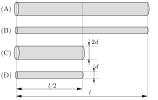 The figure below shows four
heat conductors made of the same type of material. Choose the
correct arrangement for the heat conductors (using the letters) to
their thermal conductivity from large to small (i.e. from large
thermal conductivity to small thermal conductivity).
(D) > (A) > (B) > (C)
(C) > (A) > (D) > (B)
(B) > (C) > (D) > (A)
(A) > (D) > (C) > (B)
(A) > (D) > (B) > (C)
(D) > (B)...
The figure below shows four
heat conductors made of the same type of material. Choose the
correct arrangement for the heat conductors (using the letters) to
their thermal conductivity from large to small (i.e. from large
thermal conductivity to small thermal conductivity).
(D) > (A) > (B) > (C)
(C) > (A) > (D) > (B)
(B) > (C) > (D) > (A)
(A) > (D) > (C) > (B)
(A) > (D) > (B) > (C)
(D) > (B)...
Three cylindrical wires are made of the same material. Their lengths and radii are
Three cylindrical wires are made of the same material. Their lengths and radii are wire 1: length 2ℓ, radius r/2 wire 2: length 3ℓ, radius 3r wire 3: length ℓ, radius r/4 (a) Rank the wires according to their resistances, greatest first Select one: a. 1>2>3 b. 1 =2>3 c. 3>1>2 d. 1>3>2 e. 3>2>1(b) Rank the wires according to the current density across their cross sections, greatest first Select one: a. 3>1>2 b. 1>3>2 c. 1=2>3 d. 3>2>1 e. 1>2>3
Three cylindrical wires are made of the same material. Their lengths and radii are
Three cylindrical wires are made of the same material. Their lengths and radii are wire 1: length 2ℓ, radius r/2 wire 2: length 3ℓ, radius 3r wire 3: length ℓ, radius r/4 (a) Rank the wires according to their resistances, greatest first Select one: a. 1>2>3 b. 3>2>1 c. 1>3>2 d. 3 >1>2 e. 1=2>3(b) Rank the wires according to the current density across their cross sections, greatest first Select one a. 3>1>2 b. 1>2>3 c. 1 =2>3 d. 3>2>1 e. 1>3>2
Three cubes are made from the same material. As the drawing indicates, they have different sizes...
 Three cubes are made from the
same material. As the drawing indicates, they have different sizes
and temperatures. Rank the cubes according to the radiant energy
they emit per second, largest first.
3 2T 0 0 Lo 4To 0
Three cubes are made from the
same material. As the drawing indicates, they have different sizes
and temperatures. Rank the cubes according to the radiant energy
they emit per second, largest first.
3 2T 0 0 Lo 4To 0
Three cylindrical wires are made of the same material. Their lengths and radii are
Three cylindrical wires are made of the same material. Their lengths and radii are wire 1: length ℓ, radius 2r wire 2: length 2ℓ, radius r/2 wire 3: length 4ℓ, radius r/3 (a) Rank the wires according to their resistances, greatest first. Select one: a. 1>2>3 b. 3>2>1 c. 2>3>1 d. 1=2>3 e. 1>3>2(b) A potential difference V is applied across the length of the wires. Rank them according to the current density across their cross sections, greatest first. Select one: a. 1 = 2 >3 b.1>3>2 c. 1>2>3 d. 3>2>1 e. 2>3 >...
Three cylindrical wires are made of the same material. Their lengths and radii are wire 1:...
 Three cylindrical wires are made of the same material. Their lengths and radii are wire 1: length 24, radius r/2 wire 2: length 34, radius 3r wire 3: length , radius r/4 (b) Rank the wires according to the current density across their cross sections, greatest first Select one O a. 1>3>2 O b. 1 =2> 3 c.3>1 > 2 O d. 3 > 2>1 O e. 1>23
Not yet answered Three cylindrical wires are made of the same material. Their lengths and radii...
 Not yet answered Three cylindrical wires are made of the same material. Their lengths and radii are wire 1: length 21, radius r/2 wire 2: length 31, radius 3r wire 3: length , radius r/4 (b) Rank the wires according to the current density across their cross sections, greatest first Select one: O a. 3 > 2>1 O b. 1523 O c. 1>3>2 O d. 3 >1 > 2 e. 1>2> 3
The figure below shows three sets of cross sections of equipotential surfaces; all three cover the...
 The
figure below shows three sets of cross sections of equipotential
surfaces; all three cover the same size region of space.
(a) Rank the arrangements according to the magnitude of the
electric field present in the region, greatest first (use only the
symbols > or =,for example1=2>3).
(b) In which is the electric field directed down the
page?
The
figure below shows three sets of cross sections of equipotential
surfaces; all three cover the same size region of space.
(a) Rank the arrangements according to the magnitude of the
electric field present in the region, greatest first (use only the
symbols > or =,for example1=2>3).
(b) In which is the electric field directed down the
page?
 [VI] The figure shows three wires, made of the same material, with their cross-sectional areas and lengths. The resistance of each wire is as labeled in the figure. Which of the following statements is correct? L 1.5L L/2 AR A/2 R A/2 O Ri=R2 = R3 OR] >R2>R3 OR1 = R2>R3 OR2>R1 = R3
 The resistance ratio of two conductors that have equal cross-sectional areas and equal lengths is 1:7. What is the ratio of the resistivity's of the materials from which they are made? Find the ratio of the greater resistivity to the lower one. (Express your answer to one significant figure.)
 The figure below shows four
heat conductors made of the same type of material. Choose the
correct arrangement for the heat conductors (using the letters) to
their thermal conductivity from large to small (i.e. from large
thermal conductivity to small thermal conductivity).
(D) > (A) > (B) > (C)
(C) > (A) > (D) > (B)
(B) > (C) > (D) > (A)
(A) > (D) > (C) > (B)
(A) > (D) > (B) > (C)
(D) > (B)...
The figure below shows four
heat conductors made of the same type of material. Choose the
correct arrangement for the heat conductors (using the letters) to
their thermal conductivity from large to small (i.e. from large
thermal conductivity to small thermal conductivity).
(D) > (A) > (B) > (C)
(C) > (A) > (D) > (B)
(B) > (C) > (D) > (A)
(A) > (D) > (C) > (B)
(A) > (D) > (B) > (C)
(D) > (B)...
 Three cubes are made from the
same material. As the drawing indicates, they have different sizes
and temperatures. Rank the cubes according to the radiant energy
they emit per second, largest first.
3 2T 0 0 Lo 4To 0
Three cubes are made from the
same material. As the drawing indicates, they have different sizes
and temperatures. Rank the cubes according to the radiant energy
they emit per second, largest first.
3 2T 0 0 Lo 4To 0
 Three cylindrical wires are made of the same material. Their lengths and radii are wire 1: length 24, radius r/2 wire 2: length 34, radius 3r wire 3: length , radius r/4 (b) Rank the wires according to the current density across their cross sections, greatest first Select one O a. 1>3>2 O b. 1 =2> 3 c.3>1 > 2 O d. 3 > 2>1 O e. 1>23
 Not yet answered Three cylindrical wires are made of the same material. Their lengths and radii are wire 1: length 21, radius r/2 wire 2: length 31, radius 3r wire 3: length , radius r/4 (b) Rank the wires according to the current density across their cross sections, greatest first Select one: O a. 3 > 2>1 O b. 1523 O c. 1>3>2 O d. 3 >1 > 2 e. 1>2> 3
 The
figure below shows three sets of cross sections of equipotential
surfaces; all three cover the same size region of space.
(a) Rank the arrangements according to the magnitude of the
electric field present in the region, greatest first (use only the
symbols > or =,for example1=2>3).
(b) In which is the electric field directed down the
page?
The
figure below shows three sets of cross sections of equipotential
surfaces; all three cover the same size region of space.
(a) Rank the arrangements according to the magnitude of the
electric field present in the region, greatest first (use only the
symbols > or =,for example1=2>3).
(b) In which is the electric field directed down the
page?
Most questions answered within 3 hours.
-
Where is the error in this code sequence?
String s1 = "Hello";
String s2 = "ello";...
asked 10 months ago -
Financial data for Joel de Paris, Inc., for last year
follow:
Joel de Paris, Inc.
Balance...
asked 10 months ago -
Consider this reaction:
Al2(SO4)3 (aq)+ BaCl3
(aq) Al2Cl6 (aq)- +
3BaSO4(s) . What is the...
asked 10 months ago -
Suppose that Savneet is considering increasing her
recent random sample from 20 car rentals to 40...
asked 10 months ago -
Trucks arrive at an unloading terminal at an average rate of 120
per hour.
Trucks arrive...
asked 10 months ago -
Why are methanol and ethanol completely soluble in water while
octanol is not very little soluble....
asked 10 months ago -
A facilities manager at a university reads in a research report
that the mean amount of...
asked 10 months ago -
When the CuSO4 is rehydrated by adding water to the anhydrous
compound, is this an endothermic...
asked 10 months ago -
A ray of sunlight is passing from diamond into crown glass; the
angle of incidence is...
asked 10 months ago -
A block of mass 0.249 kg is placed on top of a light, vertical
spring of...
asked 10 months ago -
how do the kidneys compensate in the presences of acidosis
a) trigger hyperventilate
b) reserve acid...
asked 10 months ago -
Question 501 pts
The rental rate of capital to the firm increases. Which of the
following...
asked 10 months ago