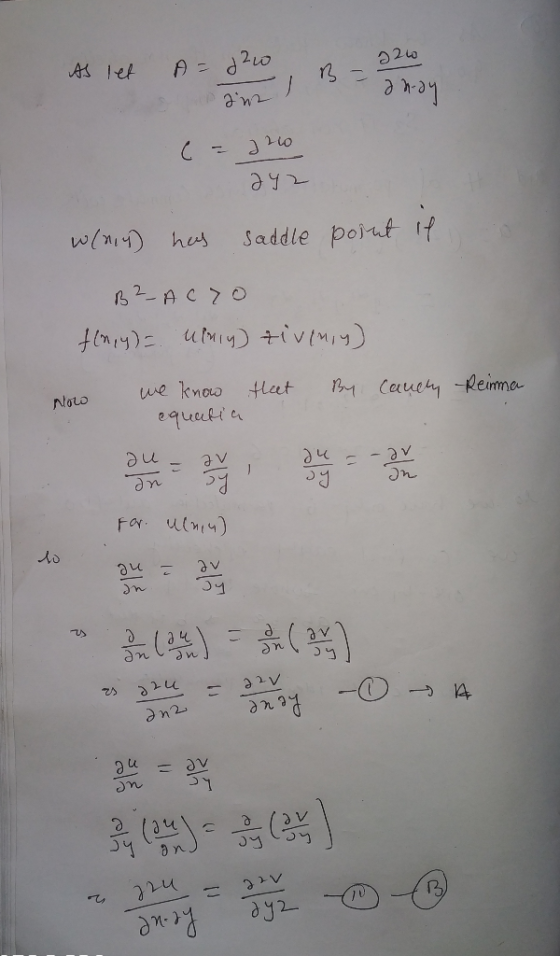
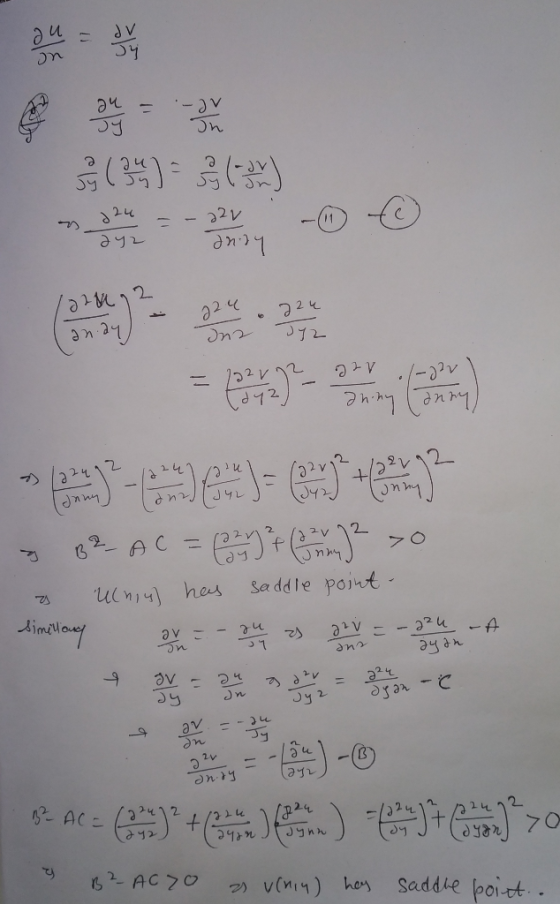
Let A = ∂ 2w/∂x2 , B = ∂ 2w/∂x∂y, C = ∂ 2w/∂y2 . From...
Let A = ∂ 2w/∂x2 , B = ∂ 2w/∂x∂y, C = ∂ 2w/∂y2 . From the calculus of functions of two variables, w(x, y), we have a saddle point if B 2 − AC > 0. With f (z) = u(x, y) + iv(x, y), apply the Cauchy–Riemann conditions and show that neither u(x, y) nor v(x, y) has a maximum or a minimum in a finite region of the complex plane. (See also Section 7.3.)
Homework Answers
2. Let R be the region R = {(X,Y)|X2 + y2 < 2} and let (X,Y)...
 2. Let R be the region R = {(X,Y)|X2 + y2 < 2} and let (X,Y) be a pair of random variables that is distributed uniformly on this region. That is fx,y(x, y) is constant in this region and 0 elsewhere. State the sample space and find the probability that the random variable x2 + y2 is less than 1, P[X2 +Y? < 1].
Cal 4 , ) and use this to 6. Let f(x,y) = x2 + y2 + 2x + y. (a) Find all critical points of f in the disk {(x,y) : x2 + y2 < 4). Use the second derivative test to determine if these points corr...
 Cal 4
, ) and use this to 6. Let f(x,y) = x2 + y2 + 2x + y. (a) Find all critical points of f in the disk {(x,y) : x2 + y2 < 4). Use the second derivative test to determine if these points correspond to a local maximum, local minimum, or saddle point. (b) Use Lagrange multipliers to find the absolute maximum/minimum values of f(x, y) on the circle a2 +y -4, as well as the points...
Cal 4
, ) and use this to 6. Let f(x,y) = x2 + y2 + 2x + y. (a) Find all critical points of f in the disk {(x,y) : x2 + y2 < 4). Use the second derivative test to determine if these points correspond to a local maximum, local minimum, or saddle point. (b) Use Lagrange multipliers to find the absolute maximum/minimum values of f(x, y) on the circle a2 +y -4, as well as the points...
Exercise 11. Let Xi,y, be random variables with joint PDF fXiXi. Let X2,Y2 be random variables...
 Exercise 11. Let Xi,y, be random variables with joint PDF fXiXi. Let X2,Y2 be random variables with joint PDF fx2,Y2. Let T: R2R2 and let S: R2 -R2 so that ST(x, y) (z, y) and TS(a, y) (x, y) for every (x, y) E R2. Let J(x, y) denote the determinant of the Jacobian of S at (x,y. Using the change of variables formula from multivariable calculus, show that
Let f(x, y) = x2 – yż and D= {(2,y) : x2 + y2 < 4}....
 Let f(x, y) = x2 – yż and D= {(2,y) : x2 + y2 < 4}. Let m and M be the absolute minimum and maximum values of f over D respectively. What is m - M?
Problem 1 You are given the maximum and minimum of the function f(x, y, z) =...
 Problem 1 You are given the maximum and minimum of the function f(x, y, z) = x2 - y2 on the surface x2 + 2y2 + 3z2 = 1 exist. Use Lagrange multiplier method to find them. Let us recall the extreme value theorem we discussed before the spring break: Extreme Value Theorem (For Functions Of Two Variables) If f(x,y) is continuous on a closed, bounded region D in the plane, then f attains a maximum value f(x,y) and a...
6 (20 pts). Let F(x, y, z) = x2 + y2 + x2 - 6xyz. (1)...
 6 (20 pts). Let F(x, y, z) = x2 + y2 + x2 - 6xyz. (1) Find the gradient vector of F(x, y, z); (2) Find the tangent plane of the level surface F(x, y, z) = x2 + y2 + x2 - 6xyz = 4 at (0, 0, 2); (3) The level surface F(x, y, z) = 4 defines a function z = f(x,y). Use linear approxi- mation to approximate z = = f(-0.002,0.003).
circle x2 + y2-9 in the x-y plane, oriented counter-clockwise. Let F(x, y, z)-(y,-x,0) Verify Stokes' Theorem b...
 circle x2 + y2-9 in the x-y plane, oriented counter-clockwise. Let F(x, y, z)-(y,-x,0) Verify Stokes' Theorem by calculating a) surl(F) nds and b) F Tds.
circle x2 + y2-9 in the x-y plane, oriented counter-clockwise. Let F(x, y, z)-(y,-x,0) Verify Stokes' Theorem by calculating a) surl(F) nds and b) F Tds.
circle x2 + y2-9 in the x-y plane, oriented counter-clockwise. Let F(x, y, z)-(y,-x,0) Verify Stokes' Theorem by calculating a) surl(F) nds and b) F Tds.
1. Find the absolute maximum and minimum values of f(r,y) = x2+y2+5y on the disc {(x,...
 1. Find the absolute maximum and minimum values of f(r,y) = x2+y2+5y on the disc {(x, y) | x2+y2 < 4}, and identify the points where these values are attained 2. Find the absolute maximum and minimum values of f(x, y) = x3 - 3x - y* + 12y on the closed region bounded by the quadrilateral with vertices at (0,0), (2,2), (2,3), (0,3), and identify the points where these values are attained. 3. A rectangular box is to have...
All of 10 questions, please. 1. Find and classify all the critical points of the function. f(x,y) - x2(y - 2) - y2 » 2. Evaluate the integral. 3. Determine the volume of the solid that is inside the...
 All of 10 questions, please.
1. Find and classify all the critical points of the function. f(x,y) - x2(y - 2) - y2 » 2. Evaluate the integral. 3. Determine the volume of the solid that is inside the cylinder x2 + y2- 16 below z-2x2 + 2y2 and above the xy - plane. 4. Determine the surface area of the portion of 2x + 3y + 6z - 9 that is in the 1st octant. » 5. Evaluate JSxz...
All of 10 questions, please.
1. Find and classify all the critical points of the function. f(x,y) - x2(y - 2) - y2 » 2. Evaluate the integral. 3. Determine the volume of the solid that is inside the cylinder x2 + y2- 16 below z-2x2 + 2y2 and above the xy - plane. 4. Determine the surface area of the portion of 2x + 3y + 6z - 9 that is in the 1st octant. » 5. Evaluate JSxz...
solve number 3 2. Show that u(x, y) = e = cos 12 + y2 is...
 solve number 3
2. Show that u(x, y) = e = cos 12 + y2 is harmonic on the punctured complex plane D=C\{0}, and find a harmonic conjugate v of it. 1 2 3. Reveal, what is f(x) = u(x,y) + iv(I,y) in Problem 2?
solve number 3
2. Show that u(x, y) = e = cos 12 + y2 is harmonic on the punctured complex plane D=C\{0}, and find a harmonic conjugate v of it. 1 2 3. Reveal, what is f(x) = u(x,y) + iv(I,y) in Problem 2?
 2. Let R be the region R = {(X,Y)|X2 + y2 < 2} and let (X,Y) be a pair of random variables that is distributed uniformly on this region. That is fx,y(x, y) is constant in this region and 0 elsewhere. State the sample space and find the probability that the random variable x2 + y2 is less than 1, P[X2 +Y? < 1].
 Cal 4
, ) and use this to 6. Let f(x,y) = x2 + y2 + 2x + y. (a) Find all critical points of f in the disk {(x,y) : x2 + y2 < 4). Use the second derivative test to determine if these points correspond to a local maximum, local minimum, or saddle point. (b) Use Lagrange multipliers to find the absolute maximum/minimum values of f(x, y) on the circle a2 +y -4, as well as the points...
Cal 4
, ) and use this to 6. Let f(x,y) = x2 + y2 + 2x + y. (a) Find all critical points of f in the disk {(x,y) : x2 + y2 < 4). Use the second derivative test to determine if these points correspond to a local maximum, local minimum, or saddle point. (b) Use Lagrange multipliers to find the absolute maximum/minimum values of f(x, y) on the circle a2 +y -4, as well as the points...
 Exercise 11. Let Xi,y, be random variables with joint PDF fXiXi. Let X2,Y2 be random variables with joint PDF fx2,Y2. Let T: R2R2 and let S: R2 -R2 so that ST(x, y) (z, y) and TS(a, y) (x, y) for every (x, y) E R2. Let J(x, y) denote the determinant of the Jacobian of S at (x,y. Using the change of variables formula from multivariable calculus, show that
 Let f(x, y) = x2 – yż and D= {(2,y) : x2 + y2 < 4}. Let m and M be the absolute minimum and maximum values of f over D respectively. What is m - M?
 Problem 1 You are given the maximum and minimum of the function f(x, y, z) = x2 - y2 on the surface x2 + 2y2 + 3z2 = 1 exist. Use Lagrange multiplier method to find them. Let us recall the extreme value theorem we discussed before the spring break: Extreme Value Theorem (For Functions Of Two Variables) If f(x,y) is continuous on a closed, bounded region D in the plane, then f attains a maximum value f(x,y) and a...
 6 (20 pts). Let F(x, y, z) = x2 + y2 + x2 - 6xyz. (1) Find the gradient vector of F(x, y, z); (2) Find the tangent plane of the level surface F(x, y, z) = x2 + y2 + x2 - 6xyz = 4 at (0, 0, 2); (3) The level surface F(x, y, z) = 4 defines a function z = f(x,y). Use linear approxi- mation to approximate z = = f(-0.002,0.003).
 circle x2 + y2-9 in the x-y plane, oriented counter-clockwise. Let F(x, y, z)-(y,-x,0) Verify Stokes' Theorem by calculating a) surl(F) nds and b) F Tds.
circle x2 + y2-9 in the x-y plane, oriented counter-clockwise. Let F(x, y, z)-(y,-x,0) Verify Stokes' Theorem by calculating a) surl(F) nds and b) F Tds.
circle x2 + y2-9 in the x-y plane, oriented counter-clockwise. Let F(x, y, z)-(y,-x,0) Verify Stokes' Theorem by calculating a) surl(F) nds and b) F Tds.
 1. Find the absolute maximum and minimum values of f(r,y) = x2+y2+5y on the disc {(x, y) | x2+y2 < 4}, and identify the points where these values are attained 2. Find the absolute maximum and minimum values of f(x, y) = x3 - 3x - y* + 12y on the closed region bounded by the quadrilateral with vertices at (0,0), (2,2), (2,3), (0,3), and identify the points where these values are attained. 3. A rectangular box is to have...
 All of 10 questions, please.
1. Find and classify all the critical points of the function. f(x,y) - x2(y - 2) - y2 » 2. Evaluate the integral. 3. Determine the volume of the solid that is inside the cylinder x2 + y2- 16 below z-2x2 + 2y2 and above the xy - plane. 4. Determine the surface area of the portion of 2x + 3y + 6z - 9 that is in the 1st octant. » 5. Evaluate JSxz...
All of 10 questions, please.
1. Find and classify all the critical points of the function. f(x,y) - x2(y - 2) - y2 » 2. Evaluate the integral. 3. Determine the volume of the solid that is inside the cylinder x2 + y2- 16 below z-2x2 + 2y2 and above the xy - plane. 4. Determine the surface area of the portion of 2x + 3y + 6z - 9 that is in the 1st octant. » 5. Evaluate JSxz...
 solve number 3
2. Show that u(x, y) = e = cos 12 + y2 is harmonic on the punctured complex plane D=C\{0}, and find a harmonic conjugate v of it. 1 2 3. Reveal, what is f(x) = u(x,y) + iv(I,y) in Problem 2?
solve number 3
2. Show that u(x, y) = e = cos 12 + y2 is harmonic on the punctured complex plane D=C\{0}, and find a harmonic conjugate v of it. 1 2 3. Reveal, what is f(x) = u(x,y) + iv(I,y) in Problem 2?
Most questions answered within 3 hours.
-
Where is the error in this code sequence?
String s1 = "Hello";
String s2 = "ello";...
asked 10 months ago -
Financial data for Joel de Paris, Inc., for last year
follow:
Joel de Paris, Inc.
Balance...
asked 10 months ago -
Consider this reaction:
Al2(SO4)3 (aq)+ BaCl3
(aq) Al2Cl6 (aq)- +
3BaSO4(s) . What is the...
asked 10 months ago -
Suppose that Savneet is considering increasing her
recent random sample from 20 car rentals to 40...
asked 10 months ago -
Trucks arrive at an unloading terminal at an average rate of 120
per hour.
Trucks arrive...
asked 10 months ago -
Why are methanol and ethanol completely soluble in water while
octanol is not very little soluble....
asked 10 months ago -
A facilities manager at a university reads in a research report
that the mean amount of...
asked 10 months ago -
When the CuSO4 is rehydrated by adding water to the anhydrous
compound, is this an endothermic...
asked 10 months ago -
A ray of sunlight is passing from diamond into crown glass; the
angle of incidence is...
asked 10 months ago -
A block of mass 0.249 kg is placed on top of a light, vertical
spring of...
asked 10 months ago -
how do the kidneys compensate in the presences of acidosis
a) trigger hyperventilate
b) reserve acid...
asked 10 months ago -
Question 501 pts
The rental rate of capital to the firm increases. Which of the
following...
asked 10 months ago