A 30.5 g sample of pure metal at 156.7˚C is added to a 0.700 kg of...
A 30.5 g sample of pure metal at 156.7˚C is added to a 0.700 kg of water (specific heat capacity = 4.180 J/˚C g) at 23.0 ˚C. What is the final temperature of the water if the metal is (a) antimony, specific heat capacity of 0.210 J/˚C g (b) iridium, specific heat capacity of 1.30 J/˚C g? Assume all heat is conserved.
Homework Answers
A. Let the final temperature of water be x °C.
Now amount of heat released by antimony,
QM = Mmetal x Specific heat capacity of metal x change in temperature
= 30.5 x 0.210 x (156.7 - x)
= 1003.66 - 6.405x
And amount of heat absorbed by water,
QH2O = Mass of water x specific heat capacity of water x Change in temperature
= 700 x 4.180 x (x - 23)
= 2926 x (x - 23)
= 2926x - 67298
As per principle of Calorimetry,
QM = QH2O
or, 1003.66 - 6.405x = 2926x - 67298
or, 2926x + 6.405 x = 1003.66 + 67298
or, 2932.405 x = 68301.66
or, x = 23.29 °C
B. Let the final temperature of water be x °C.
Now amount of heat released by iridium,
QM = Mmetal x Specific heat capacity of metal x change in temperature
= 30.5 x 1.3 x (156.7 - x)
= 6213.16 - 39.65x
And amount of heat absorbed by water,
QH2O = Mass of water x specific heat capacity of water x Change in temperature
= 700 x 4.180 x (x - 23)
= 2926 x (x - 23)
= 2926x - 67298
As per principle of Calorimetry,
QM = QH2O
or, 6213.16 - 39.65x = 2926x - 67298
or, 2926x + 39.65 x = 6213.16 + 67298
or, 2965.65 x = 73511.16
or, x = 24.79 °C
Add Answer to:
A 30.5 g sample of pure metal at 156.7˚C is added to a 0.700 kg
of...
4. A 58.215 g sample of a pure metal element is brought to 99.0°C and added...
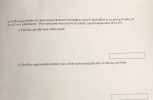 4. A 58.215 g sample of a pure metal element is brought to 99.0°C and added to 41.202 g of water at 01.5°C in a calorimeter. The metal and water arrive at a final, equal temperature of 27.2°C. a. Find the specific heat of the metal. b. Find the approximate atomic mass of the metal using the law of Dulong and Petit.
An unknown metal has a mass of 30.5 g. When 545 J of heat are added...
An unknown metal has a mass of 30.5 g. When 545 J of heat are added to the sample, the sample temperature changes by 39.8 ∘C . Calculate the specific heat of the unknown metal.
a 312 g sample of a metal is heated to 355.272 c A 312 g sample...
 a 312 g sample of a metal is heated to 355.272 c
A 312 g sample of a metal is heated to 355.272 °C and plunged into 200 g of water at a temperature of 45.471 °C. The final temperature of the water is 59.19 °C. Assuming water has a specific heat capacity of 4.184 J/g °C, what is the specific heat capacity of the metal sample, in J/g °C)? Assume no heat loss to the surroundings. Report your response...
a 312 g sample of a metal is heated to 355.272 c
A 312 g sample of a metal is heated to 355.272 °C and plunged into 200 g of water at a temperature of 45.471 °C. The final temperature of the water is 59.19 °C. Assuming water has a specific heat capacity of 4.184 J/g °C, what is the specific heat capacity of the metal sample, in J/g °C)? Assume no heat loss to the surroundings. Report your response...
A 312 g sample of a metal is heated to 383.145 °C and plunged into 200...
A 312 g sample of a metal is heated to 383.145 °C and plunged into 200 g of water at a temperature of 29.934 °C. The final temperature of the water is 82.57 °C. Assuming water has a specific heat capacity of 4.184 J/g °C, what is the specific heat capacity of the metal sample, in J/g °C)? Assume no heat loss to the surroundings. Report your response to 3 digits after the decimal.
A 312 g sample of a metal is heated to 283.328 °C and plunged into 200...
A 312 g sample of a metal is heated to 283.328 °C and plunged into 200 g of water at a temperature of 16.418 °C. The final temperature of the water is 69.021 °C. Assuming water has a specific heat capacity of 4.184 J/g °C, what is the specific heat capacity of the metal sample, in J/g °C)? Assume no heat loss to the surroundings. Report your response to 3 digits after the decimal.
Question 3 1 pts A 312 g sample of a metal is heated to 257.896 °C...
 Question 3 1 pts A 312 g sample of a metal is heated to 257.896 °C and plunged into 200 g of water at a temperature of 20.43 °C. The final temperature of the water is 79.548 °C. Assuming water has a specific heat capacity of 4.184 J/g °C, what is the specific heat capacity of the metal sample, in J/g °C)? Assume no heat loss to the surroundings. Report your response to 3 digits after the decimal.
Question 2 1 pts A 312 g sample of a metal is heated to 294.133 °C...
 Question 2 1 pts A 312 g sample of a metal is heated to 294.133 °C and plunged into 200 g of water at a temperature of 31.977 °C. The final temperature of the water is 87.391 °C. Assuming water has a specific heat capacity of 4.184 J/g °C, what is the specific heat capacity of the metal sample, in J/g °C)? Assume no heat loss to the surroundings. Report your response to 3 digits after the decimal.
1. (10 pts) A 150.0 g sample of a metal at 75.0 °C is added to 150.0 g H20 at 15.0 °C (s.h. = 4.184 J/g °C). The te...
 1. (10 pts) A 150.0 g sample of a metal at 75.0 °C is added to 150.0 g H20 at 15.0 °C (s.h. = 4.184 J/g °C). The temperature of the water rises to 18.3 °C. Calculate the specific heat capacity of the metal, assuming that all the heat lost by the metal is gained by the water.
QuesLIUI A 170.0-g sample of metal at 83.00'C is added to 170.0 g of H 200)...
 QuesLIUI A 170.0-g sample of metal at 83.00'C is added to 170.0 g of H 200) at 15.00°C in an insulated container, The temperature rises to 18.16°C. Neglecting the heat capacity of the container, what is the specific heat capacity of the metal? The specific heat capacity of H 2011) is 4.18 J/("C). a 20.5 JgC) 5.4.18 °C) C 85.6J/(g°C) 0.0.204 J/g °C) -0.204 J/(g°C) Question 2 of 21
Specific Heat Capacity A 21.5-g sample of an unknown metal is heated to 94.0°C and is...
 Specific Heat Capacity A 21.5-g sample of an unknown metal is heated to 94.0°C and is placed in a insulated container containing 128 g of water at a temperature of 21.4°C. After the metal cools, the final temperature of the metal and water is 25.0°C. Calculate the specific heat capacity of the metal, assuming that no heat escapes to the surroundings. Heat loss=Heat gained. Specific Heat Capacity of water is 4.18 J/g/K in this temperature range. Submit Answer Incompatible units....
 4. A 58.215 g sample of a pure metal element is brought to 99.0°C and added to 41.202 g of water at 01.5°C in a calorimeter. The metal and water arrive at a final, equal temperature of 27.2°C. a. Find the specific heat of the metal. b. Find the approximate atomic mass of the metal using the law of Dulong and Petit.
 a 312 g sample of a metal is heated to 355.272 c
A 312 g sample of a metal is heated to 355.272 °C and plunged into 200 g of water at a temperature of 45.471 °C. The final temperature of the water is 59.19 °C. Assuming water has a specific heat capacity of 4.184 J/g °C, what is the specific heat capacity of the metal sample, in J/g °C)? Assume no heat loss to the surroundings. Report your response...
a 312 g sample of a metal is heated to 355.272 c
A 312 g sample of a metal is heated to 355.272 °C and plunged into 200 g of water at a temperature of 45.471 °C. The final temperature of the water is 59.19 °C. Assuming water has a specific heat capacity of 4.184 J/g °C, what is the specific heat capacity of the metal sample, in J/g °C)? Assume no heat loss to the surroundings. Report your response...
 Question 3 1 pts A 312 g sample of a metal is heated to 257.896 °C and plunged into 200 g of water at a temperature of 20.43 °C. The final temperature of the water is 79.548 °C. Assuming water has a specific heat capacity of 4.184 J/g °C, what is the specific heat capacity of the metal sample, in J/g °C)? Assume no heat loss to the surroundings. Report your response to 3 digits after the decimal.
 Question 2 1 pts A 312 g sample of a metal is heated to 294.133 °C and plunged into 200 g of water at a temperature of 31.977 °C. The final temperature of the water is 87.391 °C. Assuming water has a specific heat capacity of 4.184 J/g °C, what is the specific heat capacity of the metal sample, in J/g °C)? Assume no heat loss to the surroundings. Report your response to 3 digits after the decimal.
 1. (10 pts) A 150.0 g sample of a metal at 75.0 °C is added to 150.0 g H20 at 15.0 °C (s.h. = 4.184 J/g °C). The temperature of the water rises to 18.3 °C. Calculate the specific heat capacity of the metal, assuming that all the heat lost by the metal is gained by the water.
 QuesLIUI A 170.0-g sample of metal at 83.00'C is added to 170.0 g of H 200) at 15.00°C in an insulated container, The temperature rises to 18.16°C. Neglecting the heat capacity of the container, what is the specific heat capacity of the metal? The specific heat capacity of H 2011) is 4.18 J/("C). a 20.5 JgC) 5.4.18 °C) C 85.6J/(g°C) 0.0.204 J/g °C) -0.204 J/(g°C) Question 2 of 21
 Specific Heat Capacity A 21.5-g sample of an unknown metal is heated to 94.0°C and is placed in a insulated container containing 128 g of water at a temperature of 21.4°C. After the metal cools, the final temperature of the metal and water is 25.0°C. Calculate the specific heat capacity of the metal, assuming that no heat escapes to the surroundings. Heat loss=Heat gained. Specific Heat Capacity of water is 4.18 J/g/K in this temperature range. Submit Answer Incompatible units....
Most questions answered within 3 hours.
-
Where is the error in this code sequence?
String s1 = "Hello";
String s2 = "ello";...
asked 11 months ago -
Financial data for Joel de Paris, Inc., for last year
follow:
Joel de Paris, Inc.
Balance...
asked 11 months ago -
Consider this reaction:
Al2(SO4)3 (aq)+ BaCl3
(aq) Al2Cl6 (aq)- +
3BaSO4(s) . What is the...
asked 11 months ago -
Suppose that Savneet is considering increasing her
recent random sample from 20 car rentals to 40...
asked 11 months ago -
Trucks arrive at an unloading terminal at an average rate of 120
per hour.
Trucks arrive...
asked 11 months ago -
Why are methanol and ethanol completely soluble in water while
octanol is not very little soluble....
asked 11 months ago -
A facilities manager at a university reads in a research report
that the mean amount of...
asked 11 months ago -
When the CuSO4 is rehydrated by adding water to the anhydrous
compound, is this an endothermic...
asked 11 months ago -
A ray of sunlight is passing from diamond into crown glass; the
angle of incidence is...
asked 11 months ago -
A block of mass 0.249 kg is placed on top of a light, vertical
spring of...
asked 11 months ago -
how do the kidneys compensate in the presences of acidosis
a) trigger hyperventilate
b) reserve acid...
asked 11 months ago -
Question 501 pts
The rental rate of capital to the firm increases. Which of the
following...
asked 11 months ago