A person is holding onto an out-of-control merry-go-round. The person lets go and is flung from...
A person is holding onto an out-of-control merry-go-round. The person lets go and is flung from the ride. What force is responsible for this action?
|
A. A centripetal force results in this action. |
||
|
B. A centrifugal force results in this action. |
||
|
C. The person experiences no horizontal force, which results in this action. |
||
|
D. None of the above choices correctly answer the question. |
Homework Answers

Add Answer to:
A person is holding onto an out-of-control merry-go-round. The
person lets go and is flung from...
A passenger sits in a seat of a spinning merry-go-round. The person is 15 meters from...
A passenger sits in a seat of a spinning merry-go-round. The person is 15 meters from the merry-go-round’s center going at a speed of 5 m/s. What is the passenger’s centripetal acceleration?
you stand on a merry go round at a distance of 1.2 m from its axis...
you stand on a merry go round at a distance of 1.2 m from its axis of rotation. another person standing at a distance of 1.6 m experiences a centripetal acceleration of 3m/s^2. what is your centripetal acceleration?
How can we identify what the horizontal force is when looking at a merry go round?...
How can we identify what the horizontal force is when looking at a merry go round? The original question is... A child is on a merry go round sitting 1.2M from the center. She is traveling at 1.1m/s^2. What is the net horizontal force exerted on her and what is her centripetal acceleration?
A child sitting 1.90 m from the center of a merry-go-round moves with a speed of...
A child sitting 1.90 m from the center of a merry-go-round moves with a speed of 2.15 m/s . Part A: Calculate the centripetal acceleration of the child. Part B: Calculate the net horizontal force exerted on the child. (mass = 28.5 kg )
A child sitting 2.0 m from the center of a merry-go-round moves with a speed of...
 A child sitting 2.0 m from the center of a merry-go-round moves with a speed of 1.10 m/s Calculate: the centripetal acceleration of die child and the net horizontal force exerted on the child (mass = 22.5 kg) Calculate the centripetal acceleration of the Earth in its orbit around the sun and the net force on the Earth Whit exerts this force on the Earth? Assume that the Earth orbit is a circle of radius 1.50 times 10^11 m What...
5. Little Jay is en joying his first ride on a merry-go-round. (He is riding a...
 5. Little Jay is en joying his first ride on a merry-go-round. (He is riding a stationary horse rather than one that goes up and down.) A schematic view of the merry go-round as seen from above is shown in the drawing to the right with a convenient coordinate system. A bit after the merry-go-round has started and is going around uniformly, we start our clock. Little Jays position and velocity at time t O is shown as a dot...
A horizontal 100 kg merry-go-round of radius 1.80m is started from rest by a constant horizontal...
 A horizontal 100 kg merry-go-round of radius 1.80m is started from rest by a constant horizontal force of 50 N applied tangentially to the merry-go-round. Two children o mass 50 kg are riding the merry-go-round, one of which is standing 0.75 m from the of rotation and the other is 0.5 m from the axis. (a) (5 points) Calculate the moment of incrtia of the system Assume the MR? and that the two child round has a moment of inertia...
A kid rides on the edge of a merry-go-round as it rotates counterclockwise (when viewed from...
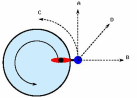 A kid rides on the edge of a merry-go-round as it rotates
counterclockwise (when viewed from above). The kid holds a ball
straight out from the edge of the merry-go-round and releases it.
Which is the correct path followed by the ball after it is
released?
A kid rides on the edge of a merry-go-round as it rotates
counterclockwise (when viewed from above). The kid holds a ball
straight out from the edge of the merry-go-round and releases it.
Which is the correct path followed by the ball after it is
released?
4. A child sitting 2 meters from the center of a merry-go-round moves at a speed...
 4. A child sitting 2 meters from the center of a merry-go-round moves at a speed of 2 m/s. Calculate (A) the centripetal acceleration of the child and (B) the horizontal force exe child (mass 22.5 kg). (A) 1 m/s2 b. 2 m/s2 c. 3 m/s2 d. 4 m/s2 e. 5 m/s2 a. 22.5 N b. 45 N c. 67.5 N d. 90N e. 112.5 N 5. If Earth was moved to a new orbit that was twice as far...
Use the worked example above to help you solve this problem. A merry-go-round modeled as a disk of mass M 7.00 x 101 kg and radius R 2.40 m is rotating in a horizontal plane about a frictionless vert...
 Use the worked example above to help you solve this problem. A merry-go-round modeled as a disk of mass M 7.00 x 101 kg and radius R 2.40 m is rotating in a horizontal plane about a frictionless vertical axle (see figure). (a) After a student with mass m 86.0 kg jumps onto the merry-go-round, the system's angular speed decreases to 1.95 rad/s. If the student walks slowly from the edge toward the center, find the angular speed of the...
 A child sitting 2.0 m from the center of a merry-go-round moves with a speed of 1.10 m/s Calculate: the centripetal acceleration of die child and the net horizontal force exerted on the child (mass = 22.5 kg) Calculate the centripetal acceleration of the Earth in its orbit around the sun and the net force on the Earth Whit exerts this force on the Earth? Assume that the Earth orbit is a circle of radius 1.50 times 10^11 m What...
 5. Little Jay is en joying his first ride on a merry-go-round. (He is riding a stationary horse rather than one that goes up and down.) A schematic view of the merry go-round as seen from above is shown in the drawing to the right with a convenient coordinate system. A bit after the merry-go-round has started and is going around uniformly, we start our clock. Little Jays position and velocity at time t O is shown as a dot...
 A horizontal 100 kg merry-go-round of radius 1.80m is started from rest by a constant horizontal force of 50 N applied tangentially to the merry-go-round. Two children o mass 50 kg are riding the merry-go-round, one of which is standing 0.75 m from the of rotation and the other is 0.5 m from the axis. (a) (5 points) Calculate the moment of incrtia of the system Assume the MR? and that the two child round has a moment of inertia...
 A kid rides on the edge of a merry-go-round as it rotates
counterclockwise (when viewed from above). The kid holds a ball
straight out from the edge of the merry-go-round and releases it.
Which is the correct path followed by the ball after it is
released?
A kid rides on the edge of a merry-go-round as it rotates
counterclockwise (when viewed from above). The kid holds a ball
straight out from the edge of the merry-go-round and releases it.
Which is the correct path followed by the ball after it is
released?
 4. A child sitting 2 meters from the center of a merry-go-round moves at a speed of 2 m/s. Calculate (A) the centripetal acceleration of the child and (B) the horizontal force exe child (mass 22.5 kg). (A) 1 m/s2 b. 2 m/s2 c. 3 m/s2 d. 4 m/s2 e. 5 m/s2 a. 22.5 N b. 45 N c. 67.5 N d. 90N e. 112.5 N 5. If Earth was moved to a new orbit that was twice as far...
 Use the worked example above to help you solve this problem. A merry-go-round modeled as a disk of mass M 7.00 x 101 kg and radius R 2.40 m is rotating in a horizontal plane about a frictionless vertical axle (see figure). (a) After a student with mass m 86.0 kg jumps onto the merry-go-round, the system's angular speed decreases to 1.95 rad/s. If the student walks slowly from the edge toward the center, find the angular speed of the...
Most questions answered within 3 hours.
-
Where is the error in this code sequence?
String s1 = "Hello";
String s2 = "ello";...
asked 11 months ago -
Financial data for Joel de Paris, Inc., for last year
follow:
Joel de Paris, Inc.
Balance...
asked 11 months ago -
Consider this reaction:
Al2(SO4)3 (aq)+ BaCl3
(aq) Al2Cl6 (aq)- +
3BaSO4(s) . What is the...
asked 11 months ago -
Suppose that Savneet is considering increasing her
recent random sample from 20 car rentals to 40...
asked 11 months ago -
Trucks arrive at an unloading terminal at an average rate of 120
per hour.
Trucks arrive...
asked 11 months ago -
Why are methanol and ethanol completely soluble in water while
octanol is not very little soluble....
asked 11 months ago -
A facilities manager at a university reads in a research report
that the mean amount of...
asked 11 months ago -
When the CuSO4 is rehydrated by adding water to the anhydrous
compound, is this an endothermic...
asked 11 months ago -
A ray of sunlight is passing from diamond into crown glass; the
angle of incidence is...
asked 11 months ago -
A block of mass 0.249 kg is placed on top of a light, vertical
spring of...
asked 11 months ago -
how do the kidneys compensate in the presences of acidosis
a) trigger hyperventilate
b) reserve acid...
asked 11 months ago -
Question 501 pts
The rental rate of capital to the firm increases. Which of the
following...
asked 11 months ago