The coefficient of restitution characterizes a collision in one dimension by relating the initial and final...
The coefficient of restitution characterizes a collision in one dimension by relating the initial and final speeds of the particles involved,
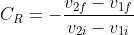
In a 2D collision, the velocity can be split into components parallel and perpendicular to the "plane of collision" (the plane tangent to the two objects' surfaces at their contact point), and the equation above applies to the perpendicular components of the velocities only. One could write

My question is, is it useful (i.e. does it produce a more accurate description of realistic 2D collisions) to generalize that matrix? Perhaps by allowing the top left element to be unequal to 1, or allowing nonzero off-diagonal elements? Or is there some nonlinear relation that works better?
As usual, if you know of any relevant published research, references would be much appreciated.
Homework Answers
To be simple, consider an object hitting a heavy plane. If there
is coefficient of friction  (and restitution
 )
between the bodies, parallel velocity is modified as well:
)
between the bodies, parallel velocity is modified as well:

Thus obtaining
![\left[ \begin{array}{c} v_{\parallel}^{out} \\ v_{\perp}^{out} \end{array} \right] = \underbrace{ \left[ \begin{array}{cc} 1 & - C_F(1+C_R) \\ 0 & - C_R \end{array} \right]}_{A} \left[ \begin{array}{c} v_{\parallel}^{in} \\ v_{\perp}^{in} \end{array} \right].](http://img.homeworklib.com/questions/8628f2d0-76da-11eb-ac25-f7b3f31c599a.png?x-oss-process=image/resize,w_560)
Note that it works as long as  . If there were a general (working for all input velocities)
matrix A, it should allow dissipation,
but not creation, of energy i.e.
. If there were a general (working for all input velocities)
matrix A, it should allow dissipation,
but not creation, of energy i.e.  (the condition is not fulfilled in the above example). I means that
either the matrix need to have other entries as well or that the
problem intrinsically needs restriction of the initial
conditions.
(the condition is not fulfilled in the above example). I means that
either the matrix need to have other entries as well or that the
problem intrinsically needs restriction of the initial
conditions.
However, bear in mind coefficient of restitution is only a effective parameter (as it has been already mentioned by jalexiou).
Anyway, it may be a nice experimental problem for an undergraduate student to find the all coefficients (and check for which conditions they work). I am curious of the results.
Add Answer to:
The coefficient of restitution characterizes a collision in one
dimension by relating the initial and final...
Most questions answered within 3 hours.
-
Where is the error in this code sequence?
String s1 = "Hello";
String s2 = "ello";...
asked 10 months ago -
Financial data for Joel de Paris, Inc., for last year
follow:
Joel de Paris, Inc.
Balance...
asked 10 months ago -
Consider this reaction:
Al2(SO4)3 (aq)+ BaCl3
(aq) Al2Cl6 (aq)- +
3BaSO4(s) . What is the...
asked 10 months ago -
Suppose that Savneet is considering increasing her
recent random sample from 20 car rentals to 40...
asked 10 months ago -
Trucks arrive at an unloading terminal at an average rate of 120
per hour.
Trucks arrive...
asked 10 months ago -
Why are methanol and ethanol completely soluble in water while
octanol is not very little soluble....
asked 10 months ago -
A facilities manager at a university reads in a research report
that the mean amount of...
asked 10 months ago -
When the CuSO4 is rehydrated by adding water to the anhydrous
compound, is this an endothermic...
asked 10 months ago -
A ray of sunlight is passing from diamond into crown glass; the
angle of incidence is...
asked 10 months ago -
A block of mass 0.249 kg is placed on top of a light, vertical
spring of...
asked 10 months ago -
how do the kidneys compensate in the presences of acidosis
a) trigger hyperventilate
b) reserve acid...
asked 10 months ago -
Question 501 pts
The rental rate of capital to the firm increases. Which of the
following...
asked 10 months ago