
Homework Answers
Add Answer to:
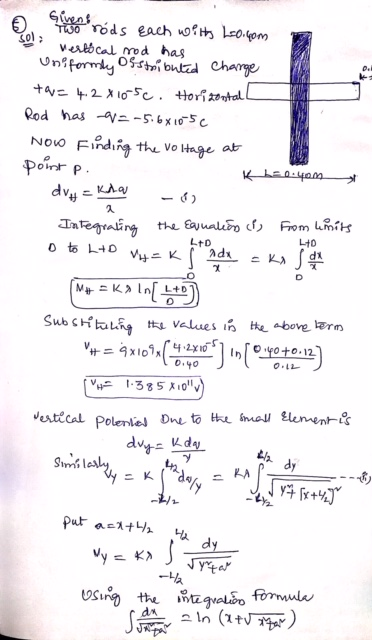
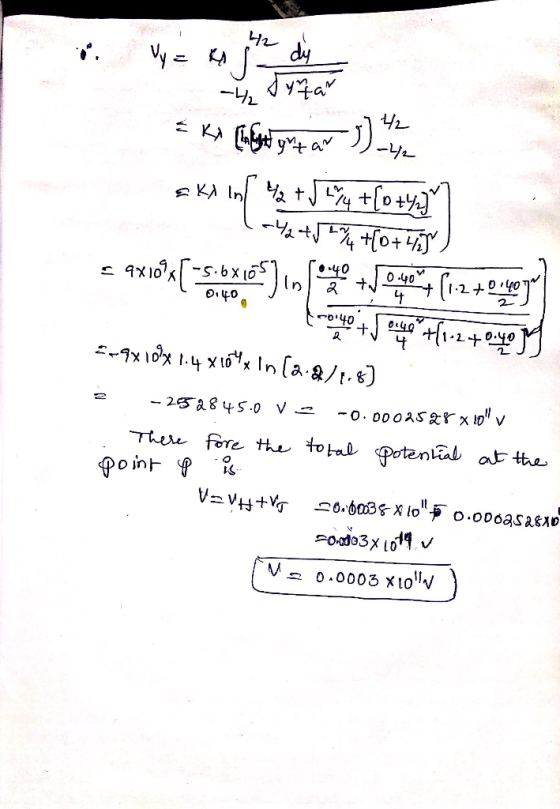
5. Two rods, each with length L 0.40 m, are placed in a symmetric cross. The...
Symmetric Cross Two rods of equal length L = 1.51 m form a symmetric cross. The...
 Symmetric Cross Two rods of equal length L = 1.51 m form a symmetric cross. The horizontal rod has a charge of Q = 100.0 C, and the vertical rod a charge of -Q = -100.0 C. The charges on both rods are distributed uniformly along their length. Calculate the potential at the point P at a distance D = 2.56 m from one end of the horizontal rod. + + + + + + + + + + +...
Symmetric Cross Two rods of equal length L 1.90 m form a symmetric cross. The horizontal...
 Symmetric Cross Two rods of equal length L 1.90 m form a symmetric cross. The horizontal rod has a charge of Q = 100.0 C, and the vertical rod a charge of -Q -100.0 C. The charges on both rods are distributed uniformly along their length. Calculate the potential at the point P at a distance D 3.96 m from one end of the horizontal rod. 2.19 10 12 V Incorrect. Tries 3/20 Previous Tries Submit Answer
Symmetric Cross T o rods or equal length L-1.24 m torm a symmetric crass. Thē horizontal...
 Symmetric Cross T o rods or equal length L-1.24 m torm a symmetric crass. Thē horizontal rcd has a changa at O-2co.o c, and th·vertical rod a charga at Q--20ถ.0 C·Tha charges nn bath rads ana distributed unromiy along their langth. Calculata the pata tal at the point p at a distance -2.44 m tram one and at the horizontal rad Submit Amawer Tries 4/10 Erevinus Tris
Consider two thin nonconducting rods of length L that are parallel to each other, and a...
 Consider two thin nonconducting rods of length L that are parallel to each other, and a distance L apart. One rod has a charge + and the other has a charge +2Q, each uniformly distributed along their lengths. Find the electric field midway between the two rods, as shown L/2 E=? t0 +20
5. The figure shows a rod of length L-1 m on the left, and the cross...
 5. The figure shows a rod of length L-1 m on the left, and the cross sectional view ofa l m by 1 m square plate on the right. They are 2h = 10 cm apart. Each object carries a uniformly distributed charge of Q-20 nC. Compute the electric field at point P which is midway between the rod and the plate. What is the direction of E? (Hint: use integral technique to calculate the electric field at P from...
Problem #3 1/2 ROZW Two insulated rods of length L = 1 m have a linear...
 Problem #3 1/2 ROZW Two insulated rods of length L = 1 m have a linear charge density of 1 = 1 nc/m. a- What is the electric field at P due to the vertical rod? b- What is the electric field at P due to the horizontal rod? C- What is the total electric field at P? Some charges are removed from the horizontal rod so the charge density is now - 2. d- What is the new total...
Answer from 1.4 Two identical rods are placed end to end, separated by a gap of...
Answer from 1.4 Two identical rods are placed end to end, separated by a gap of width D. Each rod has charge Q spread uniformly along its length, L. Using the result of problem 1.4 as a starting point, calculate the force between the rods. F =kAql/a(a + 1) F =kAql/a(a + 1)
Electric field: An equilateral triangle is formed from three rods, each of length 10 cm. Two...
Electric field: An equilateral triangle is formed from three rods, each of length 10 cm. Two of the rods carry charge +16 nC uniformly distributed along the length of each rod, while the third carries charge -16 nC, also uniformly distributed along the rod. What is the magnitude of the electric field at the center of the triangle?
Two identical steel rods AB and CD each have a length L = 6 m and...
 Two identical steel rods AB and CD each have a length L = 6 m and cross-sectional areas of 500 mm2, and are used to support the rigid beam, which is pinned at A and maintains an initial gap of 0.2 mm to support F. If a vertical force P is applied at the end of the beam, (i) (ii) determine the value of P required to close the gap If P = 12 kN, determine the force in rod...
 Symmetric Cross Two rods of equal length L = 1.51 m form a symmetric cross. The horizontal rod has a charge of Q = 100.0 C, and the vertical rod a charge of -Q = -100.0 C. The charges on both rods are distributed uniformly along their length. Calculate the potential at the point P at a distance D = 2.56 m from one end of the horizontal rod. + + + + + + + + + + +...
 Symmetric Cross Two rods of equal length L 1.90 m form a symmetric cross. The horizontal rod has a charge of Q = 100.0 C, and the vertical rod a charge of -Q -100.0 C. The charges on both rods are distributed uniformly along their length. Calculate the potential at the point P at a distance D 3.96 m from one end of the horizontal rod. 2.19 10 12 V Incorrect. Tries 3/20 Previous Tries Submit Answer
 Symmetric Cross T o rods or equal length L-1.24 m torm a symmetric crass. Thē horizontal rcd has a changa at O-2co.o c, and th·vertical rod a charga at Q--20ถ.0 C·Tha charges nn bath rads ana distributed unromiy along their langth. Calculata the pata tal at the point p at a distance -2.44 m tram one and at the horizontal rad Submit Amawer Tries 4/10 Erevinus Tris
 Consider two thin nonconducting rods of length L that are parallel to each other, and a distance L apart. One rod has a charge + and the other has a charge +2Q, each uniformly distributed along their lengths. Find the electric field midway between the two rods, as shown L/2 E=? t0 +20
 5. The figure shows a rod of length L-1 m on the left, and the cross sectional view ofa l m by 1 m square plate on the right. They are 2h = 10 cm apart. Each object carries a uniformly distributed charge of Q-20 nC. Compute the electric field at point P which is midway between the rod and the plate. What is the direction of E? (Hint: use integral technique to calculate the electric field at P from...
 Problem #3 1/2 ROZW Two insulated rods of length L = 1 m have a linear charge density of 1 = 1 nc/m. a- What is the electric field at P due to the vertical rod? b- What is the electric field at P due to the horizontal rod? C- What is the total electric field at P? Some charges are removed from the horizontal rod so the charge density is now - 2. d- What is the new total...
 Two identical steel rods AB and CD each have a length L = 6 m and cross-sectional areas of 500 mm2, and are used to support the rigid beam, which is pinned at A and maintains an initial gap of 0.2 mm to support F. If a vertical force P is applied at the end of the beam, (i) (ii) determine the value of P required to close the gap If P = 12 kN, determine the force in rod...
Most questions answered within 3 hours.
-
Where is the error in this code sequence?
String s1 = "Hello";
String s2 = "ello";...
asked 10 months ago -
Financial data for Joel de Paris, Inc., for last year
follow:
Joel de Paris, Inc.
Balance...
asked 10 months ago -
Consider this reaction:
Al2(SO4)3 (aq)+ BaCl3
(aq) Al2Cl6 (aq)- +
3BaSO4(s) . What is the...
asked 10 months ago -
Suppose that Savneet is considering increasing her
recent random sample from 20 car rentals to 40...
asked 10 months ago -
Trucks arrive at an unloading terminal at an average rate of 120
per hour.
Trucks arrive...
asked 10 months ago -
Why are methanol and ethanol completely soluble in water while
octanol is not very little soluble....
asked 10 months ago -
A facilities manager at a university reads in a research report
that the mean amount of...
asked 10 months ago -
When the CuSO4 is rehydrated by adding water to the anhydrous
compound, is this an endothermic...
asked 10 months ago -
A ray of sunlight is passing from diamond into crown glass; the
angle of incidence is...
asked 10 months ago -
A block of mass 0.249 kg is placed on top of a light, vertical
spring of...
asked 10 months ago -
how do the kidneys compensate in the presences of acidosis
a) trigger hyperventilate
b) reserve acid...
asked 10 months ago -
Question 501 pts
The rental rate of capital to the firm increases. Which of the
following...
asked 10 months ago