
Homework Answers
Add Answer to:
Problem 4 Air at 100 C flows across a thin, flat plate of subliming naphthalene that...
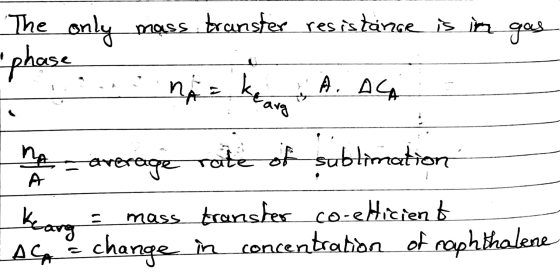
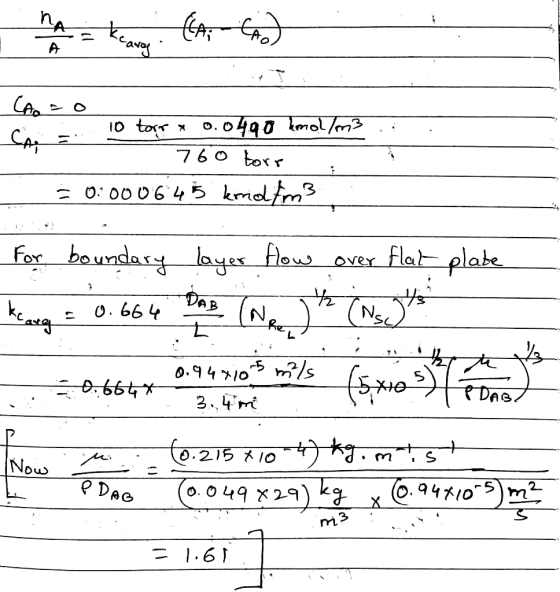
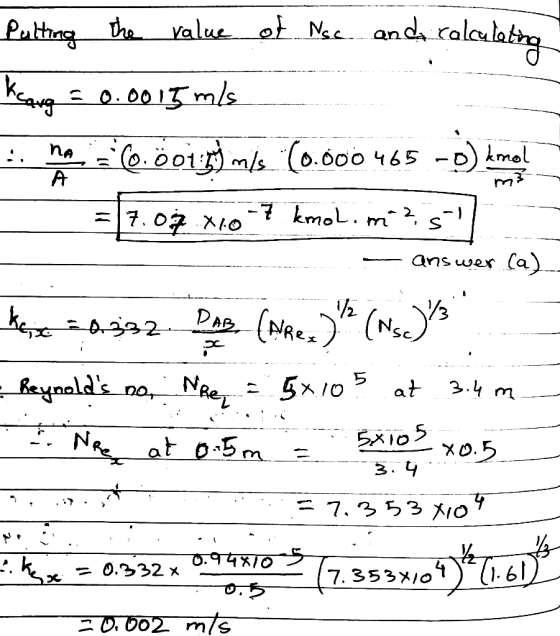
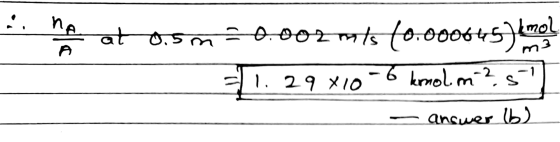
Problem 1: Air at 100 degrees Celsius, 1 atm and a free stream velocity of 5...
 Problem 1: Air at 100 degrees Celsius, 1 atm and a
free stream velocity of 5 m/s flows over a 3 meter long, thin, flat
plate of naphthalene, causing it to sublime...
Please answer all parts
Problem 1. (20 Points) Air at 100°C, 1 atm, and a free-stream velocity of 5 m/s flows over a 3- m-long, thin, flat plate of naphthalene, causing it to sublime. (a) Determine the length over which a laminar boundary layer persists. (b) For that...
Problem 1: Air at 100 degrees Celsius, 1 atm and a
free stream velocity of 5 m/s flows over a 3 meter long, thin, flat
plate of naphthalene, causing it to sublime...
Please answer all parts
Problem 1. (20 Points) Air at 100°C, 1 atm, and a free-stream velocity of 5 m/s flows over a 3- m-long, thin, flat plate of naphthalene, causing it to sublime. (a) Determine the length over which a laminar boundary layer persists. (b) For that...
Air at 70℉ flows parallel to a smooth, thin, flat plate at 13 ns. The plate...
 Air at 70℉ flows parallel to a smooth, thin, flat plate at 13 ns. The plate is 10 6 ft long Determine whether the boundary layer on the plate is most likely laminar, turbulent, or somewhere in between (transitional). Calculate the boundary layer thickness at the end of the plate where the boundary layer is laminar everywhere and where the boundary layer is turbulent everywhere (obtained from the one seventh-power law), The kinematic viscosity of air at 70°F is v...
Required information Air at 25°C and 1 atm is flowing over a long flat plate with...
 Required information Air at 25°C and 1 atm is flowing over a long flat plate with a velocity of 7 m/s. The density and kinematic viscosity of air at 1 atm and 25°C are p= 1.184 kg/m3 and V = 1.562x10⁻⁵ m2/s. Calculate the distance from the leading edge of the plate where the flow becomes turbulent. The distance from the leading edge of the plate is m. Required information Air at 25°C and 1 atm is flowing over a...
b. A very thin wing section is being tested in a low speed wind-tunnel. Assuming that...
 b. A very thin wing section is being tested in a low speed wind-tunnel. Assuming that the flow on the surface of the wing produce a laminar boundary layer and the velocity profile is given as follows; Determine the theoretical value of; 8" where Rex is the Reynold number at a distance x from the leading edge of the wing, Rei is the Reynolds number at the trailing edge of the wing and Cr (or Cp) is the average skin...
Water at 15.6 [°C] (with kinematic viscosity of 1.12 [cSt]) flows over a flat plate generatinga boundary layer. The thickness of the boundary layer at 0.50 [m] from the leading edge is 6 [mm] (a)...
 Water at 15.6 [°C] (with kinematic viscosity of 1.12 [cSt]) flows over a flat plate generatinga boundary layer. The thickness of the boundary layer at 0.50 [m] from the leading edge is 6 [mm] (a) Is the boundary layer laminar or turbulent at that point? (b) At what distance it becomes turbulent? (c) What is the layer thickness at that point?
Water at 15.6 [°C] (with kinematic viscosity of 1.12 [cSt]) flows over a flat plate generatinga boundary layer. The...
Water at 15.6 [°C] (with kinematic viscosity of 1.12 [cSt]) flows over a flat plate generatinga boundary layer. The thickness of the boundary layer at 0.50 [m] from the leading edge is 6 [mm] (a) Is the boundary layer laminar or turbulent at that point? (b) At what distance it becomes turbulent? (c) What is the layer thickness at that point?
Water at 15.6 [°C] (with kinematic viscosity of 1.12 [cSt]) flows over a flat plate generatinga boundary layer. The...
Consider 2 thin, flat plates (Plate 1 and Plate 2 shown below) with air flowing over...
 Consider 2 thin, flat plates (Plate 1 and Plate 2 shown below) with air flowing over them with a speed of 6 m/s. Plate 1 is 10 cm by 20 cm and Plate 2 is 30 cm by 20 cm. What is the ratio of the drag coefficient of Plate 2 to the drag coefficient of Plate 1 (Coz/Cp)? Take the critical Reynolds number for transition from laminar to turbulent flow to be 1,000,000. The kinematic viscosity of air (v...
Problem #3 Air flows over a flat plate at 4 m/s. An approximation for the x...
 Problem #3 Air flows over a flat plate at 4 m/s. An approximation for the x component of velocity in the in- compressible laminar boundary layer is a sinusoidal variation from u-0 at the surface (y-0) to the freestream velocity, U, at the boundary-layer edge (y-5). The equation for the profile is u-Usin( %), where cVx and c is a constant. The boundary layer is 9 mm thick 1 m from the edge of the plate. (a) Predict the boundary-layer...
Part 1 A thin plate 6 ft long and 3 ft wide is submerged and held...
 Part 1 A thin plate 6 ft long and 3 ft wide is submerged and held stationary in a stream of water (T-60F) that has a velocity of 10 ft/s. What is the thickness of the boundary layer on the plate for Re, - 500,000 (assume the boundary layer is still laminar), and at what distance downstream of the leading edge does this Reynolds number occur? What is the shear stress on the plate at this point? (a) which of...
Air at T=25°C and pressure P=1 bar flows over a square plate with a velocity V=1...
Air at T=25°C and pressure P=1 bar flows over a square plate with a velocity V=1 m/s. This plate has a length L= 1 m and it is heated over its entire length; the plate temperature is constant Tp=100°C. The following data are given. For air: dynamic viscosity: mu = 1.9*10–5 kg/(m.s); density: rho = 1.05 kg/m3; conductivity k = 0.03 W/(m K); Specific heat Cp = 1.007 kJ/(kg K); Prandtl number Pr = 0.7 For laminar flow over a...
Exercise 2 Air at 20 °C and 1 atm flows over a flat plate at 50...
 Exercise 2 Air at 20 °C and 1 atm flows over a flat plate at 50 m/s. The plate is 300 cm long and is maintained at 60C. The width of the plate is 2 m. The critical Rec = 5 x 10⁵ The properties are Conductivity k = 0.0263 W/mK, kinematic viscosity nu = v = 15.89 x 10⁻⁶ m²/s, Prandtl number is Pr=0.707 Density rho = p = 1.128 kg/m3 1. Determine the critical length Xc 2. Determine...
 Problem 1: Air at 100 degrees Celsius, 1 atm and a
free stream velocity of 5 m/s flows over a 3 meter long, thin, flat
plate of naphthalene, causing it to sublime...
Please answer all parts
Problem 1. (20 Points) Air at 100°C, 1 atm, and a free-stream velocity of 5 m/s flows over a 3- m-long, thin, flat plate of naphthalene, causing it to sublime. (a) Determine the length over which a laminar boundary layer persists. (b) For that...
Problem 1: Air at 100 degrees Celsius, 1 atm and a
free stream velocity of 5 m/s flows over a 3 meter long, thin, flat
plate of naphthalene, causing it to sublime...
Please answer all parts
Problem 1. (20 Points) Air at 100°C, 1 atm, and a free-stream velocity of 5 m/s flows over a 3- m-long, thin, flat plate of naphthalene, causing it to sublime. (a) Determine the length over which a laminar boundary layer persists. (b) For that...
 Air at 70℉ flows parallel to a smooth, thin, flat plate at 13 ns. The plate is 10 6 ft long Determine whether the boundary layer on the plate is most likely laminar, turbulent, or somewhere in between (transitional). Calculate the boundary layer thickness at the end of the plate where the boundary layer is laminar everywhere and where the boundary layer is turbulent everywhere (obtained from the one seventh-power law), The kinematic viscosity of air at 70°F is v...
 Required information Air at 25°C and 1 atm is flowing over a long flat plate with a velocity of 7 m/s. The density and kinematic viscosity of air at 1 atm and 25°C are p= 1.184 kg/m3 and V = 1.562x10⁻⁵ m2/s. Calculate the distance from the leading edge of the plate where the flow becomes turbulent. The distance from the leading edge of the plate is m. Required information Air at 25°C and 1 atm is flowing over a...
 b. A very thin wing section is being tested in a low speed wind-tunnel. Assuming that the flow on the surface of the wing produce a laminar boundary layer and the velocity profile is given as follows; Determine the theoretical value of; 8" where Rex is the Reynold number at a distance x from the leading edge of the wing, Rei is the Reynolds number at the trailing edge of the wing and Cr (or Cp) is the average skin...
 Water at 15.6 [°C] (with kinematic viscosity of 1.12 [cSt]) flows over a flat plate generatinga boundary layer. The thickness of the boundary layer at 0.50 [m] from the leading edge is 6 [mm] (a) Is the boundary layer laminar or turbulent at that point? (b) At what distance it becomes turbulent? (c) What is the layer thickness at that point?
Water at 15.6 [°C] (with kinematic viscosity of 1.12 [cSt]) flows over a flat plate generatinga boundary layer. The...
Water at 15.6 [°C] (with kinematic viscosity of 1.12 [cSt]) flows over a flat plate generatinga boundary layer. The thickness of the boundary layer at 0.50 [m] from the leading edge is 6 [mm] (a) Is the boundary layer laminar or turbulent at that point? (b) At what distance it becomes turbulent? (c) What is the layer thickness at that point?
Water at 15.6 [°C] (with kinematic viscosity of 1.12 [cSt]) flows over a flat plate generatinga boundary layer. The...
 Consider 2 thin, flat plates (Plate 1 and Plate 2 shown below) with air flowing over them with a speed of 6 m/s. Plate 1 is 10 cm by 20 cm and Plate 2 is 30 cm by 20 cm. What is the ratio of the drag coefficient of Plate 2 to the drag coefficient of Plate 1 (Coz/Cp)? Take the critical Reynolds number for transition from laminar to turbulent flow to be 1,000,000. The kinematic viscosity of air (v...
 Problem #3 Air flows over a flat plate at 4 m/s. An approximation for the x component of velocity in the in- compressible laminar boundary layer is a sinusoidal variation from u-0 at the surface (y-0) to the freestream velocity, U, at the boundary-layer edge (y-5). The equation for the profile is u-Usin( %), where cVx and c is a constant. The boundary layer is 9 mm thick 1 m from the edge of the plate. (a) Predict the boundary-layer...
 Part 1 A thin plate 6 ft long and 3 ft wide is submerged and held stationary in a stream of water (T-60F) that has a velocity of 10 ft/s. What is the thickness of the boundary layer on the plate for Re, - 500,000 (assume the boundary layer is still laminar), and at what distance downstream of the leading edge does this Reynolds number occur? What is the shear stress on the plate at this point? (a) which of...
 Exercise 2 Air at 20 °C and 1 atm flows over a flat plate at 50 m/s. The plate is 300 cm long and is maintained at 60C. The width of the plate is 2 m. The critical Rec = 5 x 10⁵ The properties are Conductivity k = 0.0263 W/mK, kinematic viscosity nu = v = 15.89 x 10⁻⁶ m²/s, Prandtl number is Pr=0.707 Density rho = p = 1.128 kg/m3 1. Determine the critical length Xc 2. Determine...
Most questions answered within 3 hours.
-
Where is the error in this code sequence?
String s1 = "Hello";
String s2 = "ello";...
asked 11 months ago -
Financial data for Joel de Paris, Inc., for last year
follow:
Joel de Paris, Inc.
Balance...
asked 11 months ago -
Consider this reaction:
Al2(SO4)3 (aq)+ BaCl3
(aq) Al2Cl6 (aq)- +
3BaSO4(s) . What is the...
asked 11 months ago -
Suppose that Savneet is considering increasing her
recent random sample from 20 car rentals to 40...
asked 11 months ago -
Trucks arrive at an unloading terminal at an average rate of 120
per hour.
Trucks arrive...
asked 11 months ago -
Why are methanol and ethanol completely soluble in water while
octanol is not very little soluble....
asked 11 months ago -
A facilities manager at a university reads in a research report
that the mean amount of...
asked 11 months ago -
When the CuSO4 is rehydrated by adding water to the anhydrous
compound, is this an endothermic...
asked 11 months ago -
A ray of sunlight is passing from diamond into crown glass; the
angle of incidence is...
asked 11 months ago -
A block of mass 0.249 kg is placed on top of a light, vertical
spring of...
asked 11 months ago -
how do the kidneys compensate in the presences of acidosis
a) trigger hyperventilate
b) reserve acid...
asked 11 months ago -
Question 501 pts
The rental rate of capital to the firm increases. Which of the
following...
asked 11 months ago