taxes, inflation, credit ratings, which factors are less likely to affect bond spreads?
taxes, inflation, credit ratings, which factors are less likely to affect bond spreads?
Homework Answers
Request Answer!
We need at least 10 more requests to produce the answer.
0 / 10 have requested this problem solution
The more requests, the faster the answer.
Add Answer to:
taxes, inflation, credit ratings, which factors are
less likely to affect bond spreads?
What are bond ratings and why are they important? How does inflation affect interest rates? What...
What are bond ratings and why are they important? How does inflation affect interest rates? What is the term structure of interest rates?
A company's bond ratings might in concept be similar to your own personal credit ratings. Use...
A company's bond ratings might in concept be similar to your own personal credit ratings. Use an example of how someone's personal credit rating might affect their financial life -- and then translate that to how a bond rating might affect a company's financial choices.
QUESTION 5 What is the relationship between bond credit spreads and rating levels? O d. Spreads...
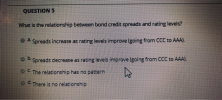 QUESTION 5 What is the relationship between bond credit spreads and rating levels? O d. Spreads increase as rating levels improve (going from CCC to AAA). O .Spreads decrease as rating levels improve (going from CCC to AAA). O The relationship has no pattern O d. There is no relationship
QUESTIONS What is the relationship between bond credit spreads and rating levels? Spreads increase as rating levels...
 QUESTIONS What is the relationship between bond credit spreads and rating levels? Spreads increase as rating levels improve (going from CCC to MMA). Spreads decrease as rating levels improve (going from CCC to AAA) The relationship has no pattern d. There is no relationship QUESTION 6 The government of Venezuela announces that its GDP is declining, devalues its currency, and increases currency controls. You have also read reports about civil unrest after a recent election. What do you expect the...
Which of the following is NOT a way to measure default risk? A. Credit ratings B....
Which of the following is NOT a way to measure default risk? A. Credit ratings B. Discriminant Analysis C. Examining yield spreads D. Technical Analysis E. All of the above ARE ways to measure default risk.
10. Bond ratings Rating agencies-such as Standard & Poor's (S&P), Moody's Investor Service, and Fitch Ratings-assign...
 10. Bond ratings
Rating agencies-such as Standard & Poor's (S&P), Moody's Investor Service, and Fitch Ratings-assign credit ratings to bonds based on both quantitative and qualitative factors. These ratings are considered indicators of the issuer's default risk, which impacts the bond's interest rate and the issuer's cost of debt capital. Based on these ratings, bonds are classified into investment-grade bonds and junk bonds. Which of the following bonds is likely to be classified as an investment-grade bond? O A bond...
10. Bond ratings
Rating agencies-such as Standard & Poor's (S&P), Moody's Investor Service, and Fitch Ratings-assign credit ratings to bonds based on both quantitative and qualitative factors. These ratings are considered indicators of the issuer's default risk, which impacts the bond's interest rate and the issuer's cost of debt capital. Based on these ratings, bonds are classified into investment-grade bonds and junk bonds. Which of the following bonds is likely to be classified as an investment-grade bond? O A bond...
Rating agencies-such as Standard& Poor's (S&P), Moody's Investor Service, and Fitch Ratings-assign credit ratings to bonds...
 Rating agencies-such as Standard& Poor's (S&P), Moody's Investor Service, and Fitch Ratings-assign credit ratings to bonds based on both quantitative and qualitative factors. These ratings are considered indicators of the issuer's default risk, which impacts the bond's interest rate and the issuer's cost of debt capital. Based on these ratings, bonds are classified into investment-grade bonds and junk bonds. Which of the following bonds is likely to be classified as an investment-grade bond? O A bond whose issuer has a...
10. Bond ratings Aa Aa Rating agencies-such as Standard & Poor's (S&P), Moody's Investor Service, and...
 10. Bond ratings Aa Aa Rating agencies-such as Standard & Poor's (S&P), Moody's Investor Service, and Fitch Ratings-assign credit ratings to bonds based on both quantitative and qualitative factors. These ratings are considered indicators of the issuer's default risk, which impacts the bond's interest rate and the issuer's cost of debt capital. Based on these ratings, bonds are classified into investment-grade bonds and junk bonds. Which of the following bonds is likely to be classified as a junk bond? OA...
7. Bond ratings Rating agencies such as Standard & Poor's (S&P), MoodyInvestor Service, and Fitch Ratings-assign...
 7. Bond ratings Rating agencies such as Standard & Poor's (S&P), MoodyInvestor Service, and Fitch Ratings-assign credit ratings to bonds based on both quantitative and qualitative factors. These ratings are considered indicators of the issuer's default risk, which impacts the bond's interest rate and the issuer's cost of debt capital nome e anche classified Based on these ratings, bonds are classified into investment-grade bonds and junk bonds. Which of the following bonds is kely to be investment-grade bond? A bond...
Question 5 5 pts Which of the following statements is (are) accurate? I. Bond ratings are...
 Question 5 5 pts Which of the following statements is (are) accurate? I. Bond ratings are typically paid for by investors interested in purchasing the bond in the primary market. II. Bond ratings are based on non-public information provided by the company. III. Bond ratings represent an independent assessment of the credit- worthiness of bonds. I and II only I and III only II and III only All are true III only
 QUESTION 5 What is the relationship between bond credit spreads and rating levels? O d. Spreads increase as rating levels improve (going from CCC to AAA). O .Spreads decrease as rating levels improve (going from CCC to AAA). O The relationship has no pattern O d. There is no relationship
 QUESTIONS What is the relationship between bond credit spreads and rating levels? Spreads increase as rating levels improve (going from CCC to MMA). Spreads decrease as rating levels improve (going from CCC to AAA) The relationship has no pattern d. There is no relationship QUESTION 6 The government of Venezuela announces that its GDP is declining, devalues its currency, and increases currency controls. You have also read reports about civil unrest after a recent election. What do you expect the...
 10. Bond ratings
Rating agencies-such as Standard & Poor's (S&P), Moody's Investor Service, and Fitch Ratings-assign credit ratings to bonds based on both quantitative and qualitative factors. These ratings are considered indicators of the issuer's default risk, which impacts the bond's interest rate and the issuer's cost of debt capital. Based on these ratings, bonds are classified into investment-grade bonds and junk bonds. Which of the following bonds is likely to be classified as an investment-grade bond? O A bond...
10. Bond ratings
Rating agencies-such as Standard & Poor's (S&P), Moody's Investor Service, and Fitch Ratings-assign credit ratings to bonds based on both quantitative and qualitative factors. These ratings are considered indicators of the issuer's default risk, which impacts the bond's interest rate and the issuer's cost of debt capital. Based on these ratings, bonds are classified into investment-grade bonds and junk bonds. Which of the following bonds is likely to be classified as an investment-grade bond? O A bond...
 Rating agencies-such as Standard& Poor's (S&P), Moody's Investor Service, and Fitch Ratings-assign credit ratings to bonds based on both quantitative and qualitative factors. These ratings are considered indicators of the issuer's default risk, which impacts the bond's interest rate and the issuer's cost of debt capital. Based on these ratings, bonds are classified into investment-grade bonds and junk bonds. Which of the following bonds is likely to be classified as an investment-grade bond? O A bond whose issuer has a...
 10. Bond ratings Aa Aa Rating agencies-such as Standard & Poor's (S&P), Moody's Investor Service, and Fitch Ratings-assign credit ratings to bonds based on both quantitative and qualitative factors. These ratings are considered indicators of the issuer's default risk, which impacts the bond's interest rate and the issuer's cost of debt capital. Based on these ratings, bonds are classified into investment-grade bonds and junk bonds. Which of the following bonds is likely to be classified as a junk bond? OA...
 7. Bond ratings Rating agencies such as Standard & Poor's (S&P), MoodyInvestor Service, and Fitch Ratings-assign credit ratings to bonds based on both quantitative and qualitative factors. These ratings are considered indicators of the issuer's default risk, which impacts the bond's interest rate and the issuer's cost of debt capital nome e anche classified Based on these ratings, bonds are classified into investment-grade bonds and junk bonds. Which of the following bonds is kely to be investment-grade bond? A bond...
 Question 5 5 pts Which of the following statements is (are) accurate? I. Bond ratings are typically paid for by investors interested in purchasing the bond in the primary market. II. Bond ratings are based on non-public information provided by the company. III. Bond ratings represent an independent assessment of the credit- worthiness of bonds. I and II only I and III only II and III only All are true III only
Most questions answered within 3 hours.
-
Where is the error in this code sequence?
String s1 = "Hello";
String s2 = "ello";...
asked 11 months ago -
Financial data for Joel de Paris, Inc., for last year
follow:
Joel de Paris, Inc.
Balance...
asked 11 months ago -
Consider this reaction:
Al2(SO4)3 (aq)+ BaCl3
(aq) Al2Cl6 (aq)- +
3BaSO4(s) . What is the...
asked 11 months ago -
Suppose that Savneet is considering increasing her
recent random sample from 20 car rentals to 40...
asked 11 months ago -
Trucks arrive at an unloading terminal at an average rate of 120
per hour.
Trucks arrive...
asked 11 months ago -
Why are methanol and ethanol completely soluble in water while
octanol is not very little soluble....
asked 11 months ago -
A facilities manager at a university reads in a research report
that the mean amount of...
asked 11 months ago -
When the CuSO4 is rehydrated by adding water to the anhydrous
compound, is this an endothermic...
asked 11 months ago -
A ray of sunlight is passing from diamond into crown glass; the
angle of incidence is...
asked 11 months ago -
A block of mass 0.249 kg is placed on top of a light, vertical
spring of...
asked 11 months ago -
how do the kidneys compensate in the presences of acidosis
a) trigger hyperventilate
b) reserve acid...
asked 11 months ago -
Question 501 pts
The rental rate of capital to the firm increases. Which of the
following...
asked 11 months ago