Hello! Just double checking the answers from my organic chemistry study guide. Please go ahead and answer ALL the questions you see below, if you can't answer all then PLEASE let someone else do them! High rating only given to ALL questions complete.

Homework Answers
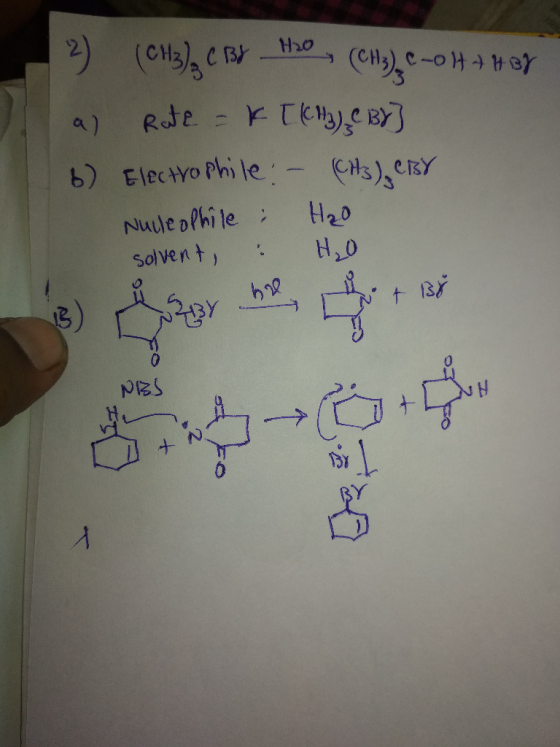
2. C. I. Increases since it is SN1 reaction, follows 1st order kinetics and unimolecular reaction. Rate depends only on alkyl halide.
Ii. No change in rate
Iii. No change, since rate depend s only on alkyl halide
IV. Increases since Iodide is good leaving group than Br
V. Decreases, since it is SN1, alkyl halide should be tertiary halide , 1-bromopropane is primary halide . Hence rate decreases.
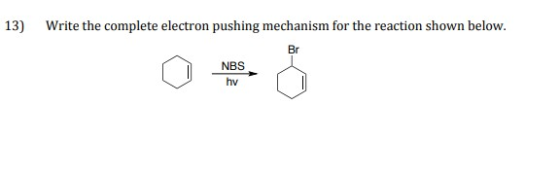
13. NBS is a selective brominating reagent at allylic and benzylic position. Hence Allylic Bromination occured.
Add Answer to:
Hello! Just double checking the answers from my organic
chemistry study guide. Please go ahead and...
consider the Sn1 reaction shown below and answer the following questions. Br Br + CH3OH CH3...
 consider the Sn1 reaction shown below and answer the following questions. Br Br + CH3OH CH3 + HBO A. Write the rate law for the reaction. B. Identify the nucleophile, the electrophile, and the reaction solvent. C. State how each of the following factors would affect the rate of the reaction. a. Increasing the concentration of the alkyl halide. b. Increasing the concentration of CH3OH. c. Replacing HOCH3 with NaOCH3. d. Changing the alkyl halide from a bromide to an...
Consider the SN2 reaction shown below and answer the following questions. Consider the SN1 reaction shown...
 Consider the SN2 reaction shown below and answer the
following questions.
Consider the SN1 reaction shown below and answer the following
questions.
1. Consider the SN2 reaction shown below and answer the following questions. acetone Br NaSCH3 SCH3 NaBr + A. Write the rate law for the reaction B. Identify the nucleophile and the electrophile in the reaction C. State how each of the following factors would affect the rate of the reaction a. Increasing the concentration of 1-bromopropane. b....
Consider the SN2 reaction shown below and answer the
following questions.
Consider the SN1 reaction shown below and answer the following
questions.
1. Consider the SN2 reaction shown below and answer the following questions. acetone Br NaSCH3 SCH3 NaBr + A. Write the rate law for the reaction B. Identify the nucleophile and the electrophile in the reaction C. State how each of the following factors would affect the rate of the reaction a. Increasing the concentration of 1-bromopropane. b....
2. Consider the Sn1 reaction shown below and answer the following questions. Br K . CHOH...
 2. Consider the Sn1 reaction shown below and answer the following questions. Br K . CHOH + CH3OH — Kºchs + HBr CH3 + HBr Ph Ph A. Write the rate law for the reaction. B. Identify the nucleophile, the electrophile, and the reaction solvent. C. State how each of the following factors would affect the rate of the reaction. a. Increasing the concentration of the alkyl halide. b. Increasing the concentration of CH3OH. c. Replacing HOCH3 with NaOCH3. d....
2. Consider the Sn1 reaction shown below and answer the following questions. + CH3OH "CH₃ +...
 2. Consider the Sn1 reaction shown below and answer the following questions. + CH3OH "CH₃ + HBr A. Write the rate law for the reaction. B. Identify the nucleophile, the electrophile, and the reaction solventi Panther ID...... C. State how each of the following factors would affect the rate of the reaction. a. Increasing the concentration of the alkyl halide. b. Increasing the concentration of CH3OH. c. Replacing HOCH3 with NaOCH3. d. Changing the alkyl halide from a bromide to...
Hello! Just double checking the answers my organic chemistry study guide about carbohydrates. Please go ahead...
 Hello! Just double checking the answers my organic chemistry
study guide about carbohydrates. Please go ahead
and answer ALL the questions you see below, if you
can't answer all then PLEASE let someone else do
them! High rating only given to ALL questions
complete. If a mechanism is required then please show electron
pushing arrows!
1. Draw a Fischer projection for D-glucose: (2R, 3S,4R,5R)-2,3,4,5,6-pentahydroxyhexanal. 2. Draw the Haworth formulas for both a.-D-glucopyranose and B-D-glucopyranose. 3. Draw the chair forms for...
Hello! Just double checking the answers my organic chemistry
study guide about carbohydrates. Please go ahead
and answer ALL the questions you see below, if you
can't answer all then PLEASE let someone else do
them! High rating only given to ALL questions
complete. If a mechanism is required then please show electron
pushing arrows!
1. Draw a Fischer projection for D-glucose: (2R, 3S,4R,5R)-2,3,4,5,6-pentahydroxyhexanal. 2. Draw the Haworth formulas for both a.-D-glucopyranose and B-D-glucopyranose. 3. Draw the chair forms for...
1. Consider the SN2 reaction shown below and answer the following questions.nobl 8 acetone no t...
 1. Consider the SN2 reaction shown below and answer the following questions.nobl 8 acetone no t iNaSCH SCH, + NaBr worl s1918. A. Write the rate law for the reaction. ebiler vil ar to nollurunoonoo oli nison. B. Identify the nucleophile and the electrophile in the reaction. HOCH lo noiden nog orgnismanl.d C. State how each of the following factors would affect the rate of the reaction. CHOW CHOOH glasa a. Increasing the concentration of 1-bromopropane. b. Decreasing the concentration...
Hello guys just double checking the answers my biology genetics study guide. Please go ahead and...
 Hello guys just double checking the answers my biology genetics
study guide. Please go ahead and answer ALL the
questions you see below, if you can't answer all then
PLEASE let someone else do them! High rating only
given to ALL questions complete
>>> Graphs are found below the
questions:
>>> Graphs:
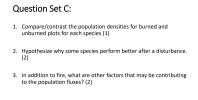
Question Set C: 1. Compare/contrast the population densities for burned and unburned plots for each species (1) 2. Hypothesize why some species perform better after a disturbance. (2)...
Hello guys just double checking the answers my biology genetics
study guide. Please go ahead and answer ALL the
questions you see below, if you can't answer all then
PLEASE let someone else do them! High rating only
given to ALL questions complete
>>> Graphs are found below the
questions:
>>> Graphs:
Question Set C: 1. Compare/contrast the population densities for burned and unburned plots for each species (1) 2. Hypothesize why some species perform better after a disturbance. (2)...
Hello guys just double checking the answers my biology genetics study guide. Please go ahead and...
 Hello guys just double
checking the answers my biology genetics study guide. Please go
ahead and answer ALL the questions you see below,
if you can't answer all then PLEASE let someone
else do them! High rating only given to ALL
questions complete (questions 1 I posted the handout for it
below)
>>> 5
Questions
>>> Handout 1:
QUESTION 1 For the pedigree shows in handout 1, the mutation may be O dominant autosomal recessive autosomal X-linked recessive O A,...
Hello guys just double
checking the answers my biology genetics study guide. Please go
ahead and answer ALL the questions you see below,
if you can't answer all then PLEASE let someone
else do them! High rating only given to ALL
questions complete (questions 1 I posted the handout for it
below)
>>> 5
Questions
>>> Handout 1:
QUESTION 1 For the pedigree shows in handout 1, the mutation may be O dominant autosomal recessive autosomal X-linked recessive O A,...
1. Consider the SN2 reaction shown below and answer the following questions. acetone Br + NaSCHE...
 1. Consider the SN2 reaction shown below and answer the following questions. acetone Br + NaSCHE SCHg+ NaBr A. Write the rate law for the reaction. B. Identify the nucleophile and the electrophile in the reaction. C. State how each of the following factors would affect the rate of the reaction. a. Increasing the concentration of 1-bromopropane. b. Decreasing the concentration of NaSCH3 by one-half. c. Changing 1-bromopropane to 2-bromopropane. d. Changing 1-bromopropane to 1-iodopropane. e. Changing NaSCH3 to CH3OH.
1. Consider the SN2 reaction shown below and answer the following questions. acetone + NaSCHE SCH3...
 1. Consider the SN2 reaction shown below and answer the following questions. acetone + NaSCHE SCH3 + NaBr A. Write the rate law for the reaction. B. Identify the nucleophile and the electrophile in the reaction. C. State how each of the following factors would affect the rate of the reaction. a. Increasing the concentration of 1-bromopropane. b. Decreasing the concentration of NaSCH3 by one-half. C. Changing 1-bromopropane to 2-bromopropane. d. Changing 1-bromopropane to 1-iodopropane. e. Changing NaSCH3 to CH3OH.
 consider the Sn1 reaction shown below and answer the following questions. Br Br + CH3OH CH3 + HBO A. Write the rate law for the reaction. B. Identify the nucleophile, the electrophile, and the reaction solvent. C. State how each of the following factors would affect the rate of the reaction. a. Increasing the concentration of the alkyl halide. b. Increasing the concentration of CH3OH. c. Replacing HOCH3 with NaOCH3. d. Changing the alkyl halide from a bromide to an...
 Consider the SN2 reaction shown below and answer the
following questions.
Consider the SN1 reaction shown below and answer the following
questions.
1. Consider the SN2 reaction shown below and answer the following questions. acetone Br NaSCH3 SCH3 NaBr + A. Write the rate law for the reaction B. Identify the nucleophile and the electrophile in the reaction C. State how each of the following factors would affect the rate of the reaction a. Increasing the concentration of 1-bromopropane. b....
Consider the SN2 reaction shown below and answer the
following questions.
Consider the SN1 reaction shown below and answer the following
questions.
1. Consider the SN2 reaction shown below and answer the following questions. acetone Br NaSCH3 SCH3 NaBr + A. Write the rate law for the reaction B. Identify the nucleophile and the electrophile in the reaction C. State how each of the following factors would affect the rate of the reaction a. Increasing the concentration of 1-bromopropane. b....
 2. Consider the Sn1 reaction shown below and answer the following questions. Br K . CHOH + CH3OH — Kºchs + HBr CH3 + HBr Ph Ph A. Write the rate law for the reaction. B. Identify the nucleophile, the electrophile, and the reaction solvent. C. State how each of the following factors would affect the rate of the reaction. a. Increasing the concentration of the alkyl halide. b. Increasing the concentration of CH3OH. c. Replacing HOCH3 with NaOCH3. d....
 2. Consider the Sn1 reaction shown below and answer the following questions. + CH3OH "CH₃ + HBr A. Write the rate law for the reaction. B. Identify the nucleophile, the electrophile, and the reaction solventi Panther ID...... C. State how each of the following factors would affect the rate of the reaction. a. Increasing the concentration of the alkyl halide. b. Increasing the concentration of CH3OH. c. Replacing HOCH3 with NaOCH3. d. Changing the alkyl halide from a bromide to...
 Hello! Just double checking the answers my organic chemistry
study guide about carbohydrates. Please go ahead
and answer ALL the questions you see below, if you
can't answer all then PLEASE let someone else do
them! High rating only given to ALL questions
complete. If a mechanism is required then please show electron
pushing arrows!
1. Draw a Fischer projection for D-glucose: (2R, 3S,4R,5R)-2,3,4,5,6-pentahydroxyhexanal. 2. Draw the Haworth formulas for both a.-D-glucopyranose and B-D-glucopyranose. 3. Draw the chair forms for...
Hello! Just double checking the answers my organic chemistry
study guide about carbohydrates. Please go ahead
and answer ALL the questions you see below, if you
can't answer all then PLEASE let someone else do
them! High rating only given to ALL questions
complete. If a mechanism is required then please show electron
pushing arrows!
1. Draw a Fischer projection for D-glucose: (2R, 3S,4R,5R)-2,3,4,5,6-pentahydroxyhexanal. 2. Draw the Haworth formulas for both a.-D-glucopyranose and B-D-glucopyranose. 3. Draw the chair forms for...
 1. Consider the SN2 reaction shown below and answer the following questions.nobl 8 acetone no t iNaSCH SCH, + NaBr worl s1918. A. Write the rate law for the reaction. ebiler vil ar to nollurunoonoo oli nison. B. Identify the nucleophile and the electrophile in the reaction. HOCH lo noiden nog orgnismanl.d C. State how each of the following factors would affect the rate of the reaction. CHOW CHOOH glasa a. Increasing the concentration of 1-bromopropane. b. Decreasing the concentration...
 Hello guys just double checking the answers my biology genetics
study guide. Please go ahead and answer ALL the
questions you see below, if you can't answer all then
PLEASE let someone else do them! High rating only
given to ALL questions complete
>>> Graphs are found below the
questions:
>>> Graphs:
Question Set C: 1. Compare/contrast the population densities for burned and unburned plots for each species (1) 2. Hypothesize why some species perform better after a disturbance. (2)...
Hello guys just double checking the answers my biology genetics
study guide. Please go ahead and answer ALL the
questions you see below, if you can't answer all then
PLEASE let someone else do them! High rating only
given to ALL questions complete
>>> Graphs are found below the
questions:
>>> Graphs:
Question Set C: 1. Compare/contrast the population densities for burned and unburned plots for each species (1) 2. Hypothesize why some species perform better after a disturbance. (2)...
 Hello guys just double
checking the answers my biology genetics study guide. Please go
ahead and answer ALL the questions you see below,
if you can't answer all then PLEASE let someone
else do them! High rating only given to ALL
questions complete (questions 1 I posted the handout for it
below)
>>> 5
Questions
>>> Handout 1:
QUESTION 1 For the pedigree shows in handout 1, the mutation may be O dominant autosomal recessive autosomal X-linked recessive O A,...
Hello guys just double
checking the answers my biology genetics study guide. Please go
ahead and answer ALL the questions you see below,
if you can't answer all then PLEASE let someone
else do them! High rating only given to ALL
questions complete (questions 1 I posted the handout for it
below)
>>> 5
Questions
>>> Handout 1:
QUESTION 1 For the pedigree shows in handout 1, the mutation may be O dominant autosomal recessive autosomal X-linked recessive O A,...
 1. Consider the SN2 reaction shown below and answer the following questions. acetone Br + NaSCHE SCHg+ NaBr A. Write the rate law for the reaction. B. Identify the nucleophile and the electrophile in the reaction. C. State how each of the following factors would affect the rate of the reaction. a. Increasing the concentration of 1-bromopropane. b. Decreasing the concentration of NaSCH3 by one-half. c. Changing 1-bromopropane to 2-bromopropane. d. Changing 1-bromopropane to 1-iodopropane. e. Changing NaSCH3 to CH3OH.
 1. Consider the SN2 reaction shown below and answer the following questions. acetone + NaSCHE SCH3 + NaBr A. Write the rate law for the reaction. B. Identify the nucleophile and the electrophile in the reaction. C. State how each of the following factors would affect the rate of the reaction. a. Increasing the concentration of 1-bromopropane. b. Decreasing the concentration of NaSCH3 by one-half. C. Changing 1-bromopropane to 2-bromopropane. d. Changing 1-bromopropane to 1-iodopropane. e. Changing NaSCH3 to CH3OH.
Most questions answered within 3 hours.
-
Where is the error in this code sequence?
String s1 = "Hello";
String s2 = "ello";...
asked 11 months ago -
Financial data for Joel de Paris, Inc., for last year
follow:
Joel de Paris, Inc.
Balance...
asked 11 months ago -
Consider this reaction:
Al2(SO4)3 (aq)+ BaCl3
(aq) Al2Cl6 (aq)- +
3BaSO4(s) . What is the...
asked 11 months ago -
Suppose that Savneet is considering increasing her
recent random sample from 20 car rentals to 40...
asked 11 months ago -
Trucks arrive at an unloading terminal at an average rate of 120
per hour.
Trucks arrive...
asked 11 months ago -
Why are methanol and ethanol completely soluble in water while
octanol is not very little soluble....
asked 11 months ago -
A facilities manager at a university reads in a research report
that the mean amount of...
asked 11 months ago -
When the CuSO4 is rehydrated by adding water to the anhydrous
compound, is this an endothermic...
asked 11 months ago -
A ray of sunlight is passing from diamond into crown glass; the
angle of incidence is...
asked 11 months ago -
A block of mass 0.249 kg is placed on top of a light, vertical
spring of...
asked 11 months ago -
how do the kidneys compensate in the presences of acidosis
a) trigger hyperventilate
b) reserve acid...
asked 11 months ago -
Question 501 pts
The rental rate of capital to the firm increases. Which of the
following...
asked 11 months ago