Given the sequence defined with the recurrence relation:
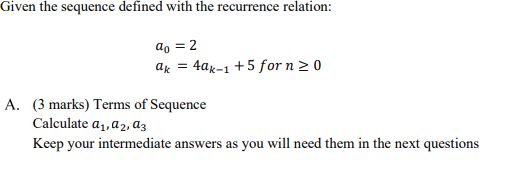

Given the sequence defined with the recurrence relation:
$$ \begin{array}{l} a_{0}=2 \\ a_{k}=4 a_{k-1}+5 \text { for } n \geq 0 \end{array} $$
A. (3 marks) Terms of Sequence Calculate \(a_{1}, a_{2}, a_{3}\) Keep your intermediate answers as you will need them in the next questions
B. ( 7 marks) Iteration Using iteration, solve the recurrence relation when \(n \geq 0\) (i.e. find an analytic formula for \(a_{n}\) ). Simplify your answer as much as possible, showing your work. In particular, your final answer should not contain \(\sum\) and \(\prod\). You must show your work to get full marks.
Homework Answers
Request Answer!
We need at least 9 more requests to produce the answer.
1 / 10 have requested this problem solution
The more requests, the faster the answer.
Given the sequence an defined recursively as follows: an 3an-1+2 for n 2 1 Al Terms of a Sequence...
 Given the sequence an defined recursively as follows: an 3an-1+2 for n 2 1 Al Terms of a Sequence (5 marks) Calculate ai , аг, аз, а4, а5 Keep your intermediate answers as you will need them in the next question. A2 Iteration (5 marks) Using iteration, solve the recurrence relation when n21 (i.e. find an analytic formula for an). Simplify your answer as much as possible, showing your work and quoting any formula or rule that you use. In...
The sequence { ak } is defined by the recurrence relation ak+2 = 3ak+1 + 4ak...
 The sequence { ak } is defined by the recurrence relation ak+2 = 3ak+1 + 4ak with initial conditions do = 0, Q1 = 1. (a) Express the recurrence relation as a matrix difference equation Uk+1 = Auk (b) Find the general formula for ak. (Advise: You can check your answer by comput- ing the first few terms.)
: Let a1, a2, a3, . . . be the sequence of integers defined by a1 = 1 and defined for n ≥ 2 by the recurrence relation a...
: Let a1, a2, a3, . . . be the sequence of integers defined by a1 = 1 and defined for n ≥ 2 by the recurrence relation an = 3an−1 + 1. Using the Principle of Mathematical Induction, prove for all integers n ≥ 1 that an = (3 n − 1) /2 .
(12 points) For each sequence described below, first find a recurrence relation for that sequence...
 Discrete Math for COMP:
(12 points) For each sequence described below, first find a recurrence relation for that sequence and then solve your recurrence relation. (a) The sequence Sn where 80 = 0, si-l and, for n 〉 1, sn s the average of the previous two terms of the sequence. (b) The sequence bn whose nth term is the number of n-bit strings that don't have two zeros in a rovw (c) The sequence en whose nth term is...
Discrete Math for COMP:
(12 points) For each sequence described below, first find a recurrence relation for that sequence and then solve your recurrence relation. (a) The sequence Sn where 80 = 0, si-l and, for n 〉 1, sn s the average of the previous two terms of the sequence. (b) The sequence bn whose nth term is the number of n-bit strings that don't have two zeros in a rovw (c) The sequence en whose nth term is...
For each of the following problems write a recurrence relation describing the running time of eac...
 For each of the following problems write a recurrence relation
describing the running time of each of the following algorithms and
determine the asymptotic complexity of the function defined by the
recurrence relation. Justify your solution using substitution and
carefully computing lower and upper bounds for the sums. Simplify
and express your answer as Θ(n k ) or Θ(n k (log n)) wherever
possible. If the algorithm takes exponential time, then just give
exponential lower bounds.
5. func5 (A,n) /*...
For each of the following problems write a recurrence relation
describing the running time of each of the following algorithms and
determine the asymptotic complexity of the function defined by the
recurrence relation. Justify your solution using substitution and
carefully computing lower and upper bounds for the sums. Simplify
and express your answer as Θ(n k ) or Θ(n k (log n)) wherever
possible. If the algorithm takes exponential time, then just give
exponential lower bounds.
5. func5 (A,n) /*...
3. Determine the asymptotic complexity of the function defined by the recurrence relation. Justify your solution...
 3. Determine the asymptotic complexity of the function defined by the recurrence relation. Justify your solution using expansion/substitution and upper and/or lower bounds, when necessary. You may not use the Master Theorem as justification of your answer. Simplify and express your answer as O(n*) or O(nk log2 n) whenever possible. If the algorithm is exponential just give exponential lower bounds c) T(n) T(n-4) cn, T(0) c' d) T(n) 3T(n/3) c, T() c' e) T(n) T(n-1)T(n-4)clog2n, T(0) c'
3. Determine the...
3. Determine the asymptotic complexity of the function defined by the recurrence relation. Justify your solution using expansion/substitution and upper and/or lower bounds, when necessary. You may not use the Master Theorem as justification of your answer. Simplify and express your answer as O(n*) or O(nk log2 n) whenever possible. If the algorithm is exponential just give exponential lower bounds c) T(n) T(n-4) cn, T(0) c' d) T(n) 3T(n/3) c, T() c' e) T(n) T(n-1)T(n-4)clog2n, T(0) c'
3. Determine the...
A sequence is defined by the first-order recurrence relation: an=5an-1+3 a0=4 a) Write out the first...
A sequence is defined by the first-order recurrence relation: an=5an-1+3 a0=4 a) Write out the first 5 terms of this sequence. b) Given that: an=A*5n+B Show that A=19/4 and B=-3/4. c) Use mathematical induction to prove that ?n = 19/4 × 5n – 3/4
3. 0 marks Suppose you have an algorithm which has the following recurrence relation for W(n),...
 3. 0 marks Suppose you have an algorithm which has the following recurrence relation for W(n), assuming n is a power of 2, i.e. assuming n-2, k20: for n for n- W()-2W(n/2)+2n+ 2 W(n)- Using back substitution and assuming n is a power of 2, ie. n-2, find an exact (ie non-recursive) formula for Win). Be sure to show your work and to simplify your final answer as much as possible. Note that you do NOT need to verify your...
MATLAB 1. The Fibonacci sequence is defined by the recurrence relation Fn = Fn-1+Fn-2 where Fo...
 MATLAB
1. The Fibonacci sequence is defined by the recurrence relation Fn = Fn-1+Fn-2 where Fo = 0 and F1 = 1. Hence F2 = 1, F3 = 2, F4 = 3, etc. In this problem you will use three different methods to compute the n-th element of the sequence. Then, you will compare the time complexity of these methods. (a) Write a recursive function called fibRec with the following declaration line begin code function nElem = fibrec (n) end...
MATLAB
1. The Fibonacci sequence is defined by the recurrence relation Fn = Fn-1+Fn-2 where Fo = 0 and F1 = 1. Hence F2 = 1, F3 = 2, F4 = 3, etc. In this problem you will use three different methods to compute the n-th element of the sequence. Then, you will compare the time complexity of these methods. (a) Write a recursive function called fibRec with the following declaration line begin code function nElem = fibrec (n) end...
3. The sequence (Fn) of Fibonacci numbers is defined by the recursive relation Fn+2 Fn+1+ F...
 3. The sequence (Fn) of Fibonacci numbers is defined by the recursive relation Fn+2 Fn+1+ F for all n E N and with Fi = F2= 1. to find a recursive relation for the sequence of ratios (a) Use the recursive relation for (F) Fn+ Fn an Hint: Divide by Fn+1 N (b) Show by induction that an 1 for all n (c) Given that the limit l = lim,0 an exists (so you do not need to prove that...
 Given the sequence an defined recursively as follows: an 3an-1+2 for n 2 1 Al Terms of a Sequence (5 marks) Calculate ai , аг, аз, а4, а5 Keep your intermediate answers as you will need them in the next question. A2 Iteration (5 marks) Using iteration, solve the recurrence relation when n21 (i.e. find an analytic formula for an). Simplify your answer as much as possible, showing your work and quoting any formula or rule that you use. In...
 The sequence { ak } is defined by the recurrence relation ak+2 = 3ak+1 + 4ak with initial conditions do = 0, Q1 = 1. (a) Express the recurrence relation as a matrix difference equation Uk+1 = Auk (b) Find the general formula for ak. (Advise: You can check your answer by comput- ing the first few terms.)
 Discrete Math for COMP:
(12 points) For each sequence described below, first find a recurrence relation for that sequence and then solve your recurrence relation. (a) The sequence Sn where 80 = 0, si-l and, for n 〉 1, sn s the average of the previous two terms of the sequence. (b) The sequence bn whose nth term is the number of n-bit strings that don't have two zeros in a rovw (c) The sequence en whose nth term is...
Discrete Math for COMP:
(12 points) For each sequence described below, first find a recurrence relation for that sequence and then solve your recurrence relation. (a) The sequence Sn where 80 = 0, si-l and, for n 〉 1, sn s the average of the previous two terms of the sequence. (b) The sequence bn whose nth term is the number of n-bit strings that don't have two zeros in a rovw (c) The sequence en whose nth term is...
 For each of the following problems write a recurrence relation
describing the running time of each of the following algorithms and
determine the asymptotic complexity of the function defined by the
recurrence relation. Justify your solution using substitution and
carefully computing lower and upper bounds for the sums. Simplify
and express your answer as Θ(n k ) or Θ(n k (log n)) wherever
possible. If the algorithm takes exponential time, then just give
exponential lower bounds.
5. func5 (A,n) /*...
For each of the following problems write a recurrence relation
describing the running time of each of the following algorithms and
determine the asymptotic complexity of the function defined by the
recurrence relation. Justify your solution using substitution and
carefully computing lower and upper bounds for the sums. Simplify
and express your answer as Θ(n k ) or Θ(n k (log n)) wherever
possible. If the algorithm takes exponential time, then just give
exponential lower bounds.
5. func5 (A,n) /*...
 3. Determine the asymptotic complexity of the function defined by the recurrence relation. Justify your solution using expansion/substitution and upper and/or lower bounds, when necessary. You may not use the Master Theorem as justification of your answer. Simplify and express your answer as O(n*) or O(nk log2 n) whenever possible. If the algorithm is exponential just give exponential lower bounds c) T(n) T(n-4) cn, T(0) c' d) T(n) 3T(n/3) c, T() c' e) T(n) T(n-1)T(n-4)clog2n, T(0) c'
3. Determine the...
3. Determine the asymptotic complexity of the function defined by the recurrence relation. Justify your solution using expansion/substitution and upper and/or lower bounds, when necessary. You may not use the Master Theorem as justification of your answer. Simplify and express your answer as O(n*) or O(nk log2 n) whenever possible. If the algorithm is exponential just give exponential lower bounds c) T(n) T(n-4) cn, T(0) c' d) T(n) 3T(n/3) c, T() c' e) T(n) T(n-1)T(n-4)clog2n, T(0) c'
3. Determine the...
 3. 0 marks Suppose you have an algorithm which has the following recurrence relation for W(n), assuming n is a power of 2, i.e. assuming n-2, k20: for n for n- W()-2W(n/2)+2n+ 2 W(n)- Using back substitution and assuming n is a power of 2, ie. n-2, find an exact (ie non-recursive) formula for Win). Be sure to show your work and to simplify your final answer as much as possible. Note that you do NOT need to verify your...
 MATLAB
1. The Fibonacci sequence is defined by the recurrence relation Fn = Fn-1+Fn-2 where Fo = 0 and F1 = 1. Hence F2 = 1, F3 = 2, F4 = 3, etc. In this problem you will use three different methods to compute the n-th element of the sequence. Then, you will compare the time complexity of these methods. (a) Write a recursive function called fibRec with the following declaration line begin code function nElem = fibrec (n) end...
MATLAB
1. The Fibonacci sequence is defined by the recurrence relation Fn = Fn-1+Fn-2 where Fo = 0 and F1 = 1. Hence F2 = 1, F3 = 2, F4 = 3, etc. In this problem you will use three different methods to compute the n-th element of the sequence. Then, you will compare the time complexity of these methods. (a) Write a recursive function called fibRec with the following declaration line begin code function nElem = fibrec (n) end...
 3. The sequence (Fn) of Fibonacci numbers is defined by the recursive relation Fn+2 Fn+1+ F for all n E N and with Fi = F2= 1. to find a recursive relation for the sequence of ratios (a) Use the recursive relation for (F) Fn+ Fn an Hint: Divide by Fn+1 N (b) Show by induction that an 1 for all n (c) Given that the limit l = lim,0 an exists (so you do not need to prove that...
Most questions answered within 3 hours.
-
Where is the error in this code sequence?
String s1 = "Hello";
String s2 = "ello";...
asked 11 months ago -
Financial data for Joel de Paris, Inc., for last year
follow:
Joel de Paris, Inc.
Balance...
asked 11 months ago -
Consider this reaction:
Al2(SO4)3 (aq)+ BaCl3
(aq) Al2Cl6 (aq)- +
3BaSO4(s) . What is the...
asked 11 months ago -
Suppose that Savneet is considering increasing her
recent random sample from 20 car rentals to 40...
asked 11 months ago -
Trucks arrive at an unloading terminal at an average rate of 120
per hour.
Trucks arrive...
asked 11 months ago -
Why are methanol and ethanol completely soluble in water while
octanol is not very little soluble....
asked 11 months ago -
A facilities manager at a university reads in a research report
that the mean amount of...
asked 11 months ago -
When the CuSO4 is rehydrated by adding water to the anhydrous
compound, is this an endothermic...
asked 11 months ago -
A ray of sunlight is passing from diamond into crown glass; the
angle of incidence is...
asked 11 months ago -
A block of mass 0.249 kg is placed on top of a light, vertical
spring of...
asked 11 months ago -
how do the kidneys compensate in the presences of acidosis
a) trigger hyperventilate
b) reserve acid...
asked 11 months ago -
Question 501 pts
The rental rate of capital to the firm increases. Which of the
following...
asked 11 months ago