If mass m1 is displaced 1 in. from its static equilibrium
position and released, determine the resulting displacements x1(t)
and x2(t) of the masses shown.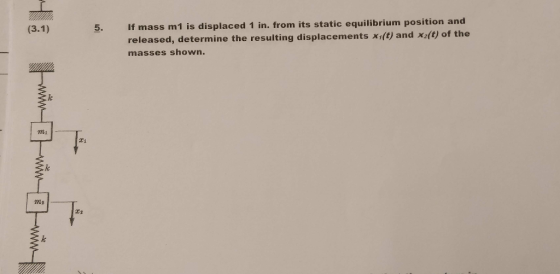
Homework Answers
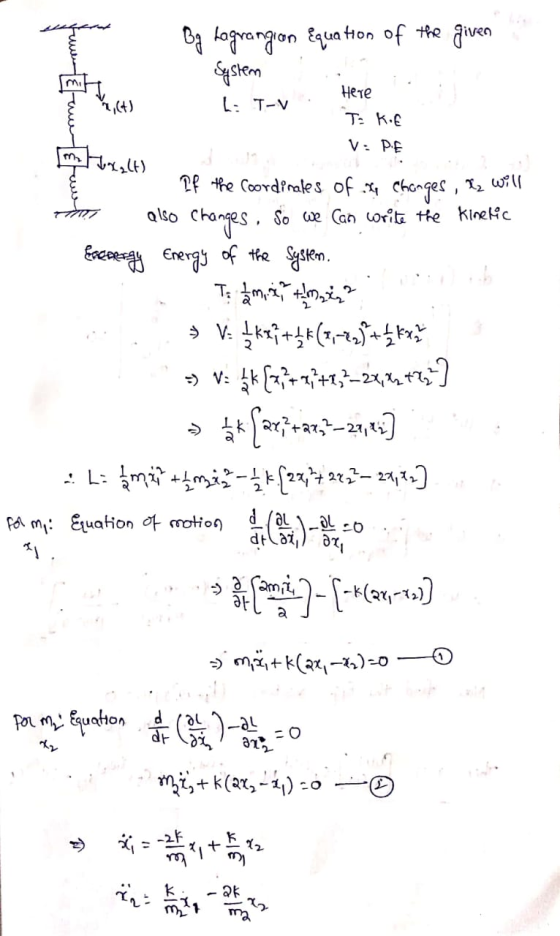
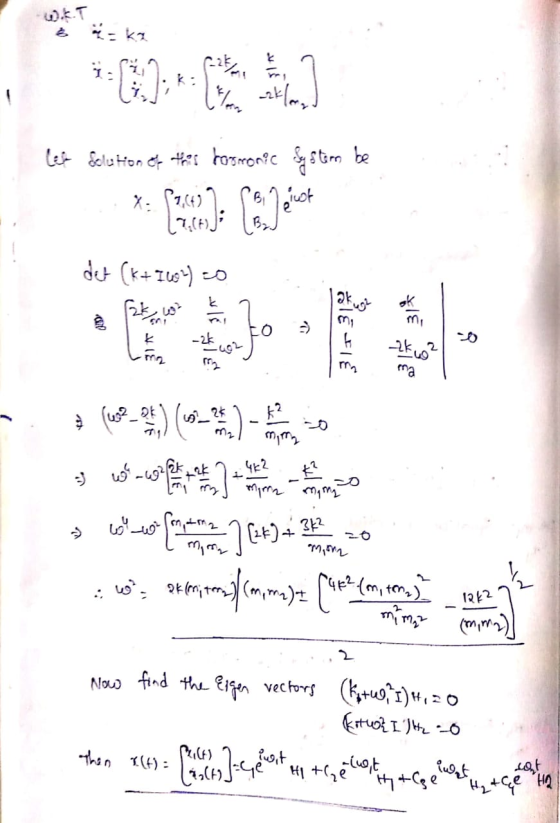
Add Answer to:
If mass m1 is displaced 1 in. from its static equilibrium
position and released, determine the...
Here we consider the two masses m1 and m2 connected this time by springs of stiffnesses...
 Here we consider the two masses m1 and m2 connected this time by
springs of stiffnesses k1, k2 and k3 as shown in the figure below.
The movement of each of the 2 masses relative to its position of
static equilibrium is designated by x1(t) and x2(t).
1. Demonstrate that the differential equation whose unknown is
the displacement x1(t) is written as follows:
2. Determine the second differential equation whose unknown is
the displacement x2(t).
3. Determine the free oscillatory...
Here we consider the two masses m1 and m2 connected this time by
springs of stiffnesses k1, k2 and k3 as shown in the figure below.
The movement of each of the 2 masses relative to its position of
static equilibrium is designated by x1(t) and x2(t).
1. Demonstrate that the differential equation whose unknown is
the displacement x1(t) is written as follows:
2. Determine the second differential equation whose unknown is
the displacement x2(t).
3. Determine the free oscillatory...
We consider here, the two masses m1 and m2 connected this time by springs of stiffnesses...
 We consider here, the two masses m1 and m2 connected this time
by springs of stiffnesses k1, k2 and k3 as shown in the figure
below. We denote x1 (t) and x2 (t) as the movement of each of the 2
masses relative to its position of equilibrium static.
1) Prove that the differential equation whose unknown is the displacement is written in the following form:
2) Deduce the second differential equation whose unknown is the
displacement
3) Determine the...
We consider here, the two masses m1 and m2 connected this time
by springs of stiffnesses k1, k2 and k3 as shown in the figure
below. We denote x1 (t) and x2 (t) as the movement of each of the 2
masses relative to its position of equilibrium static.
1) Prove that the differential equation whose unknown is the displacement is written in the following form:
2) Deduce the second differential equation whose unknown is the
displacement
3) Determine the...
We consider here, the two masses m1 and m2 connected this time by springs of stiffnesses...
 We consider here, the two masses m1 and m2
connected this time by springs of stiffnesses k1,
k2 and k3 as shown in the figure below. We
denote by x1(t) and x2(t) the movement of
each of the 2 masses relative to its position of equilibrium
static.
1. Prove that the differential equation whose unknown is the
displacement x1(t) is written in the following form: (3
points)
2. Deduce the second differential equation whose unknown is the
displacement x2(t) (3...
We consider here, the two masses m1 and m2
connected this time by springs of stiffnesses k1,
k2 and k3 as shown in the figure below. We
denote by x1(t) and x2(t) the movement of
each of the 2 masses relative to its position of equilibrium
static.
1. Prove that the differential equation whose unknown is the
displacement x1(t) is written in the following form: (3
points)
2. Deduce the second differential equation whose unknown is the
displacement x2(t) (3...
Differentiel equations We consider here, the two masses m1 and m2 connected this time by springs...
 Differentiel equations
We consider here, the two masses m1 and m2 connected this time
by springs of stiffnesses k1, k2 and k3 as indicated in the figure
below. We denote by x1 (t) and x2 (t) the movement of each of the 2
masses relative to its static equilibrium position.
1. Prove that the differential equation whose unknown is the
displacement x1 (t) is written in the following form:
2. Deduce the second differential equation whose unknown is the
displacement...
Differentiel equations
We consider here, the two masses m1 and m2 connected this time
by springs of stiffnesses k1, k2 and k3 as indicated in the figure
below. We denote by x1 (t) and x2 (t) the movement of each of the 2
masses relative to its static equilibrium position.
1. Prove that the differential equation whose unknown is the
displacement x1 (t) is written in the following form:
2. Deduce the second differential equation whose unknown is the
displacement...
The slider of mass m1 is released from rest in the position shown and then slides...
 The slider of mass m1 is released from rest in the position shown and then slides down the right side of the contoured body of mass m2. For the conditions m1-0.69 kg, m2 = 3.32 kg and r = 0.52 m, determine the absolute velocities of both masses at the instant of separation. Velocities are positive if to the right, negative if to the left. Neglect friction. n1 mg Answers: v1 = m/s V2 m/s
A mass of 0.3 kg is suspended from a spring of stiffness 200 Nm–1 . The mass is displaced by 10 mm from its equilibrium...
 A mass of 0.3 kg is suspended from a spring of stiffness 200
Nm–1 . The mass is displaced by 10 mm from its equilibrium position
and released, as shown in Figure 1. For the resulting vibration,
calculate:
(a) (i)
the frequency of vibration;
(ii) the maximum velocity of the mass during the vibration;
(iii) the maximum acceleration of the mass during the
vibration;
(iv) the mass required to produce double the maximum
velocity
calculated in (ii) using the same...
A mass of 0.3 kg is suspended from a spring of stiffness 200
Nm–1 . The mass is displaced by 10 mm from its equilibrium position
and released, as shown in Figure 1. For the resulting vibration,
calculate:
(a) (i)
the frequency of vibration;
(ii) the maximum velocity of the mass during the vibration;
(iii) the maximum acceleration of the mass during the
vibration;
(iv) the mass required to produce double the maximum
velocity
calculated in (ii) using the same...
We consider 2 coupled harmonic oscillators, as shown in the diagram below. The mass m1 is...
 We consider 2 coupled harmonic oscillators, as shown in the
diagram below.
The mass m1 is subjected to an external force F (t).
1. Construct the system of differential equations whose unknowns
are the displacements x1 (t) and x2 (t) of each of the 2 masses. (5
points).
2. Solve x1(t) and x2(t) in the case where
m1 = 1kg; m2 = 2kg; k = 1 N / m; F(t) = 0 and
x1(0) = 0; ?1′(0) = 0; x2(0)...
We consider 2 coupled harmonic oscillators, as shown in the
diagram below.
The mass m1 is subjected to an external force F (t).
1. Construct the system of differential equations whose unknowns
are the displacements x1 (t) and x2 (t) of each of the 2 masses. (5
points).
2. Solve x1(t) and x2(t) in the case where
m1 = 1kg; m2 = 2kg; k = 1 N / m; F(t) = 0 and
x1(0) = 0; ?1′(0) = 0; x2(0)...
We consider 2 coupled harmonic oscillators, as shown in the diagram below The mass m1 is...
 We consider 2 coupled harmonic oscillators, as shown in the
diagram below
The mass m1 is subjected to an external force F(t).
1) Construct the system of differential equations whose unknowns
are the displacements x1 (t) and x2 (t) of each of the 2
masses.
2) Solve x1 (t) and x2 (t) in the case where m1 = 1kg; m2 = 2kg;
k = 1 N / m; F (t) = 0 and x1 (0) = 0; ?1′ (0) =...
We consider 2 coupled harmonic oscillators, as shown in the
diagram below
The mass m1 is subjected to an external force F(t).
1) Construct the system of differential equations whose unknowns
are the displacements x1 (t) and x2 (t) of each of the 2
masses.
2) Solve x1 (t) and x2 (t) in the case where m1 = 1kg; m2 = 2kg;
k = 1 N / m; F (t) = 0 and x1 (0) = 0; ?1′ (0) =...
centroidal radius of gyration 750mm. If point C is pushed 5) The 3kg arm ABC with center of mass G has a down 3mm from its equilibrium position and released from rest (a) Determine the frequency...
 centroidal radius of gyration 750mm. If point C is pushed 5) The 3kg arm ABC with center of mass G has a down 3mm from its equilibrium position and released from rest (a) Determine the frequency of the resulting oscillation k 50 N/m 500 mm k50 N/m 500 mn -900 min-
centroidal radius of gyration 750mm. If point C is pushed 5) The 3kg arm ABC with center of mass G has a down 3mm from its equilibrium position and...
centroidal radius of gyration 750mm. If point C is pushed 5) The 3kg arm ABC with center of mass G has a down 3mm from its equilibrium position and released from rest (a) Determine the frequency of the resulting oscillation k 50 N/m 500 mm k50 N/m 500 mn -900 min-
centroidal radius of gyration 750mm. If point C is pushed 5) The 3kg arm ABC with center of mass G has a down 3mm from its equilibrium position and...
I can't get part B The cylinder is displaced 0.18 m downward from its equilibrium position...
 I can't get part B
The cylinder is displaced 0.18 m downward from its equilibrium position and is released at time t = 0. Determine the displacement y and the velocity v when t = 2.2 s. The displacement and velocity are positive if downward, negative if upward. What is the magnitude of the maximum acceleration? K= 147 N/m Equilibrium position m = 4.0 kg Answers: When t = 2.2 s: ya 0.129 When t = 2.2 s: V =...
I can't get part B
The cylinder is displaced 0.18 m downward from its equilibrium position and is released at time t = 0. Determine the displacement y and the velocity v when t = 2.2 s. The displacement and velocity are positive if downward, negative if upward. What is the magnitude of the maximum acceleration? K= 147 N/m Equilibrium position m = 4.0 kg Answers: When t = 2.2 s: ya 0.129 When t = 2.2 s: V =...
 Here we consider the two masses m1 and m2 connected this time by
springs of stiffnesses k1, k2 and k3 as shown in the figure below.
The movement of each of the 2 masses relative to its position of
static equilibrium is designated by x1(t) and x2(t).
1. Demonstrate that the differential equation whose unknown is
the displacement x1(t) is written as follows:
2. Determine the second differential equation whose unknown is
the displacement x2(t).
3. Determine the free oscillatory...
Here we consider the two masses m1 and m2 connected this time by
springs of stiffnesses k1, k2 and k3 as shown in the figure below.
The movement of each of the 2 masses relative to its position of
static equilibrium is designated by x1(t) and x2(t).
1. Demonstrate that the differential equation whose unknown is
the displacement x1(t) is written as follows:
2. Determine the second differential equation whose unknown is
the displacement x2(t).
3. Determine the free oscillatory...
 We consider here, the two masses m1 and m2 connected this time
by springs of stiffnesses k1, k2 and k3 as shown in the figure
below. We denote x1 (t) and x2 (t) as the movement of each of the 2
masses relative to its position of equilibrium static.
1) Prove that the differential equation whose unknown is the displacement is written in the following form:
2) Deduce the second differential equation whose unknown is the
displacement
3) Determine the...
We consider here, the two masses m1 and m2 connected this time
by springs of stiffnesses k1, k2 and k3 as shown in the figure
below. We denote x1 (t) and x2 (t) as the movement of each of the 2
masses relative to its position of equilibrium static.
1) Prove that the differential equation whose unknown is the displacement is written in the following form:
2) Deduce the second differential equation whose unknown is the
displacement
3) Determine the...
 We consider here, the two masses m1 and m2
connected this time by springs of stiffnesses k1,
k2 and k3 as shown in the figure below. We
denote by x1(t) and x2(t) the movement of
each of the 2 masses relative to its position of equilibrium
static.
1. Prove that the differential equation whose unknown is the
displacement x1(t) is written in the following form: (3
points)
2. Deduce the second differential equation whose unknown is the
displacement x2(t) (3...
We consider here, the two masses m1 and m2
connected this time by springs of stiffnesses k1,
k2 and k3 as shown in the figure below. We
denote by x1(t) and x2(t) the movement of
each of the 2 masses relative to its position of equilibrium
static.
1. Prove that the differential equation whose unknown is the
displacement x1(t) is written in the following form: (3
points)
2. Deduce the second differential equation whose unknown is the
displacement x2(t) (3...
 Differentiel equations
We consider here, the two masses m1 and m2 connected this time
by springs of stiffnesses k1, k2 and k3 as indicated in the figure
below. We denote by x1 (t) and x2 (t) the movement of each of the 2
masses relative to its static equilibrium position.
1. Prove that the differential equation whose unknown is the
displacement x1 (t) is written in the following form:
2. Deduce the second differential equation whose unknown is the
displacement...
Differentiel equations
We consider here, the two masses m1 and m2 connected this time
by springs of stiffnesses k1, k2 and k3 as indicated in the figure
below. We denote by x1 (t) and x2 (t) the movement of each of the 2
masses relative to its static equilibrium position.
1. Prove that the differential equation whose unknown is the
displacement x1 (t) is written in the following form:
2. Deduce the second differential equation whose unknown is the
displacement...
 The slider of mass m1 is released from rest in the position shown and then slides down the right side of the contoured body of mass m2. For the conditions m1-0.69 kg, m2 = 3.32 kg and r = 0.52 m, determine the absolute velocities of both masses at the instant of separation. Velocities are positive if to the right, negative if to the left. Neglect friction. n1 mg Answers: v1 = m/s V2 m/s
 A mass of 0.3 kg is suspended from a spring of stiffness 200
Nm–1 . The mass is displaced by 10 mm from its equilibrium position
and released, as shown in Figure 1. For the resulting vibration,
calculate:
(a) (i)
the frequency of vibration;
(ii) the maximum velocity of the mass during the vibration;
(iii) the maximum acceleration of the mass during the
vibration;
(iv) the mass required to produce double the maximum
velocity
calculated in (ii) using the same...
A mass of 0.3 kg is suspended from a spring of stiffness 200
Nm–1 . The mass is displaced by 10 mm from its equilibrium position
and released, as shown in Figure 1. For the resulting vibration,
calculate:
(a) (i)
the frequency of vibration;
(ii) the maximum velocity of the mass during the vibration;
(iii) the maximum acceleration of the mass during the
vibration;
(iv) the mass required to produce double the maximum
velocity
calculated in (ii) using the same...
 We consider 2 coupled harmonic oscillators, as shown in the
diagram below.
The mass m1 is subjected to an external force F (t).
1. Construct the system of differential equations whose unknowns
are the displacements x1 (t) and x2 (t) of each of the 2 masses. (5
points).
2. Solve x1(t) and x2(t) in the case where
m1 = 1kg; m2 = 2kg; k = 1 N / m; F(t) = 0 and
x1(0) = 0; ?1′(0) = 0; x2(0)...
We consider 2 coupled harmonic oscillators, as shown in the
diagram below.
The mass m1 is subjected to an external force F (t).
1. Construct the system of differential equations whose unknowns
are the displacements x1 (t) and x2 (t) of each of the 2 masses. (5
points).
2. Solve x1(t) and x2(t) in the case where
m1 = 1kg; m2 = 2kg; k = 1 N / m; F(t) = 0 and
x1(0) = 0; ?1′(0) = 0; x2(0)...
 We consider 2 coupled harmonic oscillators, as shown in the
diagram below
The mass m1 is subjected to an external force F(t).
1) Construct the system of differential equations whose unknowns
are the displacements x1 (t) and x2 (t) of each of the 2
masses.
2) Solve x1 (t) and x2 (t) in the case where m1 = 1kg; m2 = 2kg;
k = 1 N / m; F (t) = 0 and x1 (0) = 0; ?1′ (0) =...
We consider 2 coupled harmonic oscillators, as shown in the
diagram below
The mass m1 is subjected to an external force F(t).
1) Construct the system of differential equations whose unknowns
are the displacements x1 (t) and x2 (t) of each of the 2
masses.
2) Solve x1 (t) and x2 (t) in the case where m1 = 1kg; m2 = 2kg;
k = 1 N / m; F (t) = 0 and x1 (0) = 0; ?1′ (0) =...
 centroidal radius of gyration 750mm. If point C is pushed 5) The 3kg arm ABC with center of mass G has a down 3mm from its equilibrium position and released from rest (a) Determine the frequency of the resulting oscillation k 50 N/m 500 mm k50 N/m 500 mn -900 min-
centroidal radius of gyration 750mm. If point C is pushed 5) The 3kg arm ABC with center of mass G has a down 3mm from its equilibrium position and...
centroidal radius of gyration 750mm. If point C is pushed 5) The 3kg arm ABC with center of mass G has a down 3mm from its equilibrium position and released from rest (a) Determine the frequency of the resulting oscillation k 50 N/m 500 mm k50 N/m 500 mn -900 min-
centroidal radius of gyration 750mm. If point C is pushed 5) The 3kg arm ABC with center of mass G has a down 3mm from its equilibrium position and...
 I can't get part B
The cylinder is displaced 0.18 m downward from its equilibrium position and is released at time t = 0. Determine the displacement y and the velocity v when t = 2.2 s. The displacement and velocity are positive if downward, negative if upward. What is the magnitude of the maximum acceleration? K= 147 N/m Equilibrium position m = 4.0 kg Answers: When t = 2.2 s: ya 0.129 When t = 2.2 s: V =...
I can't get part B
The cylinder is displaced 0.18 m downward from its equilibrium position and is released at time t = 0. Determine the displacement y and the velocity v when t = 2.2 s. The displacement and velocity are positive if downward, negative if upward. What is the magnitude of the maximum acceleration? K= 147 N/m Equilibrium position m = 4.0 kg Answers: When t = 2.2 s: ya 0.129 When t = 2.2 s: V =...
Most questions answered within 3 hours.
-
Where is the error in this code sequence?
String s1 = "Hello";
String s2 = "ello";...
asked 10 months ago -
Financial data for Joel de Paris, Inc., for last year
follow:
Joel de Paris, Inc.
Balance...
asked 10 months ago -
Consider this reaction:
Al2(SO4)3 (aq)+ BaCl3
(aq) Al2Cl6 (aq)- +
3BaSO4(s) . What is the...
asked 10 months ago -
Suppose that Savneet is considering increasing her
recent random sample from 20 car rentals to 40...
asked 10 months ago -
Trucks arrive at an unloading terminal at an average rate of 120
per hour.
Trucks arrive...
asked 10 months ago -
Why are methanol and ethanol completely soluble in water while
octanol is not very little soluble....
asked 10 months ago -
A facilities manager at a university reads in a research report
that the mean amount of...
asked 10 months ago -
When the CuSO4 is rehydrated by adding water to the anhydrous
compound, is this an endothermic...
asked 10 months ago -
A ray of sunlight is passing from diamond into crown glass; the
angle of incidence is...
asked 10 months ago -
A block of mass 0.249 kg is placed on top of a light, vertical
spring of...
asked 10 months ago -
how do the kidneys compensate in the presences of acidosis
a) trigger hyperventilate
b) reserve acid...
asked 10 months ago -
Question 501 pts
The rental rate of capital to the firm increases. Which of the
following...
asked 10 months ago