
Homework Answers
Add Answer to:
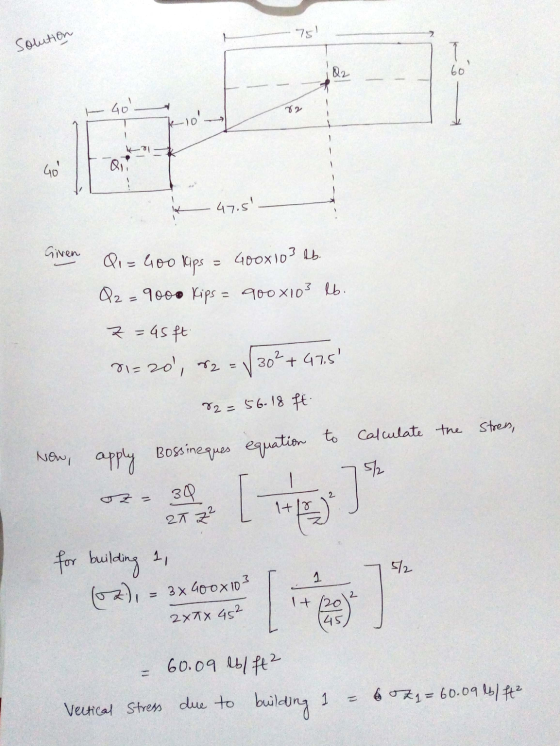
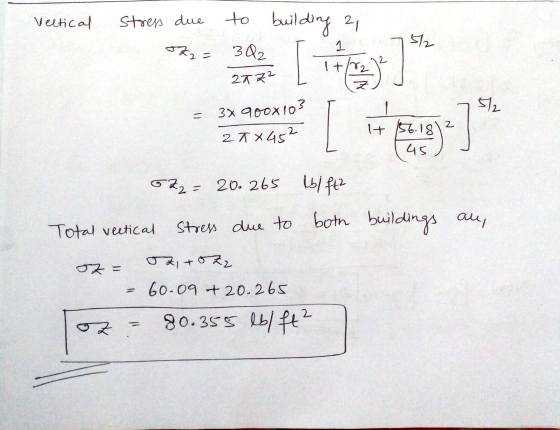
Problem 3 (20 polnts: Two buildings are constructed at the same elevation. Building No. 1 has...
8. a. Moist sand having a unit weight of 18.60 kN/m' is to be excavated to a depth of 5 m to acco...
 8. a. Moist sand having a unit weight of 18.60 kN/m' is to be excavated to a depth of 5 m to accommodate the basement of a rectangular building that is 58 m long by 38 m wide. Find the reduction in vertical stress under one corner of the building at a depth of 15 m below the original ground surface (10 m below the bottom of the excavation) that is caused by the excavation of the sand. Use Fig....
Question 4 5 pts The building has beams along building lines A through E and one-way slabs spanning between building li...
 Question 4 5 pts The building has beams along building lines A through E and one-way slabs spanning between building lines A through E. A central stalrwell/elevator shaft between bulding lines 5 and 6 provides the lateral support, so only gravity loads need to be calculated The building is used for general affice space. The slab is 8 in. thick. The beams are 12 in. wide and have a total depth of 18 in., the bay dimensions are 18.5 ft...
Problem 3: (45 points) A square foundation was decided to be constructed to support the load...
 Problem 3: (45 points) A square foundation was decided to be constructed to support the load of a column in a residential building construction project located in Claremont, CA. During the site investigation, only sandy soil (c'=0) was encountered. The ground water was observed at the depth 1.2m from ground level. Obtained samples were tested in the lab and the internal friction angle of the soil was found to be equal to 30°. The unit weight of the soil above...
Problem 3: 40 points) A square foundation was decided to be constructed to support the load...
 Problem 3: 40 points) A square foundation was decided to be constructed to support the load of a column in a residential building construction project located in Claremont, CA. During the site investigation, only sandy soil (c'= 0) was encountered. The ground water was observed at the depth 1.2m from ground level. Obtained samples were tested in the lab and the internal friction angle of the soil was found to be equal to 30°. The unit weight of the soil...
Problem 5 You are to examine the retaining wall shown on Figure 2. Assume that the wall height (H...
 Problem 5 You are to examine the retaining wall shown on Figure 2. Assume that the wall height (H) is equal to 12 feet, and the base width (B) is 7 feet. The wall will be approximately 200 feet long (into the page). The backfill material behind the wall is a poorly-graded sand with silt (ŚP-SM) that has an average total unit weight of 1 19 pounds per cubic foot (pcf) and an average water content of 12%. As indicated,...
Problem 1 (25 Points) Two solid steel (6-80 GPa) shafts are connected by the gears shown. Shaft (1) has a diameter of 45 mm, and shaft (2) has an outside diameter of 55 mm and wall thickness 4 mm...
 Problem 1 (25 Points) Two solid steel (6-80 GPa) shafts are connected by the gears shown. Shaft (1) has a diameter of 45 mm, and shaft (2) has an outside diameter of 55 mm and wall thickness 4 mm. Assume that the bearings shown allow free rotation of the shafts. If a 400 N-m torque is applied at gear D, determine (a) the maximum shear stress magnitudes in each shaft. (b) the angles of twist ф, and ф (c) the...
How do I solve this? Problem 2(50 points) The roof of the Edwin A. Stevens building...
 How
do I solve this?
Problem 2(50 points) The roof of the Edwin A. Stevens building is to be redesigned to accommodate a billboard for Stevens Institute of Technology. The new billboard will weigh 40 kips and be supported equally by two columns located 9 ft from the rear of the building. The beams supporting the new roof will be simply supported as shown. (Note there is a 5 ft overhang at the front of the building). For the grade...
How
do I solve this?
Problem 2(50 points) The roof of the Edwin A. Stevens building is to be redesigned to accommodate a billboard for Stevens Institute of Technology. The new billboard will weigh 40 kips and be supported equally by two columns located 9 ft from the rear of the building. The beams supporting the new roof will be simply supported as shown. (Note there is a 5 ft overhang at the front of the building). For the grade...
1. Two metal beams are joined together by four rivets, Each rivet has a radius of...
1. Two metal beams are joined together by four rivets, Each rivet has a radius of 5.0*10^-3m and is to be exposed to a shearing stress of no more than 5.0*10^8. What is the maximum tension that can be applied to each beam, assuming that each rivet carries 1/4 the total load? 2. a 0.50 kg ball is attached to one end of an aluminum wire that has a diameter of 1.6mm and an unstretched length of 0.80 m. The...
Problem 1 (15vpts) A proposed highway has two tangents of bearings N 75° 54' 36" E...
 Problem 1 (15vpts) A proposed highway has two tangents of bearings N 75° 54' 36" E and N 53° 22' 30" W. The highway design engineer, attempting to obtain the best fit for the simple circular curve to join these tangents, decides that the external ordinate is to be 78.00 ft. The Pl is at station 65+43.21. Determine: (a) The external angle of the curve (A) (b) The radius of the curve (d) The station of the PC (f) The...
Problem 3. Assume that the house is 9 feet tall, has pipe size of 20 in....
 Problem 3. Assume that the house is 9 feet tall, has pipe size of 20 in. and post height is 40 ft. See the chart below for the cross-sectional properties of your pipe. Assume a wind pressure of 30 psf. a. Calculate the force/foot of pipe by multiplying the wind pressure by the diameter of the pipe. The uniform load is 1200 on the pipe in lb/ft. b. Calculate the resultant force caused by the wind on the house. Treat...
 8. a. Moist sand having a unit weight of 18.60 kN/m' is to be excavated to a depth of 5 m to accommodate the basement of a rectangular building that is 58 m long by 38 m wide. Find the reduction in vertical stress under one corner of the building at a depth of 15 m below the original ground surface (10 m below the bottom of the excavation) that is caused by the excavation of the sand. Use Fig....
 Question 4 5 pts The building has beams along building lines A through E and one-way slabs spanning between building lines A through E. A central stalrwell/elevator shaft between bulding lines 5 and 6 provides the lateral support, so only gravity loads need to be calculated The building is used for general affice space. The slab is 8 in. thick. The beams are 12 in. wide and have a total depth of 18 in., the bay dimensions are 18.5 ft...
 Problem 3: (45 points) A square foundation was decided to be constructed to support the load of a column in a residential building construction project located in Claremont, CA. During the site investigation, only sandy soil (c'=0) was encountered. The ground water was observed at the depth 1.2m from ground level. Obtained samples were tested in the lab and the internal friction angle of the soil was found to be equal to 30°. The unit weight of the soil above...
 Problem 3: 40 points) A square foundation was decided to be constructed to support the load of a column in a residential building construction project located in Claremont, CA. During the site investigation, only sandy soil (c'= 0) was encountered. The ground water was observed at the depth 1.2m from ground level. Obtained samples were tested in the lab and the internal friction angle of the soil was found to be equal to 30°. The unit weight of the soil...
 Problem 5 You are to examine the retaining wall shown on Figure 2. Assume that the wall height (H) is equal to 12 feet, and the base width (B) is 7 feet. The wall will be approximately 200 feet long (into the page). The backfill material behind the wall is a poorly-graded sand with silt (ŚP-SM) that has an average total unit weight of 1 19 pounds per cubic foot (pcf) and an average water content of 12%. As indicated,...
 Problem 1 (25 Points) Two solid steel (6-80 GPa) shafts are connected by the gears shown. Shaft (1) has a diameter of 45 mm, and shaft (2) has an outside diameter of 55 mm and wall thickness 4 mm. Assume that the bearings shown allow free rotation of the shafts. If a 400 N-m torque is applied at gear D, determine (a) the maximum shear stress magnitudes in each shaft. (b) the angles of twist ф, and ф (c) the...
 How
do I solve this?
Problem 2(50 points) The roof of the Edwin A. Stevens building is to be redesigned to accommodate a billboard for Stevens Institute of Technology. The new billboard will weigh 40 kips and be supported equally by two columns located 9 ft from the rear of the building. The beams supporting the new roof will be simply supported as shown. (Note there is a 5 ft overhang at the front of the building). For the grade...
How
do I solve this?
Problem 2(50 points) The roof of the Edwin A. Stevens building is to be redesigned to accommodate a billboard for Stevens Institute of Technology. The new billboard will weigh 40 kips and be supported equally by two columns located 9 ft from the rear of the building. The beams supporting the new roof will be simply supported as shown. (Note there is a 5 ft overhang at the front of the building). For the grade...
 Problem 1 (15vpts) A proposed highway has two tangents of bearings N 75° 54' 36" E and N 53° 22' 30" W. The highway design engineer, attempting to obtain the best fit for the simple circular curve to join these tangents, decides that the external ordinate is to be 78.00 ft. The Pl is at station 65+43.21. Determine: (a) The external angle of the curve (A) (b) The radius of the curve (d) The station of the PC (f) The...
 Problem 3. Assume that the house is 9 feet tall, has pipe size of 20 in. and post height is 40 ft. See the chart below for the cross-sectional properties of your pipe. Assume a wind pressure of 30 psf. a. Calculate the force/foot of pipe by multiplying the wind pressure by the diameter of the pipe. The uniform load is 1200 on the pipe in lb/ft. b. Calculate the resultant force caused by the wind on the house. Treat...
Most questions answered within 3 hours.
-
Where is the error in this code sequence?
String s1 = "Hello";
String s2 = "ello";...
asked 10 months ago -
Financial data for Joel de Paris, Inc., for last year
follow:
Joel de Paris, Inc.
Balance...
asked 10 months ago -
Consider this reaction:
Al2(SO4)3 (aq)+ BaCl3
(aq) Al2Cl6 (aq)- +
3BaSO4(s) . What is the...
asked 10 months ago -
Suppose that Savneet is considering increasing her
recent random sample from 20 car rentals to 40...
asked 10 months ago -
Trucks arrive at an unloading terminal at an average rate of 120
per hour.
Trucks arrive...
asked 10 months ago -
Why are methanol and ethanol completely soluble in water while
octanol is not very little soluble....
asked 10 months ago -
A facilities manager at a university reads in a research report
that the mean amount of...
asked 10 months ago -
When the CuSO4 is rehydrated by adding water to the anhydrous
compound, is this an endothermic...
asked 10 months ago -
A ray of sunlight is passing from diamond into crown glass; the
angle of incidence is...
asked 10 months ago -
A block of mass 0.249 kg is placed on top of a light, vertical
spring of...
asked 10 months ago -
how do the kidneys compensate in the presences of acidosis
a) trigger hyperventilate
b) reserve acid...
asked 10 months ago -
Question 501 pts
The rental rate of capital to the firm increases. Which of the
following...
asked 10 months ago