Using the values, cos(1.10000) = 0.453598 and cos(1.30000) = 0.267502
Using the values, cos(1.10000) = 0.453598 and cos(1.30000) = 0.267502, find an approximate value of cos(1.25000) using Lagrange Interpolation.
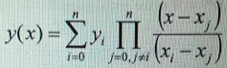
The recipe for Lagrange Interpolation to fit an nth order polynomial to n+1 data points is:
Homework Answers


Add Answer to:
Using the values, cos(1.10000) = 0.453598 and cos(1.30000) = 0.267502
a) Find False Position function for this data. b) Find the third-order interpolation function with Lagrange...
 a) Find False Position function for this data.
b) Find the third-order interpolation function with Lagrange
method
c) Find the third-order interpolation function with Newton's
Divided Difference Method.
d)Find the natural spline interpolation function for the same
data
e)Draw the given points in a row using the False Position
function, the third order polynomial obtained by Lagrange and
Newton's Divided Difference Method, and the natural spline
interpolation function using MATLAB.
4-0 2
a) Find False Position function for this data.
b) Find the third-order interpolation function with Lagrange
method
c) Find the third-order interpolation function with Newton's
Divided Difference Method.
d)Find the natural spline interpolation function for the same
data
e)Draw the given points in a row using the False Position
function, the third order polynomial obtained by Lagrange and
Newton's Divided Difference Method, and the natural spline
interpolation function using MATLAB.
4-0 2
4. For the following table, answer the questions. (1) Find the cubic Newton’s interpolating polynomial using...
 4. For the following table, answer the questions.
(1) Find the cubic Newton’s interpolating polynomial using the
first four data points and estimate the function value at x=2.5
with the interpolating polynomial.
(2) Find the quartic Newton’s interpolating polynomial using the
five data points and estimate the function value at x=2.5 with the
interpolating polynomial.
(3) Find the bases functions of Lagrange interpolation, Li(x)
(i=1,2,…,5), and estimate the function value at x=2.5 with the
Lagrange interpolating polynomial.
3 5 1...
4. For the following table, answer the questions.
(1) Find the cubic Newton’s interpolating polynomial using the
first four data points and estimate the function value at x=2.5
with the interpolating polynomial.
(2) Find the quartic Newton’s interpolating polynomial using the
five data points and estimate the function value at x=2.5 with the
interpolating polynomial.
(3) Find the bases functions of Lagrange interpolation, Li(x)
(i=1,2,…,5), and estimate the function value at x=2.5 with the
Lagrange interpolating polynomial.
3 5 1...
I'm not allowed to use polyfit or polyval functions. The hint the homework gives is setting...
 I'm not allowed to use polyfit or polyval functions.
The hint the homework gives is setting up a linear system for
the polynomial coefficients and solving it.
The test case x = [1,2,3,4]
y = [5,-2,3,0]
x_dot = [1.5,2.5]
should result in
y_dot = -1.2500 0.2500
p = -3.333 26.0000 -61.6667 44.0000
Thanks to anyone who can answer this within the next day or
so!
1 Interpolation methods 1.1 The Lagrange polynomial function (y dot,p] = my Lagrange (x, y,x_dot)...
I'm not allowed to use polyfit or polyval functions.
The hint the homework gives is setting up a linear system for
the polynomial coefficients and solving it.
The test case x = [1,2,3,4]
y = [5,-2,3,0]
x_dot = [1.5,2.5]
should result in
y_dot = -1.2500 0.2500
p = -3.333 26.0000 -61.6667 44.0000
Thanks to anyone who can answer this within the next day or
so!
1 Interpolation methods 1.1 The Lagrange polynomial function (y dot,p] = my Lagrange (x, y,x_dot)...
IN MATLAB Write a MATLAB function that can be used by a user to perform polynomial...
 IN MATLAB
Write a MATLAB function that can be used by a user to perform polynomial interpolation using Lagrange Interpolation Method on a set of data. You should name your function as YourInitials_Lagrange_interpolation. 1. FUNCTION INPUT: . The input data pairs x and f(x) should be expressed as vectors and are used to construct the interpolation polynomials The interpolating data points/value The order of interpolating polynomials to be used. For this project you code should handle first order, second order...
IN MATLAB
Write a MATLAB function that can be used by a user to perform polynomial interpolation using Lagrange Interpolation Method on a set of data. You should name your function as YourInitials_Lagrange_interpolation. 1. FUNCTION INPUT: . The input data pairs x and f(x) should be expressed as vectors and are used to construct the interpolation polynomials The interpolating data points/value The order of interpolating polynomials to be used. For this project you code should handle first order, second order...
For an nth-order Newton's divided difference interpolating polynomial fn(x), the error of interpolation can be estimated by Rn-| g(xmPX, , xm» ,&J . (x-x-Xx-x.) . . . (x-x.) | , where (xo, f(...
 For an nth-order Newton's divided difference interpolating polynomial fn(x), the error of interpolation can be estimated by Rn-| g(xmPX, , xm» ,&J . (x-x-Xx-x.) . . . (x-x.) | , where (xo, f(xo)), (xi, fx)).., (Xn-1, f(xn-1) are data points; g[x-,x,,x-.., x,] is the (n+1)-th finite divided difference. To minimize Rn, if there are more than n+1 data points available for calculating fn(x) using the nth-order Newton's interpolating polynomial, n+1 data points (Xo, f(xo)), (x1, f(x)), , (in, f(%)) should...
Using the Excel, fit a second-order polynomial to the data in Table Q2. Using the MATLAB. findfX)...
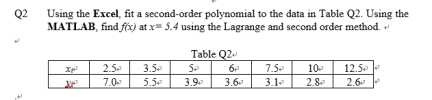 Using the Excel, fit a second-order polynomial to the data in Table Q2. Using the MATLAB. findfX) at x= 5.4 using the Lagrange and second order method. + Q2 Table Q2 2.5-| 3.5-| 5+' | 6' | 7.5-1 1001 12.5-1+' Vie | 70+ | 5.5- ו3.9 '| 3.6e | 3.1-וכ2.8 -וכ2.6 -וכ+'
Using the Excel, fit a second-order polynomial to the data in Table Q2. Using the MATLAB. findfX) at x= 5.4 using the Lagrange and second order method. +...
Using the Excel, fit a second-order polynomial to the data in Table Q2. Using the MATLAB. findfX) at x= 5.4 using the Lagrange and second order method. + Q2 Table Q2 2.5-| 3.5-| 5+' | 6' | 7.5-1 1001 12.5-1+' Vie | 70+ | 5.5- ו3.9 '| 3.6e | 3.1-וכ2.8 -וכ2.6 -וכ+'
Using the Excel, fit a second-order polynomial to the data in Table Q2. Using the MATLAB. findfX) at x= 5.4 using the Lagrange and second order method. +...
**********************matlab code please******************* 1. Interpolation error of polynomial fit Using 11 equi-dist...
 **********************matlab code please*******************
1. Interpolation error of polynomial fit Using 11 equi-distributed points (10 equal segments) in the interval [-1 1], Using Newton's form find and plot the interpolating polynomial p(x) for the function f(x) -1/(125x2). Comment on the large discrepancies between p(x) and the function f(x) that the data came from Write down an expression for the error in the interpolating polynomial above? Which part of the expression is responsible for the large errors observed?
1. Interpolation error of...
**********************matlab code please*******************
1. Interpolation error of polynomial fit Using 11 equi-distributed points (10 equal segments) in the interval [-1 1], Using Newton's form find and plot the interpolating polynomial p(x) for the function f(x) -1/(125x2). Comment on the large discrepancies between p(x) and the function f(x) that the data came from Write down an expression for the error in the interpolating polynomial above? Which part of the expression is responsible for the large errors observed?
1. Interpolation error of...
1. (Taylor Polynomial for cos(ax)) For f(x)cos(ar) do the following. (a) Find the Taylor polynomials T(x) about 0 for f...
 1. (Taylor Polynomial for cos(ax)) For f(x)cos(ar) do the following. (a) Find the Taylor polynomials T(x) about 0 for f(x) for n 1,2,3,4,5 (b) Based on the pattern in part (a), if n is an even number what is the relation between Tn (x) and TR+1()? (c) You might want to approximate cos(az) for all in 0 xS /2 by a Taylor polynomial about 0. Use the Taylor polynomial of order 3 to approximate f(0.25) when a -2, i.e. f(x)...
Hide email Problem 5 (10 points): For the data below, perform Newton Divided Difference interpola...
 Please solve problem 7 not 5. however you need data from problem 5
to slove problem 7
Hide email Problem 5 (10 points): For the data below, perform Newton Divided Difference interpolation of fC7.5 C) using first through third order interpolating polynomial:s for f viscosity of water 1000 in metric (MKS) units. Choose thexi interpolation points to provide the most accurate interpolation (points should most closely surround x = 7.5 C). 040 y i 1.781 | İ .568 | 1...
Please solve problem 7 not 5. however you need data from problem 5
to slove problem 7
Hide email Problem 5 (10 points): For the data below, perform Newton Divided Difference interpolation of fC7.5 C) using first through third order interpolating polynomial:s for f viscosity of water 1000 in metric (MKS) units. Choose thexi interpolation points to provide the most accurate interpolation (points should most closely surround x = 7.5 C). 040 y i 1.781 | İ .568 | 1...
1. Using the Lagrange interpolation polynomial, estimate the value of f(4), knowing that f(-1) = 2;...
 1. Using the Lagrange interpolation polynomial, estimate the value of f(4), knowing that f(-1) = 2; f(0) = 0; f(3) = 4 and f (7) = 7. (6 points)
 a) Find False Position function for this data.
b) Find the third-order interpolation function with Lagrange
method
c) Find the third-order interpolation function with Newton's
Divided Difference Method.
d)Find the natural spline interpolation function for the same
data
e)Draw the given points in a row using the False Position
function, the third order polynomial obtained by Lagrange and
Newton's Divided Difference Method, and the natural spline
interpolation function using MATLAB.
4-0 2
a) Find False Position function for this data.
b) Find the third-order interpolation function with Lagrange
method
c) Find the third-order interpolation function with Newton's
Divided Difference Method.
d)Find the natural spline interpolation function for the same
data
e)Draw the given points in a row using the False Position
function, the third order polynomial obtained by Lagrange and
Newton's Divided Difference Method, and the natural spline
interpolation function using MATLAB.
4-0 2
 4. For the following table, answer the questions.
(1) Find the cubic Newton’s interpolating polynomial using the
first four data points and estimate the function value at x=2.5
with the interpolating polynomial.
(2) Find the quartic Newton’s interpolating polynomial using the
five data points and estimate the function value at x=2.5 with the
interpolating polynomial.
(3) Find the bases functions of Lagrange interpolation, Li(x)
(i=1,2,…,5), and estimate the function value at x=2.5 with the
Lagrange interpolating polynomial.
3 5 1...
4. For the following table, answer the questions.
(1) Find the cubic Newton’s interpolating polynomial using the
first four data points and estimate the function value at x=2.5
with the interpolating polynomial.
(2) Find the quartic Newton’s interpolating polynomial using the
five data points and estimate the function value at x=2.5 with the
interpolating polynomial.
(3) Find the bases functions of Lagrange interpolation, Li(x)
(i=1,2,…,5), and estimate the function value at x=2.5 with the
Lagrange interpolating polynomial.
3 5 1...
 I'm not allowed to use polyfit or polyval functions.
The hint the homework gives is setting up a linear system for
the polynomial coefficients and solving it.
The test case x = [1,2,3,4]
y = [5,-2,3,0]
x_dot = [1.5,2.5]
should result in
y_dot = -1.2500 0.2500
p = -3.333 26.0000 -61.6667 44.0000
Thanks to anyone who can answer this within the next day or
so!
1 Interpolation methods 1.1 The Lagrange polynomial function (y dot,p] = my Lagrange (x, y,x_dot)...
I'm not allowed to use polyfit or polyval functions.
The hint the homework gives is setting up a linear system for
the polynomial coefficients and solving it.
The test case x = [1,2,3,4]
y = [5,-2,3,0]
x_dot = [1.5,2.5]
should result in
y_dot = -1.2500 0.2500
p = -3.333 26.0000 -61.6667 44.0000
Thanks to anyone who can answer this within the next day or
so!
1 Interpolation methods 1.1 The Lagrange polynomial function (y dot,p] = my Lagrange (x, y,x_dot)...
 IN MATLAB
Write a MATLAB function that can be used by a user to perform polynomial interpolation using Lagrange Interpolation Method on a set of data. You should name your function as YourInitials_Lagrange_interpolation. 1. FUNCTION INPUT: . The input data pairs x and f(x) should be expressed as vectors and are used to construct the interpolation polynomials The interpolating data points/value The order of interpolating polynomials to be used. For this project you code should handle first order, second order...
IN MATLAB
Write a MATLAB function that can be used by a user to perform polynomial interpolation using Lagrange Interpolation Method on a set of data. You should name your function as YourInitials_Lagrange_interpolation. 1. FUNCTION INPUT: . The input data pairs x and f(x) should be expressed as vectors and are used to construct the interpolation polynomials The interpolating data points/value The order of interpolating polynomials to be used. For this project you code should handle first order, second order...
 For an nth-order Newton's divided difference interpolating polynomial fn(x), the error of interpolation can be estimated by Rn-| g(xmPX, , xm» ,&J . (x-x-Xx-x.) . . . (x-x.) | , where (xo, f(xo)), (xi, fx)).., (Xn-1, f(xn-1) are data points; g[x-,x,,x-.., x,] is the (n+1)-th finite divided difference. To minimize Rn, if there are more than n+1 data points available for calculating fn(x) using the nth-order Newton's interpolating polynomial, n+1 data points (Xo, f(xo)), (x1, f(x)), , (in, f(%)) should...
 Using the Excel, fit a second-order polynomial to the data in Table Q2. Using the MATLAB. findfX) at x= 5.4 using the Lagrange and second order method. + Q2 Table Q2 2.5-| 3.5-| 5+' | 6' | 7.5-1 1001 12.5-1+' Vie | 70+ | 5.5- ו3.9 '| 3.6e | 3.1-וכ2.8 -וכ2.6 -וכ+'
Using the Excel, fit a second-order polynomial to the data in Table Q2. Using the MATLAB. findfX) at x= 5.4 using the Lagrange and second order method. +...
Using the Excel, fit a second-order polynomial to the data in Table Q2. Using the MATLAB. findfX) at x= 5.4 using the Lagrange and second order method. + Q2 Table Q2 2.5-| 3.5-| 5+' | 6' | 7.5-1 1001 12.5-1+' Vie | 70+ | 5.5- ו3.9 '| 3.6e | 3.1-וכ2.8 -וכ2.6 -וכ+'
Using the Excel, fit a second-order polynomial to the data in Table Q2. Using the MATLAB. findfX) at x= 5.4 using the Lagrange and second order method. +...
 **********************matlab code please*******************
1. Interpolation error of polynomial fit Using 11 equi-distributed points (10 equal segments) in the interval [-1 1], Using Newton's form find and plot the interpolating polynomial p(x) for the function f(x) -1/(125x2). Comment on the large discrepancies between p(x) and the function f(x) that the data came from Write down an expression for the error in the interpolating polynomial above? Which part of the expression is responsible for the large errors observed?
1. Interpolation error of...
**********************matlab code please*******************
1. Interpolation error of polynomial fit Using 11 equi-distributed points (10 equal segments) in the interval [-1 1], Using Newton's form find and plot the interpolating polynomial p(x) for the function f(x) -1/(125x2). Comment on the large discrepancies between p(x) and the function f(x) that the data came from Write down an expression for the error in the interpolating polynomial above? Which part of the expression is responsible for the large errors observed?
1. Interpolation error of...
 1. (Taylor Polynomial for cos(ax)) For f(x)cos(ar) do the following. (a) Find the Taylor polynomials T(x) about 0 for f(x) for n 1,2,3,4,5 (b) Based on the pattern in part (a), if n is an even number what is the relation between Tn (x) and TR+1()? (c) You might want to approximate cos(az) for all in 0 xS /2 by a Taylor polynomial about 0. Use the Taylor polynomial of order 3 to approximate f(0.25) when a -2, i.e. f(x)...
 Please solve problem 7 not 5. however you need data from problem 5
to slove problem 7
Hide email Problem 5 (10 points): For the data below, perform Newton Divided Difference interpolation of fC7.5 C) using first through third order interpolating polynomial:s for f viscosity of water 1000 in metric (MKS) units. Choose thexi interpolation points to provide the most accurate interpolation (points should most closely surround x = 7.5 C). 040 y i 1.781 | İ .568 | 1...
Please solve problem 7 not 5. however you need data from problem 5
to slove problem 7
Hide email Problem 5 (10 points): For the data below, perform Newton Divided Difference interpolation of fC7.5 C) using first through third order interpolating polynomial:s for f viscosity of water 1000 in metric (MKS) units. Choose thexi interpolation points to provide the most accurate interpolation (points should most closely surround x = 7.5 C). 040 y i 1.781 | İ .568 | 1...
 1. Using the Lagrange interpolation polynomial, estimate the value of f(4), knowing that f(-1) = 2; f(0) = 0; f(3) = 4 and f (7) = 7. (6 points)
Most questions answered within 3 hours.
-
Where is the error in this code sequence?
String s1 = "Hello";
String s2 = "ello";...
asked 10 months ago -
Financial data for Joel de Paris, Inc., for last year
follow:
Joel de Paris, Inc.
Balance...
asked 10 months ago -
Consider this reaction:
Al2(SO4)3 (aq)+ BaCl3
(aq) Al2Cl6 (aq)- +
3BaSO4(s) . What is the...
asked 10 months ago -
Suppose that Savneet is considering increasing her
recent random sample from 20 car rentals to 40...
asked 10 months ago -
Trucks arrive at an unloading terminal at an average rate of 120
per hour.
Trucks arrive...
asked 10 months ago -
Why are methanol and ethanol completely soluble in water while
octanol is not very little soluble....
asked 10 months ago -
A facilities manager at a university reads in a research report
that the mean amount of...
asked 10 months ago -
When the CuSO4 is rehydrated by adding water to the anhydrous
compound, is this an endothermic...
asked 10 months ago -
A ray of sunlight is passing from diamond into crown glass; the
angle of incidence is...
asked 10 months ago -
A block of mass 0.249 kg is placed on top of a light, vertical
spring of...
asked 10 months ago -
how do the kidneys compensate in the presences of acidosis
a) trigger hyperventilate
b) reserve acid...
asked 10 months ago -
Question 501 pts
The rental rate of capital to the firm increases. Which of the
following...
asked 10 months ago