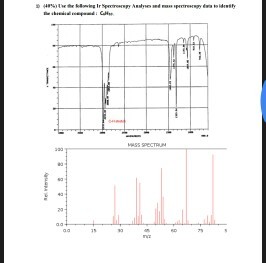
Use the following Ir Spectroscopy Analyses and mass spectroscopy data to identify the chemical compound :...
Use the following Ir Spectroscopy Analyses and mass
spectroscopy data to identify
the chemical compound : C6H10
Homework Answers
C6H10
MW 82
Calculate the degree of unsaturation: the answer is 2. The molecule has two double bonds and/or rings.
The IR spectrum below doesn't show much of interest. We would expect two carbon-carbon double bonds (1680-1640), or one carbon-carbon triple bond (2260-2100). Could it be a ring, or two rings? The C-H stretching vibrations are all under 3000, indicating that there are no hydrogens on a carbon-carbon double bond or on a carbon-carbon triple bond - it is possible that the compound is a internal alkyne.
In 13C NMR spectrum, the compound exhibits six distingushed peaks and which confirms that the compound is hex-1-yne.
Add Answer to:
Use the following Ir Spectroscopy Analyses and mass
spectroscopy data to identify
the chemical compound :...
Identify one major difference between the following pairs of chemical compounds when using IR spectroscopy analysis:...
Identify one major difference between the following pairs of chemical compounds when using IR spectroscopy analysis: a) 1-hexane and cyclohexane. b) 1-propanol and dimethylether. c) pentanal and 2-pentanone .
Using the HNMR, CNMR, IR, and mass spectroscopy given, identify the unknown compound. 7.142 10 9...
 Using the HNMR, CNMR, IR, and mass spectroscopy given, identify
the unknown compound.
7.142 10 9 3 7 6 3 2 BC WAR 2S.b6 HS.7 45. 0 29 200 180 160 140 120 100 80 60 40 200 เ00 4000 2937 841197 41 639 9 t489 86 ほ67 86 100 MS-Nil-9551 80 60 40 20 0 S0 100 150 200 250 300 350
Using the HNMR, CNMR, IR, and mass spectroscopy given, identify
the unknown compound.
7.142 10 9 3 7 6 3 2 BC WAR 2S.b6 HS.7 45. 0 29 200 180 160 140 120 100 80 60 40 200 เ00 4000 2937 841197 41 639 9 t489 86 ほ67 86 100 MS-Nil-9551 80 60 40 20 0 S0 100 150 200 250 300 350
mass spectroscopy and IR
 mass spectroscopy and IR
Question 20. Below are two IR spectra for two chemical compound. One of them is an alcohol and on...
 help please
Question 20. Below are two IR spectra for two chemical compound. One of them is an alcohol and one is an aldehyde. Please assign a correct type of compound for each spectra 60 40 20 4000 3500 3000 2500 20005001000500 Answer A: Part-2 (Mass Spectroscopy Total Points: Total pts Received: 20 Page 4 of 7
Question 20. Below are two IR spectra for two chemical compound. One of them is an alcohol and one is an aldehyde. Please...
help please
Question 20. Below are two IR spectra for two chemical compound. One of them is an alcohol and one is an aldehyde. Please assign a correct type of compound for each spectra 60 40 20 4000 3500 3000 2500 20005001000500 Answer A: Part-2 (Mass Spectroscopy Total Points: Total pts Received: 20 Page 4 of 7
Question 20. Below are two IR spectra for two chemical compound. One of them is an alcohol and one is an aldehyde. Please...
IR Spectroscopy of Aspirin 1. Draw the structure of aspirin and state the chemical name of...
 IR Spectroscopy of Aspirin 1. Draw the structure of aspirin and state the chemical name of aspirin. 2. Indicate the regions (circle and label on your IR spectrum) of your spectrum that correspond to a carbonyl and a hydroxyl functional group. Identify two other regions that correlate with other functional groups/structural features. Indicate these regions on your spectrum (circle and label on your IR spectrum). 3. Use your IR spectrum, melting point data, and FeCly test results to characterize the...
Explain how you would use infrared (IR) spectroscopy to determine if this reaction occurred (Identify a...
 Explain how you would use infrared (IR) spectroscopy to determine if this reaction occurred (Identify a key IR stretch or bend that would appear or disappear that would let you know a reaction occurred. )
How would using IR spectroscopy verify that a compound is oxidized. The compound is 2-heptonal . What IR bands would I l...
How would using IR spectroscopy verify that a compound is oxidized. The compound is 2-heptonal . What IR bands would I look for?
draw chlorination Mechanism faw Yhe chlorinahion mathenism and the other a ketone, is: A) 13C NMR B) 'H NMR C) Mass spectroscopy D IR spectroscopy E) UV/VIS spectroscopy 23. The last step in t...
 draw chlorination Mechanism
faw Yhe chlorinahion mathenism and the other a ketone, is: A) 13C NMR B) 'H NMR C) Mass spectroscopy D IR spectroscopy E) UV/VIS spectroscopy 23. The last step in the chlorination of an aromatic ring is: A) Formation of the Wheland intermediate B) Attack of the benzene ring onto the polarized chlorine molecule C) Lewis acid-Lewis base reaction D) Deprotonation of the Wheland intermediate E) Addition of the chlorine atom to the sp hybridized carbon 24....
draw chlorination Mechanism
faw Yhe chlorinahion mathenism and the other a ketone, is: A) 13C NMR B) 'H NMR C) Mass spectroscopy D IR spectroscopy E) UV/VIS spectroscopy 23. The last step in the chlorination of an aromatic ring is: A) Formation of the Wheland intermediate B) Attack of the benzene ring onto the polarized chlorine molecule C) Lewis acid-Lewis base reaction D) Deprotonation of the Wheland intermediate E) Addition of the chlorine atom to the sp hybridized carbon 24....
Spectroscopy: Choose the compound that matches the IR spectra (V) Part A Choose the compound responsible...
 Spectroscopy: Choose the compound that matches the IR spectra (V) Part A Choose the compound responsible for the IR spectrum shown. wavelength (nn) 55 25 100P 35 45 7 11 12 13 14 15 16 nts 60 40 20 ey 400 3500 2000 IS00 600 1400 1200 s00 600 wanenamber (em Не .co,Me Previous MacBook Air <Homework Chapter 10 Spectroscopy: Choose the compound that matches the IR spectra (V) 6 Нс cOMe н.с O1, CH
1. IR Spectroscopy (IR) a) Describe how you could distinguish between the reactant 2-pentanone an...
 1. IR Spectroscopy (IR) a) Describe how you could distinguish between the reactant 2-pentanone and the product 2-pentanol using IR spectroscopy. Use specific IR absorption bands for each compound that distinguishes it from the other. (3 pts) 1. NaBH 2. HO 2-pentanone b) The IR spectrum of a compound shows a strong and sharp absorption band at 3300 and a medium sharp absorption at 2150 cm-1. Which structure below fits this description? (1 pts) CH CH C CCH CHCH CH...
 Using the HNMR, CNMR, IR, and mass spectroscopy given, identify
the unknown compound.
7.142 10 9 3 7 6 3 2 BC WAR 2S.b6 HS.7 45. 0 29 200 180 160 140 120 100 80 60 40 200 เ00 4000 2937 841197 41 639 9 t489 86 ほ67 86 100 MS-Nil-9551 80 60 40 20 0 S0 100 150 200 250 300 350
Using the HNMR, CNMR, IR, and mass spectroscopy given, identify
the unknown compound.
7.142 10 9 3 7 6 3 2 BC WAR 2S.b6 HS.7 45. 0 29 200 180 160 140 120 100 80 60 40 200 เ00 4000 2937 841197 41 639 9 t489 86 ほ67 86 100 MS-Nil-9551 80 60 40 20 0 S0 100 150 200 250 300 350
 mass spectroscopy and IR
 help please
Question 20. Below are two IR spectra for two chemical compound. One of them is an alcohol and one is an aldehyde. Please assign a correct type of compound for each spectra 60 40 20 4000 3500 3000 2500 20005001000500 Answer A: Part-2 (Mass Spectroscopy Total Points: Total pts Received: 20 Page 4 of 7
Question 20. Below are two IR spectra for two chemical compound. One of them is an alcohol and one is an aldehyde. Please...
help please
Question 20. Below are two IR spectra for two chemical compound. One of them is an alcohol and one is an aldehyde. Please assign a correct type of compound for each spectra 60 40 20 4000 3500 3000 2500 20005001000500 Answer A: Part-2 (Mass Spectroscopy Total Points: Total pts Received: 20 Page 4 of 7
Question 20. Below are two IR spectra for two chemical compound. One of them is an alcohol and one is an aldehyde. Please...
 IR Spectroscopy of Aspirin 1. Draw the structure of aspirin and state the chemical name of aspirin. 2. Indicate the regions (circle and label on your IR spectrum) of your spectrum that correspond to a carbonyl and a hydroxyl functional group. Identify two other regions that correlate with other functional groups/structural features. Indicate these regions on your spectrum (circle and label on your IR spectrum). 3. Use your IR spectrum, melting point data, and FeCly test results to characterize the...
 Explain how you would use infrared (IR) spectroscopy to determine if this reaction occurred (Identify a key IR stretch or bend that would appear or disappear that would let you know a reaction occurred. )
 draw chlorination Mechanism
faw Yhe chlorinahion mathenism and the other a ketone, is: A) 13C NMR B) 'H NMR C) Mass spectroscopy D IR spectroscopy E) UV/VIS spectroscopy 23. The last step in the chlorination of an aromatic ring is: A) Formation of the Wheland intermediate B) Attack of the benzene ring onto the polarized chlorine molecule C) Lewis acid-Lewis base reaction D) Deprotonation of the Wheland intermediate E) Addition of the chlorine atom to the sp hybridized carbon 24....
draw chlorination Mechanism
faw Yhe chlorinahion mathenism and the other a ketone, is: A) 13C NMR B) 'H NMR C) Mass spectroscopy D IR spectroscopy E) UV/VIS spectroscopy 23. The last step in the chlorination of an aromatic ring is: A) Formation of the Wheland intermediate B) Attack of the benzene ring onto the polarized chlorine molecule C) Lewis acid-Lewis base reaction D) Deprotonation of the Wheland intermediate E) Addition of the chlorine atom to the sp hybridized carbon 24....
 Spectroscopy: Choose the compound that matches the IR spectra (V) Part A Choose the compound responsible for the IR spectrum shown. wavelength (nn) 55 25 100P 35 45 7 11 12 13 14 15 16 nts 60 40 20 ey 400 3500 2000 IS00 600 1400 1200 s00 600 wanenamber (em Не .co,Me Previous MacBook Air <Homework Chapter 10 Spectroscopy: Choose the compound that matches the IR spectra (V) 6 Нс cOMe н.с O1, CH
 1. IR Spectroscopy (IR) a) Describe how you could distinguish between the reactant 2-pentanone and the product 2-pentanol using IR spectroscopy. Use specific IR absorption bands for each compound that distinguishes it from the other. (3 pts) 1. NaBH 2. HO 2-pentanone b) The IR spectrum of a compound shows a strong and sharp absorption band at 3300 and a medium sharp absorption at 2150 cm-1. Which structure below fits this description? (1 pts) CH CH C CCH CHCH CH...
Most questions answered within 3 hours.
-
Where is the error in this code sequence?
String s1 = "Hello";
String s2 = "ello";...
asked 10 months ago -
Financial data for Joel de Paris, Inc., for last year
follow:
Joel de Paris, Inc.
Balance...
asked 10 months ago -
Consider this reaction:
Al2(SO4)3 (aq)+ BaCl3
(aq) Al2Cl6 (aq)- +
3BaSO4(s) . What is the...
asked 10 months ago -
Suppose that Savneet is considering increasing her
recent random sample from 20 car rentals to 40...
asked 10 months ago -
Trucks arrive at an unloading terminal at an average rate of 120
per hour.
Trucks arrive...
asked 10 months ago -
Why are methanol and ethanol completely soluble in water while
octanol is not very little soluble....
asked 10 months ago -
A facilities manager at a university reads in a research report
that the mean amount of...
asked 10 months ago -
When the CuSO4 is rehydrated by adding water to the anhydrous
compound, is this an endothermic...
asked 10 months ago -
A ray of sunlight is passing from diamond into crown glass; the
angle of incidence is...
asked 10 months ago -
A block of mass 0.249 kg is placed on top of a light, vertical
spring of...
asked 10 months ago -
how do the kidneys compensate in the presences of acidosis
a) trigger hyperventilate
b) reserve acid...
asked 10 months ago -
Question 501 pts
The rental rate of capital to the firm increases. Which of the
following...
asked 10 months ago