What is the output of the program? int function1( int x, int& y) { if( x...
What is the output of the program?
int function1( int x, int& y) {
if( x % 2 == 0) {
x = x + y;
}
y = y - x;
return x;
}
int main() {
int a, b, result;
cin >> a >> b;
result = function1(a, b);
cout << "a = "<< a << ", b = " << b << endl;
cout << "result = " << result << endl;
}
Please make comments as you go through so i can understand. thankyou.
Homework Answers
answer:
int function1( int x, int& y) the value of A passed into x and y is reference variable of B
{
if( x % 2 == 0) /* condition checked value using passed by A into X*/
{
x = x + y;
}
y = y - x;
return x;
}
int main() {
int a, b, result;/* initializing variables */
cin >> a >> b;/* assigining values to variables */
result = function1(a, b);/* calling function*/
cout << "a = "<< a << ", b = " << b << endl;/* prints the updated values of a and b after the function called*/
cout << "result = " << result << endl;/* print the result value*/
}
output:
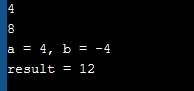
taken a value 4 and b value 8
here after calling the function1 the values are passed as b is call by refrence hence the change in the value y also changes the value b hence as x%2==0 condition succed x=x+y is done and the result is x value which is returned.
while y is the y-x value as x value updated to 12 so 8-12 is -4 which is updated as it refrence to B. b will also change to -4 hence the above output is explained.
Add Answer to:
What is the output of the program?
int function1( int x, int& y) {
if( x...
What is the output of the following program? int main(void) { int x, y, z; x...
What is the output of the following program? int main(void) { int x, y, z; x = 5; y= test(x); z= x + y; cout<< setw(4)<<x <<” + “<<setw(4)<<y<<”=” << setw(4)<<z<<endl; return 0; } int test (int x) { int w; w = x + 10; return (w); }
61. The following program is accepted by the compiler: int sum( int x, int y...
61. The following program is accepted by the compiler: int sum( int x, int y ) { int result; result = x + y; } T__ F__ 62. The following implementation is accepted by the compiler: void product() { int a; int b; int c; int result; cout << "Enter three integers: "; cin >> a >> b >> c; result = a * b * c; ...
#include <iostream> #include <chrono> using namespace std; double improvedPow(double x, int y) { // To be...
#include <iostream> #include <chrono> using namespace std; double improvedPow(double x, int y) { // To be implemented by you } int main() { cout << "To calculate x^y ..." << endl; double x; int y; cout << "Please enter x: "; cin >> x; cout << "Please enter y: "; cin >> y; if(x == 0) { if (y > 0) cout << 0 << endl; else cout << "x^y is not defined" <<endl; } else { cout << improvedPow(x,y)...
Example (4) Trace the following program and find the output >> SOURCE CODE #include <iostream.h> int...
 Example (4) Trace the following program and find the output >> SOURCE CODE #include <iostream.h> int main0 // define two integers int x-3; int y = 4; //print out a message telling which is bigger if (x >y) i cout << "x is bigger than y" << endl: else cout << "x is smaller than y" << endl; return 0; Example (5) Write a C++ program that takes from the user a number in SR (Saudi Riyal) then the program...
howthe output of the following 4 program segments (a) const int SIZE=8; int values[SIZE]...
howthe output of the following 4 program segments (a) const int SIZE=8; int values[SIZE] = {10, 10, 14, 16, 6, 25, 5, 8}; int index; index=0; res = values[index]; for (int j=1; j<SIZE; j++) { if (values[j] > res) { res = values[j]; index = j; cout << index << res << endl; } } cout <<...
Consider the following program: # include <iostream> int x = 3, y = 5; void foo(void)...
Consider the following program: # include <iostream> int x = 3, y = 5; void foo(void) { x = x + 2; y = y + 4; } void bar(void) { int x = 10; y = y + 3; foo( ); cout << x << endl; cout << y << endl; } void baz(void) { int y = 7; bar( ); cout << y << endl; } void main( ) { baz( ); } What output does this program...
Add comments on this Fibonacci C++ program in detail. #include <iostream> using namespace std; int fib(int...
Add comments on this Fibonacci C++ program in detail. #include <iostream> using namespace std; int fib(int n){ int a = 0,b = 1,c; if(n == 0 || n == 1){ return n; } while(n>2){ c = b + a; a = b; b = c; n--; } return c; } int main(){ int n; cout<<"Enter n: "; cin>>n; int result = fib(n); cout<<"Fib("<<n<<") = "<<result<<endl; return 0; }
18 C++ 1. What is the output of the following program segment? int y-22: while ((y...
 18 C++
1. What is the output of the following program segment? int y-22: while ((y 3) != 0) cout << y<< "": y=y-2; The output is 2. Suppose that the input is 100, 20,-8, 50, 20. What is the output of the following C++ code? int sum0 int num: int j cin >> num: if (num < 0) continue зит зит + num; cout<< sum << endl; The output is
18 C++
1. What is the output of the following program segment? int y-22: while ((y 3) != 0) cout << y<< "": y=y-2; The output is 2. Suppose that the input is 100, 20,-8, 50, 20. What is the output of the following C++ code? int sum0 int num: int j cin >> num: if (num < 0) continue зит зит + num; cout<< sum << endl; The output is
#include <iostream> #include <cmath> using namespace std; int main() { int x; int y; int z;...
 #include <iostream>
#include <cmath>
using namespace std;
int main()
{
int x;
int y;
int z;
int r1;
int r2;
cin >> x;
cin >> y;
cin >> z;
r1 = 4* pow(x,3)-5*pow(y,2)+3*z;
r2 = r1+7*pow(x,3)-2*pow(y,2)+11*z;
cout << "r1=";
cout << 4* pow(x,3)-5*pow(y,2)+3*z;
cout << endl;
cout << "r2=";
cout << r1+7*pow(x,3)-2*pow(y,2)+11*z;
cout << endl;
cout << "r3=";
cout << r2-9*pow(x,3)+22*pow(y,2)-6*z;
cout << endl;
return 0;
}
1-115 Your output r2-395 13-186 5:Compare output Output differs. See highlights below. -163...
#include <iostream>
#include <cmath>
using namespace std;
int main()
{
int x;
int y;
int z;
int r1;
int r2;
cin >> x;
cin >> y;
cin >> z;
r1 = 4* pow(x,3)-5*pow(y,2)+3*z;
r2 = r1+7*pow(x,3)-2*pow(y,2)+11*z;
cout << "r1=";
cout << 4* pow(x,3)-5*pow(y,2)+3*z;
cout << endl;
cout << "r2=";
cout << r1+7*pow(x,3)-2*pow(y,2)+11*z;
cout << endl;
cout << "r3=";
cout << r2-9*pow(x,3)+22*pow(y,2)-6*z;
cout << endl;
return 0;
}
1-115 Your output r2-395 13-186 5:Compare output Output differs. See highlights below. -163...
C++ output 6) What is the exact output of the following program? #include <iostream> using namespace...
 C++ output
6) What is the exact output of the following program? #include <iostream> using namespace stdi void zolo(int &a, int sb) int main int x = 5, y =8; zolo(x,y)i cout << "x " << x << endl ; cout << "y = "" << y << endl ; return o: void zolo(int &a, int &b) int v1 = b + a; ' int v2 = b-a; 3 a=v1;13
C++ output
6) What is the exact output of the following program? #include <iostream> using namespace stdi void zolo(int &a, int sb) int main int x = 5, y =8; zolo(x,y)i cout << "x " << x << endl ; cout << "y = "" << y << endl ; return o: void zolo(int &a, int &b) int v1 = b + a; ' int v2 = b-a; 3 a=v1;13
 Example (4) Trace the following program and find the output >> SOURCE CODE #include <iostream.h> int main0 // define two integers int x-3; int y = 4; //print out a message telling which is bigger if (x >y) i cout << "x is bigger than y" << endl: else cout << "x is smaller than y" << endl; return 0; Example (5) Write a C++ program that takes from the user a number in SR (Saudi Riyal) then the program...
 18 C++
1. What is the output of the following program segment? int y-22: while ((y 3) != 0) cout << y<< "": y=y-2; The output is 2. Suppose that the input is 100, 20,-8, 50, 20. What is the output of the following C++ code? int sum0 int num: int j cin >> num: if (num < 0) continue зит зит + num; cout<< sum << endl; The output is
18 C++
1. What is the output of the following program segment? int y-22: while ((y 3) != 0) cout << y<< "": y=y-2; The output is 2. Suppose that the input is 100, 20,-8, 50, 20. What is the output of the following C++ code? int sum0 int num: int j cin >> num: if (num < 0) continue зит зит + num; cout<< sum << endl; The output is
 #include <iostream>
#include <cmath>
using namespace std;
int main()
{
int x;
int y;
int z;
int r1;
int r2;
cin >> x;
cin >> y;
cin >> z;
r1 = 4* pow(x,3)-5*pow(y,2)+3*z;
r2 = r1+7*pow(x,3)-2*pow(y,2)+11*z;
cout << "r1=";
cout << 4* pow(x,3)-5*pow(y,2)+3*z;
cout << endl;
cout << "r2=";
cout << r1+7*pow(x,3)-2*pow(y,2)+11*z;
cout << endl;
cout << "r3=";
cout << r2-9*pow(x,3)+22*pow(y,2)-6*z;
cout << endl;
return 0;
}
1-115 Your output r2-395 13-186 5:Compare output Output differs. See highlights below. -163...
#include <iostream>
#include <cmath>
using namespace std;
int main()
{
int x;
int y;
int z;
int r1;
int r2;
cin >> x;
cin >> y;
cin >> z;
r1 = 4* pow(x,3)-5*pow(y,2)+3*z;
r2 = r1+7*pow(x,3)-2*pow(y,2)+11*z;
cout << "r1=";
cout << 4* pow(x,3)-5*pow(y,2)+3*z;
cout << endl;
cout << "r2=";
cout << r1+7*pow(x,3)-2*pow(y,2)+11*z;
cout << endl;
cout << "r3=";
cout << r2-9*pow(x,3)+22*pow(y,2)-6*z;
cout << endl;
return 0;
}
1-115 Your output r2-395 13-186 5:Compare output Output differs. See highlights below. -163...
 C++ output
6) What is the exact output of the following program? #include <iostream> using namespace stdi void zolo(int &a, int sb) int main int x = 5, y =8; zolo(x,y)i cout << "x " << x << endl ; cout << "y = "" << y << endl ; return o: void zolo(int &a, int &b) int v1 = b + a; ' int v2 = b-a; 3 a=v1;13
C++ output
6) What is the exact output of the following program? #include <iostream> using namespace stdi void zolo(int &a, int sb) int main int x = 5, y =8; zolo(x,y)i cout << "x " << x << endl ; cout << "y = "" << y << endl ; return o: void zolo(int &a, int &b) int v1 = b + a; ' int v2 = b-a; 3 a=v1;13
Most questions answered within 3 hours.
-
Where is the error in this code sequence?
String s1 = "Hello";
String s2 = "ello";...
asked 10 months ago -
Financial data for Joel de Paris, Inc., for last year
follow:
Joel de Paris, Inc.
Balance...
asked 10 months ago -
Consider this reaction:
Al2(SO4)3 (aq)+ BaCl3
(aq) Al2Cl6 (aq)- +
3BaSO4(s) . What is the...
asked 10 months ago -
Suppose that Savneet is considering increasing her
recent random sample from 20 car rentals to 40...
asked 10 months ago -
Trucks arrive at an unloading terminal at an average rate of 120
per hour.
Trucks arrive...
asked 10 months ago -
Why are methanol and ethanol completely soluble in water while
octanol is not very little soluble....
asked 10 months ago -
A facilities manager at a university reads in a research report
that the mean amount of...
asked 10 months ago -
When the CuSO4 is rehydrated by adding water to the anhydrous
compound, is this an endothermic...
asked 10 months ago -
A ray of sunlight is passing from diamond into crown glass; the
angle of incidence is...
asked 10 months ago -
A block of mass 0.249 kg is placed on top of a light, vertical
spring of...
asked 10 months ago -
how do the kidneys compensate in the presences of acidosis
a) trigger hyperventilate
b) reserve acid...
asked 10 months ago -
Question 501 pts
The rental rate of capital to the firm increases. Which of the
following...
asked 10 months ago