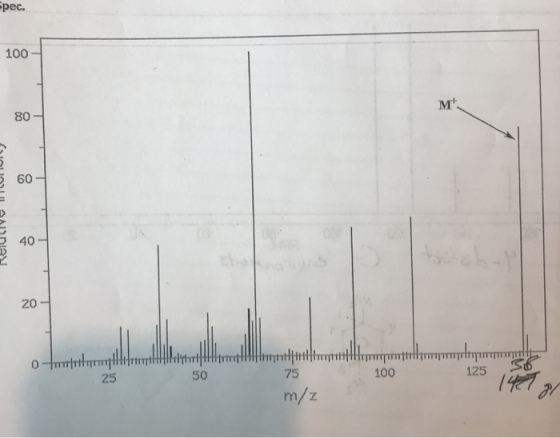
I need to analyze the mass spec. For p-nitroaniline. All major fragments lost.
Homework Answers
p-nitroaniline, M.W. = 138.12 g/mol
M+ = 138, indicate the molecular ion corresponds to p-nitroaniline
M/z = 108, indicate a possible Nitroso+ benzene fragment (Ph-NO+) in which Nitrobenzene lost O and become nitrosobenzne)
M/z = 92, Indicate aniline+ fragment, loss of nitro group. another possibility is the Ph-O+ ions formation from nitrobenzene+.
Intensity of M/z (108) similar to M/z (92)
M/z = 65, C5H5+ ions (cyclopenta-2,4-dien-1-ylium) degradation of benzene ring by HCN removal from aniline+. Commonly observed in aniline, anisole etc.
M/z = 39, C3H3+ ions (cyclopropenyl), loss of two CH (acetylene removal) from C5H5+ ion
Add Answer to:
I
need to analyze the mass spec. For p-nitroaniline. All major
fragments lost.
Hi, I need help finding a structure for an IR spec. The Mass spec is 174m/z...
Hi, I need help finding a structure for an IR spec. The Mass spec is 174m/z and the peaks I am given are 2984, 1742, 1464, and 1088cm. I have 14 hydrogens, grouped 4H: 4H: 6H, the first 4 being a singlet, the second 4 being a quartet and the 6 being a triplet. PLEASE HELP!!
Where does the m+ peak come from in mass spec? I understand it is mass of...
Where does the m+ peak come from in mass spec? I understand it is mass of compound, but what is being ionized to lead to formation of the ion without breaking into fragments? Mechanism would be appreciated.
Mass Spec Molecular Weight: Important Fragments; what are they and what do they mean? (base peak...
 Mass Spec
Molecular Weight:
Important Fragments; what are they and what do they mean? (base
peak structure, is there a halogen, is there a benzene ring, is
there an odd number of nitrogens, other important fragments that
tell something about the structure)
positive EI Mass Spectrum 73 100 90 80 Mass of molecularion is 104 what has been lost to see 89? 70 80 50- 40- 89 30- 20 72 10- w 113 14 10 20 30 40 50 80...
Mass Spec
Molecular Weight:
Important Fragments; what are they and what do they mean? (base
peak structure, is there a halogen, is there a benzene ring, is
there an odd number of nitrogens, other important fragments that
tell something about the structure)
positive EI Mass Spectrum 73 100 90 80 Mass of molecularion is 104 what has been lost to see 89? 70 80 50- 40- 89 30- 20 72 10- w 113 14 10 20 30 40 50 80...
Mass Spec Diethyl Phthalate Mass Spectrum Relative Intensity m/z MS diethylphthalate (note: major m/z values of...
 Mass Spec Diethyl Phthalate Mass Spectrum Relative Intensity m/z MS diethylphthalate (note: major m/z values of 222, 193, 177, 149 are present) 3) Propose structures for TWO fragments in the mass spectrum. Note: the molecular ion peak at 222 m/z is NOT a fragment.
5 Rationalize the indicated fragments in the EI mass spec- trum of each of the following...
 5 Rationalize the indicated fragments in the EI mass spec- trum of each of the following molecules by proposing a structure of the fragment and a mechanism by which it is produced. CH, CH,CH,CH2-C-NH CH,CH, m/2=72 (b) 3-methyl-3-hexanol, m/z = 73 (e) l-pentanol, m/z = 70 (d) peopentane, m/z = 57
3. What are the functional groups on p-nitroaniline? Draw the compound and label the groups. (need...
3. What are the functional groups on p-nitroaniline? Draw the compound and label the groups. (need at least 2)
Please intereperet all spectra fully. Solid U IR Mass Spec. Mt 100- 80 60- 40 0...
 Please intereperet all spectra fully.
Solid U IR Mass Spec. Mt 100- 80 60- 40 0 50 75 100 150 175 m/z Solid U H-NMR doublet, 2H doublet, 2H broad singlet, 1H PPM "C-NMR PPM Solid Unknown Information: Unknown #: Melting Point Infrared Analysis: Explain below how the infrared spectrum led you to select the functional group present in your unknown. Remember, your unknown must belong to one of the following functional groups: alcohol, aldehyde, amine, carboxylic acid, ketone, or...
Please intereperet all spectra fully.
Solid U IR Mass Spec. Mt 100- 80 60- 40 0 50 75 100 150 175 m/z Solid U H-NMR doublet, 2H doublet, 2H broad singlet, 1H PPM "C-NMR PPM Solid Unknown Information: Unknown #: Melting Point Infrared Analysis: Explain below how the infrared spectrum led you to select the functional group present in your unknown. Remember, your unknown must belong to one of the following functional groups: alcohol, aldehyde, amine, carboxylic acid, ketone, or...
I need to come up with fragments that match with my mass spectrum. The molecule is cyclopentanol.
 i need to come up with fragments that match with my mass
spectrum. The molecule is cyclopentanol.
6pts 11) MASS SPECTRUM: Mass to charge Composition Assignment Structure of Assigne (m/z) Unk 16 60 20 10 20 30 40 50 60 70 80
6pts 11) MASS SPECTRUM: Mass to charge Composition Assignment Structure of Assigne (m/z)
Unk 16 60 20 10 20 30 40 50 60 70 80
i need to come up with fragments that match with my mass
spectrum. The molecule is cyclopentanol.
6pts 11) MASS SPECTRUM: Mass to charge Composition Assignment Structure of Assigne (m/z) Unk 16 60 20 10 20 30 40 50 60 70 80
6pts 11) MASS SPECTRUM: Mass to charge Composition Assignment Structure of Assigne (m/z)
Unk 16 60 20 10 20 30 40 50 60 70 80
(a) Draw the five major fragments of 3-chlorodecane that give rise to peaks in the 8 Mass Spectrum and provide their...
 (a) Draw the five major fragments of 3-chlorodecane that give rise to peaks in the 8 Mass Spectrum and provide their m/e values, showing the ratio of the peak values where applicable.
(a) Draw the five major fragments of 3-chlorodecane that give rise to peaks in the 8 Mass Spectrum and provide their m/e values, showing the ratio of the peak values where applicable.
(a) Draw the five major fragments of 3-chlorodecane that give rise to peaks in the 8 Mass Spectrum and provide their m/e values, showing the ratio of the peak values where applicable.
Please help identify the organic compound using mass spec, ir spec, CNMR, and HNMR. From looking...
 Please help identify the
organic compound using mass spec, ir spec, CNMR, and HNMR.
From looking at the mass spec, I believe the molar mass of the
uknown organic compound to be 122 g/mol
From looking at CNMR, I believe there are at least 5 carbons for
each of the 5 peaks. I recall from class that there can be more due
to symmetry, but am not certain how to tell.
Above are all of the graphs given to me...
Please help identify the
organic compound using mass spec, ir spec, CNMR, and HNMR.
From looking at the mass spec, I believe the molar mass of the
uknown organic compound to be 122 g/mol
From looking at CNMR, I believe there are at least 5 carbons for
each of the 5 peaks. I recall from class that there can be more due
to symmetry, but am not certain how to tell.
Above are all of the graphs given to me...
 Mass Spec
Molecular Weight:
Important Fragments; what are they and what do they mean? (base
peak structure, is there a halogen, is there a benzene ring, is
there an odd number of nitrogens, other important fragments that
tell something about the structure)
positive EI Mass Spectrum 73 100 90 80 Mass of molecularion is 104 what has been lost to see 89? 70 80 50- 40- 89 30- 20 72 10- w 113 14 10 20 30 40 50 80...
Mass Spec
Molecular Weight:
Important Fragments; what are they and what do they mean? (base
peak structure, is there a halogen, is there a benzene ring, is
there an odd number of nitrogens, other important fragments that
tell something about the structure)
positive EI Mass Spectrum 73 100 90 80 Mass of molecularion is 104 what has been lost to see 89? 70 80 50- 40- 89 30- 20 72 10- w 113 14 10 20 30 40 50 80...
 Mass Spec Diethyl Phthalate Mass Spectrum Relative Intensity m/z MS diethylphthalate (note: major m/z values of 222, 193, 177, 149 are present) 3) Propose structures for TWO fragments in the mass spectrum. Note: the molecular ion peak at 222 m/z is NOT a fragment.
 5 Rationalize the indicated fragments in the EI mass spec- trum of each of the following molecules by proposing a structure of the fragment and a mechanism by which it is produced. CH, CH,CH,CH2-C-NH CH,CH, m/2=72 (b) 3-methyl-3-hexanol, m/z = 73 (e) l-pentanol, m/z = 70 (d) peopentane, m/z = 57
 Please intereperet all spectra fully.
Solid U IR Mass Spec. Mt 100- 80 60- 40 0 50 75 100 150 175 m/z Solid U H-NMR doublet, 2H doublet, 2H broad singlet, 1H PPM "C-NMR PPM Solid Unknown Information: Unknown #: Melting Point Infrared Analysis: Explain below how the infrared spectrum led you to select the functional group present in your unknown. Remember, your unknown must belong to one of the following functional groups: alcohol, aldehyde, amine, carboxylic acid, ketone, or...
Please intereperet all spectra fully.
Solid U IR Mass Spec. Mt 100- 80 60- 40 0 50 75 100 150 175 m/z Solid U H-NMR doublet, 2H doublet, 2H broad singlet, 1H PPM "C-NMR PPM Solid Unknown Information: Unknown #: Melting Point Infrared Analysis: Explain below how the infrared spectrum led you to select the functional group present in your unknown. Remember, your unknown must belong to one of the following functional groups: alcohol, aldehyde, amine, carboxylic acid, ketone, or...
 i need to come up with fragments that match with my mass
spectrum. The molecule is cyclopentanol.
6pts 11) MASS SPECTRUM: Mass to charge Composition Assignment Structure of Assigne (m/z) Unk 16 60 20 10 20 30 40 50 60 70 80
6pts 11) MASS SPECTRUM: Mass to charge Composition Assignment Structure of Assigne (m/z)
Unk 16 60 20 10 20 30 40 50 60 70 80
i need to come up with fragments that match with my mass
spectrum. The molecule is cyclopentanol.
6pts 11) MASS SPECTRUM: Mass to charge Composition Assignment Structure of Assigne (m/z) Unk 16 60 20 10 20 30 40 50 60 70 80
6pts 11) MASS SPECTRUM: Mass to charge Composition Assignment Structure of Assigne (m/z)
Unk 16 60 20 10 20 30 40 50 60 70 80
 (a) Draw the five major fragments of 3-chlorodecane that give rise to peaks in the 8 Mass Spectrum and provide their m/e values, showing the ratio of the peak values where applicable.
(a) Draw the five major fragments of 3-chlorodecane that give rise to peaks in the 8 Mass Spectrum and provide their m/e values, showing the ratio of the peak values where applicable.
(a) Draw the five major fragments of 3-chlorodecane that give rise to peaks in the 8 Mass Spectrum and provide their m/e values, showing the ratio of the peak values where applicable.
 Please help identify the
organic compound using mass spec, ir spec, CNMR, and HNMR.
From looking at the mass spec, I believe the molar mass of the
uknown organic compound to be 122 g/mol
From looking at CNMR, I believe there are at least 5 carbons for
each of the 5 peaks. I recall from class that there can be more due
to symmetry, but am not certain how to tell.
Above are all of the graphs given to me...
Please help identify the
organic compound using mass spec, ir spec, CNMR, and HNMR.
From looking at the mass spec, I believe the molar mass of the
uknown organic compound to be 122 g/mol
From looking at CNMR, I believe there are at least 5 carbons for
each of the 5 peaks. I recall from class that there can be more due
to symmetry, but am not certain how to tell.
Above are all of the graphs given to me...
Most questions answered within 3 hours.
-
Where is the error in this code sequence?
String s1 = "Hello";
String s2 = "ello";...
asked 10 months ago -
Financial data for Joel de Paris, Inc., for last year
follow:
Joel de Paris, Inc.
Balance...
asked 10 months ago -
Consider this reaction:
Al2(SO4)3 (aq)+ BaCl3
(aq) Al2Cl6 (aq)- +
3BaSO4(s) . What is the...
asked 10 months ago -
Suppose that Savneet is considering increasing her
recent random sample from 20 car rentals to 40...
asked 10 months ago -
Trucks arrive at an unloading terminal at an average rate of 120
per hour.
Trucks arrive...
asked 10 months ago -
Why are methanol and ethanol completely soluble in water while
octanol is not very little soluble....
asked 10 months ago -
A facilities manager at a university reads in a research report
that the mean amount of...
asked 10 months ago -
When the CuSO4 is rehydrated by adding water to the anhydrous
compound, is this an endothermic...
asked 10 months ago -
A ray of sunlight is passing from diamond into crown glass; the
angle of incidence is...
asked 10 months ago -
A block of mass 0.249 kg is placed on top of a light, vertical
spring of...
asked 10 months ago -
how do the kidneys compensate in the presences of acidosis
a) trigger hyperventilate
b) reserve acid...
asked 10 months ago -
Question 501 pts
The rental rate of capital to the firm increases. Which of the
following...
asked 10 months ago