 2.
2. 3.
3.
Homework Answers

Add Answer to:
1.2.3.
You stretch a spring with a spring constant of 965 N/m by 0.818 m. There...
6. A spring of constant of elasticity ke 20000 N/m is on a horizontal frictionless surface...
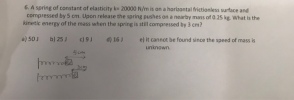 6. A spring of constant of elasticity ke 20000 N/m is on a horizontal frictionless surface and compressed by 5 cm. Upon release the spring pushes on a nearby mass of 0.25 kg. What is the kinetic energy of the mass when the spring is still compressed by 3 cm? a) 50J b) 25J c)9J d) 16J e) it cannot be found since the speed of mass is unknown. 5cm na 3c
A spring with a spring constant of 1500 N/m is attached to a block of mass...
A spring with a spring constant of 1500 N/m is attached to a block of mass 40 kg. If the spring is used to slide the block horizontally across a surface with a static coefficient of friction of 0.6 and a kinetic coefficient of 0.4, how much with the spring stretch before the block begins to move? How much will it stretch if the block is moving at a constant speed?
A spring of spring constant k=261 N/m is attached to a block of mass 1.38 kg...
A spring of spring constant k=261 N/m is attached to a block of mass 1.38 kg and stretched horizontally to a position 15.0 cm from the springs equilibrium position. The spring and mass are released and oscillate in simple harmonic motion across a frictionless horizontal surface. What is the maximum speed obtained by the mass? m/s
3. (10pts) A spring, with a spring constant of 5710 N/m, is compressed by 0.45 m...
3. (10pts) A spring, with a spring constant of 5710 N/m, is compressed by 0.45 m and used to launch a 15.5 kg mass from rest from point A across a frictionless surface and down a short hill that is H = 1.73 m high. The surface becomes rough at point B, and the mass comes to a stop at point C. (a) (5pts) How much work was done by friction between B and C? (b) (5pts) If the coefficient...
3. A force of 200 N stretches a spring How far would this spring stretch with...
 3. A force of 200 N stretches a spring How far would this spring stretch with a force of 100 N applied to i? 30 cm. What is the spring constant of the spring? 4. A 20 kg box is attached to a compressed spring that has a spring constant of 300 N'm. The box is resting on a frictionless surface and the spring is compressed 30 cm a. What is the EPE of the spring? b. What will be...
You compress a block on a spring. The spring has a constant k = 3000 N/m...
You compress a block on a spring. The spring has a constant k = 3000 N/m and the block has a mass of 4 kg. You compress the spring 0.3 m and release the block. After being released, the block hits a rough surface with a coefficient of friction of 0.6. How far does the block travel across the rough surface before it comes to a stop? Please use the correct formulas for this question so I can understand.
Please show all work 1. A horizontal massless spring with spring constant 300 N/m is compressed...
 Please show all work
1. A horizontal massless spring with spring constant 300 N/m is compressed 20 cm. The spring launches the block of mass 1 kg. When the block reaches the other side of the room it compresses a massless spring 600 N/m as shown in the figure. The surface is frictionless except the small part of length 2m, which has a coefficient of kinetic friction 0.2. Find the maximum compression of the spring 600 N/m. 300 N/m 600N/m...
Please show all work
1. A horizontal massless spring with spring constant 300 N/m is compressed 20 cm. The spring launches the block of mass 1 kg. When the block reaches the other side of the room it compresses a massless spring 600 N/m as shown in the figure. The surface is frictionless except the small part of length 2m, which has a coefficient of kinetic friction 0.2. Find the maximum compression of the spring 600 N/m. 300 N/m 600N/m...
A spring with a spring constant of 718 N/m lies on a horizontal surface and that...
A spring with a spring constant of 718 N/m lies on a horizontal surface and that surface is y = 0 m to calculate the gravitational potential energy. A mass of 3 kg is compressed 0.45 meters into the spring and held still. After the mass is released it slides over a horizontal surface in which a 3.4 meter portion of the surface has friction with a coefficient of kinetic friction of 0.30. After the horizontal surface, it travels up...
A 12 kg block is pressed against a spring with spring constant k = 1424 N/m....
A 12 kg block is pressed against a spring with spring constant k = 1424 N/m. The spring is normally 65 cm long but the block is pressed against it to compress the spring until it is only 27 cm long. The block is then released and the spring pushes it forward onto a frictionless surface. a)How fast is the block moving immediately after it leaves the spring? b) The mass then slides across a 2.5 m wide surface with...
A horizontal spring with spring constant 130 N/m is compressed 19 cm and used to launch...
A horizontal spring with spring constant 130 N/m is compressed 19 cm and used to launch a 2.8 kg box across a frictionless, horizontal surface. After the box travels some distance, the surface becomes rough. The coefficient of kinetic friction of the box on the surface is 0.15. Use work and energy to find how far the box slides across the rough surface before stopping. Express your answer to two significant figures and include the appropriate units.
 6. A spring of constant of elasticity ke 20000 N/m is on a horizontal frictionless surface and compressed by 5 cm. Upon release the spring pushes on a nearby mass of 0.25 kg. What is the kinetic energy of the mass when the spring is still compressed by 3 cm? a) 50J b) 25J c)9J d) 16J e) it cannot be found since the speed of mass is unknown. 5cm na 3c
 3. A force of 200 N stretches a spring How far would this spring stretch with a force of 100 N applied to i? 30 cm. What is the spring constant of the spring? 4. A 20 kg box is attached to a compressed spring that has a spring constant of 300 N'm. The box is resting on a frictionless surface and the spring is compressed 30 cm a. What is the EPE of the spring? b. What will be...
 Please show all work
1. A horizontal massless spring with spring constant 300 N/m is compressed 20 cm. The spring launches the block of mass 1 kg. When the block reaches the other side of the room it compresses a massless spring 600 N/m as shown in the figure. The surface is frictionless except the small part of length 2m, which has a coefficient of kinetic friction 0.2. Find the maximum compression of the spring 600 N/m. 300 N/m 600N/m...
Please show all work
1. A horizontal massless spring with spring constant 300 N/m is compressed 20 cm. The spring launches the block of mass 1 kg. When the block reaches the other side of the room it compresses a massless spring 600 N/m as shown in the figure. The surface is frictionless except the small part of length 2m, which has a coefficient of kinetic friction 0.2. Find the maximum compression of the spring 600 N/m. 300 N/m 600N/m...
Most questions answered within 3 hours.
-
Where is the error in this code sequence?
String s1 = "Hello";
String s2 = "ello";...
asked 10 months ago -
Financial data for Joel de Paris, Inc., for last year
follow:
Joel de Paris, Inc.
Balance...
asked 10 months ago -
Consider this reaction:
Al2(SO4)3 (aq)+ BaCl3
(aq) Al2Cl6 (aq)- +
3BaSO4(s) . What is the...
asked 10 months ago -
Suppose that Savneet is considering increasing her
recent random sample from 20 car rentals to 40...
asked 10 months ago -
Trucks arrive at an unloading terminal at an average rate of 120
per hour.
Trucks arrive...
asked 10 months ago -
Why are methanol and ethanol completely soluble in water while
octanol is not very little soluble....
asked 10 months ago -
A facilities manager at a university reads in a research report
that the mean amount of...
asked 10 months ago -
When the CuSO4 is rehydrated by adding water to the anhydrous
compound, is this an endothermic...
asked 10 months ago -
A ray of sunlight is passing from diamond into crown glass; the
angle of incidence is...
asked 10 months ago -
A block of mass 0.249 kg is placed on top of a light, vertical
spring of...
asked 10 months ago -
how do the kidneys compensate in the presences of acidosis
a) trigger hyperventilate
b) reserve acid...
asked 10 months ago -
Question 501 pts
The rental rate of capital to the firm increases. Which of the
following...
asked 10 months ago