

Homework Answers


Add Answer to:
Problem 2: A 25 mm thick glass sheet needs to be rapidly quenched by air jets...
finite element method 2. Aluminum fins with rectangular profiles (5 mm wide and 1 mm thick) are used to remove heat...
 finite element method
2. Aluminum fins with rectangular profiles (5 mm wide and 1 mm thick) are used to remove heat from a surface whose temperature is 150°C. The temperature of ambient air is 20°C. The thermal conductivity of aluminium is 168 W/m.K. The natural convective coefficient associated with the surrounding air is 35 W/m2.K. The fins are 150 mm long and the heat loss from the tip of the fin may be neglected. (a) Determine the temperature distribution along...
finite element method
2. Aluminum fins with rectangular profiles (5 mm wide and 1 mm thick) are used to remove heat from a surface whose temperature is 150°C. The temperature of ambient air is 20°C. The thermal conductivity of aluminium is 168 W/m.K. The natural convective coefficient associated with the surrounding air is 35 W/m2.K. The fins are 150 mm long and the heat loss from the tip of the fin may be neglected. (a) Determine the temperature distribution along...
During its manufacture, plate glass at 600°C is cooled by passing air over its surface such...
 During its manufacture, plate glass at 600°C is cooled by passing air over its surface such that the convection heat transfer coefficient is h. To prevent cracking, it is known that the temperature gradient must not exceed 15 °C/mm at any point in the glass during the cooling process. The thermal conductivity of the glass is 1.4 W/mK and its surface emissivity is 0.75. The temperature of the air that is used for the cooling is 315 °C. Assume that...
Consider a 1.2-m-high and 2-m-wide double-pane window consisting of two 3-mm-thick layers of glass (k =...
 Consider a 1.2-m-high and 2-m-wide double-pane window consisting of two 3-mm-thick layers of glass (k = 0.78 W/m K) separated by a 12-mm-wide stagnant air space (k = 0.026 W/m K). Determine the steady rate of heat transfer through this double-pane window. R . and all the surface temperatures (inner and outer of each pane) within the circuit (which you will draw and correctly label) for a day during which the room is maintained at 24°C while the temperature of...
Problem 1 Consider a 15-mm by 15-mm chip that is cooled on its top surface by a 6 m/s flow of 25 ...
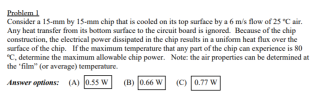 Problem 1 Consider a 15-mm by 15-mm chip that is cooled on its top surface by a 6 m/s flow of 25 °C air. Any heat transfer from its bottom surface to the circuit board is ignored. Because of the chip construction, the electrical power dissipated in the chip results in a uniform heat flux over the surface of the chip. If the maximum temperature that any part of the chip can experience is 80 "C, determine the maximum allowable...
A 70-mm diameter hot solid rod is suspended in a room in which the air and walls are at 25°C
 A 70-mm diameter hot solid rod is suspended in a room in which the air and walls are at 25°C., The surface temperature of the rod and its emissivity are 200°C and 0.8, respectively. The associated coefficient of convective heat transfer from the rod surface to the air is 15 W/m2.K. If the total heat loss from the surface area of the rod is estimated to be 947 W, what is the length of the rod? Area of both sides of the...
A 100-mm-thick steel (AISI 1010) plate, which is initially at a uniform temperature of 200°C needs...
 A 100-mm-thick steel (AISI 1010) plate, which is initially at a uniform temperature of 200°C needs to be heated to a minimum temperature of 550°C. Heating fired furnace with a temperature of 800°C and convection coefficient of 250 W/m2-K on both surfaces of the plate. Determine how long (minutes) the plate should be left in the furnace occurs in a gas-
Problem 5.056 A soda lim e glass sphere of diameter Di = 25 mm is encased...
 Problem 5.056 A soda lim e glass sphere of diameter Di = 25 mm is encased in a bakelite spherical shell of thickness = 10 mm. The composite sphere is initially at a uniform temperature T, = 36" and is exposed to a fluid at T. 10°C with h 30 W/m2. K. Determine the center temperature of the glass at 110 sec. Neglect the thermal contact resistance at the interface between the two materials. The center temperature is eC.
5) A certain automobile has a 4 mm thick glass window with a surface area of...
 5) A certain automobile has a 4 mm thick glass window with a surface area of 2.8 m². The outside temperature is 32°C while the passenger compartment is maintained at 22°C. The convection heat transfer coefficient on the exterior window surface is h = 90 W/(m²K). Determine the heat gain through the windows when the interior convection heat transfer coefficient is h = 15 W/(m²K). By controlling the air flow in the passenger compartment the interior heat transfer coefficient can...
Problem 5.09 A sheet of steel 3.6 mm thick has nitrogen atmospheres on both sides at...
 Problem 5.09 A sheet of steel 3.6 mm thick has nitrogen atmospheres on both sides at 1200°C and is permitted to achieve a steady-state diffusion condition. The diffusion coefficient for nitrogen in steel at this temperature is 6.9 x 10⁻¹¹ m2/s, and the diffusion flux is found to be 3.9 x 10 kg/m2-s Also, it is known that the concentration of nitrogen in the steel at the high-pressure surface is 4.7 kg/m3. How far into the sheet from this high...
5.09 Problem 5.09 A sheet of steel 1.5 mm thick has nitrogen atmospheres on both sides...
 5.09
Problem 5.09 A sheet of steel 1.5 mm thick has nitrogen atmospheres on both sides at 12 OC and is permitted to achieve a steady-state diffusion condition. The diffusion coefficient for nitrogen in steel at this temperature is 5.5 × 10⁻¹¹ m2/s and the diffusion flux s found to be 4.)× 10 7 kg/m2-s Also, t is known that the concentration of nit ogen in the steel at the high pressure surface s 60 kg m3 Ho far into...
5.09
Problem 5.09 A sheet of steel 1.5 mm thick has nitrogen atmospheres on both sides at 12 OC and is permitted to achieve a steady-state diffusion condition. The diffusion coefficient for nitrogen in steel at this temperature is 5.5 × 10⁻¹¹ m2/s and the diffusion flux s found to be 4.)× 10 7 kg/m2-s Also, t is known that the concentration of nit ogen in the steel at the high pressure surface s 60 kg m3 Ho far into...
 finite element method
2. Aluminum fins with rectangular profiles (5 mm wide and 1 mm thick) are used to remove heat from a surface whose temperature is 150°C. The temperature of ambient air is 20°C. The thermal conductivity of aluminium is 168 W/m.K. The natural convective coefficient associated with the surrounding air is 35 W/m2.K. The fins are 150 mm long and the heat loss from the tip of the fin may be neglected. (a) Determine the temperature distribution along...
finite element method
2. Aluminum fins with rectangular profiles (5 mm wide and 1 mm thick) are used to remove heat from a surface whose temperature is 150°C. The temperature of ambient air is 20°C. The thermal conductivity of aluminium is 168 W/m.K. The natural convective coefficient associated with the surrounding air is 35 W/m2.K. The fins are 150 mm long and the heat loss from the tip of the fin may be neglected. (a) Determine the temperature distribution along...
 During its manufacture, plate glass at 600°C is cooled by passing air over its surface such that the convection heat transfer coefficient is h. To prevent cracking, it is known that the temperature gradient must not exceed 15 °C/mm at any point in the glass during the cooling process. The thermal conductivity of the glass is 1.4 W/mK and its surface emissivity is 0.75. The temperature of the air that is used for the cooling is 315 °C. Assume that...
 Consider a 1.2-m-high and 2-m-wide double-pane window consisting of two 3-mm-thick layers of glass (k = 0.78 W/m K) separated by a 12-mm-wide stagnant air space (k = 0.026 W/m K). Determine the steady rate of heat transfer through this double-pane window. R . and all the surface temperatures (inner and outer of each pane) within the circuit (which you will draw and correctly label) for a day during which the room is maintained at 24°C while the temperature of...
 Problem 1 Consider a 15-mm by 15-mm chip that is cooled on its top surface by a 6 m/s flow of 25 °C air. Any heat transfer from its bottom surface to the circuit board is ignored. Because of the chip construction, the electrical power dissipated in the chip results in a uniform heat flux over the surface of the chip. If the maximum temperature that any part of the chip can experience is 80 "C, determine the maximum allowable...
 A 100-mm-thick steel (AISI 1010) plate, which is initially at a uniform temperature of 200°C needs to be heated to a minimum temperature of 550°C. Heating fired furnace with a temperature of 800°C and convection coefficient of 250 W/m2-K on both surfaces of the plate. Determine how long (minutes) the plate should be left in the furnace occurs in a gas-
 Problem 5.056 A soda lim e glass sphere of diameter Di = 25 mm is encased in a bakelite spherical shell of thickness = 10 mm. The composite sphere is initially at a uniform temperature T, = 36" and is exposed to a fluid at T. 10°C with h 30 W/m2. K. Determine the center temperature of the glass at 110 sec. Neglect the thermal contact resistance at the interface between the two materials. The center temperature is eC.
 5) A certain automobile has a 4 mm thick glass window with a surface area of 2.8 m². The outside temperature is 32°C while the passenger compartment is maintained at 22°C. The convection heat transfer coefficient on the exterior window surface is h = 90 W/(m²K). Determine the heat gain through the windows when the interior convection heat transfer coefficient is h = 15 W/(m²K). By controlling the air flow in the passenger compartment the interior heat transfer coefficient can...
 Problem 5.09 A sheet of steel 3.6 mm thick has nitrogen atmospheres on both sides at 1200°C and is permitted to achieve a steady-state diffusion condition. The diffusion coefficient for nitrogen in steel at this temperature is 6.9 x 10⁻¹¹ m2/s, and the diffusion flux is found to be 3.9 x 10 kg/m2-s Also, it is known that the concentration of nitrogen in the steel at the high-pressure surface is 4.7 kg/m3. How far into the sheet from this high...
 5.09
Problem 5.09 A sheet of steel 1.5 mm thick has nitrogen atmospheres on both sides at 12 OC and is permitted to achieve a steady-state diffusion condition. The diffusion coefficient for nitrogen in steel at this temperature is 5.5 × 10⁻¹¹ m2/s and the diffusion flux s found to be 4.)× 10 7 kg/m2-s Also, t is known that the concentration of nit ogen in the steel at the high pressure surface s 60 kg m3 Ho far into...
5.09
Problem 5.09 A sheet of steel 1.5 mm thick has nitrogen atmospheres on both sides at 12 OC and is permitted to achieve a steady-state diffusion condition. The diffusion coefficient for nitrogen in steel at this temperature is 5.5 × 10⁻¹¹ m2/s and the diffusion flux s found to be 4.)× 10 7 kg/m2-s Also, t is known that the concentration of nit ogen in the steel at the high pressure surface s 60 kg m3 Ho far into...
Most questions answered within 3 hours.
-
Where is the error in this code sequence?
String s1 = "Hello";
String s2 = "ello";...
asked 11 months ago -
Financial data for Joel de Paris, Inc., for last year
follow:
Joel de Paris, Inc.
Balance...
asked 11 months ago -
Consider this reaction:
Al2(SO4)3 (aq)+ BaCl3
(aq) Al2Cl6 (aq)- +
3BaSO4(s) . What is the...
asked 11 months ago -
Suppose that Savneet is considering increasing her
recent random sample from 20 car rentals to 40...
asked 11 months ago -
Trucks arrive at an unloading terminal at an average rate of 120
per hour.
Trucks arrive...
asked 11 months ago -
Why are methanol and ethanol completely soluble in water while
octanol is not very little soluble....
asked 11 months ago -
A facilities manager at a university reads in a research report
that the mean amount of...
asked 11 months ago -
When the CuSO4 is rehydrated by adding water to the anhydrous
compound, is this an endothermic...
asked 11 months ago -
A ray of sunlight is passing from diamond into crown glass; the
angle of incidence is...
asked 11 months ago -
A block of mass 0.249 kg is placed on top of a light, vertical
spring of...
asked 11 months ago -
how do the kidneys compensate in the presences of acidosis
a) trigger hyperventilate
b) reserve acid...
asked 11 months ago -
Question 501 pts
The rental rate of capital to the firm increases. Which of the
following...
asked 11 months ago