
Homework Answers
Add Answer to:
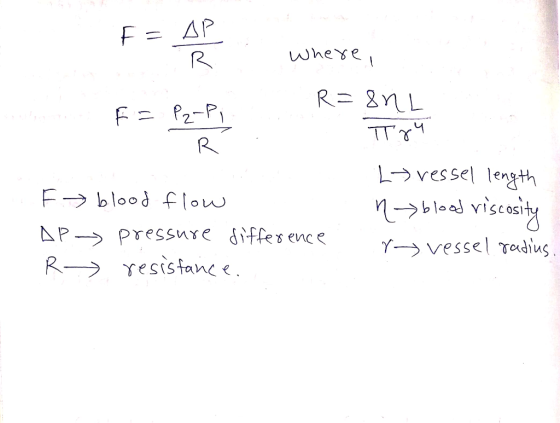
* Write the formula for the relationship between Flow, Pressure, and Resistance. 11 af allml?
1. Describe the relationship between pressure, volume, resistance and flow. How is this similar to blood...
 1. Describe the relationship between pressure, volume, resistance and flow. How is this similar to blood flow through the heart and vessels? 2. What is intrapulmonary pressure? If it is higher than atmospheric pressure, what happens? What happens if it is lower than atmospheric pressure? Which gas law would you apply to explain this? State the law. 3. What is intrapleural pressure? Why is it important? 4. What would happen if intrapleural pressure became higher than intrapulmonary pressure? What might...
For pressure driven flow of a liquid in a circular pipe, give the correct relationship between...
For pressure driven flow of a liquid in a circular pipe, give the correct relationship between maximum axial velocity and average axial velocity for both laminar and turbulent flow conditions.
Write down the relationship between the initial pressure and volume (pi,Vi) and the final pressure and...
Write down the relationship between the initial pressure and volume (pi,Vi) and the final pressure and volume (pf, Vf ) for an isothermal (constant-temperature) process.
11. The graph below shows the relationship between pressure and volume of a gas. What would...
 11. The graph below shows the relationship between pressure and volume of a gas. What would this graph look like if volume was directly proportional to pressure! Volume PV = constant Pressure
11) The formula C = -32) expresses the relationship between Fahrenheit temperature, F, and Celsius temperature,...
 11) The formula C = -32) expresses the relationship between Fahrenheit temperature, F, and Celsius temperature, C. Use the formula to convert 50°F to it equivalent temperature on the Celsius scale, rounded to the nearest degree A) 28°C B) -4°C C) 32°C D) 10°C I
What is the relationship between insulin resistance and hyperinsulinemia?
What is the relationship between insulin resistance and hyperinsulinemia?
The flow of a liquid in a laminar flow between infinite parallel plates is resulting a...
 The flow of a liquid in a laminar flow between infinite parallel plates is resulting a pressure drop due to the viscosity of the liquid and an unseen retarding force. Write an expression of pressure drop. Derive the relationship between local and maximum velocity and determine the ratio of maximum velocity to average velocity. (5+3+2 marks)
Use the growing perpetuity formula to discuss the relationship between an asset’s price and its cash...
Use the growing perpetuity formula to discuss the relationship between an asset’s price and its cash flow growth rate. Also discuss the role of the interest rate.
How is Ohm’s Law altered under conditions of turbulent flow relative to laminar flow? Consider what...
How is Ohm’s Law altered under conditions of turbulent flow relative to laminar flow? Consider what you know about the relationship between ∆P and flow. a. It is not altered. b.Flow is equal to resistance divided by driving pressure. incorrect c. Driving pressure is equal to 2 x Flow x Resistance. d. Driving pressure is proportional to Flow2.
Voltage is current times resistance. Solve this formula for C and V. What type of relationship...
Voltage is current times resistance. Solve this formula for C and V. What type of relationship doo these form (direct or indirect)? Explain fully.
 1. Describe the relationship between pressure, volume, resistance and flow. How is this similar to blood flow through the heart and vessels? 2. What is intrapulmonary pressure? If it is higher than atmospheric pressure, what happens? What happens if it is lower than atmospheric pressure? Which gas law would you apply to explain this? State the law. 3. What is intrapleural pressure? Why is it important? 4. What would happen if intrapleural pressure became higher than intrapulmonary pressure? What might...
 11. The graph below shows the relationship between pressure and volume of a gas. What would this graph look like if volume was directly proportional to pressure! Volume PV = constant Pressure
 11) The formula C = -32) expresses the relationship between Fahrenheit temperature, F, and Celsius temperature, C. Use the formula to convert 50°F to it equivalent temperature on the Celsius scale, rounded to the nearest degree A) 28°C B) -4°C C) 32°C D) 10°C I
 The flow of a liquid in a laminar flow between infinite parallel plates is resulting a pressure drop due to the viscosity of the liquid and an unseen retarding force. Write an expression of pressure drop. Derive the relationship between local and maximum velocity and determine the ratio of maximum velocity to average velocity. (5+3+2 marks)
Most questions answered within 3 hours.
-
Where is the error in this code sequence?
String s1 = "Hello";
String s2 = "ello";...
asked 11 months ago -
Financial data for Joel de Paris, Inc., for last year
follow:
Joel de Paris, Inc.
Balance...
asked 11 months ago -
Consider this reaction:
Al2(SO4)3 (aq)+ BaCl3
(aq) Al2Cl6 (aq)- +
3BaSO4(s) . What is the...
asked 11 months ago -
Suppose that Savneet is considering increasing her
recent random sample from 20 car rentals to 40...
asked 11 months ago -
Trucks arrive at an unloading terminal at an average rate of 120
per hour.
Trucks arrive...
asked 11 months ago -
Why are methanol and ethanol completely soluble in water while
octanol is not very little soluble....
asked 11 months ago -
A facilities manager at a university reads in a research report
that the mean amount of...
asked 11 months ago -
When the CuSO4 is rehydrated by adding water to the anhydrous
compound, is this an endothermic...
asked 11 months ago -
A ray of sunlight is passing from diamond into crown glass; the
angle of incidence is...
asked 11 months ago -
A block of mass 0.249 kg is placed on top of a light, vertical
spring of...
asked 11 months ago -
how do the kidneys compensate in the presences of acidosis
a) trigger hyperventilate
b) reserve acid...
asked 11 months ago -
Question 501 pts
The rental rate of capital to the firm increases. Which of the
following...
asked 11 months ago