
Homework Answers
Add Answer to:
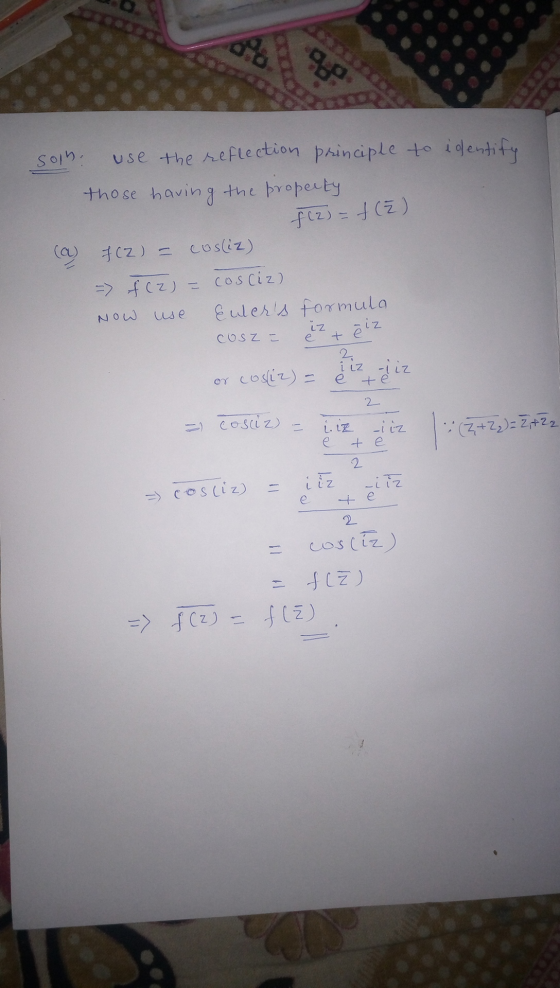
4. For the following an alytic functions defined over their domains of definition, use the reflection...
Definition. Let fi, f2.83.... be a sequence of functions defined on an interval I. The series...
 Definition. Let fi, f2.83.... be a sequence of functions defined on an interval I. The series fn(x) is said to have property 6 on I if there erists a convergent series of positive constants, Mn, satisfying \fu(x) S M for all values of n and for every or in the interval I. n=1 Theorem. If the series (1) has property C on the interval (a, b), and if the terms f(x) are continuous functions on (a, b), then nel 1...
USE DEFINITION 1 TO DETERMINE THE LAPLACE TRANSFORM OF THE FOLLOWING FUNCTION. f(t)= e sin(t) Laplace...
 USE DEFINITION 1 TO DETERMINE THE LAPLACE TRANSFORM OF THE FOLLOWING FUNCTION. f(t)= e sin(t) Laplace Transform Definition 1. Let f(t)be a function on [0,00). The Laplace transform of f is the function defined by the integral The domain of F(s) is all the values of " for which the integral in (1) exists.' The Laplace transform of fis denoted by both and ${/}. QUESTION 2. (3PTS) USE TABLE 7.1 AND 7.2 TO DETERMINE THE LAPLACE TRANSFORM OF THE GIVEN...
5. Use a substitution and an integration by parts to find each of the following indef-...
 5. Use a substitution and an integration by parts to find each of the following indef- inite integrals: (b) | (cos(a) sin(a) esas) de (a) / ( (32 – 7) sin(5x + 2)) de (c) / (e* cos(e=)) dt (d) dr 6. Spot the error in the following calculation: S() will use integration by parts with 1 We wish to compute dr. For this dv du 1 dar = 1. This gives us dr by parts we find dr =...
Definition 5.48. Let f,g:X + Y be functions and assume that Y is a set in...
 Definition 5.48. Let f,g:X + Y be functions and assume that Y is a set in which the following operations make sense. Then the following are also functions: 1. f + g defined by (f +g)(x) = f(x) + g(x) for all x E X 2. f - g defined by (f – g)(x) = f(x) – g(x) for all x € X 3. f.g defined by (fºg)(x) = f(x) · g(x) for all x E X f(x) = "147...
10. Use the limit definition of the derivative to calculate the derivatives of the following functions....
 10. Use the limit definition of the derivative to calculate the derivatives of the following functions. a. f(x) = 2x2 – 3x + 4 b. g(x) = = x2 +1 1 x2 +1 c. h(x) = 3x - 2 a. 11. Find the derivative with respect to x. x² - 4x f(x)= b. y = sec v c. 5x2 – 2xy + 7y2 = 0 1+cos x 1-cosx cos(Inu) e. S(x) = du 1+1 + + f. y =sin(x+y) g....
The functions f and g are defined by the following tables. Use the tables to evaluate...
 The functions f and g are defined by the following tables. Use the tables to evaluate the given composite function. f (g(9)) x f(x) -1 | 2 04 15 5 -1 x g(x) -3 -5 2 - 4 42 9 -1 f(g(9))=0
9 and 11 please 2-11 CAUCHY-RIEMANN EQUATIONS Are the following functions analytic? Use (1) or (7)....
 9 and 11 please
2-11 CAUCHY-RIEMANN EQUATIONS Are the following functions analytic? Use (1) or (7). 2. f(z) = izz 3. f(z) = e -2,0 (cos 2y – i sin 2y) 4. f(x) = e« (cos y – i sin y) 5. f(z) = Re (z?) – i Im (32) 6. f(x) = 1/(z – 25) 7. f(x) = i/28 8. f(z) = Arg 2TZ 9. f(z) = 3772/(23 + 4722) 10. f(x) = ln [z] + i Arg z...
9 and 11 please
2-11 CAUCHY-RIEMANN EQUATIONS Are the following functions analytic? Use (1) or (7). 2. f(z) = izz 3. f(z) = e -2,0 (cos 2y – i sin 2y) 4. f(x) = e« (cos y – i sin y) 5. f(z) = Re (z?) – i Im (32) 6. f(x) = 1/(z – 25) 7. f(x) = i/28 8. f(z) = Arg 2TZ 9. f(z) = 3772/(23 + 4722) 10. f(x) = ln [z] + i Arg z...
Evaluate piecewise-defined functions Question Given the following piecewise function, evaluate /(-4). - 4x + 3 f(x)...
 Evaluate piecewise-defined functions Question Given the following piecewise function, evaluate /(-4). - 4x + 3 f(x) = x < 0 Osr<3 3S 2? + 2 Do not include "f(-4) =" in your answer. Provide your answer below:
MAT 121 LOGARITHM PROJECT Fall 2019 Name: D. Evaluating Functions and Solving Equations 1. (4 pts)...
 MAT 121 LOGARITHM PROJECT Fall 2019 Name: D. Evaluating Functions and Solving Equations 1. (4 pts) Let 6(x) = log (2x+1)-2 and H(x) = -2+2 log, x. Find all real numbers x for which I (x) - G(x). 2. Aarnie tried to solve the equation e +er = 12 but got the wrong answer. Here is his first step: In(e)+In(e)=In(12) a. (3 pts) Explain why his first step was wrong. b. (4 pts) Help Aarnle get a correct solution. Show...
Use MATLAB to generate code for this 4.Given the following functions: (1) f1 (x, y) = cos...
Use MATLAB to generate code for this 4.Given the following functions: (1) f1 (x, y) = cos (3 x); (2) f2 (x, y) = cos (5 y); (3) f3 (x, y) = cos (3 x) cos (5 y); Please plot 3D plots/images for each of the functions. Please show your steps/ derivations to explain why you obtain those plots/figures.
 Definition. Let fi, f2.83.... be a sequence of functions defined on an interval I. The series fn(x) is said to have property 6 on I if there erists a convergent series of positive constants, Mn, satisfying \fu(x) S M for all values of n and for every or in the interval I. n=1 Theorem. If the series (1) has property C on the interval (a, b), and if the terms f(x) are continuous functions on (a, b), then nel 1...
 USE DEFINITION 1 TO DETERMINE THE LAPLACE TRANSFORM OF THE FOLLOWING FUNCTION. f(t)= e sin(t) Laplace Transform Definition 1. Let f(t)be a function on [0,00). The Laplace transform of f is the function defined by the integral The domain of F(s) is all the values of " for which the integral in (1) exists.' The Laplace transform of fis denoted by both and ${/}. QUESTION 2. (3PTS) USE TABLE 7.1 AND 7.2 TO DETERMINE THE LAPLACE TRANSFORM OF THE GIVEN...
 5. Use a substitution and an integration by parts to find each of the following indef- inite integrals: (b) | (cos(a) sin(a) esas) de (a) / ( (32 – 7) sin(5x + 2)) de (c) / (e* cos(e=)) dt (d) dr 6. Spot the error in the following calculation: S() will use integration by parts with 1 We wish to compute dr. For this dv du 1 dar = 1. This gives us dr by parts we find dr =...
 Definition 5.48. Let f,g:X + Y be functions and assume that Y is a set in which the following operations make sense. Then the following are also functions: 1. f + g defined by (f +g)(x) = f(x) + g(x) for all x E X 2. f - g defined by (f – g)(x) = f(x) – g(x) for all x € X 3. f.g defined by (fºg)(x) = f(x) · g(x) for all x E X f(x) = "147...
 10. Use the limit definition of the derivative to calculate the derivatives of the following functions. a. f(x) = 2x2 – 3x + 4 b. g(x) = = x2 +1 1 x2 +1 c. h(x) = 3x - 2 a. 11. Find the derivative with respect to x. x² - 4x f(x)= b. y = sec v c. 5x2 – 2xy + 7y2 = 0 1+cos x 1-cosx cos(Inu) e. S(x) = du 1+1 + + f. y =sin(x+y) g....
 The functions f and g are defined by the following tables. Use the tables to evaluate the given composite function. f (g(9)) x f(x) -1 | 2 04 15 5 -1 x g(x) -3 -5 2 - 4 42 9 -1 f(g(9))=0
 9 and 11 please
2-11 CAUCHY-RIEMANN EQUATIONS Are the following functions analytic? Use (1) or (7). 2. f(z) = izz 3. f(z) = e -2,0 (cos 2y – i sin 2y) 4. f(x) = e« (cos y – i sin y) 5. f(z) = Re (z?) – i Im (32) 6. f(x) = 1/(z – 25) 7. f(x) = i/28 8. f(z) = Arg 2TZ 9. f(z) = 3772/(23 + 4722) 10. f(x) = ln [z] + i Arg z...
9 and 11 please
2-11 CAUCHY-RIEMANN EQUATIONS Are the following functions analytic? Use (1) or (7). 2. f(z) = izz 3. f(z) = e -2,0 (cos 2y – i sin 2y) 4. f(x) = e« (cos y – i sin y) 5. f(z) = Re (z?) – i Im (32) 6. f(x) = 1/(z – 25) 7. f(x) = i/28 8. f(z) = Arg 2TZ 9. f(z) = 3772/(23 + 4722) 10. f(x) = ln [z] + i Arg z...
 Evaluate piecewise-defined functions Question Given the following piecewise function, evaluate /(-4). - 4x + 3 f(x) = x < 0 Osr<3 3S 2? + 2 Do not include "f(-4) =" in your answer. Provide your answer below:
 MAT 121 LOGARITHM PROJECT Fall 2019 Name: D. Evaluating Functions and Solving Equations 1. (4 pts) Let 6(x) = log (2x+1)-2 and H(x) = -2+2 log, x. Find all real numbers x for which I (x) - G(x). 2. Aarnie tried to solve the equation e +er = 12 but got the wrong answer. Here is his first step: In(e)+In(e)=In(12) a. (3 pts) Explain why his first step was wrong. b. (4 pts) Help Aarnle get a correct solution. Show...
Most questions answered within 3 hours.
-
Where is the error in this code sequence?
String s1 = "Hello";
String s2 = "ello";...
asked 10 months ago -
Financial data for Joel de Paris, Inc., for last year
follow:
Joel de Paris, Inc.
Balance...
asked 10 months ago -
Consider this reaction:
Al2(SO4)3 (aq)+ BaCl3
(aq) Al2Cl6 (aq)- +
3BaSO4(s) . What is the...
asked 10 months ago -
Suppose that Savneet is considering increasing her
recent random sample from 20 car rentals to 40...
asked 10 months ago -
Trucks arrive at an unloading terminal at an average rate of 120
per hour.
Trucks arrive...
asked 10 months ago -
Why are methanol and ethanol completely soluble in water while
octanol is not very little soluble....
asked 10 months ago -
A facilities manager at a university reads in a research report
that the mean amount of...
asked 10 months ago -
When the CuSO4 is rehydrated by adding water to the anhydrous
compound, is this an endothermic...
asked 10 months ago -
A ray of sunlight is passing from diamond into crown glass; the
angle of incidence is...
asked 10 months ago -
A block of mass 0.249 kg is placed on top of a light, vertical
spring of...
asked 10 months ago -
how do the kidneys compensate in the presences of acidosis
a) trigger hyperventilate
b) reserve acid...
asked 10 months ago -
Question 501 pts
The rental rate of capital to the firm increases. Which of the
following...
asked 10 months ago