
Homework Answers
C.) Status quo bias
The tendency to avoid making a decision altogether is status quo.
Status quo bias is an emotional bias; a preference for the current state of affairs.
Mental accounting refers to the tendency for people to separate their money into separate accounts based on a variety of subjective criteria, like the source of the money and intent for each account.
Opportunity cost refers to a benefit that a person could have received, but gave up, to take another course of action.
The overconfide effect is a well-established bias in which a person's subjective confidence in his or her judgements is reliably greater than the objective accuracy of those judgements, especially when confidence is relatively high.
Add Answer to:
D Question 17 5 pts is the tendency to avoid making a decision altogether. O Overconfidence...
A Click Submit to complete this assessment. Question 6 The decision to give a birthday present...
 A Click Submit to complete this assessment. Question 6 The decision to give a birthday present to a friend is: O A. a rational decision if the person giving the gift is concerned about the recipient's welfare. B. behavior based on risk aversion. an irrational economic decision because it reduces the economic payoff of the person giving the gift. D. decision making using bounded rationality. A Click Submit to complete this assessment. OĆ e earch on repar records and eneroency...
Question 1 2 pts A banker opts for short-term gain despite indications that his decision might...
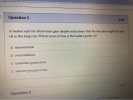 Question 1 2 pts A banker opts for short-term gain despite indications that his decision might not pay off in the long run. Which error or bias is the banker guilty of? representation O overconfidence immediate gratification selective perception bias 2 pts Question 2 at share is employing
O Identify objectives D Question 7 1 pts Decision making: e Involves analysis and evaluation e...
 O Identify objectives D Question 7 1 pts Decision making: e Involves analysis and evaluation e Requires making choices among available alternatives ® Relies on information O All of the above DQuestion 8 1 pts
Question 1 (A) (B) (C) (D) An advantage of centralised decision-making is: Greater effectiveness in volatile...
 Question 1
(A)
(B)
(C)
(D)
An advantage of centralised decision-making is: Greater effectiveness in volatile environments More motivated employees Less monitoring of decisions More rapid decision making in all contexts The total amount of variable costs will: Not be affected by relevant range considerations Change proportionately with changes in production activity Increase in per unit cost as production decreases Remain constant within a relevant range of production An opportunity cost can be defined as: A cost incurred when an...
Question 1
(A)
(B)
(C)
(D)
An advantage of centralised decision-making is: Greater effectiveness in volatile environments More motivated employees Less monitoring of decisions More rapid decision making in all contexts The total amount of variable costs will: Not be affected by relevant range considerations Change proportionately with changes in production activity Increase in per unit cost as production decreases Remain constant within a relevant range of production An opportunity cost can be defined as: A cost incurred when an...
Question 5 2 pts Should we consider sunk costs when making decisions about the present or...
 Question 5 2 pts Should we consider sunk costs when making decisions about the present or the future? No, sunk costs cannot be recovered. Yes, we should consider all costs when making decisions for the present and the future. No, sunk costs have a non-monetary value; therefore, we should not consider the costs. Yes, sunk costs are avoidable, so we should consider the costs when making decisions. Previous Question 6 2 pts Producers selling their ice cream as "95% fat...
D 5 pts Question 17 Below is a portion of a larger decision tree. Using only...
 D 5 pts Question 17 Below is a portion of a larger decision tree. Using only the information from the portion of the tree below, answer the following question: If the probability of s1 is 0.40, what is the expected Value without Perfect Information? Strong (8) 8 Small (d) Weak) 7 Strong (s) 14 No Market Research Study Medium (4) Weak ) 5 Strong ) 20 Large (d Weak) 122 O 26 074 86
D Question 3 Feedback process is the last step of decision making process. True O False...
 D Question 3 Feedback process is the last step of decision making process. True O False Question 4
Question 17 (2 points) Routine decision making is most likely involved when an individual purchases a...
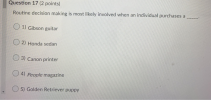 Question 17 (2 points) Routine decision making is most likely involved when an individual purchases a ___ 1) Gibson guitar 2) Honda sedan O 3) Canon printer 4) People magazine 5) Golden Retriever puppy
Question 9 5 pts Corporate social responsibility may increase a business's reputation or goodwill. O True...
 Question 9 5 pts Corporate social responsibility may increase a business's reputation or goodwill. O True O False 5 pts Question 10 The first step in making an ethical decision is to understand the problem. True O False 5 pts D Question 11 Business ethics looks at whether business decisions o are right or wrong. O derive from well-known business principles. O follow legal doctrine. O align with corporate policy. D Question 12 5 pts Ethics focuses on how persons...
Question 23 4 pts The part of the reverse logistics process that is the most challenging...
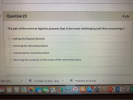 Question 23 4 pts The part of the reverse logistics process that is the most challenging and time consuming is O making the disposal decision O receiving the returned product O restocking the returned product O informing the customer of the status of the returned product KEY.doc In Class ch 9.d....doc Practice ch 9.doc ICED 17
 A Click Submit to complete this assessment. Question 6 The decision to give a birthday present to a friend is: O A. a rational decision if the person giving the gift is concerned about the recipient's welfare. B. behavior based on risk aversion. an irrational economic decision because it reduces the economic payoff of the person giving the gift. D. decision making using bounded rationality. A Click Submit to complete this assessment. OĆ e earch on repar records and eneroency...
 Question 1 2 pts A banker opts for short-term gain despite indications that his decision might not pay off in the long run. Which error or bias is the banker guilty of? representation O overconfidence immediate gratification selective perception bias 2 pts Question 2 at share is employing
 O Identify objectives D Question 7 1 pts Decision making: e Involves analysis and evaluation e Requires making choices among available alternatives ® Relies on information O All of the above DQuestion 8 1 pts
 Question 1
(A)
(B)
(C)
(D)
An advantage of centralised decision-making is: Greater effectiveness in volatile environments More motivated employees Less monitoring of decisions More rapid decision making in all contexts The total amount of variable costs will: Not be affected by relevant range considerations Change proportionately with changes in production activity Increase in per unit cost as production decreases Remain constant within a relevant range of production An opportunity cost can be defined as: A cost incurred when an...
Question 1
(A)
(B)
(C)
(D)
An advantage of centralised decision-making is: Greater effectiveness in volatile environments More motivated employees Less monitoring of decisions More rapid decision making in all contexts The total amount of variable costs will: Not be affected by relevant range considerations Change proportionately with changes in production activity Increase in per unit cost as production decreases Remain constant within a relevant range of production An opportunity cost can be defined as: A cost incurred when an...
 Question 5 2 pts Should we consider sunk costs when making decisions about the present or the future? No, sunk costs cannot be recovered. Yes, we should consider all costs when making decisions for the present and the future. No, sunk costs have a non-monetary value; therefore, we should not consider the costs. Yes, sunk costs are avoidable, so we should consider the costs when making decisions. Previous Question 6 2 pts Producers selling their ice cream as "95% fat...
 D 5 pts Question 17 Below is a portion of a larger decision tree. Using only the information from the portion of the tree below, answer the following question: If the probability of s1 is 0.40, what is the expected Value without Perfect Information? Strong (8) 8 Small (d) Weak) 7 Strong (s) 14 No Market Research Study Medium (4) Weak ) 5 Strong ) 20 Large (d Weak) 122 O 26 074 86
 D Question 3 Feedback process is the last step of decision making process. True O False Question 4
 Question 17 (2 points) Routine decision making is most likely involved when an individual purchases a ___ 1) Gibson guitar 2) Honda sedan O 3) Canon printer 4) People magazine 5) Golden Retriever puppy
 Question 9 5 pts Corporate social responsibility may increase a business's reputation or goodwill. O True O False 5 pts Question 10 The first step in making an ethical decision is to understand the problem. True O False 5 pts D Question 11 Business ethics looks at whether business decisions o are right or wrong. O derive from well-known business principles. O follow legal doctrine. O align with corporate policy. D Question 12 5 pts Ethics focuses on how persons...
 Question 23 4 pts The part of the reverse logistics process that is the most challenging and time consuming is O making the disposal decision O receiving the returned product O restocking the returned product O informing the customer of the status of the returned product KEY.doc In Class ch 9.d....doc Practice ch 9.doc ICED 17
Most questions answered within 3 hours.
-
Where is the error in this code sequence?
String s1 = "Hello";
String s2 = "ello";...
asked 10 months ago -
Financial data for Joel de Paris, Inc., for last year
follow:
Joel de Paris, Inc.
Balance...
asked 10 months ago -
Consider this reaction:
Al2(SO4)3 (aq)+ BaCl3
(aq) Al2Cl6 (aq)- +
3BaSO4(s) . What is the...
asked 10 months ago -
Suppose that Savneet is considering increasing her
recent random sample from 20 car rentals to 40...
asked 10 months ago -
Trucks arrive at an unloading terminal at an average rate of 120
per hour.
Trucks arrive...
asked 10 months ago -
Why are methanol and ethanol completely soluble in water while
octanol is not very little soluble....
asked 10 months ago -
A facilities manager at a university reads in a research report
that the mean amount of...
asked 10 months ago -
When the CuSO4 is rehydrated by adding water to the anhydrous
compound, is this an endothermic...
asked 10 months ago -
A ray of sunlight is passing from diamond into crown glass; the
angle of incidence is...
asked 10 months ago -
A block of mass 0.249 kg is placed on top of a light, vertical
spring of...
asked 10 months ago -
how do the kidneys compensate in the presences of acidosis
a) trigger hyperventilate
b) reserve acid...
asked 10 months ago -
Question 501 pts
The rental rate of capital to the firm increases. Which of the
following...
asked 10 months ago