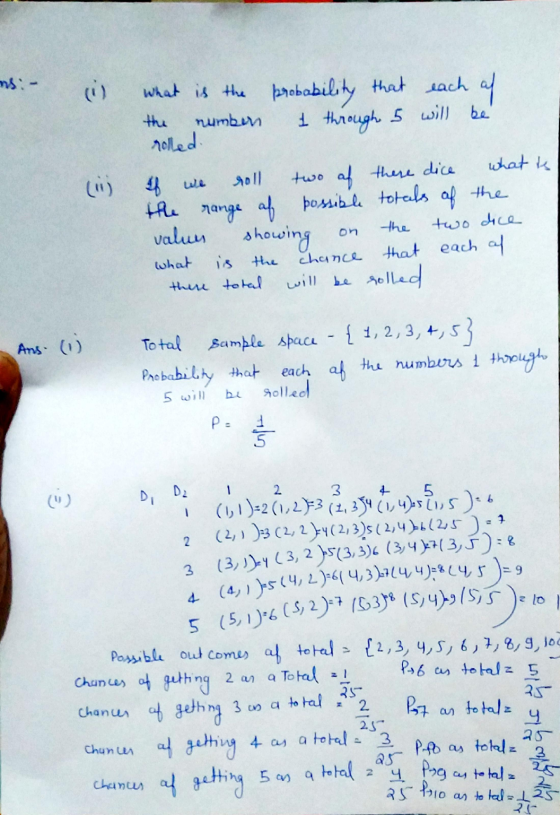
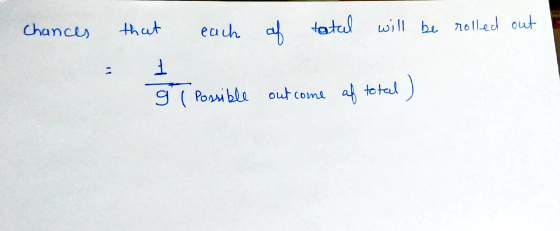
Assume that we have a fair five-sided die with the numbers 1 through 5 on its...
Assume that we have a fair five-sided die with the numbers 1
through 5 on
its sides. What is the probability that each of the numbers 1
through 5 will
be rolled? If we roll two of these dice, what is the range of
possible totals of
the values showing on the two dice? What is the chance that each of
these
totals will be rolled?
Homework Answers
Add Answer to:
Assume that we have a fair five-sided die with the numbers 1
through 5 on
its...
If we roll a red 6-sided die and a green 6-sided die (both are fair dice...
If we roll a red 6-sided die and a green 6-sided die (both are fair dice with the numbers 1-6 equally likely to be rolled), what is the probability that we get (i) A 5 on the green die AND a 3 on the red die? (ii) A 5 on the green die OR a 3 on the red die? (iii) A 5 on the green die GIVEN we rolled a 3 on the red die?
We roll a fair 8-sided die five times. (A fair 8-sided die is equally likely to...
 We roll a fair 8-sided die five times. (A fair 8-sided die is equally likely to be 1, 2, 3, 4, 5, 6, 7, or 8.) (a) What is the probability that at least one of the rolls is a 3? (b) Let X be the number of different values rolled. For example, if the five rolls are 2, 3, 8, 8, 7, then X = 4 (since four different values were rolled: 2,3,7,8). Find E[X].
We roll two fair 6-sided dice. (1) What is the probability that at least one die...
 We roll two fair 6-sided dice. (1) What is the probability that at least one die roll is 6? (2) Given that two two dice land on different numbers, what is the conditional probability that at least one die roll is a 6? Thint] You may use the graphical approach (Lecture 5 slide 11-12) to help you solve the problem. Problem 4. (8 points) We deal from a well-shuffled 52-card deck. What is the probability that the 13th card is...
a) A normal 20-sided die has each of the numbers 1 through to 20 written on...
a) A normal 20-sided die has each of the numbers 1 through to 20 written on its faces, and has an equal chance of landing on any one of these numbers. If it is rolled 7 times, what is the probability that a 3 turns up exactly 5 times?
A) Suppose I roll two fair six-sided dice. What is the probability that I rolled a...
A) Suppose I roll two fair six-sided dice. What is the probability that I rolled a total of 5? B) Suppose I roll two fair six-sided die and I announce that the sum of the two die is 6 or less. What is the probability that I rolled a total of 5?
A fair six-sided die is rolled five times. Find the chance of the event: Exactly one...
A fair six-sided die is rolled five times. Find the chance of the event: Exactly one roll is a six.
Problem 3. (10 points) We roll two fair 6-sided dice. (1) What is the probability that...
 Problem 3. (10 points) We roll two fair 6-sided dice. (1) What is the probability that at least one die roll is 6? (2) Given that two two dice land on different numbers, what is the conditional probability that at least one die roll is a 6? Thint] You may use the graphical approach (Lecture 5 slide 11-12) to help you solve the problem.
You have a pair of 4-sided dice. The four sides of each die are numbered 1,...
 You have a pair of 4-sided dice. The four sides of each die are numbered 1, 2. 3, and 4. Each time the pair of dice is rolled, you add the numbers from each die. Out of all the possible ways the dice can land, how many of them give you a sum of 5? Number How many ways give you a sum of 8? Number What is the probability of rolling a sum of 7 with these dice? Number
In this experiment, both a fair four-sided die and a fair six-sided die are rolled (these...
In this experiment, both a fair four-sided die and a fair six-sided die are rolled (these dice both have the numbers most people would expect on them). Let Z be a random variable that represents the absolute value of their difference. For instance, if a 4 and a 1 are rolled, the corresponding value of Z is 3. (a) What is the pmf of Z? (b) Draw a graph of the cdf of Z
Consider a fair six-sided die. (a) What is its probability mass function? Graph it. It represents...
 Consider a fair six-sided die. (a) What is its probability mass function? Graph it. It represents the population distribution of outcomes of rolls of a six-sided die (b) How would you describe the population distribution? (c) What is the sampling distribution of x for a six-sided fair die, when its rolled 100 times? Describe it with as much specificity as possible. NOTE: Roll of a die is a discrete variable. Why is it ok to use the Normal distribution to...
 We roll a fair 8-sided die five times. (A fair 8-sided die is equally likely to be 1, 2, 3, 4, 5, 6, 7, or 8.) (a) What is the probability that at least one of the rolls is a 3? (b) Let X be the number of different values rolled. For example, if the five rolls are 2, 3, 8, 8, 7, then X = 4 (since four different values were rolled: 2,3,7,8). Find E[X].
 We roll two fair 6-sided dice. (1) What is the probability that at least one die roll is 6? (2) Given that two two dice land on different numbers, what is the conditional probability that at least one die roll is a 6? Thint] You may use the graphical approach (Lecture 5 slide 11-12) to help you solve the problem. Problem 4. (8 points) We deal from a well-shuffled 52-card deck. What is the probability that the 13th card is...
 Problem 3. (10 points) We roll two fair 6-sided dice. (1) What is the probability that at least one die roll is 6? (2) Given that two two dice land on different numbers, what is the conditional probability that at least one die roll is a 6? Thint] You may use the graphical approach (Lecture 5 slide 11-12) to help you solve the problem.
 You have a pair of 4-sided dice. The four sides of each die are numbered 1, 2. 3, and 4. Each time the pair of dice is rolled, you add the numbers from each die. Out of all the possible ways the dice can land, how many of them give you a sum of 5? Number How many ways give you a sum of 8? Number What is the probability of rolling a sum of 7 with these dice? Number
 Consider a fair six-sided die. (a) What is its probability mass function? Graph it. It represents the population distribution of outcomes of rolls of a six-sided die (b) How would you describe the population distribution? (c) What is the sampling distribution of x for a six-sided fair die, when its rolled 100 times? Describe it with as much specificity as possible. NOTE: Roll of a die is a discrete variable. Why is it ok to use the Normal distribution to...
Most questions answered within 3 hours.
-
Where is the error in this code sequence?
String s1 = "Hello";
String s2 = "ello";...
asked 10 months ago -
Financial data for Joel de Paris, Inc., for last year
follow:
Joel de Paris, Inc.
Balance...
asked 10 months ago -
Consider this reaction:
Al2(SO4)3 (aq)+ BaCl3
(aq) Al2Cl6 (aq)- +
3BaSO4(s) . What is the...
asked 10 months ago -
Suppose that Savneet is considering increasing her
recent random sample from 20 car rentals to 40...
asked 10 months ago -
Trucks arrive at an unloading terminal at an average rate of 120
per hour.
Trucks arrive...
asked 10 months ago -
Why are methanol and ethanol completely soluble in water while
octanol is not very little soluble....
asked 10 months ago -
A facilities manager at a university reads in a research report
that the mean amount of...
asked 10 months ago -
When the CuSO4 is rehydrated by adding water to the anhydrous
compound, is this an endothermic...
asked 10 months ago -
A ray of sunlight is passing from diamond into crown glass; the
angle of incidence is...
asked 10 months ago -
A block of mass 0.249 kg is placed on top of a light, vertical
spring of...
asked 10 months ago -
how do the kidneys compensate in the presences of acidosis
a) trigger hyperventilate
b) reserve acid...
asked 10 months ago -
Question 501 pts
The rental rate of capital to the firm increases. Which of the
following...
asked 10 months ago