
Homework Answers
Add Answer to:
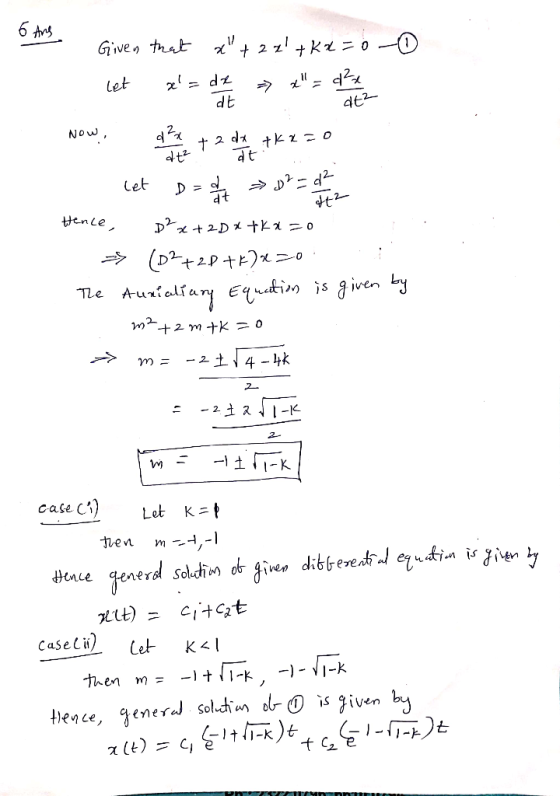
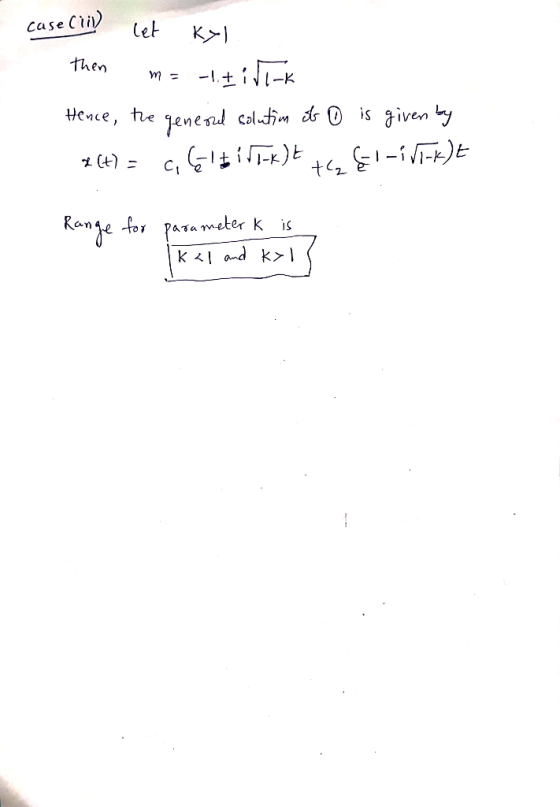
6. Consider the differential equation "+2 +kz -0. (b) (10 points) Identify the bifurcation points for...
Consider the nondimensional differential equation du where u is an unknown parameter (constant) (a) Determine the equil...
 Consider the nondimensional differential equation du where u is an unknown parameter (constant) (a) Determine the equilibrium solutions in terms of μ. (b) Draw the bifurcation diagram and clearly identify the bifurcation point. (c) Classify the stability of the branches in your bifurcation diagram using the process in class where we assumed u(t)uilibrium +u(t) where uequilibrium is the constant(s) you determined in (a) Repeat the steps in exercise (2) for the nondimensional differential equation given by du_2 dt where u...
Q1. Below is the bifurcation diagram for a first-order differential equation. y- 2 k=0 k-4 (a) Wr...
 Q1. Below is the bifurcation diagram for a first-order differential equation. y- 2 k=0 k-4 (a) Write down a first-order differential equation that would have this bifur- cation diagram. tative behaviour of solutions occurs. lution if (b) Find bifurcation values of k, i.e., values of k where a change in the quali- uit so.
Q1. Below is the bifurcation diagram for a first-order differential equation. y- 2 k=0 k-4 (a) Write down a first-order differential equation that would have this...
Q1. Below is the bifurcation diagram for a first-order differential equation. y- 2 k=0 k-4 (a) Write down a first-order differential equation that would have this bifur- cation diagram. tative behaviour of solutions occurs. lution if (b) Find bifurcation values of k, i.e., values of k where a change in the quali- uit so.
Q1. Below is the bifurcation diagram for a first-order differential equation. y- 2 k=0 k-4 (a) Write down a first-order differential equation that would have this...
2(a) Consider the one-parameter family of nonlinear ordinary differential equations -Ita-) where ...
 2(a) Consider the one-parameter family of nonlinear ordinary differential equations -Ita-) where a is a real parameter. i. Find all equilibrium points. ii. Sketch the bifurcation diagram, and indicate the behaviour of non- equilibrium solutions using appropriate arrows. ii. Find all bifurcation points and classify them
2(a) Consider the one-parameter family of nonlinear ordinary differential equations -Ita-) where a is a real parameter. i. Find all equilibrium points. ii. Sketch the bifurcation diagram, and indicate the behaviour of non- equilibrium...
2(a) Consider the one-parameter family of nonlinear ordinary differential equations -Ita-) where a is a real parameter. i. Find all equilibrium points. ii. Sketch the bifurcation diagram, and indicate the behaviour of non- equilibrium solutions using appropriate arrows. ii. Find all bifurcation points and classify them
2(a) Consider the one-parameter family of nonlinear ordinary differential equations -Ita-) where a is a real parameter. i. Find all equilibrium points. ii. Sketch the bifurcation diagram, and indicate the behaviour of non- equilibrium...
Section B - Answer any two questions. 2. (a) Consider the one-parameter family of nonlinear ordin...
 Section B - Answer any two questions. 2. (a) Consider the one-parameter family of nonlinear ordinary differential equations dr where a is a real parameter. i. Find all equilibrium points. ii. Sketch the bifurcation diagram, and indicate the behaviour of non- equilibrium solutions using appropriate arrows. ii. Find all bifurcation points and classify them. 10 Marks (b) Consider the second order differential equation i. Show that (1) can be written as the system of ordinary differential equations (y R for...
Nonlinear differential equations and Bifurcation theory. Given the ordinary differential equation =1+re+ where the parameter r...
 Nonlinear differential equations and Bifurcation
theory.
Given the ordinary differential equation =1+re+ where the parameter r is a given real number. (a) Sketch all the qualitatively different vector fields that occur as r is varied. (b) Show that a saddle-node bifurcation occurs at a critical value of r, to be determined. (c) Sketch the bifurcation diagram of fixed points r* versus r.
Nonlinear differential equations and Bifurcation
theory.
Given the ordinary differential equation =1+re+ where the parameter r is a given real number. (a) Sketch all the qualitatively different vector fields that occur as r is varied. (b) Show that a saddle-node bifurcation occurs at a critical value of r, to be determined. (c) Sketch the bifurcation diagram of fixed points r* versus r.
Bifurcation dy Consider the autonomous differential equation =y? - 2y + 8. We will begin by...
 Bifurcation dy Consider the autonomous differential equation =y? - 2y + 8. We will begin by examining dt the equilibrium solutions of the equation for various values of the parameter 8 1. Find the equilibrium solutions of the equation for 8 = -4,-2, 0, 2, 4 and make a sketch of the phase line for each value. Determine the stability of each equilibria. 2. Use a computer or some other means to sketch some solution curves for each value of...
(5) Consider the following differential equation: z' = (12-4)(p-r2) Here p is a parameter. Sketch a...
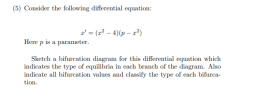 (5) Consider the following differential equation: z' = (12-4)(p-r2) Here p is a parameter. Sketch a bifurcation diagram for this differential equation which indicates the type of equilibria in each branch of the diagram. Also indicate all bifurcation values and classify the type of each bifurca tion.
Consider the nonlinear second-order differential equation x4 3(x')2 + k2x2 - 1 = 0, _ where k > 0 is a constant....
 Consider the nonlinear second-order differential equation x4 3(x')2 + k2x2 - 1 = 0, _ where k > 0 is a constant. Answer to the following questions. (a) Derive a plane autonomous system from the given equation and find all the critical points (b) Classify(discriminate/categorize) all the critical points into one of the three cat- egories: stable / saddle unstable(not saddle)} (c) Show that there is no periodic solution in a simply connected region {(r, y) R2< 0} R =...
Consider the family of differential equations dy/dx=y^3+ky+k^2 Are there any equilibrium solutions when k=0? Draw bifurcation...
 Consider the family of differential equations dy/dx=y^3+ky+k^2 Are there any equilibrium solutions when k=0? Draw bifurcation diagram Draw phase diagram for when k=1/2 Does limit exist when k=1/2 and y(0)=0
Q1 (10 points) Consider the differential equation ty" _ y = 0. a) is this differential...
 Q1 (10 points) Consider the differential equation ty" _ y = 0. a) is this differential equation linear? What is its order? Is it homogeneous? b) Try a solution of the form y=x". Is this a solution for some r? If so, find all such r. c) Based on your answer to a) about linearity and b) about what y=x" are solutions, make an educated guess a the general solution looks like. Try that guess and check that it works....
 Consider the nondimensional differential equation du where u is an unknown parameter (constant) (a) Determine the equilibrium solutions in terms of μ. (b) Draw the bifurcation diagram and clearly identify the bifurcation point. (c) Classify the stability of the branches in your bifurcation diagram using the process in class where we assumed u(t)uilibrium +u(t) where uequilibrium is the constant(s) you determined in (a) Repeat the steps in exercise (2) for the nondimensional differential equation given by du_2 dt where u...
 Q1. Below is the bifurcation diagram for a first-order differential equation. y- 2 k=0 k-4 (a) Write down a first-order differential equation that would have this bifur- cation diagram. tative behaviour of solutions occurs. lution if (b) Find bifurcation values of k, i.e., values of k where a change in the quali- uit so.
Q1. Below is the bifurcation diagram for a first-order differential equation. y- 2 k=0 k-4 (a) Write down a first-order differential equation that would have this...
Q1. Below is the bifurcation diagram for a first-order differential equation. y- 2 k=0 k-4 (a) Write down a first-order differential equation that would have this bifur- cation diagram. tative behaviour of solutions occurs. lution if (b) Find bifurcation values of k, i.e., values of k where a change in the quali- uit so.
Q1. Below is the bifurcation diagram for a first-order differential equation. y- 2 k=0 k-4 (a) Write down a first-order differential equation that would have this...
 2(a) Consider the one-parameter family of nonlinear ordinary differential equations -Ita-) where a is a real parameter. i. Find all equilibrium points. ii. Sketch the bifurcation diagram, and indicate the behaviour of non- equilibrium solutions using appropriate arrows. ii. Find all bifurcation points and classify them
2(a) Consider the one-parameter family of nonlinear ordinary differential equations -Ita-) where a is a real parameter. i. Find all equilibrium points. ii. Sketch the bifurcation diagram, and indicate the behaviour of non- equilibrium...
2(a) Consider the one-parameter family of nonlinear ordinary differential equations -Ita-) where a is a real parameter. i. Find all equilibrium points. ii. Sketch the bifurcation diagram, and indicate the behaviour of non- equilibrium solutions using appropriate arrows. ii. Find all bifurcation points and classify them
2(a) Consider the one-parameter family of nonlinear ordinary differential equations -Ita-) where a is a real parameter. i. Find all equilibrium points. ii. Sketch the bifurcation diagram, and indicate the behaviour of non- equilibrium...
 Section B - Answer any two questions. 2. (a) Consider the one-parameter family of nonlinear ordinary differential equations dr where a is a real parameter. i. Find all equilibrium points. ii. Sketch the bifurcation diagram, and indicate the behaviour of non- equilibrium solutions using appropriate arrows. ii. Find all bifurcation points and classify them. 10 Marks (b) Consider the second order differential equation i. Show that (1) can be written as the system of ordinary differential equations (y R for...
 Nonlinear differential equations and Bifurcation
theory.
Given the ordinary differential equation =1+re+ where the parameter r is a given real number. (a) Sketch all the qualitatively different vector fields that occur as r is varied. (b) Show that a saddle-node bifurcation occurs at a critical value of r, to be determined. (c) Sketch the bifurcation diagram of fixed points r* versus r.
Nonlinear differential equations and Bifurcation
theory.
Given the ordinary differential equation =1+re+ where the parameter r is a given real number. (a) Sketch all the qualitatively different vector fields that occur as r is varied. (b) Show that a saddle-node bifurcation occurs at a critical value of r, to be determined. (c) Sketch the bifurcation diagram of fixed points r* versus r.
 Bifurcation dy Consider the autonomous differential equation =y? - 2y + 8. We will begin by examining dt the equilibrium solutions of the equation for various values of the parameter 8 1. Find the equilibrium solutions of the equation for 8 = -4,-2, 0, 2, 4 and make a sketch of the phase line for each value. Determine the stability of each equilibria. 2. Use a computer or some other means to sketch some solution curves for each value of...
 (5) Consider the following differential equation: z' = (12-4)(p-r2) Here p is a parameter. Sketch a bifurcation diagram for this differential equation which indicates the type of equilibria in each branch of the diagram. Also indicate all bifurcation values and classify the type of each bifurca tion.
 Consider the nonlinear second-order differential equation x4 3(x')2 + k2x2 - 1 = 0, _ where k > 0 is a constant. Answer to the following questions. (a) Derive a plane autonomous system from the given equation and find all the critical points (b) Classify(discriminate/categorize) all the critical points into one of the three cat- egories: stable / saddle unstable(not saddle)} (c) Show that there is no periodic solution in a simply connected region {(r, y) R2< 0} R =...
 Consider the family of differential equations dy/dx=y^3+ky+k^2 Are there any equilibrium solutions when k=0? Draw bifurcation diagram Draw phase diagram for when k=1/2 Does limit exist when k=1/2 and y(0)=0
 Q1 (10 points) Consider the differential equation ty" _ y = 0. a) is this differential equation linear? What is its order? Is it homogeneous? b) Try a solution of the form y=x". Is this a solution for some r? If so, find all such r. c) Based on your answer to a) about linearity and b) about what y=x" are solutions, make an educated guess a the general solution looks like. Try that guess and check that it works....
Most questions answered within 3 hours.
-
Where is the error in this code sequence?
String s1 = "Hello";
String s2 = "ello";...
asked 10 months ago -
Financial data for Joel de Paris, Inc., for last year
follow:
Joel de Paris, Inc.
Balance...
asked 10 months ago -
Consider this reaction:
Al2(SO4)3 (aq)+ BaCl3
(aq) Al2Cl6 (aq)- +
3BaSO4(s) . What is the...
asked 10 months ago -
Suppose that Savneet is considering increasing her
recent random sample from 20 car rentals to 40...
asked 10 months ago -
Trucks arrive at an unloading terminal at an average rate of 120
per hour.
Trucks arrive...
asked 10 months ago -
Why are methanol and ethanol completely soluble in water while
octanol is not very little soluble....
asked 10 months ago -
A facilities manager at a university reads in a research report
that the mean amount of...
asked 10 months ago -
When the CuSO4 is rehydrated by adding water to the anhydrous
compound, is this an endothermic...
asked 10 months ago -
A ray of sunlight is passing from diamond into crown glass; the
angle of incidence is...
asked 10 months ago -
A block of mass 0.249 kg is placed on top of a light, vertical
spring of...
asked 10 months ago -
how do the kidneys compensate in the presences of acidosis
a) trigger hyperventilate
b) reserve acid...
asked 10 months ago -
Question 501 pts
The rental rate of capital to the firm increases. Which of the
following...
asked 10 months ago