a and b at the end, nothing else, not the first part a and b at the end, nothing else, not the first parta and b at the end, nothing else, not the first parta and b at the end, nothing else, not the first parta and b at the end, nothing else, not the first parta and b at the end, nothing else, not the first parta and b at the end, nothing else, not the first parta and b at the end, nothing else, not the first parta and b at the end, nothing else, not the first parta and b at the end, nothing else, not the first parta and b at the end, nothing else, not the first parta and b at the end, nothing else, not the first parta and b at the end, nothing else, not the first parta and b at the end, nothing else, not the first parta and b at the end, nothing else, not the first parta and b at the end, nothing else, not the first part
a and b at the end, nothing else, not the first part a and b at the end, nothing else, not the first part a and b at the end, nothing else, not the first part a and b at the end, nothing else, not the first part a and b at the end, nothing else, not the first part a and b at the end, nothing else, not the first part a and b at the end, nothing else, not the first part
Homework Answers
a)
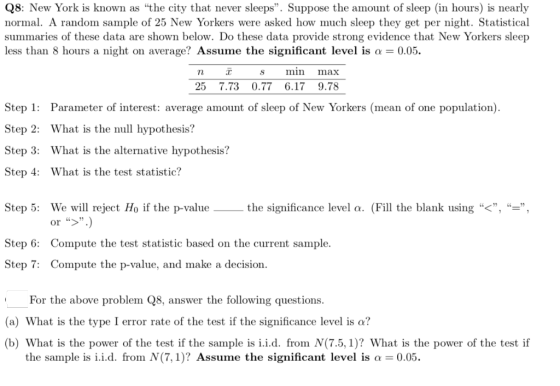
The type I error rate or significance level is the probability of rejecting the null hypothesis given that it is true. It is denoted by the Greek letter α (alpha) and is also called the alpha level.
hence type i error is α
b)
power of test is rejecting the null when it is not true
we reject the null when
Xbar < 7.73 + t * s /sqrt(n)
here
s = 0.77
n = 25
df = n-1 = 24
t = =T.INV(0.05,24)
= -1.71088
Xbar < 7.73 - 1.71088 * 0.77/sqrt(25)
< 7.46652448
power when sample is from N(7.5,1)
P(Xbar < 7.46652448 | N(7.5,1))
= P(Z <(7.46652448 - 7.5)/(1/sqrt(25)))
= P(Z < -0.1673776 )
= 0.433536475
when sample is from N(7,1)
P(Xbar < 7.46652448 | N(7,1))
= P(Z <(7.46652448 - 7)/(1/sqrt(25)))
= P(Z < 2.3326224)
= 0.990166
Please rate
Q8: New York is known as "the city that never sleeps". Suppose the amount of sleep (in hours) is ...
 ONLY a and b at the end
Q8: New York is known as "the city that never sleeps". Suppose the amount of sleep (in hours) is nearly normal. A random sample of 25 New Yorkers were asked how much sleep they get per night. Statistical summaries of these data are shown below. Do these data provide strong evidence that New Yorkers sleep less than 8 hours a night on average? Assume the significant level is α-0.05. in max 257.73 0.77...
ONLY a and b at the end
Q8: New York is known as "the city that never sleeps". Suppose the amount of sleep (in hours) is nearly normal. A random sample of 25 New Yorkers were asked how much sleep they get per night. Statistical summaries of these data are shown below. Do these data provide strong evidence that New Yorkers sleep less than 8 hours a night on average? Assume the significant level is α-0.05. in max 257.73 0.77...
The average adult is supposed to get 8 hours of sleep a night. A "sleep habits"...
The average adult is supposed to get 8 hours of sleep a night. A "sleep habits" survey answered by 28 randomly selected New Yorkers contained the question "How much sleep do you get per night?" The sample average was 7.75 hours, with a corresponding sample standard deviation of 0.8 hours. Conduct a hypothesis test to see if there is evidence that New Yorkers (who live, after all, in "the city that never sleeps") on average get less than 8 hours...
A "sleep habits" survey answered by 25 randomly selected New Yorkers contained the question "How much...
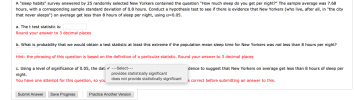 A "sleep habits" survey answered by 25 randomly selected New Yorkers contained the question "How much sleep do you get per night?" The sample average was 7.68 hours, with a corresponding sample standard deviation of 0.8 hours. Conduct a hypothesis test to see if there is evidence that New Yorkers (who live, after all, in "the city that never sleeps") on average get less than 8 hours of sleep per night, using a=0.05. a. The t test statistic is: Round...
--------A sample of 36 observations is selected from a normal population. The sample mean is 34,...
--------A sample of 36 observations is selected from a normal population. The sample mean is 34, and the population standard deviation is 5. Carry out a hypothesis test (with a level of significance α of 0.05) of the null hypothesis H0: µ ≥ 35 using the 6-step procedure ---------Suppose that someone claims that the mean number of sick days taken by U.S. employees is 5.1. You decide to investigate that claim and take a representative sample of 87 U.S. employees...
Suppose that we are interested in determining whether cats tend to sleep more than 12 hours...
 Suppose that we are interested in determining whether cats tend to sleep more than 12 hours a day on average let denote the true number of hours that cats sleep each night. You observe 32 cats for a day and record the number of hours that each of the cats slept. The average of your samples 13.1 hours and the sample standard deviation of your sample is 2.8 hours. Your confidence intervalis (a) Construct a 99% confidence interval for hours...
In R, Part 1. Learn to understand the significance level α in hypothesis testing. a) Generate a matrix “ss” with 1000 rows and 10 columns. The elements of “ss” are random samples from standard normal...
In R, Part 1. Learn to understand the significance level α in hypothesis testing. a) Generate a matrix “ss” with 1000 rows and 10 columns. The elements of “ss” are random samples from standard normal distribution. b) Run the following lines: mytest <- function(x) { return(t.test(x,mu=0)$p.value) } mytest(rnorm(100)) Note that, when you input a vector in the function mytest, you will get the p-value for the one sample t-test H0 : µ = 0 vs Ha : µ =/= 0....
1. According to a recent report, 38% of adults wait until they are 30 years of...
1. According to a recent report, 38% of adults wait until they are 30 years of age or older to get married for the first time. A researcher believes this claimed value is too low. He gathers data in order to test the hypotheses Ho: p = 0.38 vs. Ha: p > 0.38. In these hypotheses, what does p represent? A. The p-value B. The sample proportion C. The population proportion D. The sample mean E. The population mean 2....
Can someone explain each part of this? 98. The tail area above a test statistic value...
 Can someone explain each part of this?
98. The tail area above a test statistic value of z- 1.812 is 0.035. Determine whether each of the following statements is true or false. A) If the alternative hypothesis is of the form Ha: μ> μ , the data are statistically significant at significance level α 0.05. B) If the alternative hypothesis is of the form Ha: μ > μ, the data are statistically significant at significance level α-0.10. C) If the...
Can someone explain each part of this?
98. The tail area above a test statistic value of z- 1.812 is 0.035. Determine whether each of the following statements is true or false. A) If the alternative hypothesis is of the form Ha: μ> μ , the data are statistically significant at significance level α 0.05. B) If the alternative hypothesis is of the form Ha: μ > μ, the data are statistically significant at significance level α-0.10. C) If the...
A poll of 2,142 randomly selected adults showed that 92% of them own cell phones. The...
A poll of 2,142 randomly selected adults showed that 92% of them own cell phones. The technology display below results from a test of the claim that 91% of adults own cell phones. Use the normal distribution as an approximation to the binomial distribution, and assume a 0.05 significance level to complete parts (a) through (e). Test of p=0.91 vs p≠0.91 Sample X N Sample p 95% CI Z-Value P-Value 1 1970 2,142 0.919701 (0.908193,0.931210) 1.57 0.117 a. Is the...
6. A claim is made that college students spend 75% of their time on either sleeping...
6. A claim is made that college students spend 75% of their time on either sleeping or socializing. You do not believe this claim, and you set out to conduct a hypothesis test with the following hypotheses: Ho: p = 0.75 vs. Ha: p ≠ 0.75. If you gather data from a sample and compute a test statistic equal to -0.6, what would the p-value be? 7. Return to Question 6. The fact that the test statistic is negative tells...
 ONLY a and b at the end
Q8: New York is known as "the city that never sleeps". Suppose the amount of sleep (in hours) is nearly normal. A random sample of 25 New Yorkers were asked how much sleep they get per night. Statistical summaries of these data are shown below. Do these data provide strong evidence that New Yorkers sleep less than 8 hours a night on average? Assume the significant level is α-0.05. in max 257.73 0.77...
ONLY a and b at the end
Q8: New York is known as "the city that never sleeps". Suppose the amount of sleep (in hours) is nearly normal. A random sample of 25 New Yorkers were asked how much sleep they get per night. Statistical summaries of these data are shown below. Do these data provide strong evidence that New Yorkers sleep less than 8 hours a night on average? Assume the significant level is α-0.05. in max 257.73 0.77...
 A "sleep habits" survey answered by 25 randomly selected New Yorkers contained the question "How much sleep do you get per night?" The sample average was 7.68 hours, with a corresponding sample standard deviation of 0.8 hours. Conduct a hypothesis test to see if there is evidence that New Yorkers (who live, after all, in "the city that never sleeps") on average get less than 8 hours of sleep per night, using a=0.05. a. The t test statistic is: Round...
 Suppose that we are interested in determining whether cats tend to sleep more than 12 hours a day on average let denote the true number of hours that cats sleep each night. You observe 32 cats for a day and record the number of hours that each of the cats slept. The average of your samples 13.1 hours and the sample standard deviation of your sample is 2.8 hours. Your confidence intervalis (a) Construct a 99% confidence interval for hours...
 Can someone explain each part of this?
98. The tail area above a test statistic value of z- 1.812 is 0.035. Determine whether each of the following statements is true or false. A) If the alternative hypothesis is of the form Ha: μ> μ , the data are statistically significant at significance level α 0.05. B) If the alternative hypothesis is of the form Ha: μ > μ, the data are statistically significant at significance level α-0.10. C) If the...
Can someone explain each part of this?
98. The tail area above a test statistic value of z- 1.812 is 0.035. Determine whether each of the following statements is true or false. A) If the alternative hypothesis is of the form Ha: μ> μ , the data are statistically significant at significance level α 0.05. B) If the alternative hypothesis is of the form Ha: μ > μ, the data are statistically significant at significance level α-0.10. C) If the...
Most questions answered within 3 hours.
-
Where is the error in this code sequence?
String s1 = "Hello";
String s2 = "ello";...
asked 10 months ago -
Financial data for Joel de Paris, Inc., for last year
follow:
Joel de Paris, Inc.
Balance...
asked 10 months ago -
Consider this reaction:
Al2(SO4)3 (aq)+ BaCl3
(aq) Al2Cl6 (aq)- +
3BaSO4(s) . What is the...
asked 10 months ago -
Suppose that Savneet is considering increasing her
recent random sample from 20 car rentals to 40...
asked 10 months ago -
Trucks arrive at an unloading terminal at an average rate of 120
per hour.
Trucks arrive...
asked 10 months ago -
Why are methanol and ethanol completely soluble in water while
octanol is not very little soluble....
asked 10 months ago -
A facilities manager at a university reads in a research report
that the mean amount of...
asked 10 months ago -
When the CuSO4 is rehydrated by adding water to the anhydrous
compound, is this an endothermic...
asked 10 months ago -
A ray of sunlight is passing from diamond into crown glass; the
angle of incidence is...
asked 10 months ago -
A block of mass 0.249 kg is placed on top of a light, vertical
spring of...
asked 10 months ago -
how do the kidneys compensate in the presences of acidosis
a) trigger hyperventilate
b) reserve acid...
asked 10 months ago -
Question 501 pts
The rental rate of capital to the firm increases. Which of the
following...
asked 10 months ago