
Homework Answers
Add Answer to:
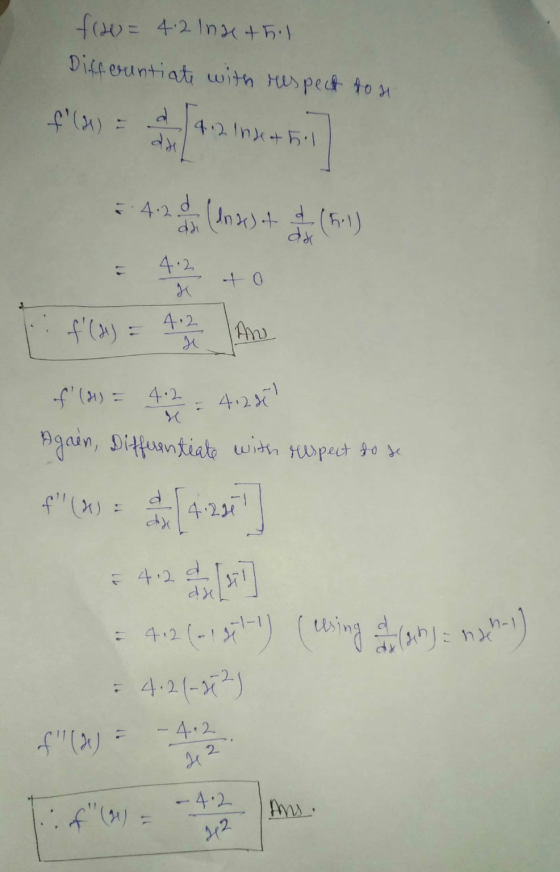
Write the first and second derivatives of the function. f(x) = 4.2 In x + 5.1...
(x + 1)2 Consider the function f(x) -. The first and second derivatives of f(x) are...
 (x + 1)2 Consider the function f(x) -. The first and second derivatives of f(x) are 1 + x2 2(1 – x2) 4x(x2 - 3) f'(x) = and f" (2) Using this information, (1 + x2) (1 + x2)3 (a) Find all relative extrema. (4 points) Minimum: Maximum: (b) Find the intervals of concavity for f(x) and identify any inflection points for yourself. (5 points) Concave up: Concave down: (c) Using the fact that lim f(x) = 1, and our...
. M Compute all the first and second partial derivatives of the function f(x,t) = 2...
 . M Compute all the first and second partial derivatives of the function f(x,t) = 2 COS(4+3 – 27t) af ar af at 22 a22 TO M PO 02f δεδε 02f at2 M
15 4 23 Let fbe a function having derivatives of all orders for all real numbers. Selected values of fand its first four derivatives are shown in the table above. 6. a) Write the second-degree Taylor...
 15 4 23 Let fbe a function having derivatives of all orders for all real numbers. Selected values of fand its first four derivatives are shown in the table above. 6. a) Write the second-degree Taylor polynomial for faboutx0 and use it to approximate f(0.2). (b) Let g be a function such that g(x) -fx Write the fifth-degree Taylor polynomial for g', the derivative of g, about x = 0 We were unable to transcribe this image
15 4 23...
15 4 23 Let fbe a function having derivatives of all orders for all real numbers. Selected values of fand its first four derivatives are shown in the table above. 6. a) Write the second-degree Taylor polynomial for faboutx0 and use it to approximate f(0.2). (b) Let g be a function such that g(x) -fx Write the fifth-degree Taylor polynomial for g', the derivative of g, about x = 0 We were unable to transcribe this image
15 4 23...
Find the first-order partial derivatives (fr. f,) and second-order partial derivatives (fxxıfyy, fxy, fyx) of the...
 Find the first-order partial derivatives (fr. f,) and second-order partial derivatives (fxxıfyy, fxy, fyx) of the following functions. a. f(x,y)=x’y+x’y? +x+y? b. f(x, y) = (x + y)? Find the critical points at which the following function may be optimized and determine whether at these points the function is maximized, minimized or at a saddle point. z = 5x2 – 3y2 – 30x + 7y + 4xy
Find the first and second derivatives of the function. g(x) = -2x3 + 10x2 + 7x...
 Find the first and second derivatives of the function. g(x) = -2x3 + 10x2 + 7x - 70 g'(x) = g"(x) = Type here to search o
Find the first and second derivatives of the function. g(x) = -2x3 + 10x2 + 7x...
 Find the first and second derivatives of the function. g(x) = -2x3 + 10x2 + 7x - 70 g'(x) = -61? + 20u+7 9"(x) = –12x + 20 Type here to search o
Let f be a function having derivatives of all orders for all real numbers. Selected values of f and its first four derivatives are shown in the table above.
 Let f be a function having derivatives of all orders for all real numbers. Selected values of f and its first four derivatives are shown in the table above. (a) Write the second-degree Taylor polynomial for f about x = 0 and use it to approximate f(0.2). (b) Let g be a function such that g(x) =f(x3). Write the fifth-degree Taylor polynomial for g', the derivative of g, about x = 0. (c) Write the third-degree Taylor polynomial for f about x =...
4. Find the second partial derivatives for the function f(x,y) = x+yat (1,0). (6 Pts)
 4. Find the second partial derivatives for the function f(x,y) = x+yat (1,0). (6 Pts)
5. (a) Suppose f is any function with continuous second-order partial derivatives such that f(0,0) =...
 5. (a) Suppose f is any function with continuous second-order partial derivatives such that f(0,0) = 0 and (0,0) is a critical point of f. Write an expression for the second-degree Taylor polynomial, Q, of f at (0,0).
for the following function: 3. Find all first and second partial derivatives, of of of of...
 for the following function: 3. Find all first and second partial derivatives, of of of of of Ꭷr ' Ꭷy ' Ꭷra ' ayya ' ᎧyᎧr f(, y =re*v
 (x + 1)2 Consider the function f(x) -. The first and second derivatives of f(x) are 1 + x2 2(1 – x2) 4x(x2 - 3) f'(x) = and f" (2) Using this information, (1 + x2) (1 + x2)3 (a) Find all relative extrema. (4 points) Minimum: Maximum: (b) Find the intervals of concavity for f(x) and identify any inflection points for yourself. (5 points) Concave up: Concave down: (c) Using the fact that lim f(x) = 1, and our...
 . M Compute all the first and second partial derivatives of the function f(x,t) = 2 COS(4+3 – 27t) af ar af at 22 a22 TO M PO 02f δεδε 02f at2 M
 15 4 23 Let fbe a function having derivatives of all orders for all real numbers. Selected values of fand its first four derivatives are shown in the table above. 6. a) Write the second-degree Taylor polynomial for faboutx0 and use it to approximate f(0.2). (b) Let g be a function such that g(x) -fx Write the fifth-degree Taylor polynomial for g', the derivative of g, about x = 0 We were unable to transcribe this image
15 4 23...
15 4 23 Let fbe a function having derivatives of all orders for all real numbers. Selected values of fand its first four derivatives are shown in the table above. 6. a) Write the second-degree Taylor polynomial for faboutx0 and use it to approximate f(0.2). (b) Let g be a function such that g(x) -fx Write the fifth-degree Taylor polynomial for g', the derivative of g, about x = 0 We were unable to transcribe this image
15 4 23...
 Find the first-order partial derivatives (fr. f,) and second-order partial derivatives (fxxıfyy, fxy, fyx) of the following functions. a. f(x,y)=x’y+x’y? +x+y? b. f(x, y) = (x + y)? Find the critical points at which the following function may be optimized and determine whether at these points the function is maximized, minimized or at a saddle point. z = 5x2 – 3y2 – 30x + 7y + 4xy
 Find the first and second derivatives of the function. g(x) = -2x3 + 10x2 + 7x - 70 g'(x) = g"(x) = Type here to search o
 Find the first and second derivatives of the function. g(x) = -2x3 + 10x2 + 7x - 70 g'(x) = -61? + 20u+7 9"(x) = –12x + 20 Type here to search o
 4. Find the second partial derivatives for the function f(x,y) = x+yat (1,0). (6 Pts)
 5. (a) Suppose f is any function with continuous second-order partial derivatives such that f(0,0) = 0 and (0,0) is a critical point of f. Write an expression for the second-degree Taylor polynomial, Q, of f at (0,0).
 for the following function: 3. Find all first and second partial derivatives, of of of of of Ꭷr ' Ꭷy ' Ꭷra ' ayya ' ᎧyᎧr f(, y =re*v
Most questions answered within 3 hours.
-
Where is the error in this code sequence?
String s1 = "Hello";
String s2 = "ello";...
asked 10 months ago -
Financial data for Joel de Paris, Inc., for last year
follow:
Joel de Paris, Inc.
Balance...
asked 10 months ago -
Consider this reaction:
Al2(SO4)3 (aq)+ BaCl3
(aq) Al2Cl6 (aq)- +
3BaSO4(s) . What is the...
asked 10 months ago -
Suppose that Savneet is considering increasing her
recent random sample from 20 car rentals to 40...
asked 10 months ago -
Trucks arrive at an unloading terminal at an average rate of 120
per hour.
Trucks arrive...
asked 10 months ago -
Why are methanol and ethanol completely soluble in water while
octanol is not very little soluble....
asked 10 months ago -
A facilities manager at a university reads in a research report
that the mean amount of...
asked 10 months ago -
When the CuSO4 is rehydrated by adding water to the anhydrous
compound, is this an endothermic...
asked 10 months ago -
A ray of sunlight is passing from diamond into crown glass; the
angle of incidence is...
asked 10 months ago -
A block of mass 0.249 kg is placed on top of a light, vertical
spring of...
asked 10 months ago -
how do the kidneys compensate in the presences of acidosis
a) trigger hyperventilate
b) reserve acid...
asked 10 months ago -
Question 501 pts
The rental rate of capital to the firm increases. Which of the
following...
asked 10 months ago