
Homework Answers


Add Answer to:
7) Consider the following two state tables and minimize the number of states. Present Next State...
3. Minimize the number of states for the state table below. Provide a reduced state table Next St...
 3. Minimize the number of states for the state table below. Provide a reduced state table Next State Present State 00 01 10 Output So 1 S20 S1 S2 82 S3I S2 83 83 S0 so S1 84 855 S6 85 6 6 87 86 7 S7 So0 S4 S6
3. Minimize the number of states for the state table below. Provide a reduced state table Next State Present State 00 01 10 Output So 1 S20 S1 S2 82...
3. Minimize the number of states for the state table below. Provide a reduced state table Next State Present State 00 01 10 Output So 1 S20 S1 S2 82 S3I S2 83 83 S0 so S1 84 855 S6 85 6 6 87 86 7 S7 So0 S4 S6
3. Minimize the number of states for the state table below. Provide a reduced state table Next State Present State 00 01 10 Output So 1 S20 S1 S2 82...
Using the implication table method, minimize the number of states in the finite state machine whose...
 Using the implication table method, minimize the number of
states in the finite state machine whose state and output
transition table is shown below.
You must submit:
a. All implication tables used for minimization. As it comes in the
examples on the class slides.
b. The state and output transition table showing the minimized
MEF.
PS NS A B с D E F G X = 0 A с A C G C E X = 1 B A D...
Using the implication table method, minimize the number of
states in the finite state machine whose state and output
transition table is shown below.
You must submit:
a. All implication tables used for minimization. As it comes in the
examples on the class slides.
b. The state and output transition table showing the minimized
MEF.
PS NS A B с D E F G X = 0 A с A C G C E X = 1 B A D...
how redundant states may be found and eliminated to minimize this FSM Next state Current x1x0...
 how redundant states may be found and eliminated to minimize
this FSM
Next state Current x1x0 Output state 00 01 11 10 Z1 ZO A A B D CO 0 B BCE DO 1 с CDF E 1 1 D DE GF 1 0 E E FHG 0 0 F F GAH HO 1 G GH B A 1 1 H HACB 1 0
how redundant states may be found and eliminated to minimize
this FSM
Next state Current x1x0 Output state 00 01 11 10 Z1 ZO A A B D CO 0 B BCE DO 1 с CDF E 1 1 D DE GF 1 0 E E FHG 0 0 F F GAH HO 1 G GH B A 1 1 H HACB 1 0
Problem 1. (10 Points) FSM Optimization Reduce the number of states in the following state table...
 Problem 1. (10 Points) FSM Optimization Reduce the number of states in the following state table and tabulate the reduced state table: Next State Output Present state X-1 X-0 X-0 X=1 В 0 в C 0 0 C F E 0 D G A 1 C 0 0 В 1 1 G G н 0 1 н G 0 А
For each of the following state machines use implication tables to see if there are any...
 For each of the following state machines use implication tables to see if there are any equivalent states. If so, give the reduced state table. (NOTE: PS-present state, NS-next state, Z output and x- input) Problem #1 NS PS X ?|23 ?|13 3 4 30 4 4 5 ?|2710 715o
7. Consider the two finite-state machines shown below FSM1 0,1 FSM2 0.0 Start Start 50 0.1...
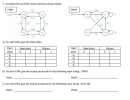 7. Consider the two finite-state machines shown below FSM1 0,1 FSM2 0.0 Start Start 50 0.1 0.11,0 0.0 0.0 0.0 1,0 0.0 a) For each FSM, give the state table. FSM1 State Output 0 FSM2 State Next state 0 Output 0 Next state 0 b) For each FSM, give the output produced for the following input string: 10001 FSM1: FSM2: c) For each FSM, give the output produced for the following input string: 0101101 FSM1: FSM2:
T = 1 a 1 c f 1 1. Consider the following state table. Next State...
 T = 1 a 1 c f 1 1. Consider the following state table. Next State Present State Output y x=0 1 c=0 8 b 1 b d 0 0 e d b 0 f 0 0 f b 8 0 1 g d 0 (a) (4 points) Draw a state diagram based on the given state table. 0 1 2009 e e 1 (b) (4 points) Obtain a reduced state table and draw the reduced state diagram.
and the arrows represent possible action transitions. S is the start state and there are two goal states: G1 and G1. The cost of each action is given by the number next to the arrow. Each state is la...
 and the arrows represent possible action transitions. S is the start state and there are two goal states: G1 and G1. The cost of each action is given by the number next to the arrow. Each state is labelled by an identifying name (S, A-F, G1, G2, H) and also a number. The number is the value of a heuristic function, which gives an estimate of the cost of getting to the nearest goal from that node. (a) Consider the...
or g) Consider the following state diagram with three inputs e-amd eleck) and two outputs We...
 or g) Consider the following state diagram with three inputs e-amd eleck) and two outputs We propose to design the following sequential circuit using D flip lops. Sequential Circuit idle r1 gnti We propose the following state coding: rira t2 State Name State Code idle ent LEnt2 01 gnt2 (2 marks) 1) Complete the following state table. r2 Present state I Output Input Next state 0 0 0 0 0 0 0 0 1 10 0 0 0
4. Create a 1-hot implementation of the traffic light state machine from problem #2 (a) Create the state table with state assignments, showing the next states as a function of the input and the outpu...
 4. Create a 1-hot implementation of the traffic light state machine from problem #2 (a) Create the state table with state assignments, showing the next states as a function of the input and the outputs as a function of the present state. (b) Determine the logic equations for the next state inputs to the flops, and for the six output control signals.
4. Create a 1-hot implementation of the traffic light state machine from problem #2 (a) Create the state...
4. Create a 1-hot implementation of the traffic light state machine from problem #2 (a) Create the state table with state assignments, showing the next states as a function of the input and the outputs as a function of the present state. (b) Determine the logic equations for the next state inputs to the flops, and for the six output control signals.
4. Create a 1-hot implementation of the traffic light state machine from problem #2 (a) Create the state...
 3. Minimize the number of states for the state table below. Provide a reduced state table Next State Present State 00 01 10 Output So 1 S20 S1 S2 82 S3I S2 83 83 S0 so S1 84 855 S6 85 6 6 87 86 7 S7 So0 S4 S6
3. Minimize the number of states for the state table below. Provide a reduced state table Next State Present State 00 01 10 Output So 1 S20 S1 S2 82...
3. Minimize the number of states for the state table below. Provide a reduced state table Next State Present State 00 01 10 Output So 1 S20 S1 S2 82 S3I S2 83 83 S0 so S1 84 855 S6 85 6 6 87 86 7 S7 So0 S4 S6
3. Minimize the number of states for the state table below. Provide a reduced state table Next State Present State 00 01 10 Output So 1 S20 S1 S2 82...
 Using the implication table method, minimize the number of
states in the finite state machine whose state and output
transition table is shown below.
You must submit:
a. All implication tables used for minimization. As it comes in the
examples on the class slides.
b. The state and output transition table showing the minimized
MEF.
PS NS A B с D E F G X = 0 A с A C G C E X = 1 B A D...
Using the implication table method, minimize the number of
states in the finite state machine whose state and output
transition table is shown below.
You must submit:
a. All implication tables used for minimization. As it comes in the
examples on the class slides.
b. The state and output transition table showing the minimized
MEF.
PS NS A B с D E F G X = 0 A с A C G C E X = 1 B A D...
 how redundant states may be found and eliminated to minimize
this FSM
Next state Current x1x0 Output state 00 01 11 10 Z1 ZO A A B D CO 0 B BCE DO 1 с CDF E 1 1 D DE GF 1 0 E E FHG 0 0 F F GAH HO 1 G GH B A 1 1 H HACB 1 0
how redundant states may be found and eliminated to minimize
this FSM
Next state Current x1x0 Output state 00 01 11 10 Z1 ZO A A B D CO 0 B BCE DO 1 с CDF E 1 1 D DE GF 1 0 E E FHG 0 0 F F GAH HO 1 G GH B A 1 1 H HACB 1 0
 Problem 1. (10 Points) FSM Optimization Reduce the number of states in the following state table and tabulate the reduced state table: Next State Output Present state X-1 X-0 X-0 X=1 В 0 в C 0 0 C F E 0 D G A 1 C 0 0 В 1 1 G G н 0 1 н G 0 А
 For each of the following state machines use implication tables to see if there are any equivalent states. If so, give the reduced state table. (NOTE: PS-present state, NS-next state, Z output and x- input) Problem #1 NS PS X ?|23 ?|13 3 4 30 4 4 5 ?|2710 715o
 7. Consider the two finite-state machines shown below FSM1 0,1 FSM2 0.0 Start Start 50 0.1 0.11,0 0.0 0.0 0.0 1,0 0.0 a) For each FSM, give the state table. FSM1 State Output 0 FSM2 State Next state 0 Output 0 Next state 0 b) For each FSM, give the output produced for the following input string: 10001 FSM1: FSM2: c) For each FSM, give the output produced for the following input string: 0101101 FSM1: FSM2:
 T = 1 a 1 c f 1 1. Consider the following state table. Next State Present State Output y x=0 1 c=0 8 b 1 b d 0 0 e d b 0 f 0 0 f b 8 0 1 g d 0 (a) (4 points) Draw a state diagram based on the given state table. 0 1 2009 e e 1 (b) (4 points) Obtain a reduced state table and draw the reduced state diagram.
 and the arrows represent possible action transitions. S is the start state and there are two goal states: G1 and G1. The cost of each action is given by the number next to the arrow. Each state is labelled by an identifying name (S, A-F, G1, G2, H) and also a number. The number is the value of a heuristic function, which gives an estimate of the cost of getting to the nearest goal from that node. (a) Consider the...
 or g) Consider the following state diagram with three inputs e-amd eleck) and two outputs We propose to design the following sequential circuit using D flip lops. Sequential Circuit idle r1 gnti We propose the following state coding: rira t2 State Name State Code idle ent LEnt2 01 gnt2 (2 marks) 1) Complete the following state table. r2 Present state I Output Input Next state 0 0 0 0 0 0 0 0 1 10 0 0 0
 4. Create a 1-hot implementation of the traffic light state machine from problem #2 (a) Create the state table with state assignments, showing the next states as a function of the input and the outputs as a function of the present state. (b) Determine the logic equations for the next state inputs to the flops, and for the six output control signals.
4. Create a 1-hot implementation of the traffic light state machine from problem #2 (a) Create the state...
4. Create a 1-hot implementation of the traffic light state machine from problem #2 (a) Create the state table with state assignments, showing the next states as a function of the input and the outputs as a function of the present state. (b) Determine the logic equations for the next state inputs to the flops, and for the six output control signals.
4. Create a 1-hot implementation of the traffic light state machine from problem #2 (a) Create the state...
Most questions answered within 3 hours.
-
Where is the error in this code sequence?
String s1 = "Hello";
String s2 = "ello";...
asked 10 months ago -
Financial data for Joel de Paris, Inc., for last year
follow:
Joel de Paris, Inc.
Balance...
asked 10 months ago -
Consider this reaction:
Al2(SO4)3 (aq)+ BaCl3
(aq) Al2Cl6 (aq)- +
3BaSO4(s) . What is the...
asked 10 months ago -
Suppose that Savneet is considering increasing her
recent random sample from 20 car rentals to 40...
asked 10 months ago -
Trucks arrive at an unloading terminal at an average rate of 120
per hour.
Trucks arrive...
asked 10 months ago -
Why are methanol and ethanol completely soluble in water while
octanol is not very little soluble....
asked 10 months ago -
A facilities manager at a university reads in a research report
that the mean amount of...
asked 10 months ago -
When the CuSO4 is rehydrated by adding water to the anhydrous
compound, is this an endothermic...
asked 10 months ago -
A ray of sunlight is passing from diamond into crown glass; the
angle of incidence is...
asked 10 months ago -
A block of mass 0.249 kg is placed on top of a light, vertical
spring of...
asked 10 months ago -
how do the kidneys compensate in the presences of acidosis
a) trigger hyperventilate
b) reserve acid...
asked 10 months ago -
Question 501 pts
The rental rate of capital to the firm increases. Which of the
following...
asked 10 months ago