
Homework Answers

Add Answer to:
How are aromatic compounds different from alkenes? 5. Complete the following reactions by drawing the organic...
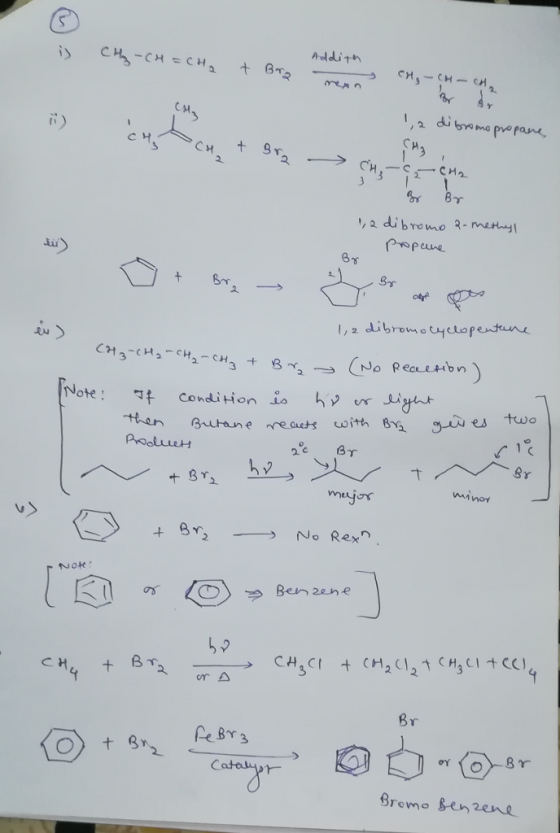
1. Complete the following reactions, with the major organic product. a. CH3-CH=CH2 + Br2 O +...
 1. Complete the following reactions, with the major organic product. a. CH3-CH=CH2 + Br2 O + B12 c. CH3-CH-CH-CH3 +KMnO4+H2O d. CH3CH2-CH=CH-CH2CH3 + H2S04 2. Between hexane, cyclohexene and toluene, which was the most reactive with bromine solution? Explain your reasoning. 3. Based on the chemical tests used in this experiment, is it possible to clearly distinguish between alkanes and alkenes? Explain your reasoning. P
1. Draw structures for the following compounds: a) l-ethyl-2-methylcyclohexane b) 4-methyl hexanal c) N-N-dimethylpentanamide 2. What...
 1. Draw structures for the following compounds: a) l-ethyl-2-methylcyclohexane b) 4-methyl hexanal c) N-N-dimethylpentanamide 2. What is the product of this bromination reaction? H2C-CH=CH-CH2-CH2-CH3 + Br2 3. What is the product of this oxidation reaction? OH H3C-CH-CH-CHg 10 Сн, 4. Consider the esterification reaction reaction below: H, SO H3C-CH2-CH2-CH2-C-OH + H2C-CH2-OH What organic compound is the reactant on the left? What organic compound is the reactant on the right? Draw the product of the reaction. What type of organic compound...
Draw the organic product (if any) expected from each of the following oxidation reactions if only...
 Draw the organic product (if any) expected from each of the following oxidation reactions if only a single oxidation occurs: CH3 -CH2-OH a) H3C 0 + H2O CH3 CHE HOCH-CH-CH3 + H2O CH Hint Previous Give Up & View Solution Check Answer Next Exit
Please answer all 4 questions 1) Draw condensed structure formulas for the following compounds 2) How...
 Please answer all 4 questions
1) Draw condensed structure formulas for the following
compounds
2) How would you describe the difference between saturated and
unsaturated hydrocarbons and what is a distinguishing feature of
aromatic hydrocarbons?
5) Do you expect the aromatic hydrocarbons to react in a similar
way to the cyclic alkenes, since they are both cyclic compounds and
have a double bond? explain
6) write the structure of the product. if no reaction occurs
write NR
Final questions 1....
Please answer all 4 questions
1) Draw condensed structure formulas for the following
compounds
2) How would you describe the difference between saturated and
unsaturated hydrocarbons and what is a distinguishing feature of
aromatic hydrocarbons?
5) Do you expect the aromatic hydrocarbons to react in a similar
way to the cyclic alkenes, since they are both cyclic compounds and
have a double bond? explain
6) write the structure of the product. if no reaction occurs
write NR
Final questions 1....
Complete the following reactions by drawing the structure of the major organic product. ( CH3 mCPBA...
 Complete the following reactions by drawing the structure of the
major organic product.
( CH3 mCPBA CH₂O₂ show dash-wedge CH3 (1) LiAlH draw a chair conformation (2) H30+ NaB (CN) Hz H LII2 C5H1N CH2OH solvent
Complete the following reactions by drawing the structure of the
major organic product.
( CH3 mCPBA CH₂O₂ show dash-wedge CH3 (1) LiAlH draw a chair conformation (2) H30+ NaB (CN) Hz H LII2 C5H1N CH2OH solvent
Organic chemistry There are 20 questions, 5 points each. Complete the following reactions, fill the blanks...
 Organic chemistry
There are 20 questions, 5 points each. Complete the following reactions, fill the blanks for reactante conditions or products. CH3 HI CH3 H2, Pd/C 2. CH3 CH3 1.O 2. CH,SCH, C2 H3C-CEC-CH3 4 1 equivalent HBr, -80°C HCH2 write the main product only
Organic chemistry
There are 20 questions, 5 points each. Complete the following reactions, fill the blanks for reactante conditions or products. CH3 HI CH3 H2, Pd/C 2. CH3 CH3 1.O 2. CH,SCH, C2 H3C-CEC-CH3 4 1 equivalent HBr, -80°C HCH2 write the main product only
2. Reactions: (27 pts) Draw the structure of the expected organic product(s) formed in the following...
 2. Reactions: (27 pts) Draw the structure of the expected organic product(s) formed in the following reactions including correct stereochemistry, if the product is racemic indicate this by either drawing both enantiomers or drawing one and writing racemic. Assume all reagents listed are present in excess unless otherwise noted. If no reaction occurs, state 'No Reaction'. Ha, Pd/C Cl2, hv A) Br CH, OH B) CH3CH,CH, OH H2SO4 D) NaBH "H CH,CH, OH SOCI TEA OTS E) CH SNa DMSO...
2. Reactions: (27 pts) Draw the structure of the expected organic product(s) formed in the following...
 2. Reactions: (27 pts) Draw the structure of the expected organic product(s) formed in the following reactions including correct stereochemistry, if the product is racemic indicate this by either drawing both enantiomers or drawing one and writing racemic. Assume all reagents listed are present in excess unless otherwise noted. If no reaction occurs, state 'No Reaction'. Ha, Pd/C Cl2, hv A) Br CH, OH B) CH3CH,CH, OH H2SO4 D) NaBH "H CH,CH, OH SOCI TEA OTS E) CH SNa DMSO...
Solubility and Reactivity of Alkanes, Alkenes and Aromatic Compounds Advance Study Form *****There are 2 pages...
 Solubility and Reactivity of Alkanes, Alkenes and Aromatic Compounds Advance Study Form *****There are 2 pages to this Advance Study Form ***** 1. a. The structure of cholesterol is shown below. Indicate if cholesterol is saturated or unsaturated. Explain your answer. b. What chemical tests would you run to determine if it saturated or unsaturated? Indicate what color changes you would expect. 2. Why don't we use Cl2 instead of Bra in the test for unsaturation? 3. Predict the product...
2. Reactions: (27 pts) Draw the structure of the expected organic product(s) formed in the following...
 2. Reactions: (27 pts) Draw the structure of the expected organic product(s) formed in the following reactions including correct stereochemistry, if the product is racemic indicate this by either drawing both enantiomers or drawing one and writing racemic. Assume all reagents listed are present in excess unless otherwise noted. If no reaction occurs, state No Reaction'. H, Pd/C Cl2, hv A) Br CH, OH B) CH3CH2CH2OH H2SO4 D NaBH, CH3CH2OH SOCI TEA H OTS CH,SNa DMSO OH F) OH PCC...
 1. Complete the following reactions, with the major organic product. a. CH3-CH=CH2 + Br2 O + B12 c. CH3-CH-CH-CH3 +KMnO4+H2O d. CH3CH2-CH=CH-CH2CH3 + H2S04 2. Between hexane, cyclohexene and toluene, which was the most reactive with bromine solution? Explain your reasoning. 3. Based on the chemical tests used in this experiment, is it possible to clearly distinguish between alkanes and alkenes? Explain your reasoning. P
 1. Draw structures for the following compounds: a) l-ethyl-2-methylcyclohexane b) 4-methyl hexanal c) N-N-dimethylpentanamide 2. What is the product of this bromination reaction? H2C-CH=CH-CH2-CH2-CH3 + Br2 3. What is the product of this oxidation reaction? OH H3C-CH-CH-CHg 10 Сн, 4. Consider the esterification reaction reaction below: H, SO H3C-CH2-CH2-CH2-C-OH + H2C-CH2-OH What organic compound is the reactant on the left? What organic compound is the reactant on the right? Draw the product of the reaction. What type of organic compound...
 Draw the organic product (if any) expected from each of the following oxidation reactions if only a single oxidation occurs: CH3 -CH2-OH a) H3C 0 + H2O CH3 CHE HOCH-CH-CH3 + H2O CH Hint Previous Give Up & View Solution Check Answer Next Exit
 Please answer all 4 questions
1) Draw condensed structure formulas for the following
compounds
2) How would you describe the difference between saturated and
unsaturated hydrocarbons and what is a distinguishing feature of
aromatic hydrocarbons?
5) Do you expect the aromatic hydrocarbons to react in a similar
way to the cyclic alkenes, since they are both cyclic compounds and
have a double bond? explain
6) write the structure of the product. if no reaction occurs
write NR
Final questions 1....
Please answer all 4 questions
1) Draw condensed structure formulas for the following
compounds
2) How would you describe the difference between saturated and
unsaturated hydrocarbons and what is a distinguishing feature of
aromatic hydrocarbons?
5) Do you expect the aromatic hydrocarbons to react in a similar
way to the cyclic alkenes, since they are both cyclic compounds and
have a double bond? explain
6) write the structure of the product. if no reaction occurs
write NR
Final questions 1....
 Complete the following reactions by drawing the structure of the
major organic product.
( CH3 mCPBA CH₂O₂ show dash-wedge CH3 (1) LiAlH draw a chair conformation (2) H30+ NaB (CN) Hz H LII2 C5H1N CH2OH solvent
Complete the following reactions by drawing the structure of the
major organic product.
( CH3 mCPBA CH₂O₂ show dash-wedge CH3 (1) LiAlH draw a chair conformation (2) H30+ NaB (CN) Hz H LII2 C5H1N CH2OH solvent
 Organic chemistry
There are 20 questions, 5 points each. Complete the following reactions, fill the blanks for reactante conditions or products. CH3 HI CH3 H2, Pd/C 2. CH3 CH3 1.O 2. CH,SCH, C2 H3C-CEC-CH3 4 1 equivalent HBr, -80°C HCH2 write the main product only
Organic chemistry
There are 20 questions, 5 points each. Complete the following reactions, fill the blanks for reactante conditions or products. CH3 HI CH3 H2, Pd/C 2. CH3 CH3 1.O 2. CH,SCH, C2 H3C-CEC-CH3 4 1 equivalent HBr, -80°C HCH2 write the main product only
 2. Reactions: (27 pts) Draw the structure of the expected organic product(s) formed in the following reactions including correct stereochemistry, if the product is racemic indicate this by either drawing both enantiomers or drawing one and writing racemic. Assume all reagents listed are present in excess unless otherwise noted. If no reaction occurs, state 'No Reaction'. Ha, Pd/C Cl2, hv A) Br CH, OH B) CH3CH,CH, OH H2SO4 D) NaBH "H CH,CH, OH SOCI TEA OTS E) CH SNa DMSO...
 2. Reactions: (27 pts) Draw the structure of the expected organic product(s) formed in the following reactions including correct stereochemistry, if the product is racemic indicate this by either drawing both enantiomers or drawing one and writing racemic. Assume all reagents listed are present in excess unless otherwise noted. If no reaction occurs, state 'No Reaction'. Ha, Pd/C Cl2, hv A) Br CH, OH B) CH3CH,CH, OH H2SO4 D) NaBH "H CH,CH, OH SOCI TEA OTS E) CH SNa DMSO...
 Solubility and Reactivity of Alkanes, Alkenes and Aromatic Compounds Advance Study Form *****There are 2 pages to this Advance Study Form ***** 1. a. The structure of cholesterol is shown below. Indicate if cholesterol is saturated or unsaturated. Explain your answer. b. What chemical tests would you run to determine if it saturated or unsaturated? Indicate what color changes you would expect. 2. Why don't we use Cl2 instead of Bra in the test for unsaturation? 3. Predict the product...
 2. Reactions: (27 pts) Draw the structure of the expected organic product(s) formed in the following reactions including correct stereochemistry, if the product is racemic indicate this by either drawing both enantiomers or drawing one and writing racemic. Assume all reagents listed are present in excess unless otherwise noted. If no reaction occurs, state No Reaction'. H, Pd/C Cl2, hv A) Br CH, OH B) CH3CH2CH2OH H2SO4 D NaBH, CH3CH2OH SOCI TEA H OTS CH,SNa DMSO OH F) OH PCC...
Most questions answered within 3 hours.
-
Where is the error in this code sequence?
String s1 = "Hello";
String s2 = "ello";...
asked 1 year ago -
Financial data for Joel de Paris, Inc., for last year
follow:
Joel de Paris, Inc.
Balance...
asked 1 year ago -
Consider this reaction:
Al2(SO4)3 (aq)+ BaCl3
(aq) Al2Cl6 (aq)- +
3BaSO4(s) . What is the...
asked 1 year ago -
Suppose that Savneet is considering increasing her
recent random sample from 20 car rentals to 40...
asked 1 year ago -
Trucks arrive at an unloading terminal at an average rate of 120
per hour.
Trucks arrive...
asked 1 year ago -
Why are methanol and ethanol completely soluble in water while
octanol is not very little soluble....
asked 1 year ago -
A facilities manager at a university reads in a research report
that the mean amount of...
asked 1 year ago -
When the CuSO4 is rehydrated by adding water to the anhydrous
compound, is this an endothermic...
asked 1 year ago -
A ray of sunlight is passing from diamond into crown glass; the
angle of incidence is...
asked 1 year ago -
A block of mass 0.249 kg is placed on top of a light, vertical
spring of...
asked 1 year ago -
how do the kidneys compensate in the presences of acidosis
a) trigger hyperventilate
b) reserve acid...
asked 1 year ago -
Question 501 pts
The rental rate of capital to the firm increases. Which of the
following...
asked 1 year ago