
Homework Answers
 Dear
student hope this solution helps you. For any query please feel
free to ask in comment box. Please don't forget to give thumbs up
thank you
Dear
student hope this solution helps you. For any query please feel
free to ask in comment box. Please don't forget to give thumbs up
thank you
Add Answer to:
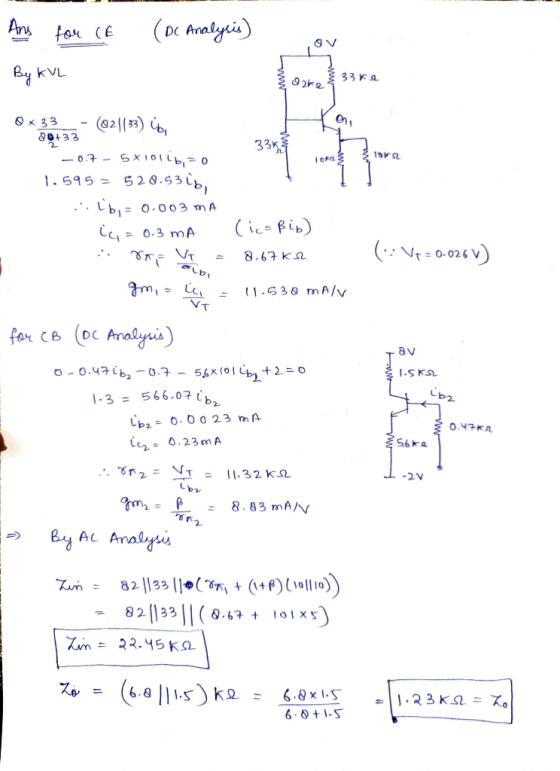
QUESTION 1 Figure Q1 shows a common emitter (CE) and common Base (CB) cascade amplifier circuit....
1. For the cascade amplifier of the figure, calculate the polarization voltages and current colle...
 For the cascade amplifier of the figure, calculate the
polarization voltages
Please clarity answer, thanks!!
1. For the cascade amplifier of the figure, calculate the polarization voltages and current collector of each stage. Also, calculate the voltage gain for each stage and the total voltage gain for cascade amplifier. 2. Repeat the previous steps using a load resistance of 2.2 kΩ 3. Calculate the input and output impedances for the cascade amplifier and the cutoff frequencies (fi) for the cascade...
For the cascade amplifier of the figure, calculate the
polarization voltages
Please clarity answer, thanks!!
1. For the cascade amplifier of the figure, calculate the polarization voltages and current collector of each stage. Also, calculate the voltage gain for each stage and the total voltage gain for cascade amplifier. 2. Repeat the previous steps using a load resistance of 2.2 kΩ 3. Calculate the input and output impedances for the cascade amplifier and the cutoff frequencies (fi) for the cascade...
For the cascade amplifier of Figure Q1(a), determine the (1) transconductance factor, gm. a.c. diode resistance.,...
 For the cascade amplifier of Figure Q1(a), determine the (1) transconductance factor, gm. a.c. diode resistance., re. (iii) ac equivalent circuit (iv) input impedance, Z (v) output impedance, Z. (vi) voltage gain, Avi (vii) voltage gain, Av2. (viii) total cascade voltage gain, Avr. Given gm = 21 pss lvpl + 15 V Ipss - 10 mA Vp.4V Vase -- 1.5 V βος = 50 μs Γ. 40 ΚΩ RO 3.3 ΚΩ R81 22 ΚΩ Rc 10 ΚΩ O V. β...
11. (5 marks total) A common-emitter amplifier has values of R = 68 k 2, R2...
 11. (5 marks total) A common-emitter amplifier has values of R = 68 k 2, R2 = 56 k 2, Rinbase) = 2.1 k 2. The source voltage V, = 35 mV and the source resistance R = 450 22. Determine: Base R, w Base W- Rinas) Riiton = (a) (b) a) (3 marks) the total input resistance Rin(tot) = b) (2 marks) the voltage at the base (V=Vin) V = 9 12. (5 marks total) For the common-emitter amplifier...
100 1.5 0.27 5. 6 Pl. Consider the CB amplifier of Figure 1, for which Vcc-15...
 100 1.5 0.27 5. 6 Pl. Consider the CB amplifier of Figure 1, for which Vcc-15 V, Rs-50 Ω, and RL-10 kQ. For the BJT, assume that B150, VBE.on0.7 V, and VcE,sat 0.3 V, and ignore the Early effect. For the other resistances, however, assume the same values as those you used for the Common-Emitter (CE) amplifier lab (disregard the value for RE2, as the resistor does not exist in the CB amplifier of Figure 1). Therefore, copy the same...
4. Consider the common-emitter amplifier of Figure 5. Draw the dc circuit and find ICQ. Draw the dc circuit and find IC...
 4. Consider the common-emitter amplifier of Figure 5. Draw the dc circuit and find ICQ. Draw the dc circuit and find ICQ. Find the value of Then, calculate values for Voltage gain Av, Open circuit voltage gain Avoc, input impedance Zin, current gain Ai, power gain G, and out- put impedance Zo. Assume operation in the frequency range for which influence of coupling and bypass capacitors can be ignored +15 V +15 V B 100 100 Ω 47ka Figure 5...
4. Consider the common-emitter amplifier of Figure 5. Draw the dc circuit and find「CQ. Draw the...
 4. Consider the common-emitter amplifier of Figure 5. Draw the dc circuit and find「CQ. Draw the dc circuit and find ICQ. Find the value of r. Then, calculate values for Voltage gain Av, Open circuit voltage gain Avoc, input impedance Zin, current gain Ai, power gain G, and out- put impedance Zo. Assume operation in the frequency range for which influence of coupling and bypass capacitors can be ignored. +15 V +15 V s in 100Ω CE Figure 5
Q1. For the cascade amplifier circuit shown in Fig (1): a) What are the functions of the capacitors C, C2 and C3? And w...
 Q1. For the cascade amplifier circuit shown in Fig (1): a) What are the functions of the capacitors C, C2 and C3? And what are the functions of the capacitors Cs and CE? b) What are the functions of the resistors RD and Rc? c) Draw the DC biasing circuits for each stage. d) Find loa, VGsa, VDs and gm for the JFET stage (you may use either mathematical or graphical methods) e) Calculate l, Ic, le and Ve for...
Vsig = 10mV*sin(2Kπ) The circuit above is a common-emitter amplifier. Given the parameters in the circuit,...
 Vsig = 10mV*sin(2Kπ)
The circuit above is a common-emitter amplifier. Given the
parameters in the circuit,
1. If Rb1=10KΩ, Calculate Rb2, Ib, Ic, Ie, Re, transconductance
(gm), Current through Rb1 (I_rb1), and Current through Rb2(I_rb2),
Vb, Vc, Ve, Vce. Also, calculate Rc to achieve a voltage gain Av =
- 100 V/
(If Rb1 value does not match up, then choose your resistor
value for Rb1.)
2. If the amplitude of Vsig keeps increasing, at what amplitude
of the input...
Vsig = 10mV*sin(2Kπ)
The circuit above is a common-emitter amplifier. Given the
parameters in the circuit,
1. If Rb1=10KΩ, Calculate Rb2, Ib, Ic, Ie, Re, transconductance
(gm), Current through Rb1 (I_rb1), and Current through Rb2(I_rb2),
Vb, Vc, Ve, Vce. Also, calculate Rc to achieve a voltage gain Av =
- 100 V/
(If Rb1 value does not match up, then choose your resistor
value for Rb1.)
2. If the amplitude of Vsig keeps increasing, at what amplitude
of the input...
1.0 kn. RE-390 Ω, r-15 Ω. and ßac-75. 5. For a common-emitter amplifier, Rc Assuming that Rg is completely bypassed at the operating frequency, the voltage gain is (a) 66.7 (d) 75 (b) 2.56 (c) 2....
 1.0 kn. RE-390 Ω, r-15 Ω. and ßac-75. 5. For a common-emitter amplifier, Rc Assuming that Rg is completely bypassed at the operating frequency, the voltage gain is (a) 66.7 (d) 75 (b) 2.56 (c) 2.47 6. In the circuit of Question 5, if the frequency is reduced to the point where Xctbypass) RE, the voltage gain (a) remains the same (b) is less (c) is greater 7. In a common-emitter amplifier with voltage-divider bias, Rimlbase) 68 k2, Ri 33...
Figure 1 is a common-emitter amplifier (with input divider). Calculate the base resistance Rb1 that is...
 Figure 1 is a common-emitter amplifier (with input divider).
Calculate the base resistance Rb1 that is needed to bias the device
at a collector voltage of Vc≈ 6-7 V. Assume a nominal value of β≈
200 for this calculation.
Λ +10 V 2.2 ΚΩ & Kh1 1 1μF V. 10 ΚΩ 1μFT o " Πι ΓW-0 . Y 10028 10 ΚΩ 1ΚΩ ξ 10 μF
Figure 1 is a common-emitter amplifier (with input divider).
Calculate the base resistance Rb1 that is needed to bias the device
at a collector voltage of Vc≈ 6-7 V. Assume a nominal value of β≈
200 for this calculation.
Λ +10 V 2.2 ΚΩ & Kh1 1 1μF V. 10 ΚΩ 1μFT o " Πι ΓW-0 . Y 10028 10 ΚΩ 1ΚΩ ξ 10 μF
 For the cascade amplifier of the figure, calculate the
polarization voltages
Please clarity answer, thanks!!
1. For the cascade amplifier of the figure, calculate the polarization voltages and current collector of each stage. Also, calculate the voltage gain for each stage and the total voltage gain for cascade amplifier. 2. Repeat the previous steps using a load resistance of 2.2 kΩ 3. Calculate the input and output impedances for the cascade amplifier and the cutoff frequencies (fi) for the cascade...
For the cascade amplifier of the figure, calculate the
polarization voltages
Please clarity answer, thanks!!
1. For the cascade amplifier of the figure, calculate the polarization voltages and current collector of each stage. Also, calculate the voltage gain for each stage and the total voltage gain for cascade amplifier. 2. Repeat the previous steps using a load resistance of 2.2 kΩ 3. Calculate the input and output impedances for the cascade amplifier and the cutoff frequencies (fi) for the cascade...
 For the cascade amplifier of Figure Q1(a), determine the (1) transconductance factor, gm. a.c. diode resistance., re. (iii) ac equivalent circuit (iv) input impedance, Z (v) output impedance, Z. (vi) voltage gain, Avi (vii) voltage gain, Av2. (viii) total cascade voltage gain, Avr. Given gm = 21 pss lvpl + 15 V Ipss - 10 mA Vp.4V Vase -- 1.5 V βος = 50 μs Γ. 40 ΚΩ RO 3.3 ΚΩ R81 22 ΚΩ Rc 10 ΚΩ O V. β...
 11. (5 marks total) A common-emitter amplifier has values of R = 68 k 2, R2 = 56 k 2, Rinbase) = 2.1 k 2. The source voltage V, = 35 mV and the source resistance R = 450 22. Determine: Base R, w Base W- Rinas) Riiton = (a) (b) a) (3 marks) the total input resistance Rin(tot) = b) (2 marks) the voltage at the base (V=Vin) V = 9 12. (5 marks total) For the common-emitter amplifier...
 100 1.5 0.27 5. 6 Pl. Consider the CB amplifier of Figure 1, for which Vcc-15 V, Rs-50 Ω, and RL-10 kQ. For the BJT, assume that B150, VBE.on0.7 V, and VcE,sat 0.3 V, and ignore the Early effect. For the other resistances, however, assume the same values as those you used for the Common-Emitter (CE) amplifier lab (disregard the value for RE2, as the resistor does not exist in the CB amplifier of Figure 1). Therefore, copy the same...
 4. Consider the common-emitter amplifier of Figure 5. Draw the dc circuit and find ICQ. Draw the dc circuit and find ICQ. Find the value of Then, calculate values for Voltage gain Av, Open circuit voltage gain Avoc, input impedance Zin, current gain Ai, power gain G, and out- put impedance Zo. Assume operation in the frequency range for which influence of coupling and bypass capacitors can be ignored +15 V +15 V B 100 100 Ω 47ka Figure 5...
 4. Consider the common-emitter amplifier of Figure 5. Draw the dc circuit and find「CQ. Draw the dc circuit and find ICQ. Find the value of r. Then, calculate values for Voltage gain Av, Open circuit voltage gain Avoc, input impedance Zin, current gain Ai, power gain G, and out- put impedance Zo. Assume operation in the frequency range for which influence of coupling and bypass capacitors can be ignored. +15 V +15 V s in 100Ω CE Figure 5
 Q1. For the cascade amplifier circuit shown in Fig (1): a) What are the functions of the capacitors C, C2 and C3? And what are the functions of the capacitors Cs and CE? b) What are the functions of the resistors RD and Rc? c) Draw the DC biasing circuits for each stage. d) Find loa, VGsa, VDs and gm for the JFET stage (you may use either mathematical or graphical methods) e) Calculate l, Ic, le and Ve for...
 Vsig = 10mV*sin(2Kπ)
The circuit above is a common-emitter amplifier. Given the
parameters in the circuit,
1. If Rb1=10KΩ, Calculate Rb2, Ib, Ic, Ie, Re, transconductance
(gm), Current through Rb1 (I_rb1), and Current through Rb2(I_rb2),
Vb, Vc, Ve, Vce. Also, calculate Rc to achieve a voltage gain Av =
- 100 V/
(If Rb1 value does not match up, then choose your resistor
value for Rb1.)
2. If the amplitude of Vsig keeps increasing, at what amplitude
of the input...
Vsig = 10mV*sin(2Kπ)
The circuit above is a common-emitter amplifier. Given the
parameters in the circuit,
1. If Rb1=10KΩ, Calculate Rb2, Ib, Ic, Ie, Re, transconductance
(gm), Current through Rb1 (I_rb1), and Current through Rb2(I_rb2),
Vb, Vc, Ve, Vce. Also, calculate Rc to achieve a voltage gain Av =
- 100 V/
(If Rb1 value does not match up, then choose your resistor
value for Rb1.)
2. If the amplitude of Vsig keeps increasing, at what amplitude
of the input...
 1.0 kn. RE-390 Ω, r-15 Ω. and ßac-75. 5. For a common-emitter amplifier, Rc Assuming that Rg is completely bypassed at the operating frequency, the voltage gain is (a) 66.7 (d) 75 (b) 2.56 (c) 2.47 6. In the circuit of Question 5, if the frequency is reduced to the point where Xctbypass) RE, the voltage gain (a) remains the same (b) is less (c) is greater 7. In a common-emitter amplifier with voltage-divider bias, Rimlbase) 68 k2, Ri 33...
 Figure 1 is a common-emitter amplifier (with input divider).
Calculate the base resistance Rb1 that is needed to bias the device
at a collector voltage of Vc≈ 6-7 V. Assume a nominal value of β≈
200 for this calculation.
Λ +10 V 2.2 ΚΩ & Kh1 1 1μF V. 10 ΚΩ 1μFT o " Πι ΓW-0 . Y 10028 10 ΚΩ 1ΚΩ ξ 10 μF
Figure 1 is a common-emitter amplifier (with input divider).
Calculate the base resistance Rb1 that is needed to bias the device
at a collector voltage of Vc≈ 6-7 V. Assume a nominal value of β≈
200 for this calculation.
Λ +10 V 2.2 ΚΩ & Kh1 1 1μF V. 10 ΚΩ 1μFT o " Πι ΓW-0 . Y 10028 10 ΚΩ 1ΚΩ ξ 10 μF
Most questions answered within 3 hours.
-
Where is the error in this code sequence?
String s1 = "Hello";
String s2 = "ello";...
asked 10 months ago -
Financial data for Joel de Paris, Inc., for last year
follow:
Joel de Paris, Inc.
Balance...
asked 10 months ago -
Consider this reaction:
Al2(SO4)3 (aq)+ BaCl3
(aq) Al2Cl6 (aq)- +
3BaSO4(s) . What is the...
asked 10 months ago -
Suppose that Savneet is considering increasing her
recent random sample from 20 car rentals to 40...
asked 10 months ago -
Trucks arrive at an unloading terminal at an average rate of 120
per hour.
Trucks arrive...
asked 10 months ago -
Why are methanol and ethanol completely soluble in water while
octanol is not very little soluble....
asked 10 months ago -
A facilities manager at a university reads in a research report
that the mean amount of...
asked 10 months ago -
When the CuSO4 is rehydrated by adding water to the anhydrous
compound, is this an endothermic...
asked 10 months ago -
A ray of sunlight is passing from diamond into crown glass; the
angle of incidence is...
asked 10 months ago -
A block of mass 0.249 kg is placed on top of a light, vertical
spring of...
asked 10 months ago -
how do the kidneys compensate in the presences of acidosis
a) trigger hyperventilate
b) reserve acid...
asked 10 months ago -
Question 501 pts
The rental rate of capital to the firm increases. Which of the
following...
asked 10 months ago