


Homework Answers

Add Answer to:
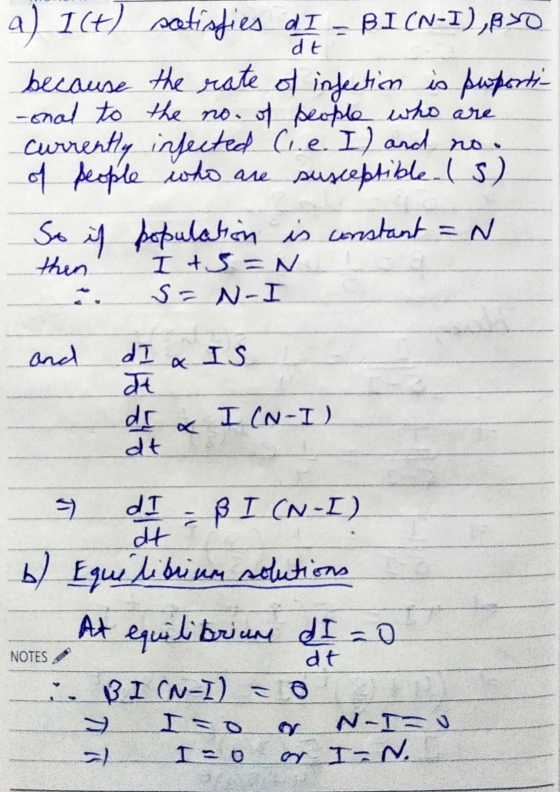
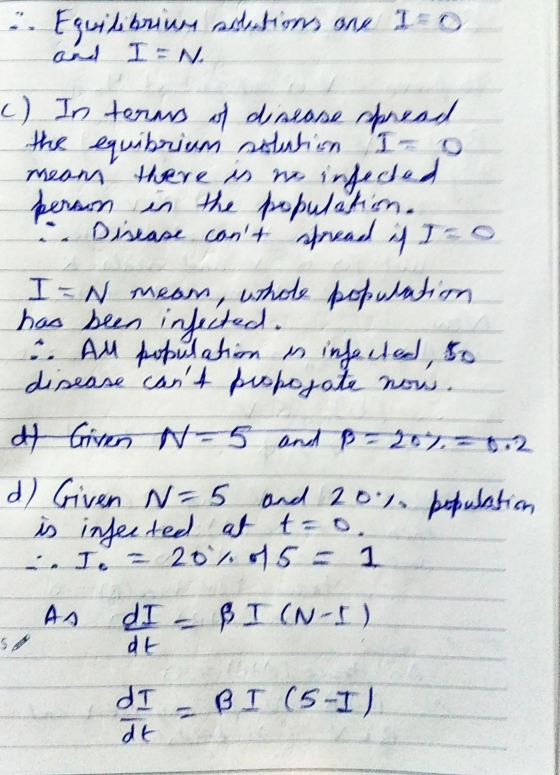
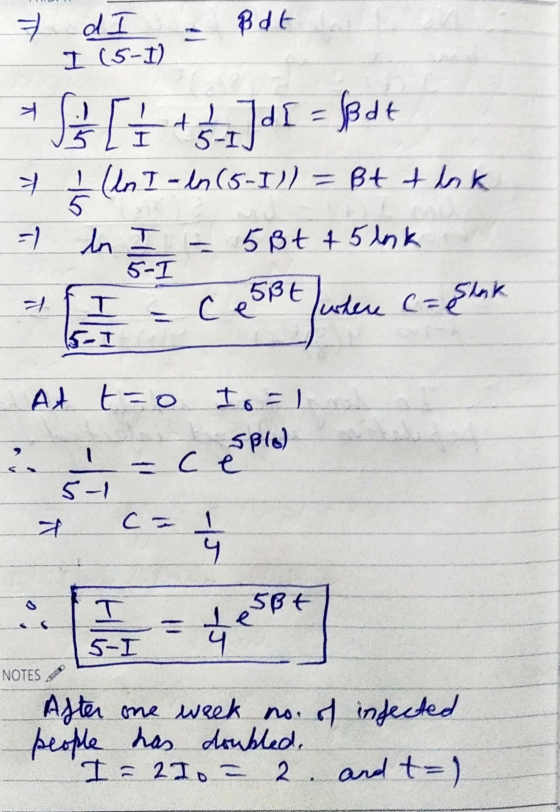
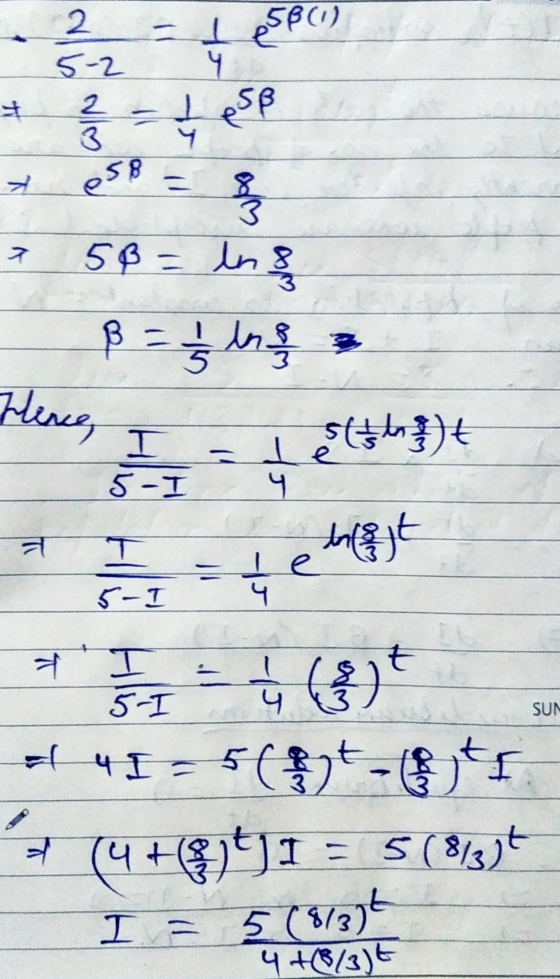
Question 1. First, we study a model for a disease which spreads quickly through a population....
6. Members of an indefinitely large population are either immune to a given disease or are suscep...
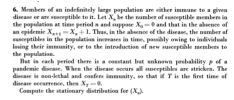 6. Members of an indefinitely large population are either immune to a given disease or are susceptible to it. Let X, be the number of susceptible members in the population at time period n and suppose Xo0 and that in the absence of an epidemic X1-X. +1. Thus, in the absence of the disease, the number of susceptibles in the population increases in time, possibly owing to individuals losing their immunity, or to the introduction of new susceptible members to...
(1 point) Suppose that news spreads through a city of fixed size of 800000 people at...
 (1 point) Suppose that news spreads through a city of fixed size
of 800000 people at a time rate proportional to the number of
people who have not heard the news.
(a.) Formulate a differential equation and initial condition for
?(?), the number of people who have heard the news ?t days after it
has happened.
No one has heard the news at first, so ?(0)=0. The "time rate of
increase in the number of people who have heard the...
(1 point) Suppose that news spreads through a city of fixed size
of 800000 people at a time rate proportional to the number of
people who have not heard the news.
(a.) Formulate a differential equation and initial condition for
?(?), the number of people who have heard the news ?t days after it
has happened.
No one has heard the news at first, so ?(0)=0. The "time rate of
increase in the number of people who have heard the...
Consider a population of size N. In the SIR model of epidemics the number of susceptible...
 Consider a population of size N. In the SIR model of epidemics the number of susceptible individuals, S(t), and infected individuals, I(t), at timet (measured in days) are governed by the equations: dt While S(t) is close to N and I(t) is close to zero the equations are approximated by where I(0) = 1o and S(0) = N – Io. A) Give the solution to the approximate model equations above (Egns.(3)-(4), along with initial conditions) for S(t) and I(t). Hint:...
Consider a system of differential equations describing the progress of a disease in a population,...
 Consider a system of differential equations describing the progress of a disease in a population, given byF, ) for a vector-valued function F. In our particular case, this IS. where z(t) is the number of susceptible individuals at time t and y(t) is the number of infected individuals at time t. The number of individuals is counted in units of 1,000 individuals a) Find the nullclines (simplest form) of this system of differential equations. The x-nullcline is y 2/3 The...
Part A - SIR model for the spread of disease Overview. This part of the assignment...
 Part A - SIR model for the spread of disease Overview. This part of the assignment uses a mix of theory and data to estimate the contact number c=b/k of an epidemic and hence to estimate the infection-spreading parameter b. The point is that once you know the value of b for a certain disease and population, you can use it in your model the next time there is an cpidemic, thus cnabling you to make predictions about the demand...
Question 1. 50 points Here we want to model the spread of the COVID-19 epidemic! Assume...
Question 1. 50 points Here we want to model the spread of the COVID-19 epidemic! Assume that ENCE112 Country get it first infection from a gentleman who flew in from China-Town, Wuham. Assume also that each without isolation, any covid-19 patient infects one other person. If we assume that each covid-19 infected person is isolated after just one day. a. Derive a recursive formula for the number of infected persons in n-days. 10 points b. Develop a recursive algorithm for...
Assignment 8 Remaining Time: 131:53:22 Question 1 Consider a system of differential equations describing the progress...
 Assignment 8 Remaining Time: 131:53:22 Question 1 Consider a system of differential equations describing the progress of a disease in a population, given by F(x, y) for 1 point How Did I Do? a vector-valued function F. In our particular case, this is: d' = 3 – 3xy - 12 y' = 3xy – 34 where x(t) is the number of susceptible individuals at time t and y(t) is the number of infected individuals at time t. The number of...
, A Total Model for a Training Program In this application, we set up a mathematical model for de...
 please do 1-6
, A Total Model for a Training Program In this application, we set up a mathematical model for determining the t s in setting up a am. Then we use calculus to find the time interval betweeng programs that produces the minimum total cost. The model assumes that the demand for trainees is constant and that the fixed cost of training a batch of trainees is known. Also, it is assumed that people who are trained, but...
please do 1-6
, A Total Model for a Training Program In this application, we set up a mathematical model for determining the t s in setting up a am. Then we use calculus to find the time interval betweeng programs that produces the minimum total cost. The model assumes that the demand for trainees is constant and that the fixed cost of training a batch of trainees is known. Also, it is assumed that people who are trained, but...
23. Daniel Bemouli's work in 1760 had the goal of appraising the effectiveness of a controversial inoculation program against smallpox. which at that time was a major threat to public health....
 23. Daniel Bemouli's work in 1760 had the goal of appraising the effectiveness of a controversial inoculation program against smallpox. which at that time was a major threat to public health. His model applies equally well to any other disease that, once contracted and survived, confers a lifetime immunity a. Find all of the critical p there are no critical points i and two critical points if a O b. Draw the phase line each critical point is asy Consider...
My Study on Sickle Cell Anemia Research In 500 words, answer the following questions 1.Select your...
My Study on Sickle Cell Anemia Research In 500 words, answer the following questions 1.Select your study sample 2. How have you selected your sample? 3. How will you select your sample population and give the rationale behind your decision Please type the solution on the keyboard so that I can copy and paste Q. No 1. Answer : Sickle cell disease : It is defined as it is a chronic heriditory form of Anemia, in which the red blood...
 6. Members of an indefinitely large population are either immune to a given disease or are susceptible to it. Let X, be the number of susceptible members in the population at time period n and suppose Xo0 and that in the absence of an epidemic X1-X. +1. Thus, in the absence of the disease, the number of susceptibles in the population increases in time, possibly owing to individuals losing their immunity, or to the introduction of new susceptible members to...
 (1 point) Suppose that news spreads through a city of fixed size
of 800000 people at a time rate proportional to the number of
people who have not heard the news.
(a.) Formulate a differential equation and initial condition for
?(?), the number of people who have heard the news ?t days after it
has happened.
No one has heard the news at first, so ?(0)=0. The "time rate of
increase in the number of people who have heard the...
(1 point) Suppose that news spreads through a city of fixed size
of 800000 people at a time rate proportional to the number of
people who have not heard the news.
(a.) Formulate a differential equation and initial condition for
?(?), the number of people who have heard the news ?t days after it
has happened.
No one has heard the news at first, so ?(0)=0. The "time rate of
increase in the number of people who have heard the...
 Consider a population of size N. In the SIR model of epidemics the number of susceptible individuals, S(t), and infected individuals, I(t), at timet (measured in days) are governed by the equations: dt While S(t) is close to N and I(t) is close to zero the equations are approximated by where I(0) = 1o and S(0) = N – Io. A) Give the solution to the approximate model equations above (Egns.(3)-(4), along with initial conditions) for S(t) and I(t). Hint:...
 Consider a system of differential equations describing the progress of a disease in a population, given byF, ) for a vector-valued function F. In our particular case, this IS. where z(t) is the number of susceptible individuals at time t and y(t) is the number of infected individuals at time t. The number of individuals is counted in units of 1,000 individuals a) Find the nullclines (simplest form) of this system of differential equations. The x-nullcline is y 2/3 The...
 Part A - SIR model for the spread of disease Overview. This part of the assignment uses a mix of theory and data to estimate the contact number c=b/k of an epidemic and hence to estimate the infection-spreading parameter b. The point is that once you know the value of b for a certain disease and population, you can use it in your model the next time there is an cpidemic, thus cnabling you to make predictions about the demand...
 Assignment 8 Remaining Time: 131:53:22 Question 1 Consider a system of differential equations describing the progress of a disease in a population, given by F(x, y) for 1 point How Did I Do? a vector-valued function F. In our particular case, this is: d' = 3 – 3xy - 12 y' = 3xy – 34 where x(t) is the number of susceptible individuals at time t and y(t) is the number of infected individuals at time t. The number of...
 please do 1-6
, A Total Model for a Training Program In this application, we set up a mathematical model for determining the t s in setting up a am. Then we use calculus to find the time interval betweeng programs that produces the minimum total cost. The model assumes that the demand for trainees is constant and that the fixed cost of training a batch of trainees is known. Also, it is assumed that people who are trained, but...
please do 1-6
, A Total Model for a Training Program In this application, we set up a mathematical model for determining the t s in setting up a am. Then we use calculus to find the time interval betweeng programs that produces the minimum total cost. The model assumes that the demand for trainees is constant and that the fixed cost of training a batch of trainees is known. Also, it is assumed that people who are trained, but...
 23. Daniel Bemouli's work in 1760 had the goal of appraising the effectiveness of a controversial inoculation program against smallpox. which at that time was a major threat to public health. His model applies equally well to any other disease that, once contracted and survived, confers a lifetime immunity a. Find all of the critical p there are no critical points i and two critical points if a O b. Draw the phase line each critical point is asy Consider...
Most questions answered within 3 hours.
-
Where is the error in this code sequence?
String s1 = "Hello";
String s2 = "ello";...
asked 10 months ago -
Financial data for Joel de Paris, Inc., for last year
follow:
Joel de Paris, Inc.
Balance...
asked 10 months ago -
Consider this reaction:
Al2(SO4)3 (aq)+ BaCl3
(aq) Al2Cl6 (aq)- +
3BaSO4(s) . What is the...
asked 10 months ago -
Suppose that Savneet is considering increasing her
recent random sample from 20 car rentals to 40...
asked 10 months ago -
Trucks arrive at an unloading terminal at an average rate of 120
per hour.
Trucks arrive...
asked 10 months ago -
Why are methanol and ethanol completely soluble in water while
octanol is not very little soluble....
asked 10 months ago -
A facilities manager at a university reads in a research report
that the mean amount of...
asked 10 months ago -
When the CuSO4 is rehydrated by adding water to the anhydrous
compound, is this an endothermic...
asked 10 months ago -
A ray of sunlight is passing from diamond into crown glass; the
angle of incidence is...
asked 10 months ago -
A block of mass 0.249 kg is placed on top of a light, vertical
spring of...
asked 10 months ago -
how do the kidneys compensate in the presences of acidosis
a) trigger hyperventilate
b) reserve acid...
asked 10 months ago -
Question 501 pts
The rental rate of capital to the firm increases. Which of the
following...
asked 10 months ago