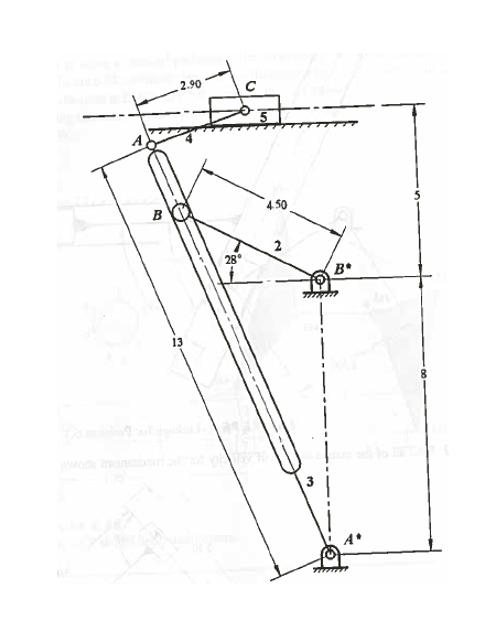
In the figure below, the slider C is driven by an ω2 from the crank rotating about point B. Locate all instant centers necessary to solve for the velocity of slider body 5 (point C). Show the necessary instant centers in the diagram below and list the steps necessary to obtain the solution. No need for a numerical answer, just the steps.
Homework Answers


Add Answer to:
In the figure below, the slider C is driven by an ω2 from the
crank rotating...
Question 4 (15 marks) The figure below shows a slider-crank mechanism. Link AB is driven with...
 Question 4 (15 marks) The figure below shows a slider-crank mechanism. Link AB is driven with a CONSTANT angular velocity of 4 rad/s. a) Determine the (vector) velocity of point B. b) Determine the angular velocity of link BC and the velocity of the slider at C. c) Determine the (vector) acceleration of point B. d) Determine the (vector) acceleration of the slider at C. 125 mm MAB = 4 rad/s 300 mm 600
1. The offset slider-crank mechanism illustrated in Figure is driven by slider 4 at a velocity...
 1. The offset slider-crank mechanism illustrated in Figure is driven by slider 4 at a velocity Ve-101 m/s at the position shown. Determine the instantaneous velocity of point D and the angular velocities of links 2 and 3. Show details of your work to get full marks (20 points) 50 140 2 45. A(G 20 50 1 of
1. The offset slider-crank mechanism illustrated in Figure is driven by slider 4 at a velocity Ve-101 m/s at the position shown....
1. The offset slider-crank mechanism illustrated in Figure is driven by slider 4 at a velocity Ve-101 m/s at the position shown. Determine the instantaneous velocity of point D and the angular velocities of links 2 and 3. Show details of your work to get full marks (20 points) 50 140 2 45. A(G 20 50 1 of
1. The offset slider-crank mechanism illustrated in Figure is driven by slider 4 at a velocity Ve-101 m/s at the position shown....
3. Link 2 (AB) of the slider crank inversion shown in Figure 3 is rotating at a constant 2 11.00k(rad/s). Determine the angular velocity of link 4 (DC) at the instant shown in the figure. Hints: The...
 3. Link 2 (AB) of the slider crank inversion shown in Figure 3 is rotating at a constant 2 11.00k(rad/s). Determine the angular velocity of link 4 (DC) at the instant shown in the figure. Hints: The angle between links 3 and 4 is fized so they have the same angular velocity. Consider Cs as point on Link 3 sliding through the bearing on link 4. (100 points) C3 90° A = (0,0). Figure 3: Slider crank inversion. (110.09,0) cm....
ine given 4) In the figure aside, an in-line slider- crank mechanism is shown. a) Calculate the velocity of the cou...
 ine given 4) In the figure aside, an in-line slider- crank mechanism is shown. a) Calculate the velocity of the coupler point D if crank AB is rotating CW wilth a speed of 2 rad/sec b) Calculate the necessary crank if the velocity of the coupler point is required to be 50 cm/sec, at the given position. speed AB 5am BC-10cm 0 30 degrees
ine given 4) In the figure aside, an in-line slider- crank mechanism is shown. a) Calculate...
ine given 4) In the figure aside, an in-line slider- crank mechanism is shown. a) Calculate the velocity of the coupler point D if crank AB is rotating CW wilth a speed of 2 rad/sec b) Calculate the necessary crank if the velocity of the coupler point is required to be 50 cm/sec, at the given position. speed AB 5am BC-10cm 0 30 degrees
ine given 4) In the figure aside, an in-line slider- crank mechanism is shown. a) Calculate...
Problem 2 A variation of the Scotch-yoke linkage in the posture shown is driven by crank...
 Problem 2 A variation of the Scotch-yoke linkage in the posture shown is driven by crank 2 at w- 36 rad/s CCW. Use the relative-velocity approach to determine the velocity of the crosshead of link 4. Locate all instant centers using the circle-diagram method. 02 105 45 lo2 Figure P3.26 RAo2 250 mm.
Ection Il-Slider Crank Mechanism Use Figure I and the information below to answer questions 3,4 a...
 please answer all
ection Il-Slider Crank Mechanism Use Figure I and the information below to answer questions 3,4 and S FigureI INot drawn to scalel D connecting rodplston The diagram in Figure 1 above displays a simple schematic diagram of a Slider Crank Mechanism The crank link (i.e. #4) turns counterclockwise by a motor at 1250 rpm. The length of the coupler link (ie. label #3) is 6.375 inches long and the maximum displacement for this mechanism is 3.0 inches....
please answer all
ection Il-Slider Crank Mechanism Use Figure I and the information below to answer questions 3,4 and S FigureI INot drawn to scalel D connecting rodplston The diagram in Figure 1 above displays a simple schematic diagram of a Slider Crank Mechanism The crank link (i.e. #4) turns counterclockwise by a motor at 1250 rpm. The length of the coupler link (ie. label #3) is 6.375 inches long and the maximum displacement for this mechanism is 3.0 inches....
QUESTION 1 A slider crank linkage is shown in figure 3 below. The angular velocity and...
 QUESTION 1 A slider crank linkage is shown in figure 3 below. The angular velocity and the angular acceleration of the crank are 10 rad/s and 40 rad/s2 respectively. Link AB is 50 mm and link BC is 95 mm. A point D on link BC is 0.2 times BC from point B Determine the following; 1.1 velocity of the piston, 1.2 angular velocity of links BC 1.3 acceleration of the piston 1.4 angular acceleration of link BC 1.5 acceleration...
Question 3. A crank shaft mechanism is shown in Figure 3. Link B is rotating with...
 Question 3. A crank shaft mechanism is shown in Figure 3. Link B is rotating with a constant angular velocity wgåg in the fixed reference frame A as shown in the figure. For this mechanism: (a) Using the vector kinematic equations and methods taught in this [20 marks) module, obtain the expressions for velocity and acceleration of point in the fixed frame A, in terms of wb.lg, lc, and e. Link C lo 1B Link B az в/ A 0...
(15 points) (45 minutes) he figure below shows a slider crank mechanism with an external force...
 (15 points) (45 minutes) he figure below shows a slider crank mechanism with an external force applied to the piston. For the given crank velocity at the shown configuration, find the following: 1 Draw free body diagram for each link showing the coordinate frames, accelerations, reaction forces, and externally applied forces. Points) 2. Apply Newton's law to develop the dynamic equations of motion for each link. 3. Solve for all the reaction forces and the crank torque (S (5 Points)...
1. For the inverted slider crank shown below, (a) Differentiate the velocity equations to get the...
 1. For the inverted slider crank shown below, (a) Differentiate the velocity equations to get the acceleration equations and put into matrix form (b) Solve for and θ3 (c) Setup and differentiate the position equations to get the velocity of point B (d) Finally, solve for the acceleration magnitude and direction of point B 62 where a2-75 mm, a3-400 mm, d-125 mm, r-193.6 mm, θ2-150°, θ3-11.170 and θ-60ad/sec (constant). The position equations are as follows: a2 sin θ-r sin θ3-0...
 Question 4 (15 marks) The figure below shows a slider-crank mechanism. Link AB is driven with a CONSTANT angular velocity of 4 rad/s. a) Determine the (vector) velocity of point B. b) Determine the angular velocity of link BC and the velocity of the slider at C. c) Determine the (vector) acceleration of point B. d) Determine the (vector) acceleration of the slider at C. 125 mm MAB = 4 rad/s 300 mm 600
 1. The offset slider-crank mechanism illustrated in Figure is driven by slider 4 at a velocity Ve-101 m/s at the position shown. Determine the instantaneous velocity of point D and the angular velocities of links 2 and 3. Show details of your work to get full marks (20 points) 50 140 2 45. A(G 20 50 1 of
1. The offset slider-crank mechanism illustrated in Figure is driven by slider 4 at a velocity Ve-101 m/s at the position shown....
1. The offset slider-crank mechanism illustrated in Figure is driven by slider 4 at a velocity Ve-101 m/s at the position shown. Determine the instantaneous velocity of point D and the angular velocities of links 2 and 3. Show details of your work to get full marks (20 points) 50 140 2 45. A(G 20 50 1 of
1. The offset slider-crank mechanism illustrated in Figure is driven by slider 4 at a velocity Ve-101 m/s at the position shown....
 3. Link 2 (AB) of the slider crank inversion shown in Figure 3 is rotating at a constant 2 11.00k(rad/s). Determine the angular velocity of link 4 (DC) at the instant shown in the figure. Hints: The angle between links 3 and 4 is fized so they have the same angular velocity. Consider Cs as point on Link 3 sliding through the bearing on link 4. (100 points) C3 90° A = (0,0). Figure 3: Slider crank inversion. (110.09,0) cm....
 ine given 4) In the figure aside, an in-line slider- crank mechanism is shown. a) Calculate the velocity of the coupler point D if crank AB is rotating CW wilth a speed of 2 rad/sec b) Calculate the necessary crank if the velocity of the coupler point is required to be 50 cm/sec, at the given position. speed AB 5am BC-10cm 0 30 degrees
ine given 4) In the figure aside, an in-line slider- crank mechanism is shown. a) Calculate...
ine given 4) In the figure aside, an in-line slider- crank mechanism is shown. a) Calculate the velocity of the coupler point D if crank AB is rotating CW wilth a speed of 2 rad/sec b) Calculate the necessary crank if the velocity of the coupler point is required to be 50 cm/sec, at the given position. speed AB 5am BC-10cm 0 30 degrees
ine given 4) In the figure aside, an in-line slider- crank mechanism is shown. a) Calculate...
 Problem 2 A variation of the Scotch-yoke linkage in the posture shown is driven by crank 2 at w- 36 rad/s CCW. Use the relative-velocity approach to determine the velocity of the crosshead of link 4. Locate all instant centers using the circle-diagram method. 02 105 45 lo2 Figure P3.26 RAo2 250 mm.
 please answer all
ection Il-Slider Crank Mechanism Use Figure I and the information below to answer questions 3,4 and S FigureI INot drawn to scalel D connecting rodplston The diagram in Figure 1 above displays a simple schematic diagram of a Slider Crank Mechanism The crank link (i.e. #4) turns counterclockwise by a motor at 1250 rpm. The length of the coupler link (ie. label #3) is 6.375 inches long and the maximum displacement for this mechanism is 3.0 inches....
please answer all
ection Il-Slider Crank Mechanism Use Figure I and the information below to answer questions 3,4 and S FigureI INot drawn to scalel D connecting rodplston The diagram in Figure 1 above displays a simple schematic diagram of a Slider Crank Mechanism The crank link (i.e. #4) turns counterclockwise by a motor at 1250 rpm. The length of the coupler link (ie. label #3) is 6.375 inches long and the maximum displacement for this mechanism is 3.0 inches....
 QUESTION 1 A slider crank linkage is shown in figure 3 below. The angular velocity and the angular acceleration of the crank are 10 rad/s and 40 rad/s2 respectively. Link AB is 50 mm and link BC is 95 mm. A point D on link BC is 0.2 times BC from point B Determine the following; 1.1 velocity of the piston, 1.2 angular velocity of links BC 1.3 acceleration of the piston 1.4 angular acceleration of link BC 1.5 acceleration...
 Question 3. A crank shaft mechanism is shown in Figure 3. Link B is rotating with a constant angular velocity wgåg in the fixed reference frame A as shown in the figure. For this mechanism: (a) Using the vector kinematic equations and methods taught in this [20 marks) module, obtain the expressions for velocity and acceleration of point in the fixed frame A, in terms of wb.lg, lc, and e. Link C lo 1B Link B az в/ A 0...
 (15 points) (45 minutes) he figure below shows a slider crank mechanism with an external force applied to the piston. For the given crank velocity at the shown configuration, find the following: 1 Draw free body diagram for each link showing the coordinate frames, accelerations, reaction forces, and externally applied forces. Points) 2. Apply Newton's law to develop the dynamic equations of motion for each link. 3. Solve for all the reaction forces and the crank torque (S (5 Points)...
 1. For the inverted slider crank shown below, (a) Differentiate the velocity equations to get the acceleration equations and put into matrix form (b) Solve for and θ3 (c) Setup and differentiate the position equations to get the velocity of point B (d) Finally, solve for the acceleration magnitude and direction of point B 62 where a2-75 mm, a3-400 mm, d-125 mm, r-193.6 mm, θ2-150°, θ3-11.170 and θ-60ad/sec (constant). The position equations are as follows: a2 sin θ-r sin θ3-0...
Most questions answered within 3 hours.
-
Where is the error in this code sequence?
String s1 = "Hello";
String s2 = "ello";...
asked 10 months ago -
Financial data for Joel de Paris, Inc., for last year
follow:
Joel de Paris, Inc.
Balance...
asked 10 months ago -
Consider this reaction:
Al2(SO4)3 (aq)+ BaCl3
(aq) Al2Cl6 (aq)- +
3BaSO4(s) . What is the...
asked 10 months ago -
Suppose that Savneet is considering increasing her
recent random sample from 20 car rentals to 40...
asked 10 months ago -
Trucks arrive at an unloading terminal at an average rate of 120
per hour.
Trucks arrive...
asked 10 months ago -
Why are methanol and ethanol completely soluble in water while
octanol is not very little soluble....
asked 10 months ago -
A facilities manager at a university reads in a research report
that the mean amount of...
asked 10 months ago -
When the CuSO4 is rehydrated by adding water to the anhydrous
compound, is this an endothermic...
asked 10 months ago -
A ray of sunlight is passing from diamond into crown glass; the
angle of incidence is...
asked 10 months ago -
A block of mass 0.249 kg is placed on top of a light, vertical
spring of...
asked 10 months ago -
how do the kidneys compensate in the presences of acidosis
a) trigger hyperventilate
b) reserve acid...
asked 10 months ago -
Question 501 pts
The rental rate of capital to the firm increases. Which of the
following...
asked 10 months ago