

Homework Answers
Add Answer to:
Problem 9.65 ③ 50t 11 Review I Constants 1 Periodic Table Part A A typical raindrop...
answer part A & B! Problem 9.65 3 21 of 22 Review Constants Periodic Table Part...
 answer part A & B!
Problem 9.65 3 21 of 22 Review Constants Periodic Table Part A A typical raindrop is much more massive than a mosquito and falling much faster than a mosquito fies. How does a mosquito survive the impact? Recent research has found that the collision of a falling raindrop with a mosquito is a perfectly inelastic collision. That is the mosquito is swept up by the raindrop and ends up traveling along with the raindrop. Once...
answer part A & B!
Problem 9.65 3 21 of 22 Review Constants Periodic Table Part A A typical raindrop is much more massive than a mosquito and falling much faster than a mosquito fies. How does a mosquito survive the impact? Recent research has found that the collision of a falling raindrop with a mosquito is a perfectly inelastic collision. That is the mosquito is swept up by the raindrop and ends up traveling along with the raindrop. Once...
Part A Problem 9.62 A hovering mosquito is hit by a raindrop that is 30 times...
 Part A Problem 9.62 A hovering mosquito is hit by a raindrop that is 30 times as massive and falling at 8.9 m/s, a typical raindrop speed. How fast is the raindrop, with the attached mosquito, falling immediately afterward if the collision is perfectly inelastic? A typical raindrop is much more massive than a mosquito and falling much faster than a mosquito flies. How does a mos quito survive the impact? Recent research has found that the collision of a...
A typical raindrop is much more massive than a mosquito and falls much faster than a...
 A typical raindrop is much more massive than a mosquito and falls much faster than a mosquito flies. How does a mosquito survive the impact? Recent research has found that the collision of a failing raindrop with a mosquito is a perfectly inelastic collision. That is, the mosquito is "swept up" by the raindrop and ends up traveling along with the raindrop. Once the relative speed between the mosquito and the raindrop is zero, the mosquito is able to detach...
Because a raindrop is "soft" and deformable, the collision duration is a relatively long 8.0 ms. How many times larger...
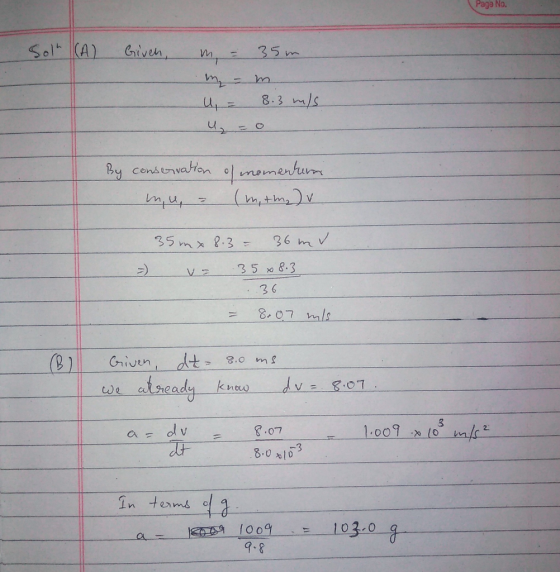
Because a raindrop is "soft" and deformable, the collision duration is a relatively long 8.0 ms. How many times larger than gravity is the mosquito's average acceleration during the collision? This is the information I have so far: A hovering mosquito is hit by a raindrop that is 45 times as massive and falling at 8.4 m/s , a typical raindrop speed. How fast is the raindrop, with the attached mosquito, falling immediately afterward if the collision is completely inelastic?...
Review | Constants i Periodic Table Part A H-C-OH Spell out the full name of the...
 Review | Constants i Periodic Table Part A H-C-OH Spell out the full name of the compound. If there is more than one answer, enter each answer separated by a comma. Submit Request Answer Part B OH Br Spell out the full name of the compound. If there is more than one answer, enter each answer separated by a comma. Review Constants 1 Periodic Table Part C c— ОН Spell out the full name of the compound. If there is...
Problem 14.73 17 of 18 〉 Review I Constants Periodic Table Part A An infant's toy...
 Problem 14.73 17 of 18 〉 Review I Constants Periodic Table Part A An infant's toy has a 120 g wooden animal hanging from a spring. If pulled down gently, the animal oscillates up and down with a period of 0.47 S. His older sister pulls the spring a bit more than intended. She pulls the animal 32 cm below its equilibrium position, then lets go. The animal flies upward and detaches from the spring right at the animal's equilibrium...
Review 1 Constants | Periodic Table Part A What is the amplitude of this oscillator? Express...
 Review 1 Constants | Periodic Table Part A What is the amplitude of this oscillator? Express your answer with the appropriate units. The acceleration of an oscillator undergoing simple harmonic motion is described by the equation a(t)(20m/s2 )cos(30t). where the time t is measured in seconds. A-1 Value Units Submit Request Answer
Review I Constants I Periodic Table An electron with a speed of 5.00x10⁶ m/s, collides with...
 Review I Constants I Periodic Table An electron with a speed of 5.00x10⁶ m/s, collides with an atom. The collision excites the atom from its ground state (0 eV) to a state with an energy of 3.60 eV Part A What is the speed of the electron after the collision? Express your answer in meters per second. ΑΣφ ? Request Answer Submit
70f33 > Review Constants Periodic Table Part A Which electron has a higher probably of being...
 70f33 > Review Constants Periodic Table Part A Which electron has a higher probably of being found at 0.5 A of nudeus, one na 28 orbital or one in a portal Prehability They will be equal Neither can be found within 0.5 of the nucleus Submit Request Answer Distance from us (A) Figure: Comparison of 16, 2s, and 2p radial probability functions. - Part B Which orbital, 28 or 2p. will be lower in energy in a multielectron mom? 2p...
Problem 9.38 10 of 19 > Review Constants Periodic Table In an Atwood machine, block 1 with mass mi and a loss ma...
 Problem 9.38 10 of 19 > Review Constants Periodic Table In an Atwood machine, block 1 with mass mi and a loss massive block 2 with mass are connected by a string that passes over a solid cylindrical pulley of mass M and radius R. Usemi 0.20 k m 0.16 kg. M = 0.50 kg, and R-0.10 m. (Figure 1) Determine the rotational inertia of the pulley Express your answer with the appropriate units. 1. Value Units Figure Submit Rest...
 answer part A & B!
Problem 9.65 3 21 of 22 Review Constants Periodic Table Part A A typical raindrop is much more massive than a mosquito and falling much faster than a mosquito fies. How does a mosquito survive the impact? Recent research has found that the collision of a falling raindrop with a mosquito is a perfectly inelastic collision. That is the mosquito is swept up by the raindrop and ends up traveling along with the raindrop. Once...
answer part A & B!
Problem 9.65 3 21 of 22 Review Constants Periodic Table Part A A typical raindrop is much more massive than a mosquito and falling much faster than a mosquito fies. How does a mosquito survive the impact? Recent research has found that the collision of a falling raindrop with a mosquito is a perfectly inelastic collision. That is the mosquito is swept up by the raindrop and ends up traveling along with the raindrop. Once...
 Part A Problem 9.62 A hovering mosquito is hit by a raindrop that is 30 times as massive and falling at 8.9 m/s, a typical raindrop speed. How fast is the raindrop, with the attached mosquito, falling immediately afterward if the collision is perfectly inelastic? A typical raindrop is much more massive than a mosquito and falling much faster than a mosquito flies. How does a mos quito survive the impact? Recent research has found that the collision of a...
 A typical raindrop is much more massive than a mosquito and falls much faster than a mosquito flies. How does a mosquito survive the impact? Recent research has found that the collision of a failing raindrop with a mosquito is a perfectly inelastic collision. That is, the mosquito is "swept up" by the raindrop and ends up traveling along with the raindrop. Once the relative speed between the mosquito and the raindrop is zero, the mosquito is able to detach...
 Review | Constants i Periodic Table Part A H-C-OH Spell out the full name of the compound. If there is more than one answer, enter each answer separated by a comma. Submit Request Answer Part B OH Br Spell out the full name of the compound. If there is more than one answer, enter each answer separated by a comma. Review Constants 1 Periodic Table Part C c— ОН Spell out the full name of the compound. If there is...
 Problem 14.73 17 of 18 〉 Review I Constants Periodic Table Part A An infant's toy has a 120 g wooden animal hanging from a spring. If pulled down gently, the animal oscillates up and down with a period of 0.47 S. His older sister pulls the spring a bit more than intended. She pulls the animal 32 cm below its equilibrium position, then lets go. The animal flies upward and detaches from the spring right at the animal's equilibrium...
 Review 1 Constants | Periodic Table Part A What is the amplitude of this oscillator? Express your answer with the appropriate units. The acceleration of an oscillator undergoing simple harmonic motion is described by the equation a(t)(20m/s2 )cos(30t). where the time t is measured in seconds. A-1 Value Units Submit Request Answer
 Review I Constants I Periodic Table An electron with a speed of 5.00x10⁶ m/s, collides with an atom. The collision excites the atom from its ground state (0 eV) to a state with an energy of 3.60 eV Part A What is the speed of the electron after the collision? Express your answer in meters per second. ΑΣφ ? Request Answer Submit
 70f33 > Review Constants Periodic Table Part A Which electron has a higher probably of being found at 0.5 A of nudeus, one na 28 orbital or one in a portal Prehability They will be equal Neither can be found within 0.5 of the nucleus Submit Request Answer Distance from us (A) Figure: Comparison of 16, 2s, and 2p radial probability functions. - Part B Which orbital, 28 or 2p. will be lower in energy in a multielectron mom? 2p...
 Problem 9.38 10 of 19 > Review Constants Periodic Table In an Atwood machine, block 1 with mass mi and a loss massive block 2 with mass are connected by a string that passes over a solid cylindrical pulley of mass M and radius R. Usemi 0.20 k m 0.16 kg. M = 0.50 kg, and R-0.10 m. (Figure 1) Determine the rotational inertia of the pulley Express your answer with the appropriate units. 1. Value Units Figure Submit Rest...
Most questions answered within 3 hours.
-
Where is the error in this code sequence?
String s1 = "Hello";
String s2 = "ello";...
asked 10 months ago -
Financial data for Joel de Paris, Inc., for last year
follow:
Joel de Paris, Inc.
Balance...
asked 10 months ago -
Consider this reaction:
Al2(SO4)3 (aq)+ BaCl3
(aq) Al2Cl6 (aq)- +
3BaSO4(s) . What is the...
asked 10 months ago -
Suppose that Savneet is considering increasing her
recent random sample from 20 car rentals to 40...
asked 10 months ago -
Trucks arrive at an unloading terminal at an average rate of 120
per hour.
Trucks arrive...
asked 10 months ago -
Why are methanol and ethanol completely soluble in water while
octanol is not very little soluble....
asked 10 months ago -
A facilities manager at a university reads in a research report
that the mean amount of...
asked 10 months ago -
When the CuSO4 is rehydrated by adding water to the anhydrous
compound, is this an endothermic...
asked 10 months ago -
A ray of sunlight is passing from diamond into crown glass; the
angle of incidence is...
asked 10 months ago -
A block of mass 0.249 kg is placed on top of a light, vertical
spring of...
asked 10 months ago -
how do the kidneys compensate in the presences of acidosis
a) trigger hyperventilate
b) reserve acid...
asked 10 months ago -
Question 501 pts
The rental rate of capital to the firm increases. Which of the
following...
asked 10 months ago