
Homework Answers
Let p be a prime >0. Prove that 12,23 (21) gives a set of different remainders modulus p. Also prove that for every number a with pla, a is congruent to one and only one of the element in the...
 Let p be a prime >0. Prove that 12,23 (21) gives a set of different remainders modulus p. Also prove that for every number a with pla, a is congruent to one and only one of the element in the previous set.
Let p be a prime >0. Prove that 12,23 (21) gives a set of different remainders modulus p. Also prove that for every number a with pla, a is congruent to one and only one of the element...
Let p be a prime >0. Prove that 12,23 (21) gives a set of different remainders modulus p. Also prove that for every number a with pla, a is congruent to one and only one of the element in the previous set.
Let p be a prime >0. Prove that 12,23 (21) gives a set of different remainders modulus p. Also prove that for every number a with pla, a is congruent to one and only one of the element...
2. Show that P[AIB] satisfies the three axioms of probability b) PISIB] 1 for sample space S c) I...
 2. Show that P[AIB] satisfies the three axioms of probability b) PISIB] 1 for sample space S c) If AnC 0 (empty set), then P[An CIB] P[AIB] + P[CIB]
2. Show that P[AIB] satisfies the three axioms of probability b) PISIB] 1 for sample space S c) If AnC 0 (empty set), then P[An CIB] P[AIB] + P[CIB]
2. Show that P[AIB] satisfies the three axioms of probability b) PISIB] 1 for sample space S c) If AnC 0 (empty set), then P[An CIB] P[AIB] + P[CIB]
l. Suppose that A, B, and C are events such that PLA] = P[B] = 0.3,...
 l. Suppose that A, B, and C are events such that PLA] = P[B] = 0.3, P[C] = 0.55, P[An B] = For each of the events given below in parts (a)-(d), do the following: (i) Write a set expression for the event. (Note that there are multiple ways to write this in many cases.) (ii) Evaluate the probability of the event. (Hint: Draw the Venn Diagram. You may then want to identify the probabilities of each of the disjoint...
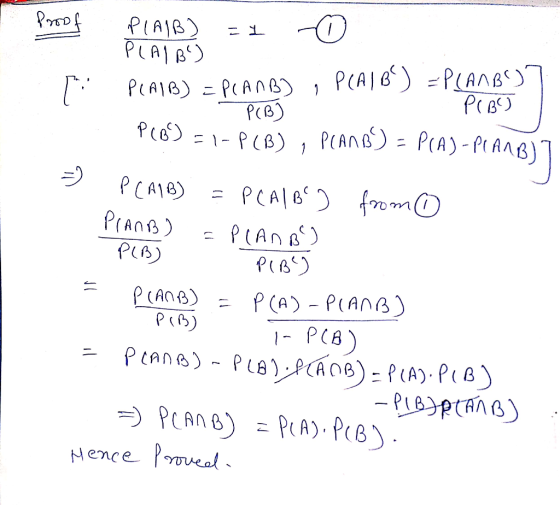
1. Use the formula P(A) PABP(B) + P(AlBc)P(B") to prove that if P(AB) P (AlBc) then...
 1. Use the formula P(A) PABP(B) + P(AlBc)P(B") to prove that if P(AB) P (AlBc) then A and B are independent. Then prove the converse (that if A and B are independent then P(AIB)- P(ABe). [Assume that P(B) > 0 and P(B) > 0.]
Recall Bayes' Rule P(AIB) = P(A)P(B|A) PB) Suppose 1 in 100 birds is a duck. 1...
 Recall Bayes' Rule P(AIB) = P(A)P(B|A) PB) Suppose 1 in 100 birds is a duck. 1 in 10 birds walks and talks like a duck (for instance, some geese walk and talk like ducks despite not being ducks) 9 out of 10 ducks walk and talk like a duck (some ducks refuse to conform. Here I am saying that the bird walks and talks like a duck, given that the bird is a duck) The probability that a bird is...
10.00 polnts Exercise 4-21 Algo Let P(A)-0.41, P(B) 0.36, and P(ANB) 0.22 a. Are A and...
 10.00 polnts Exercise 4-21 Algo Let P(A)-0.41, P(B) 0.36, and P(ANB) 0.22 a. Are A and B independent events? O Yes because PAIB) PIA Yes because FIA n B)メ。 No because PIA | B) PIA) No because PA n B) #0 b. Are A and B mutually exclusive events? O Yes because PIAI B) PIA) Yes because RA n B) # 0 O No because PIA | B) PIA) @ No because P(A n Β) # O c. What is...
10] Q3. (a) Prove the Bonferroni Inequality on three events A1, A2 and A3: P(An Agn A)21-P(A)- P(A2) - P(Aa) (b) Usi...
 10] Q3. (a) Prove the Bonferroni Inequality on three events A1, A2 and A3: P(An Agn A)21-P(A)- P(A2) - P(Aa) (b) Using the results in Q3.(a), and clearly describing the events At, A2 and A3. construct a 100(1-a)% joint confidence intervals for estima- tion of three parameters, denoted by 01,02 and 03, say.
10] Q3. (a) Prove the Bonferroni Inequality on three events A1, A2 and A3: P(An Agn A)21-P(A)- P(A2) - P(Aa) (b) Using the results in Q3.(a), and...
10] Q3. (a) Prove the Bonferroni Inequality on three events A1, A2 and A3: P(An Agn A)21-P(A)- P(A2) - P(Aa) (b) Using the results in Q3.(a), and clearly describing the events At, A2 and A3. construct a 100(1-a)% joint confidence intervals for estima- tion of three parameters, denoted by 01,02 and 03, say.
10] Q3. (a) Prove the Bonferroni Inequality on three events A1, A2 and A3: P(An Agn A)21-P(A)- P(A2) - P(Aa) (b) Using the results in Q3.(a), and...
(a) On R2, prove that di ((zı, y), (z2W2)) := Izı-zal + ly,-Val is a metric. (b) Assume that doc ( (zi, yī), (z2,p)) := maxlz-zal, lyi-yl} is a metric on R2 for each p 21. Prove that di and d induce...
 (a) On R2, prove that di ((zı, y), (z2W2)) := Izı-zal + ly,-Val is a metric. (b) Assume that doc ( (zi, yī), (z2,p)) := maxlz-zal, lyi-yl} is a metric on R2 for each p 21. Prove that di and d induce the same topology on R2. You may use the following lemma (but do not need to prove it): Lemma: Let d and d' be two metrics on aset X; let T and T' be the topologies the induce...
Prove the following statements. Show your working. (i) If P(A|B,C) = P(B|A,C), then P(A|C) = P(BIC)...
 Prove the following statements. Show your working. (i) If P(A|B,C) = P(B|A,C), then P(A|C) = P(BIC) (ii) If P(A|B,C) = P(A), then P(B,C|A) = P(B,C) (iii) If P(A, B|C) = P(A|C) * P(BIC), then P(A|B,C) = P(AC)
I want help to solve this question 10) Prove the following a+b-1 b (a) Let P(A)...
 I want help to solve this question
10) Prove the following a+b-1 b (a) Let P(A) = a and P(B) = b then P(A|B) 2 a+b=1 (b) If A1, A2, -. , An is a sequence of independent events, then ) = 1 - [1 - P(A1)]. [1 – P(A2)]... [1 - P(An)] n i=1
I want help to solve this question
10) Prove the following a+b-1 b (a) Let P(A) = a and P(B) = b then P(A|B) 2 a+b=1 (b) If A1, A2, -. , An is a sequence of independent events, then ) = 1 - [1 - P(A1)]. [1 – P(A2)]... [1 - P(An)] n i=1
 Let p be a prime >0. Prove that 12,23 (21) gives a set of different remainders modulus p. Also prove that for every number a with pla, a is congruent to one and only one of the element in the previous set.
Let p be a prime >0. Prove that 12,23 (21) gives a set of different remainders modulus p. Also prove that for every number a with pla, a is congruent to one and only one of the element...
Let p be a prime >0. Prove that 12,23 (21) gives a set of different remainders modulus p. Also prove that for every number a with pla, a is congruent to one and only one of the element in the previous set.
Let p be a prime >0. Prove that 12,23 (21) gives a set of different remainders modulus p. Also prove that for every number a with pla, a is congruent to one and only one of the element...
 2. Show that P[AIB] satisfies the three axioms of probability b) PISIB] 1 for sample space S c) If AnC 0 (empty set), then P[An CIB] P[AIB] + P[CIB]
2. Show that P[AIB] satisfies the three axioms of probability b) PISIB] 1 for sample space S c) If AnC 0 (empty set), then P[An CIB] P[AIB] + P[CIB]
2. Show that P[AIB] satisfies the three axioms of probability b) PISIB] 1 for sample space S c) If AnC 0 (empty set), then P[An CIB] P[AIB] + P[CIB]
 l. Suppose that A, B, and C are events such that PLA] = P[B] = 0.3, P[C] = 0.55, P[An B] = For each of the events given below in parts (a)-(d), do the following: (i) Write a set expression for the event. (Note that there are multiple ways to write this in many cases.) (ii) Evaluate the probability of the event. (Hint: Draw the Venn Diagram. You may then want to identify the probabilities of each of the disjoint...
 1. Use the formula P(A) PABP(B) + P(AlBc)P(B") to prove that if P(AB) P (AlBc) then A and B are independent. Then prove the converse (that if A and B are independent then P(AIB)- P(ABe). [Assume that P(B) > 0 and P(B) > 0.]
 Recall Bayes' Rule P(AIB) = P(A)P(B|A) PB) Suppose 1 in 100 birds is a duck. 1 in 10 birds walks and talks like a duck (for instance, some geese walk and talk like ducks despite not being ducks) 9 out of 10 ducks walk and talk like a duck (some ducks refuse to conform. Here I am saying that the bird walks and talks like a duck, given that the bird is a duck) The probability that a bird is...
 10.00 polnts Exercise 4-21 Algo Let P(A)-0.41, P(B) 0.36, and P(ANB) 0.22 a. Are A and B independent events? O Yes because PAIB) PIA Yes because FIA n B)メ。 No because PIA | B) PIA) No because PA n B) #0 b. Are A and B mutually exclusive events? O Yes because PIAI B) PIA) Yes because RA n B) # 0 O No because PIA | B) PIA) @ No because P(A n Β) # O c. What is...
 10] Q3. (a) Prove the Bonferroni Inequality on three events A1, A2 and A3: P(An Agn A)21-P(A)- P(A2) - P(Aa) (b) Using the results in Q3.(a), and clearly describing the events At, A2 and A3. construct a 100(1-a)% joint confidence intervals for estima- tion of three parameters, denoted by 01,02 and 03, say.
10] Q3. (a) Prove the Bonferroni Inequality on three events A1, A2 and A3: P(An Agn A)21-P(A)- P(A2) - P(Aa) (b) Using the results in Q3.(a), and...
10] Q3. (a) Prove the Bonferroni Inequality on three events A1, A2 and A3: P(An Agn A)21-P(A)- P(A2) - P(Aa) (b) Using the results in Q3.(a), and clearly describing the events At, A2 and A3. construct a 100(1-a)% joint confidence intervals for estima- tion of three parameters, denoted by 01,02 and 03, say.
10] Q3. (a) Prove the Bonferroni Inequality on three events A1, A2 and A3: P(An Agn A)21-P(A)- P(A2) - P(Aa) (b) Using the results in Q3.(a), and...
 (a) On R2, prove that di ((zı, y), (z2W2)) := Izı-zal + ly,-Val is a metric. (b) Assume that doc ( (zi, yī), (z2,p)) := maxlz-zal, lyi-yl} is a metric on R2 for each p 21. Prove that di and d induce the same topology on R2. You may use the following lemma (but do not need to prove it): Lemma: Let d and d' be two metrics on aset X; let T and T' be the topologies the induce...
 Prove the following statements. Show your working. (i) If P(A|B,C) = P(B|A,C), then P(A|C) = P(BIC) (ii) If P(A|B,C) = P(A), then P(B,C|A) = P(B,C) (iii) If P(A, B|C) = P(A|C) * P(BIC), then P(A|B,C) = P(AC)
 I want help to solve this question
10) Prove the following a+b-1 b (a) Let P(A) = a and P(B) = b then P(A|B) 2 a+b=1 (b) If A1, A2, -. , An is a sequence of independent events, then ) = 1 - [1 - P(A1)]. [1 – P(A2)]... [1 - P(An)] n i=1
I want help to solve this question
10) Prove the following a+b-1 b (a) Let P(A) = a and P(B) = b then P(A|B) 2 a+b=1 (b) If A1, A2, -. , An is a sequence of independent events, then ) = 1 - [1 - P(A1)]. [1 – P(A2)]... [1 - P(An)] n i=1
Most questions answered within 3 hours.
-
Where is the error in this code sequence?
String s1 = "Hello";
String s2 = "ello";...
asked 11 months ago -
Financial data for Joel de Paris, Inc., for last year
follow:
Joel de Paris, Inc.
Balance...
asked 11 months ago -
Consider this reaction:
Al2(SO4)3 (aq)+ BaCl3
(aq) Al2Cl6 (aq)- +
3BaSO4(s) . What is the...
asked 11 months ago -
Suppose that Savneet is considering increasing her
recent random sample from 20 car rentals to 40...
asked 11 months ago -
Trucks arrive at an unloading terminal at an average rate of 120
per hour.
Trucks arrive...
asked 11 months ago -
Why are methanol and ethanol completely soluble in water while
octanol is not very little soluble....
asked 11 months ago -
A facilities manager at a university reads in a research report
that the mean amount of...
asked 11 months ago -
When the CuSO4 is rehydrated by adding water to the anhydrous
compound, is this an endothermic...
asked 11 months ago -
A ray of sunlight is passing from diamond into crown glass; the
angle of incidence is...
asked 11 months ago -
A block of mass 0.249 kg is placed on top of a light, vertical
spring of...
asked 11 months ago -
how do the kidneys compensate in the presences of acidosis
a) trigger hyperventilate
b) reserve acid...
asked 11 months ago -
Question 501 pts
The rental rate of capital to the firm increases. Which of the
following...
asked 11 months ago