For each of the following pairs of sets, prove that they are
equinumerous. Remember that we have two ways to do this: we can
find a bijection explicitly, or we can prove that there is an
injection in each direction and then use the Schr¨oder-Bernstein
theorem.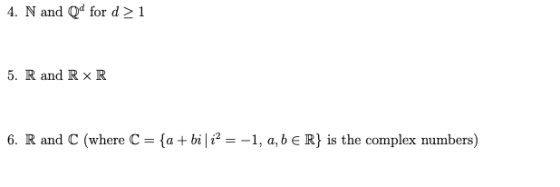
Homework Answers


Add Answer to:
For each of the following pairs of sets, prove that they are
equinumerous. Remember that we...
For each of the following sets, prove that it is countable by showing that there is...
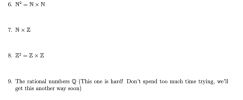 For each of the following sets, prove that it is countable by
showing that there is a bijection to that set from N.
6. N2 N x N 7. N x Z 8. Z2 Zx Z 9. The rational numbers Q (This one is hard! Don't spend too much time trying, we'll get this another way soon)
For each of the following sets, prove that it is countable by
showing that there is a bijection to that set from N.
6. N2 N x N 7. N x Z 8. Z2 Zx Z 9. The rational numbers Q (This one is hard! Don't spend too much time trying, we'll get this another way soon)
5. Describe the following sets of real numbers and find the supremum and infimum of these...
 5. Describe the following sets of real numbers and find the supremum and infimum of these sets: (a) {x}\x2 – 2 <4€R} (b) {x|x+ 2 +13 – x4<4} (©) {x|x<for all neN} 6. For any two elements x and y of an ordered field, prove that _x+ y + x- x + y - x - y (a) max{x,y}=- (b) min{x,y}=-
Problem 8. Given each pair of sets, come up with a formula for a bijection between them You do no...
 Problem 8. Given each pair of sets, come up with a formula for a bijection between them You do not need to prove your function is a bijection. Your formula should not be complicated by any means 1. From (0, 1) to (211, 2019) 2. From [0, 1) to (0, 1] 3. From NU (o) to N. 4. From the set of even numbers to 2 5. From the set of odd numbers to Z. 6. r2'2 7. From R...
How to prove this 3. [BC#1.5.8] Show that for any complex numbers zi,22 E C, we...
 How to prove this
3. [BC#1.5.8] Show that for any complex numbers zi,22 E C, we have = a1 +bi, etc.), or you can appeal to po- This can be done directly ( lar/exponential form(s)...
How to prove this
3. [BC#1.5.8] Show that for any complex numbers zi,22 E C, we have = a1 +bi, etc.), or you can appeal to po- This can be done directly ( lar/exponential form(s)...
We write R+ for the set of positive real numbers. For any positive real number e,...
 We write R+ for the set of positive real numbers. For any positive real number e, we write (-6, 6) = {x a real number : -e < x <e}. Prove that the intersection of all such intervals is the set containing zero, n (-e, e) = {0} EER+
HW 9: N-bit Arithmetic For each of the <X, Y> pairs in the table below: a)...
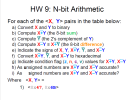 HW 9: N-bit Arithmetic For each of the <X, Y> pairs in the table below: a) Convert X and Y to binary b) Compute X+Y (the 8-bit sum) c) Compute Y (the 2's complement of Y) d) Compute X-Y = X+Y (the 8-bit difference) e) Indicate the signs of X, Y, X+Y, Y, and X-Y f) Convert X+Y, Y, and X-Y to hexadecimal g) Indicate condition flag (z, n, C, v) values for X+Y, X-Y h) As unsigned numbers are...
1 For each of the following pairs of numbers a and b, calculate and find integers...
 1 For each of the following pairs of numbers a and b, calculate and find integers r and s such ged (a; b) by Eucledian algorithm that gcd(a; b) = ra + sb. ia= 203, b-91 ii a = 21, b=8 2 Prove that for n 2 1,2+2+2+2* +...+2 -2n+1 -2 3 Prove that Vn 2 1,8" -3 is divisible by 5. 4 Prove that + n(n+1) = nnīYn E N where N is the set of all positive integers....
2. Determine whether the given sets are countable or uncountable. Justify each answer with a bijection...
 2. Determine whether the given sets are countable or uncountable. Justify each answer with a bijection (or table like we did with Q+) or using results from class/textbook. (a) {0, 1, 2} * N (b) A = {(x, y) : x2 + y2 = 1} (c) {0, 1} R Che set of all 2-element subsets of N (e) Real numbers with decimal representations consists of all 1s. (f) The set of all functions from {0,1} to N
Which of the following sets, together with the given binary operation *, DOES NOT form a...
 Which of the following sets, together with the given binary operation *, DOES NOT form a group? (Notation: As usual, the notations Z, Q, R, and C represent the sets of integers, rational numbers, real numbers, and complex numbers, respectively.) (A.) G is {a+bV2 ER\{0} | a, b e Q}; * is the usual multiplication of real numbers (B.) G is {a + biv2 € C\{0} | a, b E Q}; * is the usual multiplication of complex numbers (C.)...
Team Task 7: Complex number as matrices MATHS 120 Wednesda y, May 22, 2019 In this team task, you will investigate how complex numbers can be represented trices with real entries, in such a way t...
 Team Task 7: Complex number as matrices MATHS 120 Wednesda y, May 22, 2019 In this team task, you will investigate how complex numbers can be represented trices with real entries, in such a way that multiplication of complex numbers corresponds to matrix multiplication. as 2 x2 ma a -b. For example, For a, b e R and : a+ bi e C, let M, be the 2 x 2 matrix a Problem 1: What is M-1 Problem 2: What...
 For each of the following sets, prove that it is countable by
showing that there is a bijection to that set from N.
6. N2 N x N 7. N x Z 8. Z2 Zx Z 9. The rational numbers Q (This one is hard! Don't spend too much time trying, we'll get this another way soon)
For each of the following sets, prove that it is countable by
showing that there is a bijection to that set from N.
6. N2 N x N 7. N x Z 8. Z2 Zx Z 9. The rational numbers Q (This one is hard! Don't spend too much time trying, we'll get this another way soon)
 5. Describe the following sets of real numbers and find the supremum and infimum of these sets: (a) {x}\x2 – 2 <4€R} (b) {x|x+ 2 +13 – x4<4} (©) {x|x<for all neN} 6. For any two elements x and y of an ordered field, prove that _x+ y + x- x + y - x - y (a) max{x,y}=- (b) min{x,y}=-
 Problem 8. Given each pair of sets, come up with a formula for a bijection between them You do not need to prove your function is a bijection. Your formula should not be complicated by any means 1. From (0, 1) to (211, 2019) 2. From [0, 1) to (0, 1] 3. From NU (o) to N. 4. From the set of even numbers to 2 5. From the set of odd numbers to Z. 6. r2'2 7. From R...
 How to prove this
3. [BC#1.5.8] Show that for any complex numbers zi,22 E C, we have = a1 +bi, etc.), or you can appeal to po- This can be done directly ( lar/exponential form(s)...
How to prove this
3. [BC#1.5.8] Show that for any complex numbers zi,22 E C, we have = a1 +bi, etc.), or you can appeal to po- This can be done directly ( lar/exponential form(s)...
 We write R+ for the set of positive real numbers. For any positive real number e, we write (-6, 6) = {x a real number : -e < x <e}. Prove that the intersection of all such intervals is the set containing zero, n (-e, e) = {0} EER+
 HW 9: N-bit Arithmetic For each of the <X, Y> pairs in the table below: a) Convert X and Y to binary b) Compute X+Y (the 8-bit sum) c) Compute Y (the 2's complement of Y) d) Compute X-Y = X+Y (the 8-bit difference) e) Indicate the signs of X, Y, X+Y, Y, and X-Y f) Convert X+Y, Y, and X-Y to hexadecimal g) Indicate condition flag (z, n, C, v) values for X+Y, X-Y h) As unsigned numbers are...
 1 For each of the following pairs of numbers a and b, calculate and find integers r and s such ged (a; b) by Eucledian algorithm that gcd(a; b) = ra + sb. ia= 203, b-91 ii a = 21, b=8 2 Prove that for n 2 1,2+2+2+2* +...+2 -2n+1 -2 3 Prove that Vn 2 1,8" -3 is divisible by 5. 4 Prove that + n(n+1) = nnīYn E N where N is the set of all positive integers....
 2. Determine whether the given sets are countable or uncountable. Justify each answer with a bijection (or table like we did with Q+) or using results from class/textbook. (a) {0, 1, 2} * N (b) A = {(x, y) : x2 + y2 = 1} (c) {0, 1} R Che set of all 2-element subsets of N (e) Real numbers with decimal representations consists of all 1s. (f) The set of all functions from {0,1} to N
 Which of the following sets, together with the given binary operation *, DOES NOT form a group? (Notation: As usual, the notations Z, Q, R, and C represent the sets of integers, rational numbers, real numbers, and complex numbers, respectively.) (A.) G is {a+bV2 ER\{0} | a, b e Q}; * is the usual multiplication of real numbers (B.) G is {a + biv2 € C\{0} | a, b E Q}; * is the usual multiplication of complex numbers (C.)...
 Team Task 7: Complex number as matrices MATHS 120 Wednesda y, May 22, 2019 In this team task, you will investigate how complex numbers can be represented trices with real entries, in such a way that multiplication of complex numbers corresponds to matrix multiplication. as 2 x2 ma a -b. For example, For a, b e R and : a+ bi e C, let M, be the 2 x 2 matrix a Problem 1: What is M-1 Problem 2: What...
Most questions answered within 3 hours.
-
Where is the error in this code sequence?
String s1 = "Hello";
String s2 = "ello";...
asked 11 months ago -
Financial data for Joel de Paris, Inc., for last year
follow:
Joel de Paris, Inc.
Balance...
asked 11 months ago -
Consider this reaction:
Al2(SO4)3 (aq)+ BaCl3
(aq) Al2Cl6 (aq)- +
3BaSO4(s) . What is the...
asked 11 months ago -
Suppose that Savneet is considering increasing her
recent random sample from 20 car rentals to 40...
asked 11 months ago -
Trucks arrive at an unloading terminal at an average rate of 120
per hour.
Trucks arrive...
asked 11 months ago -
Why are methanol and ethanol completely soluble in water while
octanol is not very little soluble....
asked 11 months ago -
A facilities manager at a university reads in a research report
that the mean amount of...
asked 11 months ago -
When the CuSO4 is rehydrated by adding water to the anhydrous
compound, is this an endothermic...
asked 11 months ago -
A ray of sunlight is passing from diamond into crown glass; the
angle of incidence is...
asked 11 months ago -
A block of mass 0.249 kg is placed on top of a light, vertical
spring of...
asked 11 months ago -
how do the kidneys compensate in the presences of acidosis
a) trigger hyperventilate
b) reserve acid...
asked 11 months ago -
Question 501 pts
The rental rate of capital to the firm increases. Which of the
following...
asked 11 months ago