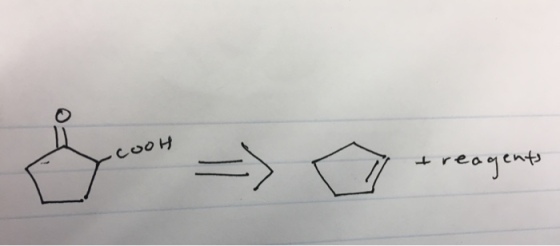
Homework Answers
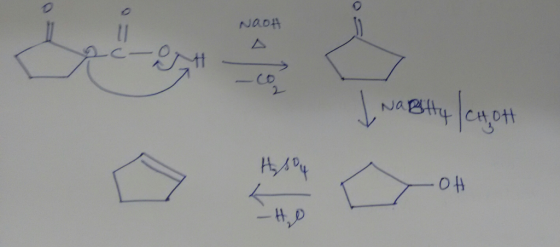
 In
the second mechanism, it is like Mclafferty rearrangement kind of
mechanism. You can consider which one you like.
In
the second mechanism, it is like Mclafferty rearrangement kind of
mechanism. You can consider which one you like.
I am sorry, in both the cases -CO2 not -H2O. please ignore this error.
Thank you and good luck.
6. (10 pts) For the following step in the citric acid cycle, COO H COO CH...
 6. (10 pts) For the following step in the citric acid cycle, COO H COO CH Succinate dehydrogenase + FAD + FADH CH, OOC H COO Succinate Fumarate a. What class of enzyme catalyzes this reaction? b. How does this step ultimately contribute to the formation of ATP? Be specific, c. Knowing that the next step is a hydration of the alkene, briefly explain why this step needed to occur? That is, why not hydrate the succinate?
Question 6 6. (10 pts) For the following step in the citric acid cycle, COO H...
 Question 6
6. (10 pts) For the following step in the citric acid cycle, COO H COO CH Succinate dehydrogenase + FAD + FADH CH, OOC H COO Succinate Fumarate a. What class of enzyme catalyzes this reaction? b. How does this step ultimately contribute to the formation of ATP? Be specific, c. Knowing that the next step is a hydration of the alkene, briefly explain why this step needed to occur? That is, why not hydrate the succinate?
Question 6
6. (10 pts) For the following step in the citric acid cycle, COO H COO CH Succinate dehydrogenase + FAD + FADH CH, OOC H COO Succinate Fumarate a. What class of enzyme catalyzes this reaction? b. How does this step ultimately contribute to the formation of ATP? Be specific, c. Knowing that the next step is a hydration of the alkene, briefly explain why this step needed to occur? That is, why not hydrate the succinate?
VI. Starting from acetylene (CH C H) and using any needed reagents to synthesize the following...
 VI. Starting from acetylene (CH C H) and using any needed reagents to synthesize the following molecule: Show every single step of the synthesis (10 pts)
REA model for customer art seller - acquisition/payment Complete an REA model with minimum and maximum...
REA model for customer art seller - acquisition/payment Complete an REA model with minimum and maximum cardinalities of the process (transaction cycle) you will be prototyping for the System Project. 1. Make up a company within your industry. 2. Model one complete transaction cycle REA model with cardinalities. 3. Identify the 2 related events you want to choose for your system project. These 2 events must be connected by a relationship line. a. This can be handwritten, although your final...
Acetyl COA + H2O Coo- o coo- Citrate synthase CH2 -OH -ooc— CH2 CH2 NADH +...
 Acetyl COA + H2O Coo- o coo- Citrate synthase CH2 -OH -ooc— CH2 CH2 NADH + H+ COO- Oxaloacetate Coo- Citrate Aconitase Malate dehydrogenase NAD+ - Çoo- Çoo- ---OH -O00—-H HO-CH CH2 CH2 Coo- Malate Coo- Isocitrate Isocitrate lyase Malate synthase COO- COO- Coh CH2 Acetyl COA + H2O Ho Glyoxylate coo Succinate Figure 17.23 Biochemistry, Seventh Edition 2012 W. H. Freeman and Company Question 1 (10 pts) Using diagrams show the pathway that is used to convert succinate to...
ܝ Ouloacetate COO H-SCOA Citrate 600 T CO CHE CH CHOICES: A acetyl S-COA B. ADP...
 ܝ Ouloacetate COO H-SCOA Citrate 600 T CO CHE CH CHOICES: A acetyl S-COA B. ADP C. ATP D. CO2 E. FAD F. FADH2 G.H20 H. NAD I. NADH/H J. O2 K. H-SCOA 16 BONUS COO 14 13 8 HO-C-COO CH? 21.00 COO CH -Coo Isocrate COO Malate HO-CH HO HT CH COO СОО Citric acid cycle 2 3 4 17 15 COO BONUS 6 COO CH 5 Pumatate 7 & 8 CH e-Ketoglutarale HC 12 CH, coo? C=0 11...
Question 1 Using the reagents listed below, propose a sythesis of the larget compound starting from...
 Question 1 Using the reagents listed below, propose a sythesis of the larget compound starting from benzene. Euter ye wish to use them. You may assume that all reactions are appropriately worked up and that mixtures of con CI NH A. Cl/FeCl3 B. HNO3/H SO4 C. CH COCIAICI: D. NaNO/HCI E HC1/Cuci F. KCN/CuCN G. H2PO2 H II O/hcat I. II, CrO4 J. 1)LiAlH42)HO K H/Ni L. 1) Mg 2)CO, 3)H,09 M. CH OLH:0 N. (CH4)2S02NaOH 0. CH3OH P. SOCI...
Show two methods to synthesize each alkene: a one-step method using a Wittig reagent, and a...
 Show two methods to synthesize each alkene: a one-step method using a Wittig reagent, and a two-step method that forms a carbon-carbon bond with an organometallic reagent in one of the steps. а. b, Problem 21.22 Draw the product formed when CH,CH,CH,CH,NH, reacts with each carbonyl compound in the presence of mild acid. -сно а. Problem 21.25 What carbonyl compound and amine are formed by the hydrolysis of each compound? a.
just complete 8-10 please coo CH3 CH2 H CH H H HN-c-c-N-C-C-N-C-C-N-C-Coo H OH OH OH...
 just complete 8-10 please
coo CH3 CH2 H CH H H HN-c-c-N-C-C-N-C-C-N-C-Coo H OH OH OH 1. How many amino acid residues are in this structure? 2. How many peptide bonds are in this structure? 3. What is the name of the C terminal residue? 4. What is the one-letter abbreviation of the N-terminal residue? 5. What is the sequence, given in three-letter code, of this peptide? 6. Circle one peptide bond. 7. Circle one alpha-carbon. 8. What is the...
just complete 8-10 please
coo CH3 CH2 H CH H H HN-c-c-N-C-C-N-C-C-N-C-Coo H OH OH OH 1. How many amino acid residues are in this structure? 2. How many peptide bonds are in this structure? 3. What is the name of the C terminal residue? 4. What is the one-letter abbreviation of the N-terminal residue? 5. What is the sequence, given in three-letter code, of this peptide? 6. Circle one peptide bond. 7. Circle one alpha-carbon. 8. What is the...
please help 18 points Using the reagents listed below. propose a sythesis of the target compound...
 please help
18 points Using the reagents listed below. propose a sythesis of the target compound starting from benzene. Enter your answer as a list of letters corresponding to the selected reagents in the order you wish to use them. You may assure that all reactions are appropriately worked up and that mixtures of constitutional isomers can be separated. You may use a reagent more than once if needed. NH2 J. 1)LAH, 2)HO K. H /Ni A. CI/FeCl3 B. HNO3/H...
please help
18 points Using the reagents listed below. propose a sythesis of the target compound starting from benzene. Enter your answer as a list of letters corresponding to the selected reagents in the order you wish to use them. You may assure that all reactions are appropriately worked up and that mixtures of constitutional isomers can be separated. You may use a reagent more than once if needed. NH2 J. 1)LAH, 2)HO K. H /Ni A. CI/FeCl3 B. HNO3/H...
 6. (10 pts) For the following step in the citric acid cycle, COO H COO CH Succinate dehydrogenase + FAD + FADH CH, OOC H COO Succinate Fumarate a. What class of enzyme catalyzes this reaction? b. How does this step ultimately contribute to the formation of ATP? Be specific, c. Knowing that the next step is a hydration of the alkene, briefly explain why this step needed to occur? That is, why not hydrate the succinate?
 Question 6
6. (10 pts) For the following step in the citric acid cycle, COO H COO CH Succinate dehydrogenase + FAD + FADH CH, OOC H COO Succinate Fumarate a. What class of enzyme catalyzes this reaction? b. How does this step ultimately contribute to the formation of ATP? Be specific, c. Knowing that the next step is a hydration of the alkene, briefly explain why this step needed to occur? That is, why not hydrate the succinate?
Question 6
6. (10 pts) For the following step in the citric acid cycle, COO H COO CH Succinate dehydrogenase + FAD + FADH CH, OOC H COO Succinate Fumarate a. What class of enzyme catalyzes this reaction? b. How does this step ultimately contribute to the formation of ATP? Be specific, c. Knowing that the next step is a hydration of the alkene, briefly explain why this step needed to occur? That is, why not hydrate the succinate?
 VI. Starting from acetylene (CH C H) and using any needed reagents to synthesize the following molecule: Show every single step of the synthesis (10 pts)
 Acetyl COA + H2O Coo- o coo- Citrate synthase CH2 -OH -ooc— CH2 CH2 NADH + H+ COO- Oxaloacetate Coo- Citrate Aconitase Malate dehydrogenase NAD+ - Çoo- Çoo- ---OH -O00—-H HO-CH CH2 CH2 Coo- Malate Coo- Isocitrate Isocitrate lyase Malate synthase COO- COO- Coh CH2 Acetyl COA + H2O Ho Glyoxylate coo Succinate Figure 17.23 Biochemistry, Seventh Edition 2012 W. H. Freeman and Company Question 1 (10 pts) Using diagrams show the pathway that is used to convert succinate to...
 ܝ Ouloacetate COO H-SCOA Citrate 600 T CO CHE CH CHOICES: A acetyl S-COA B. ADP C. ATP D. CO2 E. FAD F. FADH2 G.H20 H. NAD I. NADH/H J. O2 K. H-SCOA 16 BONUS COO 14 13 8 HO-C-COO CH? 21.00 COO CH -Coo Isocrate COO Malate HO-CH HO HT CH COO СОО Citric acid cycle 2 3 4 17 15 COO BONUS 6 COO CH 5 Pumatate 7 & 8 CH e-Ketoglutarale HC 12 CH, coo? C=0 11...
 Question 1 Using the reagents listed below, propose a sythesis of the larget compound starting from benzene. Euter ye wish to use them. You may assume that all reactions are appropriately worked up and that mixtures of con CI NH A. Cl/FeCl3 B. HNO3/H SO4 C. CH COCIAICI: D. NaNO/HCI E HC1/Cuci F. KCN/CuCN G. H2PO2 H II O/hcat I. II, CrO4 J. 1)LiAlH42)HO K H/Ni L. 1) Mg 2)CO, 3)H,09 M. CH OLH:0 N. (CH4)2S02NaOH 0. CH3OH P. SOCI...
 Show two methods to synthesize each alkene: a one-step method using a Wittig reagent, and a two-step method that forms a carbon-carbon bond with an organometallic reagent in one of the steps. а. b, Problem 21.22 Draw the product formed when CH,CH,CH,CH,NH, reacts with each carbonyl compound in the presence of mild acid. -сно а. Problem 21.25 What carbonyl compound and amine are formed by the hydrolysis of each compound? a.
 just complete 8-10 please
coo CH3 CH2 H CH H H HN-c-c-N-C-C-N-C-C-N-C-Coo H OH OH OH 1. How many amino acid residues are in this structure? 2. How many peptide bonds are in this structure? 3. What is the name of the C terminal residue? 4. What is the one-letter abbreviation of the N-terminal residue? 5. What is the sequence, given in three-letter code, of this peptide? 6. Circle one peptide bond. 7. Circle one alpha-carbon. 8. What is the...
just complete 8-10 please
coo CH3 CH2 H CH H H HN-c-c-N-C-C-N-C-C-N-C-Coo H OH OH OH 1. How many amino acid residues are in this structure? 2. How many peptide bonds are in this structure? 3. What is the name of the C terminal residue? 4. What is the one-letter abbreviation of the N-terminal residue? 5. What is the sequence, given in three-letter code, of this peptide? 6. Circle one peptide bond. 7. Circle one alpha-carbon. 8. What is the...
 please help
18 points Using the reagents listed below. propose a sythesis of the target compound starting from benzene. Enter your answer as a list of letters corresponding to the selected reagents in the order you wish to use them. You may assure that all reactions are appropriately worked up and that mixtures of constitutional isomers can be separated. You may use a reagent more than once if needed. NH2 J. 1)LAH, 2)HO K. H /Ni A. CI/FeCl3 B. HNO3/H...
please help
18 points Using the reagents listed below. propose a sythesis of the target compound starting from benzene. Enter your answer as a list of letters corresponding to the selected reagents in the order you wish to use them. You may assure that all reactions are appropriately worked up and that mixtures of constitutional isomers can be separated. You may use a reagent more than once if needed. NH2 J. 1)LAH, 2)HO K. H /Ni A. CI/FeCl3 B. HNO3/H...
Most questions answered within 3 hours.
-
Where is the error in this code sequence?
String s1 = "Hello";
String s2 = "ello";...
asked 10 months ago -
Financial data for Joel de Paris, Inc., for last year
follow:
Joel de Paris, Inc.
Balance...
asked 10 months ago -
Consider this reaction:
Al2(SO4)3 (aq)+ BaCl3
(aq) Al2Cl6 (aq)- +
3BaSO4(s) . What is the...
asked 10 months ago -
Suppose that Savneet is considering increasing her
recent random sample from 20 car rentals to 40...
asked 10 months ago -
Trucks arrive at an unloading terminal at an average rate of 120
per hour.
Trucks arrive...
asked 10 months ago -
Why are methanol and ethanol completely soluble in water while
octanol is not very little soluble....
asked 10 months ago -
A facilities manager at a university reads in a research report
that the mean amount of...
asked 10 months ago -
When the CuSO4 is rehydrated by adding water to the anhydrous
compound, is this an endothermic...
asked 10 months ago -
A ray of sunlight is passing from diamond into crown glass; the
angle of incidence is...
asked 10 months ago -
A block of mass 0.249 kg is placed on top of a light, vertical
spring of...
asked 10 months ago -
how do the kidneys compensate in the presences of acidosis
a) trigger hyperventilate
b) reserve acid...
asked 10 months ago -
Question 501 pts
The rental rate of capital to the firm increases. Which of the
following...
asked 10 months ago