
Homework Answers
Add Answer to:
Given the function f(x) and its derivative f'(x). F"(7), sketch the graph of f(x). If applicable,...
Sketch the graph of the function f(x) - (2-6)(x+3) 9(2+2) A sketch need not be exact...
 Sketch the graph of the function f(x) - (2-6)(x+3) 9(2+2) A sketch need not be exact or to scale! A sketch does need to show important points and features of the graph: intervals on which the function is increasing/decreasing, concavity, points at which local and absolute max, and min. values occur, inflection points, intercepts, vertical and horizontal asymptotes, and any other features particular to the particular function,
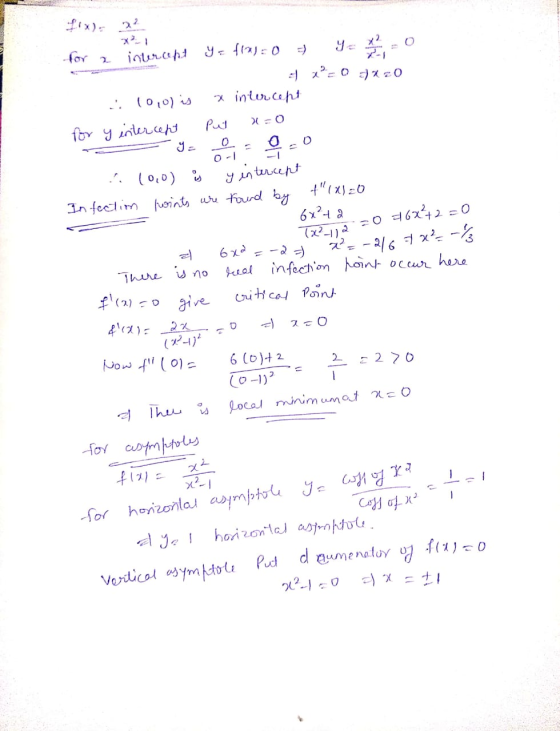
Analyze and sketch the graph of each function.
Analyze and sketch the graph of each function. Local intercepts, relative extrema, points of inflection and asymptotes. State for each problem the following: domain, range, intercepts, symmetry, asymptotes (horizontal and/or vertical asymptotes), critical numbers, points of inflection. a. \(Y=x^{2}+1 / x^{2}-9\)b. \(Y=x^{2} / x^{2}+3\)c. \(\mathrm{Y}=\frac{1}{3}\left(x^{2}-3 x+2\right)\)d. \(\mathrm{F}(\mathrm{x})=\frac{1}{x e^{x}}\)e. \(F(x)=x^{5}-5 x\)
| Sketch the curve of the function f(x) = + unction f(x) = "* [r'(x) =...
 | Sketch the curve of the function f(x) = + unction f(x) = "* [r'(x) = 2*, S"(x) = 205*] Do this by determining the following information: domain, vertical asymptotes and limit - behavior, horizontal asymptotes, x \& y intercepts, symmetry, intervals of increase/decrease and maximum/minimum points, intervals of concavity and inflection points
For the function f(x) = -**-4x find the following, and use it to graph the function....
 For the function f(x) = -**-4x find the following, and use it to graph the function. Find: a) (2pts) Domain b)(2pts) Intercepts c)(2pts) Symmetry d) (2pts) Asymptotes e) 4pts) Intervals of Increase or decrease f) (2pts) Local maximum and local minimum values g)(4pts) Concavity and Points of inflection and h)(2pts) Sketch the curve
show all work, no written work f(x)= Vx? -2.Vx -3 Given: %3D a. Investigate the function...
 show all work, no written work
f(x)= Vx? -2.Vx -3 Given: %3D a. Investigate the function by these criteria: 1) Domain; 2) Axis intersections; 3) Asymptotes (show the relevant limits) 4) Intervals of increase and decrease; 5) Points of relative extremum; 6) Intervals of concavity (upward or downward); 7) Inflection points. 8) Draw the function's graph. b. Find the equations of the tangent lines to the graph of the function at all extremum and inflection points, and add them to...
show all work, no written work
f(x)= Vx? -2.Vx -3 Given: %3D a. Investigate the function by these criteria: 1) Domain; 2) Axis intersections; 3) Asymptotes (show the relevant limits) 4) Intervals of increase and decrease; 5) Points of relative extremum; 6) Intervals of concavity (upward or downward); 7) Inflection points. 8) Draw the function's graph. b. Find the equations of the tangent lines to the graph of the function at all extremum and inflection points, and add them to...
f(T) = 22 9 Instructions: • If you are asked for a function, enter a function....
 f(T) = 22 9 Instructions: • If you are asked for a function, enter a function. • If you are asked to find 2- or y-values, enter either a number or a list of numbers separated by commas. If there are no solutions, enter None. • If you are asked to find an interval or union of intervals, use interval notation. Enter { } if an interval is empty • If you are asked to find a limit, enter either...
1. (20 points) The second derivative of a function f(x) satisfies f "(x) = 10x4 -...
 1. (20 points) The second derivative of a function f(x) satisfies f "(x) = 10x4 - 2 Moreover, f'(0) = 0 and f(1) = 0. (a) Find the function f(x). (b) Draw a graph of f(x). Indicate all asymptotes (if any), local maxima and minima, inflection points, intervals where f(x) is increasing, and intervals where f(x) is concave upward.
8,14 please 8. The graph of the first derivative f' of a function f is shown....
 8,14 please
8. The graph of the first derivative f' of a function f is shown. (a) On what intervals is f increasing? Explain. (b) At what values of x does f have a local maximum or minimum? Explain. (c) On what intervals is f concave upward or concave down- ward? Explain (d) What are the x-coordinates of the inflection points of f? Why? y = f'(x) 2 6 8 9-18 (a) Find the intervals on which f is increasing...
8,14 please
8. The graph of the first derivative f' of a function f is shown. (a) On what intervals is f increasing? Explain. (b) At what values of x does f have a local maximum or minimum? Explain. (c) On what intervals is f concave upward or concave down- ward? Explain (d) What are the x-coordinates of the inflection points of f? Why? y = f'(x) 2 6 8 9-18 (a) Find the intervals on which f is increasing...
Analyze and sketch a graph of the function. Find any intercepts, relative extrema, points of inflection,...
 Analyze and sketch a graph of the function. Find any intercepts, relative extrema, points of inflection, and asymptotes. (If an answer does not exist, enter DNE.) x25 y= x2-64 intercept (x, y)- relative minimum (x, y)- relative maximum (x, y) point of inflection (x, y)- Find the equations of the asymptotes. (smaller x-value) (larger x-value) (horizontal asymptote) Use a graphing utility to verify your results. O 1/8 points Previous Answers LarCalc9 3.6.009. Analyze and sketch a graph of the function....
9. Sketch the graph of a function, using the given information a. Intercepts: (0, 0) and (4, 0) L...
 9. Sketch the graph of a function, using the given information a. Intercepts: (0, 0) and (4, 0) Local Minimum: (3,-27) Points of Inflection: (0, 0) and (2, -16) f(x) c0 over the interval (-0,3) f(x)>0 over the interval (3,) f (x)>0 over the intervals (-o,0) and (2,0) "(x) <0 over the interval (0, 2 b. Sketch a graph of a differentiable function /(x) over the closed interval [-2, /(-2)-f (7) -3 and f (4) 3. The roots of /(x)...
 Sketch the graph of the function f(x) - (2-6)(x+3) 9(2+2) A sketch need not be exact or to scale! A sketch does need to show important points and features of the graph: intervals on which the function is increasing/decreasing, concavity, points at which local and absolute max, and min. values occur, inflection points, intercepts, vertical and horizontal asymptotes, and any other features particular to the particular function,
 | Sketch the curve of the function f(x) = + unction f(x) = "* [r'(x) = 2*, S"(x) = 205*] Do this by determining the following information: domain, vertical asymptotes and limit - behavior, horizontal asymptotes, x \& y intercepts, symmetry, intervals of increase/decrease and maximum/minimum points, intervals of concavity and inflection points
 For the function f(x) = -**-4x find the following, and use it to graph the function. Find: a) (2pts) Domain b)(2pts) Intercepts c)(2pts) Symmetry d) (2pts) Asymptotes e) 4pts) Intervals of Increase or decrease f) (2pts) Local maximum and local minimum values g)(4pts) Concavity and Points of inflection and h)(2pts) Sketch the curve
 show all work, no written work
f(x)= Vx? -2.Vx -3 Given: %3D a. Investigate the function by these criteria: 1) Domain; 2) Axis intersections; 3) Asymptotes (show the relevant limits) 4) Intervals of increase and decrease; 5) Points of relative extremum; 6) Intervals of concavity (upward or downward); 7) Inflection points. 8) Draw the function's graph. b. Find the equations of the tangent lines to the graph of the function at all extremum and inflection points, and add them to...
show all work, no written work
f(x)= Vx? -2.Vx -3 Given: %3D a. Investigate the function by these criteria: 1) Domain; 2) Axis intersections; 3) Asymptotes (show the relevant limits) 4) Intervals of increase and decrease; 5) Points of relative extremum; 6) Intervals of concavity (upward or downward); 7) Inflection points. 8) Draw the function's graph. b. Find the equations of the tangent lines to the graph of the function at all extremum and inflection points, and add them to...
 f(T) = 22 9 Instructions: • If you are asked for a function, enter a function. • If you are asked to find 2- or y-values, enter either a number or a list of numbers separated by commas. If there are no solutions, enter None. • If you are asked to find an interval or union of intervals, use interval notation. Enter { } if an interval is empty • If you are asked to find a limit, enter either...
 1. (20 points) The second derivative of a function f(x) satisfies f "(x) = 10x4 - 2 Moreover, f'(0) = 0 and f(1) = 0. (a) Find the function f(x). (b) Draw a graph of f(x). Indicate all asymptotes (if any), local maxima and minima, inflection points, intervals where f(x) is increasing, and intervals where f(x) is concave upward.
 8,14 please
8. The graph of the first derivative f' of a function f is shown. (a) On what intervals is f increasing? Explain. (b) At what values of x does f have a local maximum or minimum? Explain. (c) On what intervals is f concave upward or concave down- ward? Explain (d) What are the x-coordinates of the inflection points of f? Why? y = f'(x) 2 6 8 9-18 (a) Find the intervals on which f is increasing...
8,14 please
8. The graph of the first derivative f' of a function f is shown. (a) On what intervals is f increasing? Explain. (b) At what values of x does f have a local maximum or minimum? Explain. (c) On what intervals is f concave upward or concave down- ward? Explain (d) What are the x-coordinates of the inflection points of f? Why? y = f'(x) 2 6 8 9-18 (a) Find the intervals on which f is increasing...
 Analyze and sketch a graph of the function. Find any intercepts, relative extrema, points of inflection, and asymptotes. (If an answer does not exist, enter DNE.) x25 y= x2-64 intercept (x, y)- relative minimum (x, y)- relative maximum (x, y) point of inflection (x, y)- Find the equations of the asymptotes. (smaller x-value) (larger x-value) (horizontal asymptote) Use a graphing utility to verify your results. O 1/8 points Previous Answers LarCalc9 3.6.009. Analyze and sketch a graph of the function....
 9. Sketch the graph of a function, using the given information a. Intercepts: (0, 0) and (4, 0) Local Minimum: (3,-27) Points of Inflection: (0, 0) and (2, -16) f(x) c0 over the interval (-0,3) f(x)>0 over the interval (3,) f (x)>0 over the intervals (-o,0) and (2,0) "(x) <0 over the interval (0, 2 b. Sketch a graph of a differentiable function /(x) over the closed interval [-2, /(-2)-f (7) -3 and f (4) 3. The roots of /(x)...
Most questions answered within 3 hours.
-
Where is the error in this code sequence?
String s1 = "Hello";
String s2 = "ello";...
asked 10 months ago -
Financial data for Joel de Paris, Inc., for last year
follow:
Joel de Paris, Inc.
Balance...
asked 10 months ago -
Consider this reaction:
Al2(SO4)3 (aq)+ BaCl3
(aq) Al2Cl6 (aq)- +
3BaSO4(s) . What is the...
asked 10 months ago -
Suppose that Savneet is considering increasing her
recent random sample from 20 car rentals to 40...
asked 10 months ago -
Trucks arrive at an unloading terminal at an average rate of 120
per hour.
Trucks arrive...
asked 10 months ago -
Why are methanol and ethanol completely soluble in water while
octanol is not very little soluble....
asked 10 months ago -
A facilities manager at a university reads in a research report
that the mean amount of...
asked 10 months ago -
When the CuSO4 is rehydrated by adding water to the anhydrous
compound, is this an endothermic...
asked 10 months ago -
A ray of sunlight is passing from diamond into crown glass; the
angle of incidence is...
asked 10 months ago -
A block of mass 0.249 kg is placed on top of a light, vertical
spring of...
asked 10 months ago -
how do the kidneys compensate in the presences of acidosis
a) trigger hyperventilate
b) reserve acid...
asked 10 months ago -
Question 501 pts
The rental rate of capital to the firm increases. Which of the
following...
asked 10 months ago