The real vector space C2 (R) contains all twice differentiable real functions whose second derviative is...
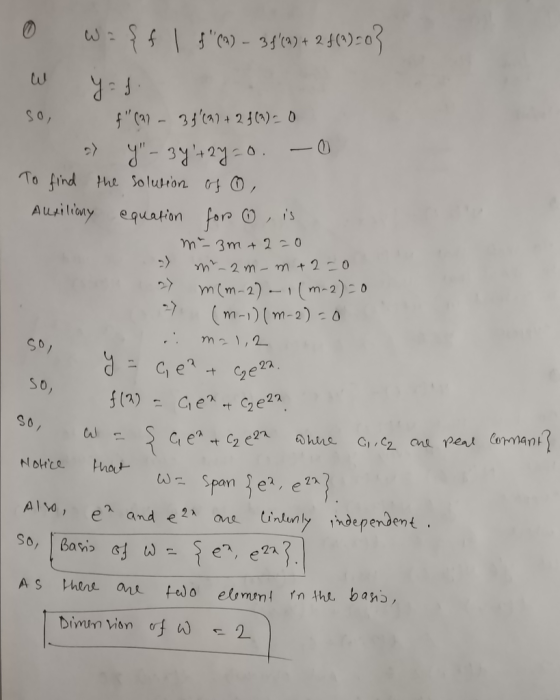
- The real vector space C2 (R) contains all twice differentiable real functions whose second derviative is still continuous. In M231(Differential Equations) you have learned (or will learn) that a function y = f(x) satisfies the condition f'' (x) — 3f'(x) + 2f(x) = 0 for all x, if and only if f is of the form f(x)= C1ex + C2e2x . You may just take this fact for granted in this class.
Give a basis for the vector space W consisting of those functions
that satisfy f" (x)-3f' (x) + 2f(x) = 0 for all c; and determine
the dimension of W.
Homework Answers
Add Answer to:
The real vector space C2 (R) contains all twice
differentiable real functions whose second derviative is...
Determine whether the given set S is a subspace of the vector space V.
 Determine whether the given set S is a subspace of
the vector space V.A. V=C2(ℝ) (twice continuously
differentiable functions), and S is the subset of VV consisting of
those functions satisfying the differential equation
y″=0. B. V=ℙ5, and SS is the subset of ℙ5 consisting of those polynomials satisfying
p(1)>p(0)C. V=ℙ4, and SS is the subset of ℙ4 consisting of all polynomials of the form
p(x)=ax3+bx.D. V=Mn×n(ℝ), and SS is the subset of all
symmetric matrices.E. V=ℝ2, and S consists of...
Determine whether the given set S is a subspace of
the vector space V.A. V=C2(ℝ) (twice continuously
differentiable functions), and S is the subset of VV consisting of
those functions satisfying the differential equation
y″=0. B. V=ℙ5, and SS is the subset of ℙ5 consisting of those polynomials satisfying
p(1)>p(0)C. V=ℙ4, and SS is the subset of ℙ4 consisting of all polynomials of the form
p(x)=ax3+bx.D. V=Mn×n(ℝ), and SS is the subset of all
symmetric matrices.E. V=ℝ2, and S consists of...
Let V = Cº(R) be the vector space of infinitely differentiable real valued functions on the...
 Let V = Cº(R) be the vector space of infinitely differentiable real valued functions on the real line. Let D: V → V be the differentiation operator, i.e. D(f(x)) = f'(x). Let Eq:V → V be the operator defined by Ea(f(x)) = eax f(x), where a is a real number. a) Show that E, is invertible with inverse E-a: b) Show that (D – a)E, = E,D and deduce that for n a positive integer, (D – a)" = E,D"...
Let V be the vector space consisting of all functions f: R + R satisfying f(x)...
 Let V be the vector space consisting of all functions f: R + R satisfying f(x) = a exp(x) +b cos(x) + csin(x) for some real numbers a, b, and c. (The function exp refers to the exponential, exp(22) = e.) Let F be the basis (exp cos sin of V. Let T :V + V be the linear transformation T(f) = f + f' + 2f" (where f' is the derivative of f). You may use the linearity of...
Let Coo denote the set of smooth functions, ie, functions f : R → R whose nth derivative exists, ...
 Let Coo denote the set of smooth functions, ie, functions f : R → R whose nth derivative exists, for all n. Recall that this is a vector space, where "vectors" of Coo are function:s like f(t) = sin(t) or f(t) = te, or polynomials like f(t)-t2-2, or constant functions like f(t) = 5, and more The set of smooth functions f (t) which satisfy the differential equation f"(t) +2f (t) -0 for all t, is the same as the...
Problem 4. Let V be the vector space of all infinitely differentiable functions f: [0, ]...
 Problem 4. Let V be the vector space of all infinitely differentiable functions f: [0, ] -» R, equipped with the inner product f(t)g(t)d (f,g) = (a) Let UC V be the subspace spanned by B = (sinr, cos x, 1) (you may assume without proof that B is linearly independent, and hence a basis for U). Find the B-matrix [D]93 of the "derivative linear transformation" D : U -> U given by D(f) = f'. (b) Let WC V...
2) Let CI0,1] be the vector space of all continuous real valued functions with domain [0,1J.Let...
 2) Let CI0,1] be the vector space of all continuous real valued functions with domain [0,1J.Let (f.8)-Co)ds be the inner product in C10.11 where fand g are two functions in CI0,1. Answer the following questions for f(x)-x and g(x)-cos. a) Find 《f4) and i g I where l.l denotes the length induced by this inner product,Show your work b) Determine the scalar c so that f-cg is orthogonal to f.Show all your work.
2. On subspaces of C(-1,1) Let V C(-1,1) be the vector space of all continuous real...
 2. On subspaces of C(-1,1) Let V C(-1,1) be the vector space of all continuous real valued functions on on the interval (-1, 1), with usual addition and scalar multiplication. (a) Verify, if the set W-f eV: f(0)-0is a subspace of V or not? (b) Verify, if the set W-Uev f(0) 1 is a subspace of V or not? (c) Verify, if the set W-İfEV:f(x)-0V-2-z is a subspace of V or not? 1b) PrtScn Home FS F6 F7 F8 5
(a) Can there be differentiable functions f,g (on R) with g(0)-f(0) 0 and f()g(x) for all z E R? What about if we ask (only) for continuous functions f,g? (a) Can there be differentiable functio...
 (a) Can there be differentiable functions f,g (on R) with g(0)-f(0) 0 and f()g(x) for all z E R? What about if we ask (only) for continuous functions f,g?
(a) Can there be differentiable functions f,g (on R) with g(0)-f(0) 0 and f()g(x) for all z E R? What about if we ask (only) for continuous functions f,g?
(a) Can there be differentiable functions f,g (on R) with g(0)-f(0) 0 and f()g(x) for all z E R? What about if we ask (only) for continuous functions f,g?
Let f: R -R and g : R → Rbe some functions, and let x be a vector in R . Suppose that all the com...
 Let f: R -R and g : R → Rbe some functions, and let x be a vector in R . Suppose that all the components off and g are directionally differentiable at x, and that g is such that, for all w RM, y +az) - g(y) y, w Then the composite function F(x)-g(f(x)) is directionally differentiable at x and the following chain rule holds: F, (x,d)=g'(f(x);f,(x,d)), YdER".
Let f: R -R and g : R → Rbe some...
Let f: R -R and g : R → Rbe some functions, and let x be a vector in R . Suppose that all the components off and g are directionally differentiable at x, and that g is such that, for all w RM, y +az) - g(y) y, w Then the composite function F(x)-g(f(x)) is directionally differentiable at x and the following chain rule holds: F, (x,d)=g'(f(x);f,(x,d)), YdER".
Let f: R -R and g : R → Rbe some...
34. Let V be the subspace of the vector space of all real- valued continuous functions...
 34. Let V be the subspace of the vector space of all real- valued continuous functions that has basis S = {e'. e-}. Show that V and Rare isomorphic.
 Determine whether the given set S is a subspace of
the vector space V.A. V=C2(ℝ) (twice continuously
differentiable functions), and S is the subset of VV consisting of
those functions satisfying the differential equation
y″=0. B. V=ℙ5, and SS is the subset of ℙ5 consisting of those polynomials satisfying
p(1)>p(0)C. V=ℙ4, and SS is the subset of ℙ4 consisting of all polynomials of the form
p(x)=ax3+bx.D. V=Mn×n(ℝ), and SS is the subset of all
symmetric matrices.E. V=ℝ2, and S consists of...
Determine whether the given set S is a subspace of
the vector space V.A. V=C2(ℝ) (twice continuously
differentiable functions), and S is the subset of VV consisting of
those functions satisfying the differential equation
y″=0. B. V=ℙ5, and SS is the subset of ℙ5 consisting of those polynomials satisfying
p(1)>p(0)C. V=ℙ4, and SS is the subset of ℙ4 consisting of all polynomials of the form
p(x)=ax3+bx.D. V=Mn×n(ℝ), and SS is the subset of all
symmetric matrices.E. V=ℝ2, and S consists of...
 Let V = Cº(R) be the vector space of infinitely differentiable real valued functions on the real line. Let D: V → V be the differentiation operator, i.e. D(f(x)) = f'(x). Let Eq:V → V be the operator defined by Ea(f(x)) = eax f(x), where a is a real number. a) Show that E, is invertible with inverse E-a: b) Show that (D – a)E, = E,D and deduce that for n a positive integer, (D – a)" = E,D"...
 Let V be the vector space consisting of all functions f: R + R satisfying f(x) = a exp(x) +b cos(x) + csin(x) for some real numbers a, b, and c. (The function exp refers to the exponential, exp(22) = e.) Let F be the basis (exp cos sin of V. Let T :V + V be the linear transformation T(f) = f + f' + 2f" (where f' is the derivative of f). You may use the linearity of...
 Let Coo denote the set of smooth functions, ie, functions f : R → R whose nth derivative exists, for all n. Recall that this is a vector space, where "vectors" of Coo are function:s like f(t) = sin(t) or f(t) = te, or polynomials like f(t)-t2-2, or constant functions like f(t) = 5, and more The set of smooth functions f (t) which satisfy the differential equation f"(t) +2f (t) -0 for all t, is the same as the...
 Problem 4. Let V be the vector space of all infinitely differentiable functions f: [0, ] -» R, equipped with the inner product f(t)g(t)d (f,g) = (a) Let UC V be the subspace spanned by B = (sinr, cos x, 1) (you may assume without proof that B is linearly independent, and hence a basis for U). Find the B-matrix [D]93 of the "derivative linear transformation" D : U -> U given by D(f) = f'. (b) Let WC V...
 2) Let CI0,1] be the vector space of all continuous real valued functions with domain [0,1J.Let (f.8)-Co)ds be the inner product in C10.11 where fand g are two functions in CI0,1. Answer the following questions for f(x)-x and g(x)-cos. a) Find 《f4) and i g I where l.l denotes the length induced by this inner product,Show your work b) Determine the scalar c so that f-cg is orthogonal to f.Show all your work.
 2. On subspaces of C(-1,1) Let V C(-1,1) be the vector space of all continuous real valued functions on on the interval (-1, 1), with usual addition and scalar multiplication. (a) Verify, if the set W-f eV: f(0)-0is a subspace of V or not? (b) Verify, if the set W-Uev f(0) 1 is a subspace of V or not? (c) Verify, if the set W-İfEV:f(x)-0V-2-z is a subspace of V or not? 1b) PrtScn Home FS F6 F7 F8 5
 (a) Can there be differentiable functions f,g (on R) with g(0)-f(0) 0 and f()g(x) for all z E R? What about if we ask (only) for continuous functions f,g?
(a) Can there be differentiable functions f,g (on R) with g(0)-f(0) 0 and f()g(x) for all z E R? What about if we ask (only) for continuous functions f,g?
(a) Can there be differentiable functions f,g (on R) with g(0)-f(0) 0 and f()g(x) for all z E R? What about if we ask (only) for continuous functions f,g?
 Let f: R -R and g : R → Rbe some functions, and let x be a vector in R . Suppose that all the components off and g are directionally differentiable at x, and that g is such that, for all w RM, y +az) - g(y) y, w Then the composite function F(x)-g(f(x)) is directionally differentiable at x and the following chain rule holds: F, (x,d)=g'(f(x);f,(x,d)), YdER".
Let f: R -R and g : R → Rbe some...
Let f: R -R and g : R → Rbe some functions, and let x be a vector in R . Suppose that all the components off and g are directionally differentiable at x, and that g is such that, for all w RM, y +az) - g(y) y, w Then the composite function F(x)-g(f(x)) is directionally differentiable at x and the following chain rule holds: F, (x,d)=g'(f(x);f,(x,d)), YdER".
Let f: R -R and g : R → Rbe some...
 34. Let V be the subspace of the vector space of all real- valued continuous functions that has basis S = {e'. e-}. Show that V and Rare isomorphic.
Most questions answered within 3 hours.
-
Where is the error in this code sequence?
String s1 = "Hello";
String s2 = "ello";...
asked 10 months ago -
Financial data for Joel de Paris, Inc., for last year
follow:
Joel de Paris, Inc.
Balance...
asked 10 months ago -
Consider this reaction:
Al2(SO4)3 (aq)+ BaCl3
(aq) Al2Cl6 (aq)- +
3BaSO4(s) . What is the...
asked 10 months ago -
Suppose that Savneet is considering increasing her
recent random sample from 20 car rentals to 40...
asked 10 months ago -
Trucks arrive at an unloading terminal at an average rate of 120
per hour.
Trucks arrive...
asked 10 months ago -
Why are methanol and ethanol completely soluble in water while
octanol is not very little soluble....
asked 10 months ago -
A facilities manager at a university reads in a research report
that the mean amount of...
asked 10 months ago -
When the CuSO4 is rehydrated by adding water to the anhydrous
compound, is this an endothermic...
asked 10 months ago -
A ray of sunlight is passing from diamond into crown glass; the
angle of incidence is...
asked 10 months ago -
A block of mass 0.249 kg is placed on top of a light, vertical
spring of...
asked 10 months ago -
how do the kidneys compensate in the presences of acidosis
a) trigger hyperventilate
b) reserve acid...
asked 10 months ago -
Question 501 pts
The rental rate of capital to the firm increases. Which of the
following...
asked 10 months ago