
Homework Answers
![A=\left[ \begin{array}{ccccc} 1 & 2 & 0 & -1 & 1 \\\\ 3 & 6 & 1 & 2 & 5 \\\\ 2 & 4 & 1 & 9 & 10 \\\\ 1 & 2 & 3 & 2 & 0 \end{array} \right] \longrightarrow_{R_2=R_2-3R_1} \left[ \begin{array}{ccccc} 1 & 2 & 0 & -1 & 1 \\\\ 0 & 0 & 1 & 5 & 2 \\\\ 2 & 4 & 1 & 9 & 10 \\\\ 1 & 2 & 3 & 2 & 0 \end{array} \right] \\ \\\longrightarrow_{R_3=R_3-2R_1} \left[ \begin{array}{ccccc} 1 & 2 & 0 & -1 & 1 \\\\ 0 & 0 & 1 & 5 & 2 \\\\ 0 & 0 & 1 & 11 & 8 \\\\ 1 & 2 & 3 & 2 & 0 \end{array} \right] \longrightarrow_{R_4=R_4-R_1} \left[ \begin{array}{ccccc} 1 & 2 & 0 & -1 & 1 \\\\ 0 & 0 & 1 & 5 & 2 \\\\ 0 & 0 & 1 & 11 & 8 \\\\ 0 & 0 & 3 & 3 & -1 \end{array} \right]](http://img.homeworklib.com/questions/32ba5160-7ee5-11eb-a745-534b42a796f9.png?x-oss-process=image/resize,w_560)
![\\\longrightarrow_{R_3=R_3-R_2} \left[ \begin{array}{ccccc} 1 & 2 & 0 & -1 & 1 \\\\ 0 & 0 & 1 & 5 & 2 \\\\ 0 & 0 & 0 & 6 & 6 \\\\ 0 & 0 & 3 & 3 & -1 \end{array} \right] \longrightarrow_{R_4=R_4-3R_2}\left[ \begin{array}{ccccc} 1 & 2 & 0 & -1 & 1 \\\\ 0 & 0 & 1 & 5 & 2 \\\\ 0 & 0 & 0 & 6 & 6 \\\\ 0 & 0 & 0 & -12 & -7 \end{array} \right]\\ \longrightarrow_{R_4=R_4+2R_3} \left[ \begin{array}{ccccc} 1 & 2 & 0 & -1 & 1 \\\\ 0 & 0 & 1 & 5 & 2 \\\\ 0 & 0 & 0 & 6 & 6 \\\\ 0 & 0 & 0 & 0 & 5 \end{array} \right]](http://img.homeworklib.com/questions/330fb060-7ee5-11eb-b46b-f5ff1d4c992f.png?x-oss-process=image/resize,w_560)
![\longrightarrow_{R_5=\frac{1}{5}R_5,~R_4=\frac{1}{6}R_4} \left[ \begin{array}{ccccc} 1 & 2 & 0 & -1 & 1 \\\\ 0 & 0 & 1 & 5 & 2 \\\\ 0 & 0 & 0 & 1 & 1 \\\\ 0 & 0 & 0 & 0 & 1 \end{array} \right]=B](http://img.homeworklib.com/questions/335f8c20-7ee5-11eb-8e37-359da44b71c3.png?x-oss-process=image/resize,w_560)
a) B is the row reduced form of A, thus for null space A, we consider BX=O, then
![\left[ \begin{array}{ccccc} 1 & 2 & 0 & -1 & 1 \\\\ 0 & 0 & 1 & 5 & 2 \\\\ 0 & 0 & 0 & 1 & 1 \\\\ 0 & 0 & 0 & 0 & 1 \end{array} \right] \left[ \begin{array}{c} x_{1} \\\\ x_{2} \\\\ x_{3} \\\\ x_{4}\\\\ x_{5} \end{array} \right] =\left[ \begin{array}{c} 0 \\\\ 0 \\\\ 0 \\\\ 0\\\\ 0 \end{array} \right] \\ \\=>x_1+2x_2-x_4+x_5=0,~x_3+5x_4+2x_5=0,~x_4+x_5=0,~x_5=0.\\ =>x_5=0=>x_4=0=>x_3=0=> x_1+2x_2=0. \\(x_1,x_2,x_3,x_4,x_5)=(-2x_2,x_2,0,0,0)=(-2,1,0,0,0)x_2.](http://img.homeworklib.com/questions/33d1fa90-7ee5-11eb-bb0c-69ae46bd8d0e.png?x-oss-process=image/resize,w_560)
Thus basis for null space is {(-2,1,0,0,0)}.
b) Not that 1st, 3rd,4th and 5th columns of B contains leading 1. Thus the corresponding columns of the original matrix B wil give the basis elements for column space, that is range.
Thus basis for range is {(1,3,2,1),(0,1,1,3),(-1,2,9,2),(1,5,10,0).
c) rank = 4, and nullity =1.
Question 3) (8 points) Consider the following matrix: A= ſi 4 0 0 28 3 12...
 Question 3) (8 points) Consider the following matrix: A= ſi 4 0 0 28 3 12 2 11 -5 5 6 0 8 1 (a) Find a basis for the Rowspace(A). Then state the dimension of the Rowspace(A). (b) Find a basis for the Colspace(A). Then state the dimension of the Colspace(A). (e) Find a basis for the Nullspace(A). Then state the dimension of the Nullspace(A). (d) State and confirm the Rank-Nullity Theorem for this matrix.
0 -3 -6 4 9 [10 2 0 -1] -1 -2 -1 3 1 0 1...
 0 -3 -6 4 9 [10 2 0 -1] -1 -2 -1 3 1 0 1 -1 0 -2 12. Given A and B = -2 -3 0 3 -1 0 0 0 1 4 5 -9 0 0 0 0 0 (a) (4 points) Find a basis for the column space of A. ܗ ܬ ܚ ܝ with A row equivalent to B. (b) (4 points) Find a basis for the nullspace of A. (c) (2 points) nullity (A)=
Use the fact that matrices A and B are row-equivalent. 1 2 1 0 0 2...
 Use the fact that matrices A and B are row-equivalent. 1 2 1 0 0 2 5 1 1 0 3 7 2 2 -2 5 11 4-1 4 1 0 30-4 0 1 -1 0 BE 2 0 0 0 1 -2 0 0 0 0 0 (a) Find the rank and nullity of A. rank nullity (b) Find a basis for the nullspace of A. (c) Find a basis for the row space of A. III 100- DUL...
2 -2 4 4.A=134-11. -2 1 3 (a) Find the rank and nullity (dimension of the...
 2 -2 4 4.A=134-11. -2 1 3 (a) Find the rank and nullity (dimension of the nullspace) of A (b) Find a basis for the nullspace of A. (c) Find a basis for the column space of A. c F1nd a basis for the column space o (d) Find a basis for the orthogonal complement of the nullspace of A
1 1 Use the fact that matrices A and B are row-equivalent. -2 -5 8 0...
 1 1 Use the fact that matrices A and B are row-equivalent. -2 -5 8 0 -17 3 -51 5 A= -5-9 13 7-67 7-13 5 -3 1 0 1 0 1 0 1 -2 0 B = 3 0 0 0 1-5 0 0 0 0 0 (a) Find the rank and nullity of A. rank nullity (b) Find a basis for the nullspace of A. It (c) Find a basis for the row space of A. lll III...
Use the fact that matrices A and B are row-equivalent. A = 1 2 1 0...
 Use the fact that matrices A and B are row-equivalent. A = 1 2 1 0 0 2 5 1 1 0 3 7 2 2 -2 10 23 7 -2 10 1 0 3 0-4 0 1 -1 0 2 0 0 0 1 -2 0 0 0 0 0 B = (a) Find the rank and nullity of A. rank nullity (b) Find a basis for the nullspace of A. (c) Find a basis for the row space...
Problem 2. Let 1 1 1 3 1 2 1 1 6 1 A = 3...
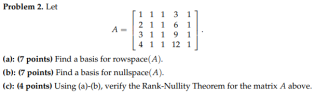 Problem 2. Let 1 1 1 3 1 2 1 1 6 1 A = 3 1 1 9 1 4 1 1 12 1 (a): (7 points) Find a basis for rowspace(A) (b): (7 points) Find a basis for nullspace(A) (c): (4 points) Using (a)-(b), verify the Rank-Nullity Theorem for the matrix A above
QUESTION 4. Consider the following matrix: I 8 0 167 A= -7 7 0 [ 0...
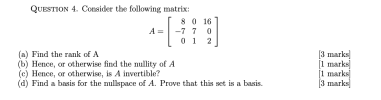 QUESTION 4. Consider the following matrix: I 8 0 167 A= -7 7 0 [ 0 1 2 (a) Find the rank of A Hence, or otherwise find the nullity of A (c) Hence, or otherwise, is A invertible? (d) Find a basis for the nullspace of A. Prove that this set is a basis. [3 marks] [1 marks [1 marks) (3 marks]
could u help me for this question?thanku!! 21. Let T be a linear transformation from P2 into P3 over R defined by T(p(x)) xp(x). (a) Find [T]B.A the matrix of T relative to the bases A = {1-x, l-x...
 could u help me for this question?thanku!!
21. Let T be a linear transformation from P2 into P3 over R defined by T(p(x)) xp(x). (a) Find [T]B.A the matrix of T relative to the bases A = {1-x, l-x2,x) and B={1,1+x, 1 +x+12, 1-x3}. (b) Use [TlB. A to find a basis for the range of T. (c) Use TB.A to find a basis for the kernel of T. (d) State the rank and nullity of T.
21. Let T...
could u help me for this question?thanku!!
21. Let T be a linear transformation from P2 into P3 over R defined by T(p(x)) xp(x). (a) Find [T]B.A the matrix of T relative to the bases A = {1-x, l-x2,x) and B={1,1+x, 1 +x+12, 1-x3}. (b) Use [TlB. A to find a basis for the range of T. (c) Use TB.A to find a basis for the kernel of T. (d) State the rank and nullity of T.
21. Let T...
Consider the matrix 0 4 8 24 0-3-6 3 18 A-0 24 2 -12 0 -2-3...
 Consider the matrix 0 4 8 24 0-3-6 3 18 A-0 24 2 -12 0 -2-3 0 7 0 3 5 [51 [51 a) Find a basis for the row space Row(A) of A (b) Find a basis for the column space Col(A) of A (c) Find a basis space d) Find the rank Rank(A) and the nullity of A (e) Determine if the vector v (1,4,-2,5,2) belongs to the null space of A. - As always,[5 is for the...
 Question 3) (8 points) Consider the following matrix: A= ſi 4 0 0 28 3 12 2 11 -5 5 6 0 8 1 (a) Find a basis for the Rowspace(A). Then state the dimension of the Rowspace(A). (b) Find a basis for the Colspace(A). Then state the dimension of the Colspace(A). (e) Find a basis for the Nullspace(A). Then state the dimension of the Nullspace(A). (d) State and confirm the Rank-Nullity Theorem for this matrix.
 0 -3 -6 4 9 [10 2 0 -1] -1 -2 -1 3 1 0 1 -1 0 -2 12. Given A and B = -2 -3 0 3 -1 0 0 0 1 4 5 -9 0 0 0 0 0 (a) (4 points) Find a basis for the column space of A. ܗ ܬ ܚ ܝ with A row equivalent to B. (b) (4 points) Find a basis for the nullspace of A. (c) (2 points) nullity (A)=
 Use the fact that matrices A and B are row-equivalent. 1 2 1 0 0 2 5 1 1 0 3 7 2 2 -2 5 11 4-1 4 1 0 30-4 0 1 -1 0 BE 2 0 0 0 1 -2 0 0 0 0 0 (a) Find the rank and nullity of A. rank nullity (b) Find a basis for the nullspace of A. (c) Find a basis for the row space of A. III 100- DUL...
 2 -2 4 4.A=134-11. -2 1 3 (a) Find the rank and nullity (dimension of the nullspace) of A (b) Find a basis for the nullspace of A. (c) Find a basis for the column space of A. c F1nd a basis for the column space o (d) Find a basis for the orthogonal complement of the nullspace of A
 1 1 Use the fact that matrices A and B are row-equivalent. -2 -5 8 0 -17 3 -51 5 A= -5-9 13 7-67 7-13 5 -3 1 0 1 0 1 0 1 -2 0 B = 3 0 0 0 1-5 0 0 0 0 0 (a) Find the rank and nullity of A. rank nullity (b) Find a basis for the nullspace of A. It (c) Find a basis for the row space of A. lll III...
 Use the fact that matrices A and B are row-equivalent. A = 1 2 1 0 0 2 5 1 1 0 3 7 2 2 -2 10 23 7 -2 10 1 0 3 0-4 0 1 -1 0 2 0 0 0 1 -2 0 0 0 0 0 B = (a) Find the rank and nullity of A. rank nullity (b) Find a basis for the nullspace of A. (c) Find a basis for the row space...
 Problem 2. Let 1 1 1 3 1 2 1 1 6 1 A = 3 1 1 9 1 4 1 1 12 1 (a): (7 points) Find a basis for rowspace(A) (b): (7 points) Find a basis for nullspace(A) (c): (4 points) Using (a)-(b), verify the Rank-Nullity Theorem for the matrix A above
 QUESTION 4. Consider the following matrix: I 8 0 167 A= -7 7 0 [ 0 1 2 (a) Find the rank of A Hence, or otherwise find the nullity of A (c) Hence, or otherwise, is A invertible? (d) Find a basis for the nullspace of A. Prove that this set is a basis. [3 marks] [1 marks [1 marks) (3 marks]
 could u help me for this question?thanku!!
21. Let T be a linear transformation from P2 into P3 over R defined by T(p(x)) xp(x). (a) Find [T]B.A the matrix of T relative to the bases A = {1-x, l-x2,x) and B={1,1+x, 1 +x+12, 1-x3}. (b) Use [TlB. A to find a basis for the range of T. (c) Use TB.A to find a basis for the kernel of T. (d) State the rank and nullity of T.
21. Let T...
could u help me for this question?thanku!!
21. Let T be a linear transformation from P2 into P3 over R defined by T(p(x)) xp(x). (a) Find [T]B.A the matrix of T relative to the bases A = {1-x, l-x2,x) and B={1,1+x, 1 +x+12, 1-x3}. (b) Use [TlB. A to find a basis for the range of T. (c) Use TB.A to find a basis for the kernel of T. (d) State the rank and nullity of T.
21. Let T...
 Consider the matrix 0 4 8 24 0-3-6 3 18 A-0 24 2 -12 0 -2-3 0 7 0 3 5 [51 [51 a) Find a basis for the row space Row(A) of A (b) Find a basis for the column space Col(A) of A (c) Find a basis space d) Find the rank Rank(A) and the nullity of A (e) Determine if the vector v (1,4,-2,5,2) belongs to the null space of A. - As always,[5 is for the...
Most questions answered within 3 hours.
-
Where is the error in this code sequence?
String s1 = "Hello";
String s2 = "ello";...
asked 10 months ago -
Financial data for Joel de Paris, Inc., for last year
follow:
Joel de Paris, Inc.
Balance...
asked 10 months ago -
Consider this reaction:
Al2(SO4)3 (aq)+ BaCl3
(aq) Al2Cl6 (aq)- +
3BaSO4(s) . What is the...
asked 10 months ago -
Suppose that Savneet is considering increasing her
recent random sample from 20 car rentals to 40...
asked 10 months ago -
Trucks arrive at an unloading terminal at an average rate of 120
per hour.
Trucks arrive...
asked 10 months ago -
Why are methanol and ethanol completely soluble in water while
octanol is not very little soluble....
asked 10 months ago -
A facilities manager at a university reads in a research report
that the mean amount of...
asked 10 months ago -
When the CuSO4 is rehydrated by adding water to the anhydrous
compound, is this an endothermic...
asked 10 months ago -
A ray of sunlight is passing from diamond into crown glass; the
angle of incidence is...
asked 10 months ago -
A block of mass 0.249 kg is placed on top of a light, vertical
spring of...
asked 10 months ago -
how do the kidneys compensate in the presences of acidosis
a) trigger hyperventilate
b) reserve acid...
asked 10 months ago -
Question 501 pts
The rental rate of capital to the firm increases. Which of the
following...
asked 10 months ago