Assume: The positive y direction is up. A pulley (in the form of a uniform disk)...
Assume: The positive y direction is up.
A pulley (in the form of a uniform disk)
withmass 65 kg and a radius 11 cmis attached
to the ceiling, in a uniform gravitational field,
and rotates with no friction about its pivot.
The acceleration of gravity is 9.8 m/s2 .
These masses are connected by a massless
inextensible cord. T1, T2, and T3 are magnitudes
of the tensions.
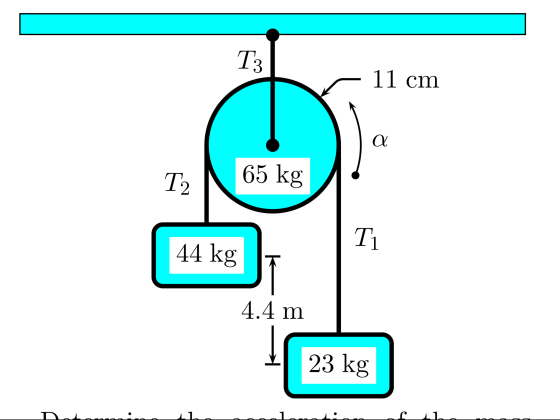
a)Determine the acceleration of the mass
23 kg.
b)Determine the acceleration of the center of
mass ~acm of M2 +m1.
c)Determine the magnitude of the tension T1.
d)Determine the magnitude of the difference
in the tensions T = T2 ? T1.
e)Determine the magnitude of the tension T3.
f)Determine the magnitude of the difference
in the force of gravity on the sum of the three
masses and the tension in the cord holding up
the pulley Fg = (Mp +M2 + m1) g ? T3.
Homework Answers
a)
Writing equations of motions :
for M1 = 23 kg,
T1 - M1*g = M1*a -------- (1)
for M2 :
M2*g - T2 = M2*a -----------(2)
Adding the two equations,
T1 - T2 + (M2-M1)*g = (M1+M2)*a -------- (3)
For the pulley:
(T2 - T1)*R = I*A
where I = 0.5*MR^2
A = angular acceleration = a/R
So, (T2 - T1)*R = 0.5*MR^2*(a/R)
So, T2- T1 = 0.5*M*a ----------- (4)
Adding equations (3) and (4), we get:
(M2-M1)*g = 0.5*M*a + (M1+M2)*a
So, a = (M2-M1)*g/(0.5*M + (M1+M2))
So, a = (44-23)*9.8/(0.5*65+(44+23))
So, a = 2.07 m/s2 <---------answer(acceleration)
b)
acceleration of center of mass = (M1*a - M2*a)/(M1+M2) = 0.649 m/s2
c)
T1 = M1*(g+a) = 23*(9.8+2.07) = 273 N
d)
T2 - T1 = 0.5*M*a = 0.5*65*2.07 = 67.3 N <-----------answer
e)
T3 = T2 - T1 = 67.3 N <-------answer
f)
Fg = (M+M2 + M1) g - T3.= (65+44+23)*9.8 - 67.3 = 1226.3 N <--------answer
Add Answer to:
Assume: The positive y direction is up.
A pulley (in the form of a uniform disk)...
A pulley with mass Mp and a radius Rp is attached to the ceiling, in a...
 A pulley with mass Mp and a radius Rp is
attached to the ceiling, in a gravity field of 9.81 m/s2
and rotates with no friction about its pivot.
Mass M2 is larger than mass m1. The
quantities Tn and g are magnitudes.
True False Greater than Less than Equal to T3
is ..... m1g + M2g + Mpg.
True False Greater than Less than Equal to The magnitude
of the acceleration of m1 is ..... that of
M2.
True False Greater...
A pulley with mass Mp and a radius Rp is
attached to the ceiling, in a gravity field of 9.81 m/s2
and rotates with no friction about its pivot.
Mass M2 is larger than mass m1. The
quantities Tn and g are magnitudes.
True False Greater than Less than Equal to T3
is ..... m1g + M2g + Mpg.
True False Greater than Less than Equal to The magnitude
of the acceleration of m1 is ..... that of
M2.
True False Greater...
Thank you, sorry about that Relevant formulas kx/2, y(t) = (a/2) + Voyt + yox(t) =...
 Thank you, sorry about that
Relevant formulas kx/2, y(t) = (a/2) + Voyt + yox(t) = 1.0t + Xo, vy(t) = at +Voyvo(t) = V.O. (2) Atwood machine with two pulleys: Two identical pulleys support two masses, M2 > M1. Find the tension in all three strings, and the acceleration of M2 and Ms. The pulleys are solid cylinders of mass Mo =.5 kg, and radii Rp.5m. M2 = 2 kg, M1 = 1kg. Write down the equations (ie. angular...
Thank you, sorry about that
Relevant formulas kx/2, y(t) = (a/2) + Voyt + yox(t) = 1.0t + Xo, vy(t) = at +Voyvo(t) = V.O. (2) Atwood machine with two pulleys: Two identical pulleys support two masses, M2 > M1. Find the tension in all three strings, and the acceleration of M2 and Ms. The pulleys are solid cylinders of mass Mo =.5 kg, and radii Rp.5m. M2 = 2 kg, M1 = 1kg. Write down the equations (ie. angular...
(1) A thin stick is glued to a uniform disk to form a composite pulley. Then...
 (1) A thin stick is glued to a uniform disk to form a composite pulley. Then a non-slip string with two masses is hung over the disk and the system is released from rest. Uniform Disk mass: 4 kg radius: 5 cm Calculate the moment of inertia of the stick plus disk combination and find the angular acceleration of the composite pulley, the linear acceleration of the two hanging blocks, and the tensions in each part of the string (which...
Atwood's machine consists of blocks of masses mi -8.8 kg and m2 - 17.5 kg attached...
 Atwood's machine consists of blocks of masses mi -8.8 kg and m2 - 17.5 kg attached by a cord running over a pulley as in the figure below. The pulley is id cylinder with mass M-7.30 kg and radiusr 0.200 m. The block of mass m2 is allowed to drop, and the cord turns the pulley without slipping. (a) Why must the tension T2 be greater than the tension T1? Score: 1 out of Comment: (b) What is the acceleration...
An Atwood's machine consists of blocks of masses m,-11.0kg and m2-18.0kg attached by a cord running...
 An Atwood's machine consists of blocks of masses m,-11.0kg and m2-18.0kg attached by a cord running over a pulley as in the figure below. The pulley is a solid cylinder with mass M 8.50 kg and radius 0.200 m. The block of mass m2 is allowed to drop, and the cord turns the pulley without slipping. (a) Why must the tension T2 be greater than the tension T1? This answer has not been graded yet (b) What is the acceleration...
Two blocks are connected by a lightweight string passing over a pulley, as shown in the figure below. The block with ma...
Two blocks are connected by a lightweight string passing over a pulley, as shown in the figure below. The block with mass m1 = 16.5 kg on the incline plane accelerates up the plane with negligible friction. The block's acceleration is a = 1.40 m/s2, and the tension in the segment of string attached to this block is T1. The hanging block has a mass of m2 = 23.5 kg, and the tension in the string attached to it is T2....
An object of mass m1 = 4.50 kg is connected by a light cord to an object of mass
An object of mass m1 = 4.50 kg is connected by a light cord to an object of mass m2 = 3.00 kg on a frictionless surface (see figure). The pulley rotates about a frictionless axle and has a moment of inertia of 0.570 kg · m² and a radius of 0.310 m. Assume that the cord does not slip on the pulley. (a) Find the acceleration of the two masses. m/s2 (b) Find the tensions T1 and T2
A mass m2 = 15.0 kg is connected by a light cord to a mass m1...
A mass m2 = 15.0 kg is connected by a light cord to a mass m1 = 15.0 kg, which slides on a smooth horizontal surface. The pulley, of mass M = 1.00 kg, rotates about a frictionless axle and has a radius R = 0.200 m and a moment of inertia I = 0.0900 kg-m2 . The cord does not slip on the pulley. a) What is the magnitude of the acceleration of m1? b) What is the tension...
two blocks with masses M1 and M2 hang one under the other. For this problem take the positive direction to be upward, an...
 two blocks with masses M1 and M2 hang one under the other. For
this problem take the positive direction to be upward, and use g
for the magnitude of the acceleration due to gravity1-find T2 the tension in the lower rope2 - Find T1 the tension in the upper rope;For question 3 and 4 the blocks are now acceleration upward due
to the tension in the strings with acceleration of magnitude
a.3- Find T2 the tension in the lower rope4-...
two blocks with masses M1 and M2 hang one under the other. For
this problem take the positive direction to be upward, and use g
for the magnitude of the acceleration due to gravity1-find T2 the tension in the lower rope2 - Find T1 the tension in the upper rope;For question 3 and 4 the blocks are now acceleration upward due
to the tension in the strings with acceleration of magnitude
a.3- Find T2 the tension in the lower rope4-...
Two blocks are connected by a lightweight string passing over a pulley, as shown in the figure below. The block with ma...
 Two blocks are connected by a lightweight string passing over a
pulley, as shown in the figure below. The block with mass
m1 = 16.5 kg on the incline plane accelerates
up the plane with negligible friction. The block's acceleration is
a = 1.80 m/s2, and the tension in the segment
of string attached to this block is T1. The
hanging block has a mass of m2 = 22.5 kg, and
the tension in the string attached to it is...
Two blocks are connected by a lightweight string passing over a
pulley, as shown in the figure below. The block with mass
m1 = 16.5 kg on the incline plane accelerates
up the plane with negligible friction. The block's acceleration is
a = 1.80 m/s2, and the tension in the segment
of string attached to this block is T1. The
hanging block has a mass of m2 = 22.5 kg, and
the tension in the string attached to it is...
 A pulley with mass Mp and a radius Rp is
attached to the ceiling, in a gravity field of 9.81 m/s2
and rotates with no friction about its pivot.
Mass M2 is larger than mass m1. The
quantities Tn and g are magnitudes.
True False Greater than Less than Equal to T3
is ..... m1g + M2g + Mpg.
True False Greater than Less than Equal to The magnitude
of the acceleration of m1 is ..... that of
M2.
True False Greater...
A pulley with mass Mp and a radius Rp is
attached to the ceiling, in a gravity field of 9.81 m/s2
and rotates with no friction about its pivot.
Mass M2 is larger than mass m1. The
quantities Tn and g are magnitudes.
True False Greater than Less than Equal to T3
is ..... m1g + M2g + Mpg.
True False Greater than Less than Equal to The magnitude
of the acceleration of m1 is ..... that of
M2.
True False Greater...
 Thank you, sorry about that
Relevant formulas kx/2, y(t) = (a/2) + Voyt + yox(t) = 1.0t + Xo, vy(t) = at +Voyvo(t) = V.O. (2) Atwood machine with two pulleys: Two identical pulleys support two masses, M2 > M1. Find the tension in all three strings, and the acceleration of M2 and Ms. The pulleys are solid cylinders of mass Mo =.5 kg, and radii Rp.5m. M2 = 2 kg, M1 = 1kg. Write down the equations (ie. angular...
Thank you, sorry about that
Relevant formulas kx/2, y(t) = (a/2) + Voyt + yox(t) = 1.0t + Xo, vy(t) = at +Voyvo(t) = V.O. (2) Atwood machine with two pulleys: Two identical pulleys support two masses, M2 > M1. Find the tension in all three strings, and the acceleration of M2 and Ms. The pulleys are solid cylinders of mass Mo =.5 kg, and radii Rp.5m. M2 = 2 kg, M1 = 1kg. Write down the equations (ie. angular...
 (1) A thin stick is glued to a uniform disk to form a composite pulley. Then a non-slip string with two masses is hung over the disk and the system is released from rest. Uniform Disk mass: 4 kg radius: 5 cm Calculate the moment of inertia of the stick plus disk combination and find the angular acceleration of the composite pulley, the linear acceleration of the two hanging blocks, and the tensions in each part of the string (which...
 Atwood's machine consists of blocks of masses mi -8.8 kg and m2 - 17.5 kg attached by a cord running over a pulley as in the figure below. The pulley is id cylinder with mass M-7.30 kg and radiusr 0.200 m. The block of mass m2 is allowed to drop, and the cord turns the pulley without slipping. (a) Why must the tension T2 be greater than the tension T1? Score: 1 out of Comment: (b) What is the acceleration...
 An Atwood's machine consists of blocks of masses m,-11.0kg and m2-18.0kg attached by a cord running over a pulley as in the figure below. The pulley is a solid cylinder with mass M 8.50 kg and radius 0.200 m. The block of mass m2 is allowed to drop, and the cord turns the pulley without slipping. (a) Why must the tension T2 be greater than the tension T1? This answer has not been graded yet (b) What is the acceleration...
 two blocks with masses M1 and M2 hang one under the other. For
this problem take the positive direction to be upward, and use g
for the magnitude of the acceleration due to gravity1-find T2 the tension in the lower rope2 - Find T1 the tension in the upper rope;For question 3 and 4 the blocks are now acceleration upward due
to the tension in the strings with acceleration of magnitude
a.3- Find T2 the tension in the lower rope4-...
two blocks with masses M1 and M2 hang one under the other. For
this problem take the positive direction to be upward, and use g
for the magnitude of the acceleration due to gravity1-find T2 the tension in the lower rope2 - Find T1 the tension in the upper rope;For question 3 and 4 the blocks are now acceleration upward due
to the tension in the strings with acceleration of magnitude
a.3- Find T2 the tension in the lower rope4-...
 Two blocks are connected by a lightweight string passing over a
pulley, as shown in the figure below. The block with mass
m1 = 16.5 kg on the incline plane accelerates
up the plane with negligible friction. The block's acceleration is
a = 1.80 m/s2, and the tension in the segment
of string attached to this block is T1. The
hanging block has a mass of m2 = 22.5 kg, and
the tension in the string attached to it is...
Two blocks are connected by a lightweight string passing over a
pulley, as shown in the figure below. The block with mass
m1 = 16.5 kg on the incline plane accelerates
up the plane with negligible friction. The block's acceleration is
a = 1.80 m/s2, and the tension in the segment
of string attached to this block is T1. The
hanging block has a mass of m2 = 22.5 kg, and
the tension in the string attached to it is...
Most questions answered within 3 hours.
-
Where is the error in this code sequence?
String s1 = "Hello";
String s2 = "ello";...
asked 11 months ago -
Financial data for Joel de Paris, Inc., for last year
follow:
Joel de Paris, Inc.
Balance...
asked 11 months ago -
Consider this reaction:
Al2(SO4)3 (aq)+ BaCl3
(aq) Al2Cl6 (aq)- +
3BaSO4(s) . What is the...
asked 11 months ago -
Suppose that Savneet is considering increasing her
recent random sample from 20 car rentals to 40...
asked 11 months ago -
Trucks arrive at an unloading terminal at an average rate of 120
per hour.
Trucks arrive...
asked 11 months ago -
Why are methanol and ethanol completely soluble in water while
octanol is not very little soluble....
asked 11 months ago -
A facilities manager at a university reads in a research report
that the mean amount of...
asked 11 months ago -
When the CuSO4 is rehydrated by adding water to the anhydrous
compound, is this an endothermic...
asked 11 months ago -
A ray of sunlight is passing from diamond into crown glass; the
angle of incidence is...
asked 11 months ago -
A block of mass 0.249 kg is placed on top of a light, vertical
spring of...
asked 11 months ago -
how do the kidneys compensate in the presences of acidosis
a) trigger hyperventilate
b) reserve acid...
asked 11 months ago -
Question 501 pts
The rental rate of capital to the firm increases. Which of the
following...
asked 11 months ago