




Homework Answers
1) Option (B) is the correct answer.
Because in monopolisticaly competitive markets, there will be a imperfect competition where there will be many producers who sells differentiated products to consumers.
2&3) True.
Because advertising or promotion will help to capture the business.
Advertising in the monopolistic competition market will help the producers to sell their differentiated products. As advertising will help to generate awareness about their newer differentiated product.
4&5) Option (A) is the correct answer. Highly Elastic.
Because there will be many firms and the market power is low. So demand will be highly elastic in the long run. Main factor which influences the demand elasticity is price. In this case, firms are price setters and there are multiple products available in the market. So demand will be highly elastic.
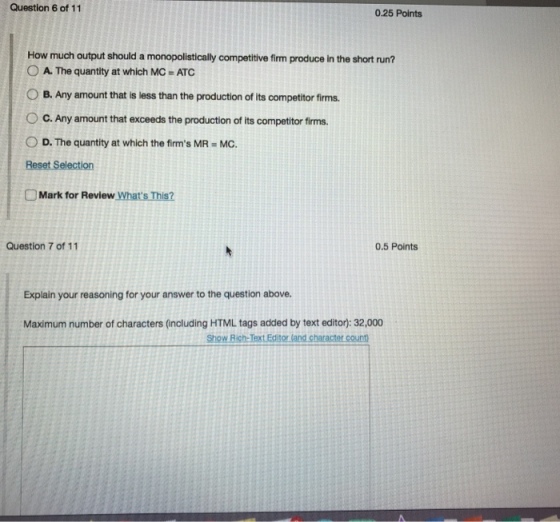
6&7) Option (D) is the correct answer.
Because any quantity exceeding or lower than the competitor firm cannot be right option as the prices do vary among the players.
8&9) Option (C). Zero Economic Profit.
Because in the long run, demand for the monopolistically compatetive firms will get reduced and so is the profit. So they can only generate breakeven in the long run.
10) Option (A) is thecorrect answer.
Because the price they change is equal to Marginal cost to make profits. They are price setters.
Add Answer to:
1)
2&3) Explain.
4&5)) Explain.
6&7)Explain.
8&9)Explain.
10)
Part 1 of 7- Question 1 of 11...
1. Which of the following is NOT a characteristic of a monopolistically competitive market?
1. Which of the following is NOT a characteristic of a monopolistically competitive market?A. many sellers.B. differentiated products.C. long-run economic profits.D. free entry and exit.2. Which of the following products is likely to be sold in a monopolistically competitive market?A. video games.B. breakfast cereal.E. beer.D. all of the above.3. Which of the following is true regarding the similarities and differences in monopolistic competition and monopoly?A. The monopolist faces a downward-sloping demand curve while the monopolistic competitor faces an elastic demand...
Please Help Question 9 0.16 pts The gap between the actual quantity produced by a monopolistically...
 Please Help
Question 9 0.16 pts The gap between the actual quantity produced by a monopolistically competitive firm and the optimal quantity in a competitive market is known as inefficient scale. insufficient capacity. flux capacity O markup. excess capacity Question 10 0.16 pts We could state correctly that the minimum characteristic necessary to distinguish among price-making firms is O price discrimination. the number of firms in the industry. whether they produce industrial or consumer products. O product differentiation. O the...
Please Help
Question 9 0.16 pts The gap between the actual quantity produced by a monopolistically competitive firm and the optimal quantity in a competitive market is known as inefficient scale. insufficient capacity. flux capacity O markup. excess capacity Question 10 0.16 pts We could state correctly that the minimum characteristic necessary to distinguish among price-making firms is O price discrimination. the number of firms in the industry. whether they produce industrial or consumer products. O product differentiation. O the...
QUESTION 6 Industry is a perfectly competitive industry. Assume that as a result of changes in...
 QUESTION 6 Industry is a perfectly competitive industry. Assume that as a result of changes in other markets there is a twenty percent increase in the price of variable inputs used by firms in industry Y. After all adjustments have taken place, we would expect the equilibrium price in industry Yto: increase and the number of firms to increase. decrease and the number of firms to increase. increase and the number of firms to decrease. decrease and the number of...
The Prisoner's Dilemma utilizes game theory to explain behavior of firms in: Markets characterized by natural...
 The Prisoner's Dilemma utilizes game theory to explain behavior of firms in: Markets characterized by natural monopoly. Monopoly markets. Perfectly competitive markets. Monopolistically competitive markets. Oligopoly markets At 500 units of output, total costs = $50,000 and total variable cost = $5,000. What does average fixed costs (ATC) equal at 500 units? $45,000 $50. $100. $90. Statement 1: Marginal cost pricing occurs when the market price of a good is equal to the marginal cost of the last unit of...
Please answer the 3 following questions: QUESTION 3 Which of the following is NOT a characteristic...
 Please answer the 3 following questions:
QUESTION 3 Which of the following is NOT a characteristic of firms in a monopolistically competitive market? O advertising differentiated products existence of significant economies of scale o ease of entry and exit QUESTION 4 For a firm that sells an information product, the long-run equilibrium exists at a point at which economic profits are O negative. zero. O positive. dependent upon the particular product. QUESTION 5 Advertising intended to reach as many consumers...
Please answer the 3 following questions:
QUESTION 3 Which of the following is NOT a characteristic of firms in a monopolistically competitive market? O advertising differentiated products existence of significant economies of scale o ease of entry and exit QUESTION 4 For a firm that sells an information product, the long-run equilibrium exists at a point at which economic profits are O negative. zero. O positive. dependent upon the particular product. QUESTION 5 Advertising intended to reach as many consumers...
Please Help Question 13 0.16 pts An industry (such as California cheese) might advertise so that...
 Please Help
Question 13 0.16 pts An industry (such as California cheese) might advertise so that its product (cheese) O will now be viewed as homo O may be characterized by a horizontal demand curve. O will be sold in perfectly competitive markets. O is no longer viewed as homogeneous. O will now have a price elasticity of demand that is more elastic. geneous for all producers. Question 14 0.16 pts Firms in a monopolistically competitive industry produce monopolistic goods...
Please Help
Question 13 0.16 pts An industry (such as California cheese) might advertise so that its product (cheese) O will now be viewed as homo O may be characterized by a horizontal demand curve. O will be sold in perfectly competitive markets. O is no longer viewed as homogeneous. O will now have a price elasticity of demand that is more elastic. geneous for all producers. Question 14 0.16 pts Firms in a monopolistically competitive industry produce monopolistic goods...
QUESTION 1 Which of the following is always a characteristic of the oligopoly market structure? Many...
QUESTION 1 Which of the following is always a characteristic of the oligopoly market structure? Many sellers, each small in size relative to the overall market. Few sellers. All sellers produce identical products. Easy, low-cost entry and exit. QUESTION 2 The industry that most closely approximates the conditions of the oligopoly model is: Restaurant. Retail clothing. Airlines in the U.S. The local cable company. QUESTION 3 In which of the following market structures must the price and output decisions of...
These three questions please! Question 32 (1 point) Because a monopolistically competitive firm has some market...
 These three questions please!
Question 32 (1 point) Because a monopolistically competitive firm has some market power, in the long-run what does the price of its good exceed? its average u its average total cost its marginal cost its profit per unit Question 33 (1 point) In monopolistically competitive markets, what does the property of free entry and exit suggest? The market structure will eventually be characterized by perfect competition in the long run. O All firms earn zero economic...
These three questions please!
Question 32 (1 point) Because a monopolistically competitive firm has some market power, in the long-run what does the price of its good exceed? its average u its average total cost its marginal cost its profit per unit Question 33 (1 point) In monopolistically competitive markets, what does the property of free entry and exit suggest? The market structure will eventually be characterized by perfect competition in the long run. O All firms earn zero economic...
can you please help me with these problems . microeconomics 0/1.21 pts ed Question 80 The practice of setting prices deliberately below pricing. costs in an eff...
 can you please help me with these problems .
microeconomics
0/1.21 pts ed Question 80 The practice of setting prices deliberately below pricing. costs in an effort to drive a competitor out of the market is known as predatory average variable O average fixed explicit average total marginal 0/1.21 pts wered Question 78 0/1.21 An example of a tying arrangement is a restaurant offering both Pepsi and Coca-Cola products. a car manufacturer installing expensive onboard GPS/navigation systems in all the...
can you please help me with these problems .
microeconomics
0/1.21 pts ed Question 80 The practice of setting prices deliberately below pricing. costs in an effort to drive a competitor out of the market is known as predatory average variable O average fixed explicit average total marginal 0/1.21 pts wered Question 78 0/1.21 An example of a tying arrangement is a restaurant offering both Pepsi and Coca-Cola products. a car manufacturer installing expensive onboard GPS/navigation systems in all the...
the typical firm in the United States economy (x) has some degree of market power. (y)...
the typical firm in the United States economy (x) has some degree of market power. (y) sells its product for a price that is equal to the marginal cost of producing the last unit. (z) is imperfectly competitive. A. (x), (y) and (z) B. (x) and (y) only C. (x) and (z) only D. (y) and (z) only E. (y) only 2. Which of the following statements is (are) correct? (x) Monopolistic competitive markets consist of many sellers with differentiated...
 Please Help
Question 9 0.16 pts The gap between the actual quantity produced by a monopolistically competitive firm and the optimal quantity in a competitive market is known as inefficient scale. insufficient capacity. flux capacity O markup. excess capacity Question 10 0.16 pts We could state correctly that the minimum characteristic necessary to distinguish among price-making firms is O price discrimination. the number of firms in the industry. whether they produce industrial or consumer products. O product differentiation. O the...
Please Help
Question 9 0.16 pts The gap between the actual quantity produced by a monopolistically competitive firm and the optimal quantity in a competitive market is known as inefficient scale. insufficient capacity. flux capacity O markup. excess capacity Question 10 0.16 pts We could state correctly that the minimum characteristic necessary to distinguish among price-making firms is O price discrimination. the number of firms in the industry. whether they produce industrial or consumer products. O product differentiation. O the...
 QUESTION 6 Industry is a perfectly competitive industry. Assume that as a result of changes in other markets there is a twenty percent increase in the price of variable inputs used by firms in industry Y. After all adjustments have taken place, we would expect the equilibrium price in industry Yto: increase and the number of firms to increase. decrease and the number of firms to increase. increase and the number of firms to decrease. decrease and the number of...
 The Prisoner's Dilemma utilizes game theory to explain behavior of firms in: Markets characterized by natural monopoly. Monopoly markets. Perfectly competitive markets. Monopolistically competitive markets. Oligopoly markets At 500 units of output, total costs = $50,000 and total variable cost = $5,000. What does average fixed costs (ATC) equal at 500 units? $45,000 $50. $100. $90. Statement 1: Marginal cost pricing occurs when the market price of a good is equal to the marginal cost of the last unit of...
 Please answer the 3 following questions:
QUESTION 3 Which of the following is NOT a characteristic of firms in a monopolistically competitive market? O advertising differentiated products existence of significant economies of scale o ease of entry and exit QUESTION 4 For a firm that sells an information product, the long-run equilibrium exists at a point at which economic profits are O negative. zero. O positive. dependent upon the particular product. QUESTION 5 Advertising intended to reach as many consumers...
Please answer the 3 following questions:
QUESTION 3 Which of the following is NOT a characteristic of firms in a monopolistically competitive market? O advertising differentiated products existence of significant economies of scale o ease of entry and exit QUESTION 4 For a firm that sells an information product, the long-run equilibrium exists at a point at which economic profits are O negative. zero. O positive. dependent upon the particular product. QUESTION 5 Advertising intended to reach as many consumers...
 Please Help
Question 13 0.16 pts An industry (such as California cheese) might advertise so that its product (cheese) O will now be viewed as homo O may be characterized by a horizontal demand curve. O will be sold in perfectly competitive markets. O is no longer viewed as homogeneous. O will now have a price elasticity of demand that is more elastic. geneous for all producers. Question 14 0.16 pts Firms in a monopolistically competitive industry produce monopolistic goods...
Please Help
Question 13 0.16 pts An industry (such as California cheese) might advertise so that its product (cheese) O will now be viewed as homo O may be characterized by a horizontal demand curve. O will be sold in perfectly competitive markets. O is no longer viewed as homogeneous. O will now have a price elasticity of demand that is more elastic. geneous for all producers. Question 14 0.16 pts Firms in a monopolistically competitive industry produce monopolistic goods...
 These three questions please!
Question 32 (1 point) Because a monopolistically competitive firm has some market power, in the long-run what does the price of its good exceed? its average u its average total cost its marginal cost its profit per unit Question 33 (1 point) In monopolistically competitive markets, what does the property of free entry and exit suggest? The market structure will eventually be characterized by perfect competition in the long run. O All firms earn zero economic...
These three questions please!
Question 32 (1 point) Because a monopolistically competitive firm has some market power, in the long-run what does the price of its good exceed? its average u its average total cost its marginal cost its profit per unit Question 33 (1 point) In monopolistically competitive markets, what does the property of free entry and exit suggest? The market structure will eventually be characterized by perfect competition in the long run. O All firms earn zero economic...
 can you please help me with these problems .
microeconomics
0/1.21 pts ed Question 80 The practice of setting prices deliberately below pricing. costs in an effort to drive a competitor out of the market is known as predatory average variable O average fixed explicit average total marginal 0/1.21 pts wered Question 78 0/1.21 An example of a tying arrangement is a restaurant offering both Pepsi and Coca-Cola products. a car manufacturer installing expensive onboard GPS/navigation systems in all the...
can you please help me with these problems .
microeconomics
0/1.21 pts ed Question 80 The practice of setting prices deliberately below pricing. costs in an effort to drive a competitor out of the market is known as predatory average variable O average fixed explicit average total marginal 0/1.21 pts wered Question 78 0/1.21 An example of a tying arrangement is a restaurant offering both Pepsi and Coca-Cola products. a car manufacturer installing expensive onboard GPS/navigation systems in all the...
Most questions answered within 3 hours.
-
Where is the error in this code sequence?
String s1 = "Hello";
String s2 = "ello";...
asked 10 months ago -
Financial data for Joel de Paris, Inc., for last year
follow:
Joel de Paris, Inc.
Balance...
asked 10 months ago -
Consider this reaction:
Al2(SO4)3 (aq)+ BaCl3
(aq) Al2Cl6 (aq)- +
3BaSO4(s) . What is the...
asked 10 months ago -
Suppose that Savneet is considering increasing her
recent random sample from 20 car rentals to 40...
asked 10 months ago -
Trucks arrive at an unloading terminal at an average rate of 120
per hour.
Trucks arrive...
asked 10 months ago -
Why are methanol and ethanol completely soluble in water while
octanol is not very little soluble....
asked 10 months ago -
A facilities manager at a university reads in a research report
that the mean amount of...
asked 10 months ago -
When the CuSO4 is rehydrated by adding water to the anhydrous
compound, is this an endothermic...
asked 10 months ago -
A ray of sunlight is passing from diamond into crown glass; the
angle of incidence is...
asked 10 months ago -
A block of mass 0.249 kg is placed on top of a light, vertical
spring of...
asked 10 months ago -
how do the kidneys compensate in the presences of acidosis
a) trigger hyperventilate
b) reserve acid...
asked 10 months ago -
Question 501 pts
The rental rate of capital to the firm increases. Which of the
following...
asked 10 months ago