
Homework Answers


Add Answer to:
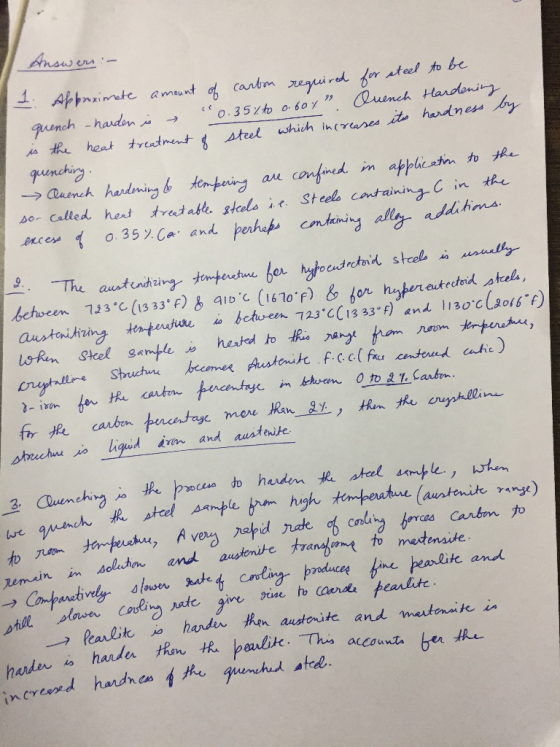
Lab Homework. Answer these questions before coming to the Lab. 1. What is the approximate amount...
Using the isothermal transformation diagram for an alloy steel (type 4340) specify the nature of the final microstruct...
 Using the isothermal transformation diagram for an alloy steel (type 4340) specify the nature of the final microstructure (in terms of micro-constituents present and approximate percentages) of a small specimen that has been subjected to the following time-temperature treatments: In each case assume that the specimen begins at 760°C and that it has been held at this temperature long enough to have achieved a complete and homogeneous austenite structure. (a) (a) Rapidly cool to 400°C, hold for 10 seconds, and...
Q21. Which one of the following statements about the ductility of metals is TRUE? A High ductility occurs in brittle materials B Ductility is the amount of deformation at the 0.2% proof stress C Duct...
 Q21. Which one of the following statements about the ductility of metals is TRUE? A High ductility occurs in brittle materials B Ductility is the amount of deformation at the 0.2% proof stress C Ductility can be measured as % reduction in area from broken tensile samples D Ductility is deformation in the elastic region E Ductility is the change between upper and lower yield point in steels Q22. Which one of the following statements is TRUE about Charpy impact...
please answer question 2,3,4 A critical feature of steel is that a considerable amount of...
 please answer question 2,3,4
A critical feature of steel is that a considerable amount of carbon can be dissolved in the austenite, phase, (up to 2.14 w/o at 1147"C), whereas carbon is essentially insoluble in ferrite, Cooling from point d to e, just above the eutectoid but still in the an increased fraction of the +y region, will produce phase and a microstructure similar to that shown: the particles precinitates out in the form af an intermetallic.compound called iron-carbide...
please answer question 2,3,4
A critical feature of steel is that a considerable amount of carbon can be dissolved in the austenite, phase, (up to 2.14 w/o at 1147"C), whereas carbon is essentially insoluble in ferrite, Cooling from point d to e, just above the eutectoid but still in the an increased fraction of the +y region, will produce phase and a microstructure similar to that shown: the particles precinitates out in the form af an intermetallic.compound called iron-carbide...
I need help to write a nice introduction for experiment 6 please ( no hands write ) typing Thank you HEAT TREATMENT OF STEELS EXPERIMENT 6 EXPERIMENT 6 HEAT TREATMENT OF STEELS THEORY The Ef...
 I need help to write a nice introduction for experiment 6
please ( no hands write ) typing
Thank you
HEAT TREATMENT OF STEELS EXPERIMENT 6 EXPERIMENT 6 HEAT TREATMENT OF STEELS THEORY The Effect of Cooling Rate One of the most convenient methods for controlling the properties of a given steel, i.e., a steel whose composition is already fixed, consists of austenizing the steel and ten cooling to room temperature at some predetermined rate. A variation of cooling rates...
I need help to write a nice introduction for experiment 6
please ( no hands write ) typing
Thank you
HEAT TREATMENT OF STEELS EXPERIMENT 6 EXPERIMENT 6 HEAT TREATMENT OF STEELS THEORY The Effect of Cooling Rate One of the most convenient methods for controlling the properties of a given steel, i.e., a steel whose composition is already fixed, consists of austenizing the steel and ten cooling to room temperature at some predetermined rate. A variation of cooling rates...
Please help answer questions 1-4 of my assignment with the given [HCl] Concentration of 0.1522 Titration...
 Please help answer questions 1-4 of my assignment with the given
[HCl] Concentration of 0.1522
Titration of Room Temperature Ca(OH)2 Solution. Note these are 10.00 mL samples. Room Temperature_210 "C294 K (lab manual, p. 8-5) Trial Trial 2 Trial 3 Final Volume (mL) Initial Volume (mL) Volume Delivered (mL) Average Volume (mL) 28.66 mL Titration of "Hot" Ca(OH)2 Solution. Note these are 10.00 mL samples. Temperature of "Hot" Solution_90 _°C - 363 _K (lab manual, p. 8-5) Trial 1 Trial...
Please help answer questions 1-4 of my assignment with the given
[HCl] Concentration of 0.1522
Titration of Room Temperature Ca(OH)2 Solution. Note these are 10.00 mL samples. Room Temperature_210 "C294 K (lab manual, p. 8-5) Trial Trial 2 Trial 3 Final Volume (mL) Initial Volume (mL) Volume Delivered (mL) Average Volume (mL) 28.66 mL Titration of "Hot" Ca(OH)2 Solution. Note these are 10.00 mL samples. Temperature of "Hot" Solution_90 _°C - 363 _K (lab manual, p. 8-5) Trial 1 Trial...
Answer these questions before coming to the lab and turn in your answers at the beginning...
 Answer these questions before coming to the lab and turn in your answers at the beginning of the lab to get credit. Turning this prelab question sheet at the end of the lab would result in not getting any credit for the prelab. 1. A cube's length was measured with a caliper to be 2.638 cm and the mass of the cube is 61.60 g. a) How many significant figures you get when you read with this caliper? b) Calculate...
how are melting points used Answer these questions before coming to the lab and turn in...
 how
are melting points used
Answer these questions before coming to the lab and turn in your answers at the beginning of the lab to get credit. Turning this pre lab question sheet later would result in not getting any credit for the pre lab. Period T is defined as the time required for an object with mass M attached to a string length L to complete one cycle of motion. For small oscillations of a pendulum we have T=21V...
how
are melting points used
Answer these questions before coming to the lab and turn in your answers at the beginning of the lab to get credit. Turning this pre lab question sheet later would result in not getting any credit for the pre lab. Period T is defined as the time required for an object with mass M attached to a string length L to complete one cycle of motion. For small oscillations of a pendulum we have T=21V...
Important! Answer these questions before coming to lab. Write the answers in your notebook and on a sheet of paper...
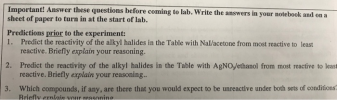 Important! Answer these questions before coming to lab. Write the answers in your notebook and on a sheet of paper to turn in at the start of lab. Predictions prior to the experiment: 1. Predict the reactivity of the alkyl halides in the Table with Nal/acetone from most reactive to least reactive. Briefly explain your reasoning. 2. Predict the reactivity of the alkyl halides in the Table with AgNO,/ethanol from most reactive to least reactive. Briefly explain your reasoning.. 3....
Prelab Name Class Section Answer these questions before coming to the lab and turn in your...
 Prelab Name Class Section Answer these questions before coming to the lab and turn in your answers at the beginning of the lab to get credit. Turning this pre lab question sheet later would result in not getting any credit for the pre lab. 1. What is a standing wave? 2. What is the name given to a point on a vibrating string at which displacement is always zero? 3. The length of the string from the vibrator to the...
Answer the following before coming to lab: 1.) Based on what you saw last week, which...
 Answer the following before coming to lab: 1.) Based on what you saw last week, which enantiomer of tartaric acid would you expect to co- crystallize with (SS)-1,2-diammoniumcyclohexane? 2.) If you had a neutral aqueous solution of triethylamine, would you add acid or base in order to extract it with an organic solvent? 3.) Now, consider a dichloromethane solution of triethylamine. Would you extract with acidic aqueous or basic aqueous solution in order to get the triethylamine out of the...
 Using the isothermal transformation diagram for an alloy steel (type 4340) specify the nature of the final microstructure (in terms of micro-constituents present and approximate percentages) of a small specimen that has been subjected to the following time-temperature treatments: In each case assume that the specimen begins at 760°C and that it has been held at this temperature long enough to have achieved a complete and homogeneous austenite structure. (a) (a) Rapidly cool to 400°C, hold for 10 seconds, and...
 Q21. Which one of the following statements about the ductility of metals is TRUE? A High ductility occurs in brittle materials B Ductility is the amount of deformation at the 0.2% proof stress C Ductility can be measured as % reduction in area from broken tensile samples D Ductility is deformation in the elastic region E Ductility is the change between upper and lower yield point in steels Q22. Which one of the following statements is TRUE about Charpy impact...
 please answer question 2,3,4
A critical feature of steel is that a considerable amount of carbon can be dissolved in the austenite, phase, (up to 2.14 w/o at 1147"C), whereas carbon is essentially insoluble in ferrite, Cooling from point d to e, just above the eutectoid but still in the an increased fraction of the +y region, will produce phase and a microstructure similar to that shown: the particles precinitates out in the form af an intermetallic.compound called iron-carbide...
please answer question 2,3,4
A critical feature of steel is that a considerable amount of carbon can be dissolved in the austenite, phase, (up to 2.14 w/o at 1147"C), whereas carbon is essentially insoluble in ferrite, Cooling from point d to e, just above the eutectoid but still in the an increased fraction of the +y region, will produce phase and a microstructure similar to that shown: the particles precinitates out in the form af an intermetallic.compound called iron-carbide...
 I need help to write a nice introduction for experiment 6
please ( no hands write ) typing
Thank you
HEAT TREATMENT OF STEELS EXPERIMENT 6 EXPERIMENT 6 HEAT TREATMENT OF STEELS THEORY The Effect of Cooling Rate One of the most convenient methods for controlling the properties of a given steel, i.e., a steel whose composition is already fixed, consists of austenizing the steel and ten cooling to room temperature at some predetermined rate. A variation of cooling rates...
I need help to write a nice introduction for experiment 6
please ( no hands write ) typing
Thank you
HEAT TREATMENT OF STEELS EXPERIMENT 6 EXPERIMENT 6 HEAT TREATMENT OF STEELS THEORY The Effect of Cooling Rate One of the most convenient methods for controlling the properties of a given steel, i.e., a steel whose composition is already fixed, consists of austenizing the steel and ten cooling to room temperature at some predetermined rate. A variation of cooling rates...
 Please help answer questions 1-4 of my assignment with the given
[HCl] Concentration of 0.1522
Titration of Room Temperature Ca(OH)2 Solution. Note these are 10.00 mL samples. Room Temperature_210 "C294 K (lab manual, p. 8-5) Trial Trial 2 Trial 3 Final Volume (mL) Initial Volume (mL) Volume Delivered (mL) Average Volume (mL) 28.66 mL Titration of "Hot" Ca(OH)2 Solution. Note these are 10.00 mL samples. Temperature of "Hot" Solution_90 _°C - 363 _K (lab manual, p. 8-5) Trial 1 Trial...
Please help answer questions 1-4 of my assignment with the given
[HCl] Concentration of 0.1522
Titration of Room Temperature Ca(OH)2 Solution. Note these are 10.00 mL samples. Room Temperature_210 "C294 K (lab manual, p. 8-5) Trial Trial 2 Trial 3 Final Volume (mL) Initial Volume (mL) Volume Delivered (mL) Average Volume (mL) 28.66 mL Titration of "Hot" Ca(OH)2 Solution. Note these are 10.00 mL samples. Temperature of "Hot" Solution_90 _°C - 363 _K (lab manual, p. 8-5) Trial 1 Trial...
 Answer these questions before coming to the lab and turn in your answers at the beginning of the lab to get credit. Turning this prelab question sheet at the end of the lab would result in not getting any credit for the prelab. 1. A cube's length was measured with a caliper to be 2.638 cm and the mass of the cube is 61.60 g. a) How many significant figures you get when you read with this caliper? b) Calculate...
 how
are melting points used
Answer these questions before coming to the lab and turn in your answers at the beginning of the lab to get credit. Turning this pre lab question sheet later would result in not getting any credit for the pre lab. Period T is defined as the time required for an object with mass M attached to a string length L to complete one cycle of motion. For small oscillations of a pendulum we have T=21V...
how
are melting points used
Answer these questions before coming to the lab and turn in your answers at the beginning of the lab to get credit. Turning this pre lab question sheet later would result in not getting any credit for the pre lab. Period T is defined as the time required for an object with mass M attached to a string length L to complete one cycle of motion. For small oscillations of a pendulum we have T=21V...
 Important! Answer these questions before coming to lab. Write the answers in your notebook and on a sheet of paper to turn in at the start of lab. Predictions prior to the experiment: 1. Predict the reactivity of the alkyl halides in the Table with Nal/acetone from most reactive to least reactive. Briefly explain your reasoning. 2. Predict the reactivity of the alkyl halides in the Table with AgNO,/ethanol from most reactive to least reactive. Briefly explain your reasoning.. 3....
 Prelab Name Class Section Answer these questions before coming to the lab and turn in your answers at the beginning of the lab to get credit. Turning this pre lab question sheet later would result in not getting any credit for the pre lab. 1. What is a standing wave? 2. What is the name given to a point on a vibrating string at which displacement is always zero? 3. The length of the string from the vibrator to the...
 Answer the following before coming to lab: 1.) Based on what you saw last week, which enantiomer of tartaric acid would you expect to co- crystallize with (SS)-1,2-diammoniumcyclohexane? 2.) If you had a neutral aqueous solution of triethylamine, would you add acid or base in order to extract it with an organic solvent? 3.) Now, consider a dichloromethane solution of triethylamine. Would you extract with acidic aqueous or basic aqueous solution in order to get the triethylamine out of the...
Most questions answered within 3 hours.
-
Where is the error in this code sequence?
String s1 = "Hello";
String s2 = "ello";...
asked 11 months ago -
Financial data for Joel de Paris, Inc., for last year
follow:
Joel de Paris, Inc.
Balance...
asked 11 months ago -
Consider this reaction:
Al2(SO4)3 (aq)+ BaCl3
(aq) Al2Cl6 (aq)- +
3BaSO4(s) . What is the...
asked 11 months ago -
Suppose that Savneet is considering increasing her
recent random sample from 20 car rentals to 40...
asked 11 months ago -
Trucks arrive at an unloading terminal at an average rate of 120
per hour.
Trucks arrive...
asked 11 months ago -
Why are methanol and ethanol completely soluble in water while
octanol is not very little soluble....
asked 11 months ago -
A facilities manager at a university reads in a research report
that the mean amount of...
asked 11 months ago -
When the CuSO4 is rehydrated by adding water to the anhydrous
compound, is this an endothermic...
asked 11 months ago -
A ray of sunlight is passing from diamond into crown glass; the
angle of incidence is...
asked 11 months ago -
A block of mass 0.249 kg is placed on top of a light, vertical
spring of...
asked 11 months ago -
how do the kidneys compensate in the presences of acidosis
a) trigger hyperventilate
b) reserve acid...
asked 11 months ago -
Question 501 pts
The rental rate of capital to the firm increases. Which of the
following...
asked 11 months ago