Homework Answers
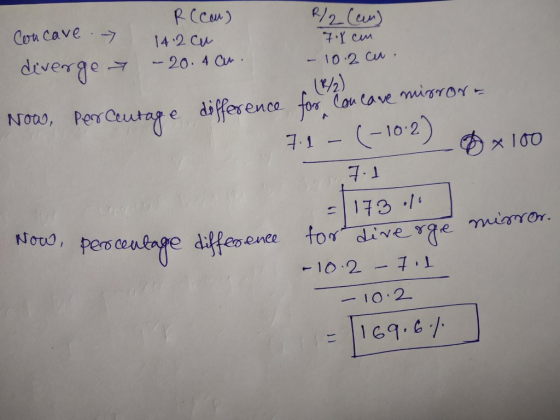
Add Answer to:
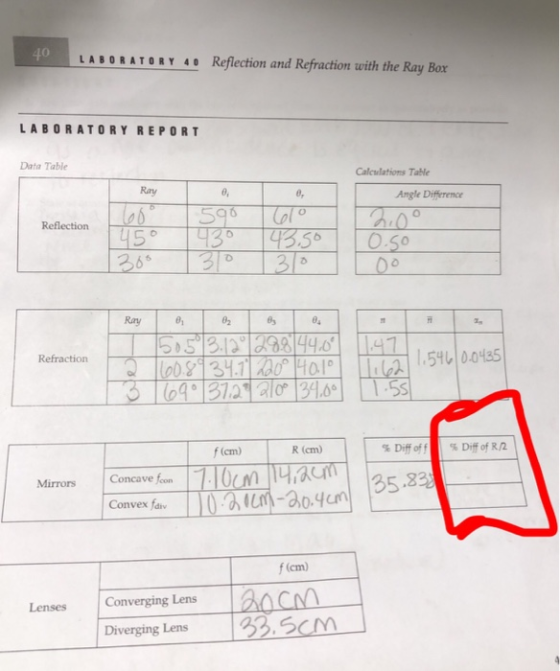
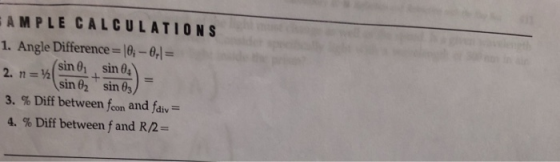
I need the circled part and the sample calculations !!!!
0 LABORATORY 40 Reflection and Refraction...
Following will be two mirrors and two lenses. We are going to find the image distance...
Following will be two mirrors and two lenses. We are going to find the image distance and the image height for each object. 1. Draw the ray diagrams for each situation properly as accurate as possible. 2. Calculate the image distance with the following data, and compare with drawing. f=4.0 cm d_o=12.0 cm h_o=3.0 cm Remember the sign of f depends on the mirror/lens type. 3. Calculate the magnification and image height, and compare with your drawing. Do this for...
1. I am nearsighted and looking for contact lenses which will correct my vision. I should...
1. I am nearsighted and looking for contact lenses which will correct my vision. I should select: a. A diverging lens, characterized by a negative focusing power b. A converging lens, characterized by a negative focusing power c. A diverging lens, characterized by a positive focusing power d. A converging lens, characterized by a positive focusing power 2. I have a glass lens (index of refraction 1.5) with a concave side with radius of curvature 2 m and a convex...
All I need is the index of refraction from the info above if thats possible! Thanks!...
 All I need is the index of refraction from the info above if thats
possible! Thanks!
DATA SHEE PARTI: Reflection, Mirrors, and Focal Length Measurements Section A: Reflection from a Plane Mirror Table A 0. 54 percent error 5.26% trial1 57 trial 2 30 26 13.3% trial 3 72 70 2.78% percent error = x 100% BE ection B1: Reflection from a Concave Mirror Focal Length of the Concave Mirror: f81= 5.50cm Radius of Curvature of the Concave Mirror: R$1=...
All I need is the index of refraction from the info above if thats
possible! Thanks!
DATA SHEE PARTI: Reflection, Mirrors, and Focal Length Measurements Section A: Reflection from a Plane Mirror Table A 0. 54 percent error 5.26% trial1 57 trial 2 30 26 13.3% trial 3 72 70 2.78% percent error = x 100% BE ection B1: Reflection from a Concave Mirror Focal Length of the Concave Mirror: f81= 5.50cm Radius of Curvature of the Concave Mirror: R$1=...
PHYS 203 Name: Ray Tracing Name: Work in pairs. Turn in one copy per pair Part A: Ray Tracing (18 pts) For each of the following situations, draw the three principle rays and find the image. M...
 PHYS 203 Name: Ray Tracing Name: Work in pairs. Turn in one copy per pair Part A: Ray Tracing (18 pts) For each of the following situations, draw the three principle rays and find the image. Measure, f.p. q. h and h and label them below (1 "large box" 1.0 cm). Indicate whether the image is: - real or virtual upright or inverted - enlarged or reduced - in front or behind the mirrorlens No pens allowed. Draw this in...
please do all the questions will full working answers *Question 186: Refraction/Snell's Law The index of...
 please do all the questions will full working answers
*Question 186: Refraction/Snell's Law The index of refraction of water is 1.33. What is the angle of refraction of a beam of light hitting the water surface at an angle of 30 degrees with the normal and entering the water? Select one: a. 53.1 degrees b. 67.9 degrees c. 22.1 degrees d. 40.6 degrees e. 10.2 degrees *Question 197: Critical Angle A diamond (refractive index 2.46) is placed in water (refractive...
please do all the questions will full working answers
*Question 186: Refraction/Snell's Law The index of refraction of water is 1.33. What is the angle of refraction of a beam of light hitting the water surface at an angle of 30 degrees with the normal and entering the water? Select one: a. 53.1 degrees b. 67.9 degrees c. 22.1 degrees d. 40.6 degrees e. 10.2 degrees *Question 197: Critical Angle A diamond (refractive index 2.46) is placed in water (refractive...
plz help 1. If the speed of light changes to one third of its value entering...
 plz
help
1. If the speed of light changes to one third of its value entering from air to another medium, what is the refractive index of that medium with respect to air (nair-1) 3.0 A) B) 0.5 С) 2.0 D) Can't be determined from the information given. 2. Carbon disulfide (n, 1.63) is poured into a container made of crown glass (n2-1.49). What is the critical angle for internal reflection of a ray in the liquid when it is...
plz
help
1. If the speed of light changes to one third of its value entering from air to another medium, what is the refractive index of that medium with respect to air (nair-1) 3.0 A) B) 0.5 С) 2.0 D) Can't be determined from the information given. 2. Carbon disulfide (n, 1.63) is poured into a container made of crown glass (n2-1.49). What is the critical angle for internal reflection of a ray in the liquid when it is...
please I need answers to all questions because am writing text on Friday. 7. Suppose an...
 please I need answers to all questions because am
writing text on Friday.
7. Suppose an object such as a book page is held 7.50 cm from a concave lens of focal length -1C em. Such a lens could be used in eyeglasses to correct pronounced nearsightedness. (a) Using the thin le equations to calculate the location of the image. (b) What magnification is produced? (c) Use ray tracing get an approximate location for the image. 8. The left face...
please I need answers to all questions because am
writing text on Friday.
7. Suppose an object such as a book page is held 7.50 cm from a concave lens of focal length -1C em. Such a lens could be used in eyeglasses to correct pronounced nearsightedness. (a) Using the thin le equations to calculate the location of the image. (b) What magnification is produced? (c) Use ray tracing get an approximate location for the image. 8. The left face...
1. Conceptual questions: (This one should take less than 5 minutes. Manage your time!) a) For...
 1. Conceptual questions: (This one should take less than 5 minutes. Manage your time!) a) For a total internal reflection to occur, the incident angle of a light should be (greater/smaller) than the refractive angle. N S N s . b) Two identical bar magnets are given to the right. At point a, b, and c, the directions of the net magnetic fields are to the and (left? Or right?), respectively. b C c) A polarized electromagnetic wave passes through...
Version 1 0.) Red light propagates through window glass at a speed of 2.0 x 10 m/s. This means that bli light must...
 Version 1 0.) Red light propagates through window glass at a speed of 2.0 x 10 m/s. This means that bli light must propagate through vacuum at a speed of: A) 1.5 x 10 m/s B) 2.0 x 10 m/s C) 2.5 x 10 m/s D) 3.0 x 10 m/s E) No way to know with the information given, but it must be <3.0 x 10 m/s A screen red, yellow, blue glass 7.) Red, yellow, and blue light along...
Note: This test contains ten questions from chapter 19 to chapter 27. For full credit, you...
 Note: This test contains ten questions from chapter 19 to chapter 27. For full credit, you should show all the steps of your numerical answers. No credit would be earned for just circling the right answers. Chapter 19 - Electric Potential and Electric Potential Energy 1. Two point charges are of + 7 uC and - 4 C are held at the corners of a rectangle as shown. The lengths of the sides of rectangle are 0.15 m, and 0.05...
 All I need is the index of refraction from the info above if thats
possible! Thanks!
DATA SHEE PARTI: Reflection, Mirrors, and Focal Length Measurements Section A: Reflection from a Plane Mirror Table A 0. 54 percent error 5.26% trial1 57 trial 2 30 26 13.3% trial 3 72 70 2.78% percent error = x 100% BE ection B1: Reflection from a Concave Mirror Focal Length of the Concave Mirror: f81= 5.50cm Radius of Curvature of the Concave Mirror: R$1=...
All I need is the index of refraction from the info above if thats
possible! Thanks!
DATA SHEE PARTI: Reflection, Mirrors, and Focal Length Measurements Section A: Reflection from a Plane Mirror Table A 0. 54 percent error 5.26% trial1 57 trial 2 30 26 13.3% trial 3 72 70 2.78% percent error = x 100% BE ection B1: Reflection from a Concave Mirror Focal Length of the Concave Mirror: f81= 5.50cm Radius of Curvature of the Concave Mirror: R$1=...
 PHYS 203 Name: Ray Tracing Name: Work in pairs. Turn in one copy per pair Part A: Ray Tracing (18 pts) For each of the following situations, draw the three principle rays and find the image. Measure, f.p. q. h and h and label them below (1 "large box" 1.0 cm). Indicate whether the image is: - real or virtual upright or inverted - enlarged or reduced - in front or behind the mirrorlens No pens allowed. Draw this in...
 please do all the questions will full working answers
*Question 186: Refraction/Snell's Law The index of refraction of water is 1.33. What is the angle of refraction of a beam of light hitting the water surface at an angle of 30 degrees with the normal and entering the water? Select one: a. 53.1 degrees b. 67.9 degrees c. 22.1 degrees d. 40.6 degrees e. 10.2 degrees *Question 197: Critical Angle A diamond (refractive index 2.46) is placed in water (refractive...
please do all the questions will full working answers
*Question 186: Refraction/Snell's Law The index of refraction of water is 1.33. What is the angle of refraction of a beam of light hitting the water surface at an angle of 30 degrees with the normal and entering the water? Select one: a. 53.1 degrees b. 67.9 degrees c. 22.1 degrees d. 40.6 degrees e. 10.2 degrees *Question 197: Critical Angle A diamond (refractive index 2.46) is placed in water (refractive...
 plz
help
1. If the speed of light changes to one third of its value entering from air to another medium, what is the refractive index of that medium with respect to air (nair-1) 3.0 A) B) 0.5 С) 2.0 D) Can't be determined from the information given. 2. Carbon disulfide (n, 1.63) is poured into a container made of crown glass (n2-1.49). What is the critical angle for internal reflection of a ray in the liquid when it is...
plz
help
1. If the speed of light changes to one third of its value entering from air to another medium, what is the refractive index of that medium with respect to air (nair-1) 3.0 A) B) 0.5 С) 2.0 D) Can't be determined from the information given. 2. Carbon disulfide (n, 1.63) is poured into a container made of crown glass (n2-1.49). What is the critical angle for internal reflection of a ray in the liquid when it is...
 please I need answers to all questions because am
writing text on Friday.
7. Suppose an object such as a book page is held 7.50 cm from a concave lens of focal length -1C em. Such a lens could be used in eyeglasses to correct pronounced nearsightedness. (a) Using the thin le equations to calculate the location of the image. (b) What magnification is produced? (c) Use ray tracing get an approximate location for the image. 8. The left face...
please I need answers to all questions because am
writing text on Friday.
7. Suppose an object such as a book page is held 7.50 cm from a concave lens of focal length -1C em. Such a lens could be used in eyeglasses to correct pronounced nearsightedness. (a) Using the thin le equations to calculate the location of the image. (b) What magnification is produced? (c) Use ray tracing get an approximate location for the image. 8. The left face...
 1. Conceptual questions: (This one should take less than 5 minutes. Manage your time!) a) For a total internal reflection to occur, the incident angle of a light should be (greater/smaller) than the refractive angle. N S N s . b) Two identical bar magnets are given to the right. At point a, b, and c, the directions of the net magnetic fields are to the and (left? Or right?), respectively. b C c) A polarized electromagnetic wave passes through...
 Version 1 0.) Red light propagates through window glass at a speed of 2.0 x 10 m/s. This means that bli light must propagate through vacuum at a speed of: A) 1.5 x 10 m/s B) 2.0 x 10 m/s C) 2.5 x 10 m/s D) 3.0 x 10 m/s E) No way to know with the information given, but it must be <3.0 x 10 m/s A screen red, yellow, blue glass 7.) Red, yellow, and blue light along...
 Note: This test contains ten questions from chapter 19 to chapter 27. For full credit, you should show all the steps of your numerical answers. No credit would be earned for just circling the right answers. Chapter 19 - Electric Potential and Electric Potential Energy 1. Two point charges are of + 7 uC and - 4 C are held at the corners of a rectangle as shown. The lengths of the sides of rectangle are 0.15 m, and 0.05...
Most questions answered within 3 hours.
-
Where is the error in this code sequence?
String s1 = "Hello";
String s2 = "ello";...
asked 10 months ago -
Financial data for Joel de Paris, Inc., for last year
follow:
Joel de Paris, Inc.
Balance...
asked 10 months ago -
Consider this reaction:
Al2(SO4)3 (aq)+ BaCl3
(aq) Al2Cl6 (aq)- +
3BaSO4(s) . What is the...
asked 10 months ago -
Suppose that Savneet is considering increasing her
recent random sample from 20 car rentals to 40...
asked 10 months ago -
Trucks arrive at an unloading terminal at an average rate of 120
per hour.
Trucks arrive...
asked 10 months ago -
Why are methanol and ethanol completely soluble in water while
octanol is not very little soluble....
asked 10 months ago -
A facilities manager at a university reads in a research report
that the mean amount of...
asked 10 months ago -
When the CuSO4 is rehydrated by adding water to the anhydrous
compound, is this an endothermic...
asked 10 months ago -
A ray of sunlight is passing from diamond into crown glass; the
angle of incidence is...
asked 10 months ago -
A block of mass 0.249 kg is placed on top of a light, vertical
spring of...
asked 10 months ago -
how do the kidneys compensate in the presences of acidosis
a) trigger hyperventilate
b) reserve acid...
asked 10 months ago -
Question 501 pts
The rental rate of capital to the firm increases. Which of the
following...
asked 10 months ago