For the following reaction, why is only one OH group converted
to an ether and not both?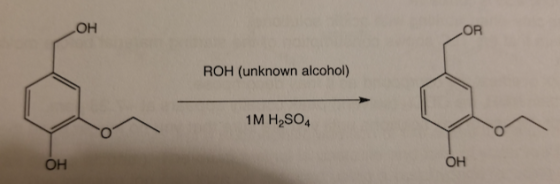
Homework Answers
The other alcohol is connected to the ether group by intra-molecular hydrogen bonding. Thus, it is difficult to convert the alcohol group to ether.
Add Answer to:
For the following reaction, why is only one OH group converted
to an ether and not...
Begin by naming the molecule. What functional group could this alcohol be converted to using only...
 Begin by naming the molecule.
What functional group could this alcohol be converted to using
only one step?
How many signals would be seen in the 13C NMR
specturm of the alcohol above?
What splitting patterns would be seen in the 1H NMR
spectrum of the alcohol, assuming that the OH proton behaves like a
CH proton in terms of splitting? (single, double, triplet...)
НО,
Begin by naming the molecule.
What functional group could this alcohol be converted to using
only one step?
How many signals would be seen in the 13C NMR
specturm of the alcohol above?
What splitting patterns would be seen in the 1H NMR
spectrum of the alcohol, assuming that the OH proton behaves like a
CH proton in terms of splitting? (single, double, triplet...)
НО,
in the synthesis of 2-ehtoxynaphthalene, both phenol and ethyl alcohol contain OH group, but only the...
in the synthesis of 2-ehtoxynaphthalene, both phenol and ethyl alcohol contain OH group, but only the phenolic OH group reacts to any extent . why?
In the synthesis of phenacetin from acetaminophen, an alcohol is converted to an ether. a. Is...
In the synthesis of phenacetin from acetaminophen, an alcohol is converted to an ether. a. Is the–OH in acetaminophen a nucleophile or electrophile? b. What is the function of the ethanol/NaOH? c. What is the function of the CH3 CH2I? d. Describe the mechanism of this reaction.Identify the nucleophile in each step. Use curved arrows to show bondsbreaking and forming. What is the leaving group? e. Would you get phenacetin by treating acetaminophen with sulfuric acid followed by ethanol? Give...
OH inctional group as an alcohol, ether, acetal, or 16.72 Label each functional group as an...
 OH inctional group as an alcohol, ether, acetal, or 16.72 Label each functional group as an hemiacetal. осна OCH OCH CH2CH3 ОН b. CH3-C-OCH,CH,CH3 CHE 16.73 What acetal is formed when each aldehyde or ketone is
This is a williamson ether synthesis SN2 reaction. what are the complete mechanisms of this reaction,...
 This is a williamson ether synthesis SN2 reaction. what are
the complete mechanisms of this reaction, with the intermediates
included?
MLNVILI SYNTHESIS OF 2-BUTOXYNAPHTHALENE OH 1. NaOH, ETOH 2. n-BuBr DISCUSSION: Nucleophilic substitution reaction is a frequently used method to convert one functional group into another. A nucleophile is mixed with an electrophile and the nucleophile replaces the leaving group to produce a new compound. In this experiment, a weak nucleophile (2-naphthol) is converted into a strong nucleophile. Then this...
This is a williamson ether synthesis SN2 reaction. what are
the complete mechanisms of this reaction, with the intermediates
included?
MLNVILI SYNTHESIS OF 2-BUTOXYNAPHTHALENE OH 1. NaOH, ETOH 2. n-BuBr DISCUSSION: Nucleophilic substitution reaction is a frequently used method to convert one functional group into another. A nucleophile is mixed with an electrophile and the nucleophile replaces the leaving group to produce a new compound. In this experiment, a weak nucleophile (2-naphthol) is converted into a strong nucleophile. Then this...
Which of the two routes would generate ethyl-t-butyl ether as the major product (for a Sn2 reaction only) and why? Rout...
 Which of the two routes would generate ethyl-t-butyl ether as
the major product (for a Sn2 reaction only) and why?
Route A OHTE (The nucleophile generated here is OR ethyl t-butyl ether Route B - OH + (The nucleophile generated here is
Which of the two routes would generate ethyl-t-butyl ether as
the major product (for a Sn2 reaction only) and why?
Route A OHTE (The nucleophile generated here is OR ethyl t-butyl ether Route B - OH + (The nucleophile generated here is
Additional Questions: 15. (a) An alcohol (pka = 15) is reacted with NaNH, (pka = 36)....
 Additional Questions: 15. (a) An alcohol (pka = 15) is reacted with NaNH, (pka = 36). What role does the alcohol play (acid, base, no role)? (b) Draw the reaction of ROH and NaNH2. Use curved arrows to show electron movement R-O-H + O NHA Na slavonotons boi gelts, Part A define NaNH2 as acting as a base and not as a nucleophile? Why do we define 185 or product of the following reaction. What role does the alcohol play?...
please explain mechanism 42. Provide the product for the following reaction HOCH,CH,OH Mg/ether Н,0° Br H2SO4...
 please explain mechanism
42. Provide the product for the following reaction HOCH,CH,OH Mg/ether Н,0° Br H2SO4 2. Но хото го он ПІ А) 1 B) II C) III
please explain mechanism
42. Provide the product for the following reaction HOCH,CH,OH Mg/ether Н,0° Br H2SO4 2. Но хото го он ПІ А) 1 B) II C) III
What organic product is produced in the following reaction? Select one: alkane thiol alcohol phenol ether...
 What organic product is produced in the following reaction? Select one: alkane thiol alcohol phenol ether Identify the correct common name for CH_3 CH_2-O-CH_2CH_3. Select one: diethyl ether 2, 2-dioxyethane isobutyl ether No correct response is provided ethyl ethane ether
1.Predict all the products for the following reaction. Which is the major product? Why? + conc....
 1.Predict all the products for the following reaction. Which is the major product? Why? + conc. H2SO4 heat OH 2. Give an alcohol that you could use to synthesis each of the following alkenes? din 3.Draw the mechanisms for the following two schemes (two separate mechanisms). Only show the mechanism for the most stable product for each scheme. What is the key difference in the mechanistic steps between these two reactions? ОН ОН conc H2SO4 conc H2SO4 heat heat
 Begin by naming the molecule.
What functional group could this alcohol be converted to using
only one step?
How many signals would be seen in the 13C NMR
specturm of the alcohol above?
What splitting patterns would be seen in the 1H NMR
spectrum of the alcohol, assuming that the OH proton behaves like a
CH proton in terms of splitting? (single, double, triplet...)
НО,
Begin by naming the molecule.
What functional group could this alcohol be converted to using
only one step?
How many signals would be seen in the 13C NMR
specturm of the alcohol above?
What splitting patterns would be seen in the 1H NMR
spectrum of the alcohol, assuming that the OH proton behaves like a
CH proton in terms of splitting? (single, double, triplet...)
НО,
 OH inctional group as an alcohol, ether, acetal, or 16.72 Label each functional group as an hemiacetal. осна OCH OCH CH2CH3 ОН b. CH3-C-OCH,CH,CH3 CHE 16.73 What acetal is formed when each aldehyde or ketone is
 This is a williamson ether synthesis SN2 reaction. what are
the complete mechanisms of this reaction, with the intermediates
included?
MLNVILI SYNTHESIS OF 2-BUTOXYNAPHTHALENE OH 1. NaOH, ETOH 2. n-BuBr DISCUSSION: Nucleophilic substitution reaction is a frequently used method to convert one functional group into another. A nucleophile is mixed with an electrophile and the nucleophile replaces the leaving group to produce a new compound. In this experiment, a weak nucleophile (2-naphthol) is converted into a strong nucleophile. Then this...
This is a williamson ether synthesis SN2 reaction. what are
the complete mechanisms of this reaction, with the intermediates
included?
MLNVILI SYNTHESIS OF 2-BUTOXYNAPHTHALENE OH 1. NaOH, ETOH 2. n-BuBr DISCUSSION: Nucleophilic substitution reaction is a frequently used method to convert one functional group into another. A nucleophile is mixed with an electrophile and the nucleophile replaces the leaving group to produce a new compound. In this experiment, a weak nucleophile (2-naphthol) is converted into a strong nucleophile. Then this...
 Which of the two routes would generate ethyl-t-butyl ether as
the major product (for a Sn2 reaction only) and why?
Route A OHTE (The nucleophile generated here is OR ethyl t-butyl ether Route B - OH + (The nucleophile generated here is
Which of the two routes would generate ethyl-t-butyl ether as
the major product (for a Sn2 reaction only) and why?
Route A OHTE (The nucleophile generated here is OR ethyl t-butyl ether Route B - OH + (The nucleophile generated here is
 Additional Questions: 15. (a) An alcohol (pka = 15) is reacted with NaNH, (pka = 36). What role does the alcohol play (acid, base, no role)? (b) Draw the reaction of ROH and NaNH2. Use curved arrows to show electron movement R-O-H + O NHA Na slavonotons boi gelts, Part A define NaNH2 as acting as a base and not as a nucleophile? Why do we define 185 or product of the following reaction. What role does the alcohol play?...
 please explain mechanism
42. Provide the product for the following reaction HOCH,CH,OH Mg/ether Н,0° Br H2SO4 2. Но хото го он ПІ А) 1 B) II C) III
please explain mechanism
42. Provide the product for the following reaction HOCH,CH,OH Mg/ether Н,0° Br H2SO4 2. Но хото го он ПІ А) 1 B) II C) III
 What organic product is produced in the following reaction? Select one: alkane thiol alcohol phenol ether Identify the correct common name for CH_3 CH_2-O-CH_2CH_3. Select one: diethyl ether 2, 2-dioxyethane isobutyl ether No correct response is provided ethyl ethane ether
 1.Predict all the products for the following reaction. Which is the major product? Why? + conc. H2SO4 heat OH 2. Give an alcohol that you could use to synthesis each of the following alkenes? din 3.Draw the mechanisms for the following two schemes (two separate mechanisms). Only show the mechanism for the most stable product for each scheme. What is the key difference in the mechanistic steps between these two reactions? ОН ОН conc H2SO4 conc H2SO4 heat heat
Most questions answered within 3 hours.
-
Where is the error in this code sequence?
String s1 = "Hello";
String s2 = "ello";...
asked 10 months ago -
Financial data for Joel de Paris, Inc., for last year
follow:
Joel de Paris, Inc.
Balance...
asked 10 months ago -
Consider this reaction:
Al2(SO4)3 (aq)+ BaCl3
(aq) Al2Cl6 (aq)- +
3BaSO4(s) . What is the...
asked 10 months ago -
Suppose that Savneet is considering increasing her
recent random sample from 20 car rentals to 40...
asked 10 months ago -
Trucks arrive at an unloading terminal at an average rate of 120
per hour.
Trucks arrive...
asked 10 months ago -
Why are methanol and ethanol completely soluble in water while
octanol is not very little soluble....
asked 10 months ago -
A facilities manager at a university reads in a research report
that the mean amount of...
asked 10 months ago -
When the CuSO4 is rehydrated by adding water to the anhydrous
compound, is this an endothermic...
asked 10 months ago -
A ray of sunlight is passing from diamond into crown glass; the
angle of incidence is...
asked 10 months ago -
A block of mass 0.249 kg is placed on top of a light, vertical
spring of...
asked 10 months ago -
how do the kidneys compensate in the presences of acidosis
a) trigger hyperventilate
b) reserve acid...
asked 10 months ago -
Question 501 pts
The rental rate of capital to the firm increases. Which of the
following...
asked 10 months ago