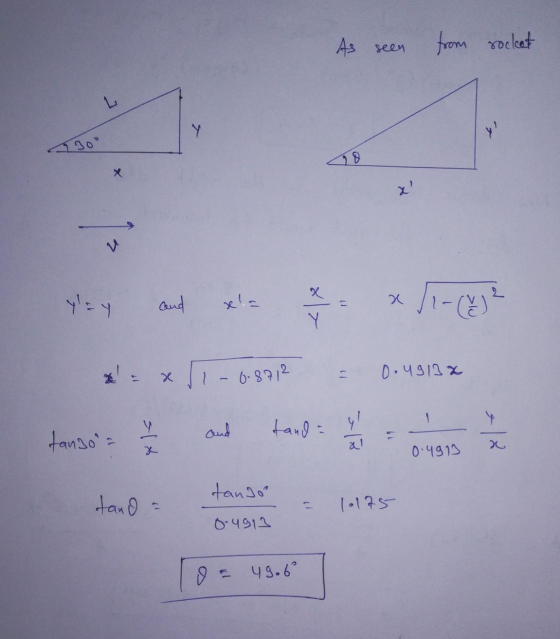
As the drawing shows, a carpenter on a space station has constructed a 30.0° ramp. A...
Homework Answers
Add Answer to:
As the drawing shows, a carpenter on a space station has
constructed a 30.0° ramp. A...
A rocket leaves a space station in the positive-x direction and a laser-produced beam of light...
A rocket leaves a space station in the positive-x direction and a laser-produced beam of light is sent out from the space station in the positive-y direction i.e. the rocket and the light beam leave the space station along perpendicular paths. Measured relative to the space station, the rocket moves at 0.6c. What is the velocity and speed of the light beam as observed by an observer in the rocket? *Please do not just answer with the speed of light,...
The figure below shows a block with mass m = 5.3 kg pulled up a ramp...
 The figure below shows a block with mass m = 5.3 kg pulled up a ramp inclined at an angle of 6 = 28° with a force of magnitude F = 33 N parallel to the ramp. m (a) If there is no friction between the block and the ramp, what is the magnitude of the block's acceleration (in m/s2)? 1.485 Draw a free-body diagram. What forces act on the block? Let the x-axis be parallel to the incline. What...
1. Adjust the angle of inclination of the ramp to be larger than the critical angle...
 1. Adjust the angle of inclination of the ramp to be larger than the critical angle you found in the previous experiment. Place the block at the top of the ramp, carpeted side down, and release it. a Describe the motion of the block. If the block does not remain at rest, does the speed of the block increase, decrease, or remain constant? Block on Inc line b. In the space provided at right, draw a free body diagram of...
An astronaut out on a spacewalk to construct a new section of the International Space Station...
 An astronaut out on a spacewalk to construct a new section of the International Space Station walks with a constant velocity of 1.50 m/s on a flat sheet of metal placed on a flat, frictionless, horizontal honeycomb surface linking the two parts of the station. The mass of the astronaut is 78.0 kg, and the mass of the sheet of metal is 250 kg. (Assume that the given velocity is relative to the flat sheet.) (a) What is the velocity...
4) An astronaut standing at radius R1 on the inner ring of this space station moves...
4) An astronaut standing at radius R1 on the inner ring of this space station moves a distance X1 along a circular arc as the station rotates. A) Over what distance X2 does another astronaut at radius R2 on the outer ring move in the same time? B) Over what angle, in degrees, did the space station rotate in this period, expressed in terms of R1 and X?
A space station is constructed in the shape of a hollow ring of mass 4.85 x...
 A space station is constructed in the shape of a hollow ring of mass 4.85 x 10⁴ kg. Members of the crew walk on a deck formed by the inner surface of the outer cylindrical wall of the ring, with radius 140 m. At rest when constructed, the ring is set rotating about its axis so that the people inside experience an effective free-fall acceleration equal to g. (See figure below.) The rotation is achieved by firing two small rockets...
A racetrack has the shape of an inverted cone, as the drawing shows. On this surface...
A racetrack has the shape of an inverted cone, as the drawing shows. On this surface the cars race in circles that are parallel to the ground, and the surface is at an angle θ = 40°. For a speed of 23 m/s, at what value of the distance d should a driver locate his car if he wishes to stay on a circular path without depending on friction?
You are the astrogator on a starship that has just left a space station one hour...
You are the astrogator on a starship that has just left a space station one hour ago heading toward galactic East at half light speed. The captain receives orders listing the coordinates of a rendezvous with another ship as (1 light-hour North, 2 light-hours East). The coordinates, of course, are measured relative to the space station, and the captain wants them translated into coordinates relative to your starship. What do you tell him?
After a space station is constructed, it is spun up from rest, using rockets attached tangentially...
 After a space station is constructed, it is spun up from rest,
using rockets attached tangentially to the outside hull, in order
to simulate earth gravity for the occupants inside, shown in the
figure. We can model the station as a hoop that rotates around its
axis, and ignore the rest of the structure for the moment of
inertia.
The mass of the station is m = 50,000 kg, the outer
radius is r = 100 m.
a) The two...
After a space station is constructed, it is spun up from rest,
using rockets attached tangentially to the outside hull, in order
to simulate earth gravity for the occupants inside, shown in the
figure. We can model the station as a hoop that rotates around its
axis, and ignore the rest of the structure for the moment of
inertia.
The mass of the station is m = 50,000 kg, the outer
radius is r = 100 m.
a) The two...
what is the period of rotation gure shows a space station. It has the shape of...
 what is the period of rotation
gure shows a space station. It has the shape of a hollow ring, with diameter D = 480 m. Review Part A The space station rotates in order to simulate Earth's gravity - so that the normal force on an astronaut at the outer edge would be the astronaut's weight on Earth. What is the period of the rotation Time for one complete revolution needed to achieve this? Express your answer to 2 significant...
what is the period of rotation
gure shows a space station. It has the shape of a hollow ring, with diameter D = 480 m. Review Part A The space station rotates in order to simulate Earth's gravity - so that the normal force on an astronaut at the outer edge would be the astronaut's weight on Earth. What is the period of the rotation Time for one complete revolution needed to achieve this? Express your answer to 2 significant...
 The figure below shows a block with mass m = 5.3 kg pulled up a ramp inclined at an angle of 6 = 28° with a force of magnitude F = 33 N parallel to the ramp. m (a) If there is no friction between the block and the ramp, what is the magnitude of the block's acceleration (in m/s2)? 1.485 Draw a free-body diagram. What forces act on the block? Let the x-axis be parallel to the incline. What...
 1. Adjust the angle of inclination of the ramp to be larger than the critical angle you found in the previous experiment. Place the block at the top of the ramp, carpeted side down, and release it. a Describe the motion of the block. If the block does not remain at rest, does the speed of the block increase, decrease, or remain constant? Block on Inc line b. In the space provided at right, draw a free body diagram of...
 An astronaut out on a spacewalk to construct a new section of the International Space Station walks with a constant velocity of 1.50 m/s on a flat sheet of metal placed on a flat, frictionless, horizontal honeycomb surface linking the two parts of the station. The mass of the astronaut is 78.0 kg, and the mass of the sheet of metal is 250 kg. (Assume that the given velocity is relative to the flat sheet.) (a) What is the velocity...
 A space station is constructed in the shape of a hollow ring of mass 4.85 x 10⁴ kg. Members of the crew walk on a deck formed by the inner surface of the outer cylindrical wall of the ring, with radius 140 m. At rest when constructed, the ring is set rotating about its axis so that the people inside experience an effective free-fall acceleration equal to g. (See figure below.) The rotation is achieved by firing two small rockets...
 After a space station is constructed, it is spun up from rest,
using rockets attached tangentially to the outside hull, in order
to simulate earth gravity for the occupants inside, shown in the
figure. We can model the station as a hoop that rotates around its
axis, and ignore the rest of the structure for the moment of
inertia.
The mass of the station is m = 50,000 kg, the outer
radius is r = 100 m.
a) The two...
After a space station is constructed, it is spun up from rest,
using rockets attached tangentially to the outside hull, in order
to simulate earth gravity for the occupants inside, shown in the
figure. We can model the station as a hoop that rotates around its
axis, and ignore the rest of the structure for the moment of
inertia.
The mass of the station is m = 50,000 kg, the outer
radius is r = 100 m.
a) The two...
 what is the period of rotation
gure shows a space station. It has the shape of a hollow ring, with diameter D = 480 m. Review Part A The space station rotates in order to simulate Earth's gravity - so that the normal force on an astronaut at the outer edge would be the astronaut's weight on Earth. What is the period of the rotation Time for one complete revolution needed to achieve this? Express your answer to 2 significant...
what is the period of rotation
gure shows a space station. It has the shape of a hollow ring, with diameter D = 480 m. Review Part A The space station rotates in order to simulate Earth's gravity - so that the normal force on an astronaut at the outer edge would be the astronaut's weight on Earth. What is the period of the rotation Time for one complete revolution needed to achieve this? Express your answer to 2 significant...
Most questions answered within 3 hours.
-
Where is the error in this code sequence?
String s1 = "Hello";
String s2 = "ello";...
asked 10 months ago -
Financial data for Joel de Paris, Inc., for last year
follow:
Joel de Paris, Inc.
Balance...
asked 10 months ago -
Consider this reaction:
Al2(SO4)3 (aq)+ BaCl3
(aq) Al2Cl6 (aq)- +
3BaSO4(s) . What is the...
asked 10 months ago -
Suppose that Savneet is considering increasing her
recent random sample from 20 car rentals to 40...
asked 10 months ago -
Trucks arrive at an unloading terminal at an average rate of 120
per hour.
Trucks arrive...
asked 10 months ago -
Why are methanol and ethanol completely soluble in water while
octanol is not very little soluble....
asked 10 months ago -
A facilities manager at a university reads in a research report
that the mean amount of...
asked 10 months ago -
When the CuSO4 is rehydrated by adding water to the anhydrous
compound, is this an endothermic...
asked 10 months ago -
A ray of sunlight is passing from diamond into crown glass; the
angle of incidence is...
asked 10 months ago -
A block of mass 0.249 kg is placed on top of a light, vertical
spring of...
asked 10 months ago -
how do the kidneys compensate in the presences of acidosis
a) trigger hyperventilate
b) reserve acid...
asked 10 months ago -
Question 501 pts
The rental rate of capital to the firm increases. Which of the
following...
asked 10 months ago