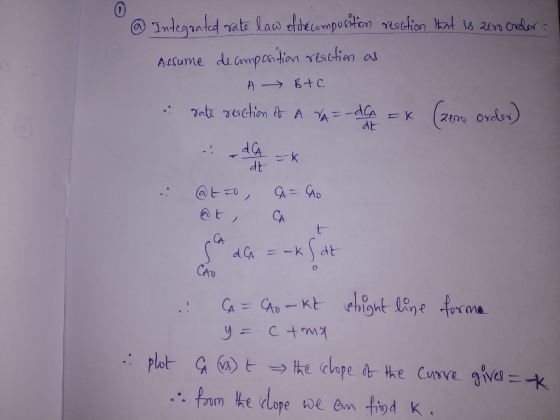
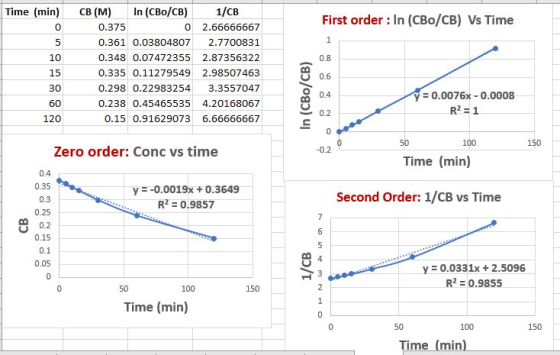
![the collision frequency factor. in (A) A plot of ln(k) versus 1M results in In k ve 1m with Trendline a straight line with a slope E. 15 00 MR. The value of E can then be calculated using the value of Rand to oo the slope of the line. This experiment uses the Arrhenius equation, which relates the temperature and specific reaction rate constant to determine the activation energy for the crystal violet reaction. The reaction will be performed at different t Once the order of reaction respect violet determined, the values of the corresponding rate constants will be determined. The average temperatures and rate constants will be entered into a new spreadsheet. The temperature values will be converted to the Kelvin scale and the inverse will be calculated. The natural log of the rate constants will also be calculated. A graph of the natural log of the rate constant (n k) versus the inverse of the absolute temperature (inverse will be plotted and the value of the activation energy will be calculated. PRELABORATORY ASSIGNMENT 1. Write equations, in the form of a straight line, for the following Explain how to determine the rate constant for each. a. The integrated rate law of a decomposition reaction that is zero order a b. The integrated rate law of a decomposition reaction that is second order. Kinetics of Crystal Violet 2: Determining order Using the Integrated Rate of Reaction Method 2. The following data was collected for the decomposition of reactant B to products and Time (min.) [B] (M) 0.375 0.0 0.361 5.0 0.348 10.0 0.335 15.0 0.298 0.238 0.150 120.0 a. Write an equation for the reaction. integrated method to determine b. Use Excel or a similar spreadsheet program and the to explain your the order of reaction for reactant B. Use correlation (R answer.](http://img.homeworklib.com/questions/0d694cc0-7fbc-11eb-a393-5f885dab8993.png?x-oss-process=image/resize,w_560)
Homework Answers


Add Answer to:
ln(k) = -E_a/R 1/T + ln(A) A plot of ln (k)versus 1/T result in a straight...
A plot of ln Rate vs. 1/T for a certain reaction gave a straight line with...
A plot of ln Rate vs. 1/T for a certain reaction gave a straight line with a slope of -8571. What is the activation energy for this reaction? Give your answer in kJ/mole please show work What is the order of reaction with respect to a certain reactant if doubling the concentration of that reactant causes the reaction rate to double? please explain What is the order of reaction with respect to a certain reactant if quadrupling the concentration of...
the slope of a line graph of ln k versus 1/T is -1.82 ×10^4 K what...
the slope of a line graph of ln k versus 1/T is -1.82 ×10^4 K what is the final temperature if it is observed that the rate constant of a reaction increases by a factor of 20 when increased from 25 deg Celsius to this higher final temperature ? (detailed solution please )
The rate constant (k) for a reaction was measured as a function of temperature. A plot...
The rate constant (k) for a reaction was measured as a function of temperature. A plot of ln k versus 1/T(ln k) is linear and has a slope of -5375 K. Calculate the activation energy for the reaction.
Plot the natural log of the concentration of the ozone Versus time. Since we get a...
 Plot the natural log of the concentration of the ozone Versus time. Since we get a straight line, that mean., that we can consider an integrated rate law for this reaction to be given by the following: ln([O_3]/[O_3]_o) = -kt How long does it take for half the ozone to decompose, and what is the concentration of ozone at that time? What is the initial reaction rate of the ozone decomposition reaction? Provide both the magnitude and the units. What...
The following reaction was monitored as a function of time: A?B+C A plot of ln[A] versus...
The following reaction was monitored as a function of time: A?B+C A plot of ln[A] versus time yields a straight line with slope ?4.5×10?3 /s . What is the value of the rate constant (k) for this reaction at this temperature?
The following reaction was monitored as a function of time: A→B+C A plot of ln[A] versus...
The following reaction was monitored as a function of time: A→B+C A plot of ln[A] versus time yields a straight line with slope −4.0×10⁻³ /s . What is the value of the rate constant (k) for this reaction at this temperature? Write the rate law for the reaction. What is the half-life? If the initial concentration of A is 0.240 M , what is the concentration after 220 s ?
The Arrhenius equation shows the relationship between the rate constant k and the temperature T in...
The Arrhenius equation shows the relationship between the rate constant k and the temperature T in kelvins and is typically written as k=A e − E a /RT where R is the gas constant ( 8.314 J/mol⋅K ), A is a constant called the frequency factor, and E a is the activation energy for the reaction. However, a more practical form of this equation is ln k 2 k 1 = E a R ( 1 T 1 − 1...
For a second-order reaction, a straight line is obtained from a plot of 1/[A] versus t...
For a second-order reaction, a straight line is obtained from a plot of 1/[A] versus t ln(t) versus [A] ln(1/t) versus [A] [A] versus t ln[A] versus t
a. A reaction has the following activation energy and reaction rate k constant at 20 °C...
 a. A reaction has the following activation energy and reaction rate k constant at 20 °C 10,000 cal/mo k2 1.42 h Calculate: a. reaction rate constants for 10, 15, 20, 25, 30, 35 and 40 oC b.construct the Arrhenius plot (x-1/T versus y - log k) using the reaction rate constants calculated in a. calculate Qio for each pair of temperatures with the difference od 10°C, such as between 10 and 20°C., 15 and 25 °C, etc. (you will have...
the rate constant (k) for a reaction was measured as a function of temperature. A plot...
the rate constant (k) for a reaction was measured as a function of temperature. A plot of lnk versus 1/T(in K) is linear and has a slope of -9.90•10^3 K. calculate the activation energy for the reaction.
 Plot the natural log of the concentration of the ozone Versus time. Since we get a straight line, that mean., that we can consider an integrated rate law for this reaction to be given by the following: ln([O_3]/[O_3]_o) = -kt How long does it take for half the ozone to decompose, and what is the concentration of ozone at that time? What is the initial reaction rate of the ozone decomposition reaction? Provide both the magnitude and the units. What...
 a. A reaction has the following activation energy and reaction rate k constant at 20 °C 10,000 cal/mo k2 1.42 h Calculate: a. reaction rate constants for 10, 15, 20, 25, 30, 35 and 40 oC b.construct the Arrhenius plot (x-1/T versus y - log k) using the reaction rate constants calculated in a. calculate Qio for each pair of temperatures with the difference od 10°C, such as between 10 and 20°C., 15 and 25 °C, etc. (you will have...
Most questions answered within 3 hours.
-
Where is the error in this code sequence?
String s1 = "Hello";
String s2 = "ello";...
asked 11 months ago -
Financial data for Joel de Paris, Inc., for last year
follow:
Joel de Paris, Inc.
Balance...
asked 11 months ago -
Consider this reaction:
Al2(SO4)3 (aq)+ BaCl3
(aq) Al2Cl6 (aq)- +
3BaSO4(s) . What is the...
asked 11 months ago -
Suppose that Savneet is considering increasing her
recent random sample from 20 car rentals to 40...
asked 11 months ago -
Trucks arrive at an unloading terminal at an average rate of 120
per hour.
Trucks arrive...
asked 11 months ago -
Why are methanol and ethanol completely soluble in water while
octanol is not very little soluble....
asked 11 months ago -
A facilities manager at a university reads in a research report
that the mean amount of...
asked 11 months ago -
When the CuSO4 is rehydrated by adding water to the anhydrous
compound, is this an endothermic...
asked 11 months ago -
A ray of sunlight is passing from diamond into crown glass; the
angle of incidence is...
asked 11 months ago -
A block of mass 0.249 kg is placed on top of a light, vertical
spring of...
asked 11 months ago -
how do the kidneys compensate in the presences of acidosis
a) trigger hyperventilate
b) reserve acid...
asked 11 months ago -
Question 501 pts
The rental rate of capital to the firm increases. Which of the
following...
asked 11 months ago