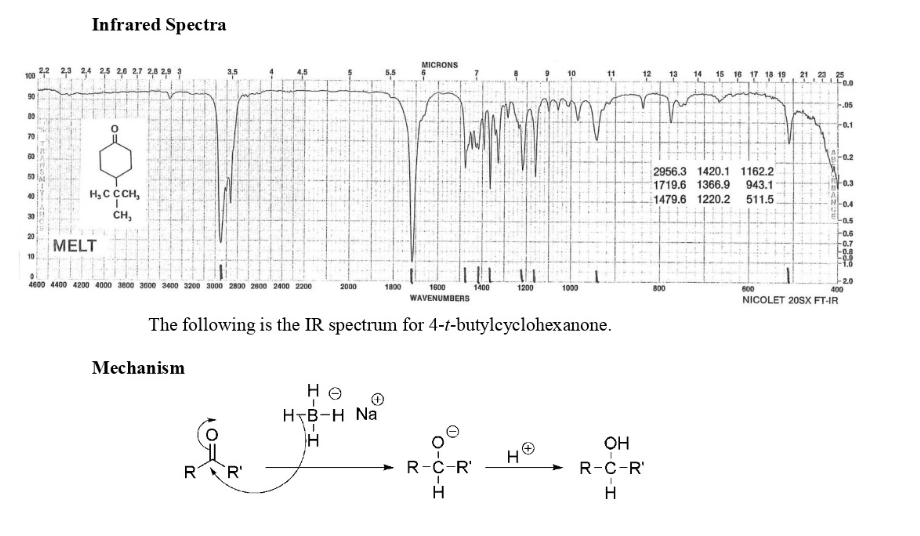
What is the approximate frequency of the most important absorption in the starting material that should be absent in the IR spectrum of the product?
What is the approximate frequency of the most important absorption in the starting material that should be absent in the IR spectrum of the product?


Homework Answers
Ketone group undergoes reduction in NaBH4 and produces hydroxy derivative as shown below:

The reaction described converts a ketone to an alcohol.

Therefore, the peak in the IR spectrum of product will be missing the peak corresponds to ketone.
The normal frequency for a ketone peak from cyclohexanone is 1715 cm-1.
Add Answer to:
What is the approximate frequency of the most important absorption in the starting material that should be absent in the IR spectrum of the product?
aldehyde and ketone are starting material product is chalone 10. 12 pts. Compare the IR spectrum...
 aldehyde and ketone are starting material
product is chalone
10. 12 pts. Compare the IR spectrum of your product with the IR spectra of the starting materials (posted on black Write the frequency of C=0 stretch (in cm-l) in each case. Explain why the carbonyl stretch appears al a rowe wavenumber in the spectrum of your product as compared to the reactants. Aldehyde C=0 stretch: 1716.6 cm? Ketone C=0 stretch: 1699.3 cm Product C=0 stretch: 1653.97cm
aldehyde and ketone are starting material
product is chalone
10. 12 pts. Compare the IR spectrum of your product with the IR spectra of the starting materials (posted on black Write the frequency of C=0 stretch (in cm-l) in each case. Explain why the carbonyl stretch appears al a rowe wavenumber in the spectrum of your product as compared to the reactants. Aldehyde C=0 stretch: 1716.6 cm? Ketone C=0 stretch: 1699.3 cm Product C=0 stretch: 1653.97cm
hello how do i mark up this IR spectrum? we are to state the Absorption frequency...
 hello how do i mark up this IR spectrum? we are to state the
Absorption frequency for each of the important peaks And how do we
make a NMR spectrum markup based in our IR? thank you so much for
all ur help
Transmittance op 2500 " " " '20o0 " " " Warenumber(cm-1) - 10 60)
hello how do i mark up this IR spectrum? we are to state the
Absorption frequency for each of the important peaks And how do we
make a NMR spectrum markup based in our IR? thank you so much for
all ur help
Transmittance op 2500 " " " '20o0 " " " Warenumber(cm-1) - 10 60)
I-Predict the approximate positions of all of the important absorptions in the IR spectrum of this...
 I-Predict the approximate positions of all of the important absorptions in the IR spectrum of this compound. CHCH CH-CHCOH Explain which functional group is present in the compound with the following IR spectrum. Show a possible structure for the compound. NEAT 3- Show the structure of the ion that is responsible for the peak a-at m/z 43 in the mass spectrum of 2-heptanone. (5) CH3CCH2CH2CH2CH2CH3
At the end of the second lab period an IR spectrum of the product, 1,2-epoxycyclohexane, was...
 At the end of the second lab period an IR spectrum of the product, 1,2-epoxycyclohexane, was obtained as shown: Write a brief conclusion (3-4 sentences) to comment on how IR is used to characterize the product. You may wish to compare the IR of the starting material from Parts A and B (weeks 1 and 2).
What are the most important and distinctive peaks on a IR spectrum of 3-methylheptan-3-ol?
What are the most important and distinctive peaks on a IR spectrum of 3-methylheptan-3-ol?
The S–H stretching absorption in the IR spectrum of thiols is less intense and occurs at...
The S–H stretching absorption in the IR spectrum of thiols is less intense and occurs at lower frequencies (~2550 cm-1) compared to the O–H stretching absorption of alcohols (3200–3600 cm- 1). Use what you know about influences on IR stretching frequency to explain why this is the case.
can some analysis the TLC? 20 Free Figure 1. IR spectrum of the starting material, 1-bromo-2,4,5-trifluorobenzene...
 can
some analysis the TLC?
20 Free Figure 1. IR spectrum of the starting material, 1-bromo-2,4,5-trifluorobenzene (1). 3 2.2 Bis(2,4,5-trifluorophenyl)methanol 4. IR (ATR, cm): 3342, 3072, 2977, 2876, 1630, 1513, 1429, 1412, 1333, 1268, 1196, 1148, 1098, 1051, 881, 849, 809, 769; 'H NMR (90 MHz, CDC13) 87.28 - 7.11 (m, 2H), 6.84 (td, 2H), 6.17 (s, 1H), 2.46 (s, 1H). ---- Figure 3. TLC of the starting material (1, left) and the product (4, right) taken in hexanes/EtoAc 9:1.
can
some analysis the TLC?
20 Free Figure 1. IR spectrum of the starting material, 1-bromo-2,4,5-trifluorobenzene (1). 3 2.2 Bis(2,4,5-trifluorophenyl)methanol 4. IR (ATR, cm): 3342, 3072, 2977, 2876, 1630, 1513, 1429, 1412, 1333, 1268, 1196, 1148, 1098, 1051, 881, 849, 809, 769; 'H NMR (90 MHz, CDC13) 87.28 - 7.11 (m, 2H), 6.84 (td, 2H), 6.17 (s, 1H), 2.46 (s, 1H). ---- Figure 3. TLC of the starting material (1, left) and the product (4, right) taken in hexanes/EtoAc 9:1.
1. What easily identified type of vibration(s) (give functional group and approximate expected frequency) would be...
1. What easily identified type of vibration(s) (give functional group and approximate expected frequency) would be present in the IR spectrum of the isobutyraldehyde reactant but not in the product 2-methyl-3-heptanol, allowing the compounds to be distinguished? 2. What easily identified type of vibration(s) (give functional group approximate expected frequency) would be present in the IR spectrum of 2-methyl-3-heptanol but not in either of the reactants, allowing the compounds to be distinguished? 3. Does the IR spectrum of the example...
For the reaction below, focus only on 2-methyl-2-butanol (starting material) and 2-chloro-2-methylbutane (desired product). We will...
 For the reaction below, focus only on 2-methyl-2-butanol
(starting material) and 2-chloro-2-methylbutane (desired product).
We will not analyze HCl or H2O by IR.
From the two IR spectra below, identify which spectrum belongs
to which molecule. Then label the IR spectrum with the molecule’s
characteristic IR peaks. Highlight or place a box around the most
characteristic peak in the starting material’s IR. You do not need
to label the fingerprint region.
For the reaction below, focus only on 2-methyl-2-butanol...
For the reaction below, focus only on 2-methyl-2-butanol
(starting material) and 2-chloro-2-methylbutane (desired product).
We will not analyze HCl or H2O by IR.
From the two IR spectra below, identify which spectrum belongs
to which molecule. Then label the IR spectrum with the molecule’s
characteristic IR peaks. Highlight or place a box around the most
characteristic peak in the starting material’s IR. You do not need
to label the fingerprint region.
For the reaction below, focus only on 2-methyl-2-butanol...
Does your IR spectrum indicate that the starting material was acetylated ? Briefly explain. Transmittance 0...
 Does your IR spectrum indicate that the starting material was
acetylated ? Briefly explain.
Transmittance 0 4000 3500 3000 2500 Wavenumbers (cm-1) 2000 1500 1000
Does your IR spectrum indicate that the starting material was
acetylated ? Briefly explain.
Transmittance 0 4000 3500 3000 2500 Wavenumbers (cm-1) 2000 1500 1000
 aldehyde and ketone are starting material
product is chalone
10. 12 pts. Compare the IR spectrum of your product with the IR spectra of the starting materials (posted on black Write the frequency of C=0 stretch (in cm-l) in each case. Explain why the carbonyl stretch appears al a rowe wavenumber in the spectrum of your product as compared to the reactants. Aldehyde C=0 stretch: 1716.6 cm? Ketone C=0 stretch: 1699.3 cm Product C=0 stretch: 1653.97cm
aldehyde and ketone are starting material
product is chalone
10. 12 pts. Compare the IR spectrum of your product with the IR spectra of the starting materials (posted on black Write the frequency of C=0 stretch (in cm-l) in each case. Explain why the carbonyl stretch appears al a rowe wavenumber in the spectrum of your product as compared to the reactants. Aldehyde C=0 stretch: 1716.6 cm? Ketone C=0 stretch: 1699.3 cm Product C=0 stretch: 1653.97cm
 hello how do i mark up this IR spectrum? we are to state the
Absorption frequency for each of the important peaks And how do we
make a NMR spectrum markup based in our IR? thank you so much for
all ur help
Transmittance op 2500 " " " '20o0 " " " Warenumber(cm-1) - 10 60)
hello how do i mark up this IR spectrum? we are to state the
Absorption frequency for each of the important peaks And how do we
make a NMR spectrum markup based in our IR? thank you so much for
all ur help
Transmittance op 2500 " " " '20o0 " " " Warenumber(cm-1) - 10 60)
 I-Predict the approximate positions of all of the important absorptions in the IR spectrum of this compound. CHCH CH-CHCOH Explain which functional group is present in the compound with the following IR spectrum. Show a possible structure for the compound. NEAT 3- Show the structure of the ion that is responsible for the peak a-at m/z 43 in the mass spectrum of 2-heptanone. (5) CH3CCH2CH2CH2CH2CH3
 At the end of the second lab period an IR spectrum of the product, 1,2-epoxycyclohexane, was obtained as shown: Write a brief conclusion (3-4 sentences) to comment on how IR is used to characterize the product. You may wish to compare the IR of the starting material from Parts A and B (weeks 1 and 2).
 can
some analysis the TLC?
20 Free Figure 1. IR spectrum of the starting material, 1-bromo-2,4,5-trifluorobenzene (1). 3 2.2 Bis(2,4,5-trifluorophenyl)methanol 4. IR (ATR, cm): 3342, 3072, 2977, 2876, 1630, 1513, 1429, 1412, 1333, 1268, 1196, 1148, 1098, 1051, 881, 849, 809, 769; 'H NMR (90 MHz, CDC13) 87.28 - 7.11 (m, 2H), 6.84 (td, 2H), 6.17 (s, 1H), 2.46 (s, 1H). ---- Figure 3. TLC of the starting material (1, left) and the product (4, right) taken in hexanes/EtoAc 9:1.
can
some analysis the TLC?
20 Free Figure 1. IR spectrum of the starting material, 1-bromo-2,4,5-trifluorobenzene (1). 3 2.2 Bis(2,4,5-trifluorophenyl)methanol 4. IR (ATR, cm): 3342, 3072, 2977, 2876, 1630, 1513, 1429, 1412, 1333, 1268, 1196, 1148, 1098, 1051, 881, 849, 809, 769; 'H NMR (90 MHz, CDC13) 87.28 - 7.11 (m, 2H), 6.84 (td, 2H), 6.17 (s, 1H), 2.46 (s, 1H). ---- Figure 3. TLC of the starting material (1, left) and the product (4, right) taken in hexanes/EtoAc 9:1.
 For the reaction below, focus only on 2-methyl-2-butanol
(starting material) and 2-chloro-2-methylbutane (desired product).
We will not analyze HCl or H2O by IR.
From the two IR spectra below, identify which spectrum belongs
to which molecule. Then label the IR spectrum with the molecule’s
characteristic IR peaks. Highlight or place a box around the most
characteristic peak in the starting material’s IR. You do not need
to label the fingerprint region.
For the reaction below, focus only on 2-methyl-2-butanol...
For the reaction below, focus only on 2-methyl-2-butanol
(starting material) and 2-chloro-2-methylbutane (desired product).
We will not analyze HCl or H2O by IR.
From the two IR spectra below, identify which spectrum belongs
to which molecule. Then label the IR spectrum with the molecule’s
characteristic IR peaks. Highlight or place a box around the most
characteristic peak in the starting material’s IR. You do not need
to label the fingerprint region.
For the reaction below, focus only on 2-methyl-2-butanol...
 Does your IR spectrum indicate that the starting material was
acetylated ? Briefly explain.
Transmittance 0 4000 3500 3000 2500 Wavenumbers (cm-1) 2000 1500 1000
Does your IR spectrum indicate that the starting material was
acetylated ? Briefly explain.
Transmittance 0 4000 3500 3000 2500 Wavenumbers (cm-1) 2000 1500 1000
Most questions answered within 3 hours.
-
Where is the error in this code sequence?
String s1 = "Hello";
String s2 = "ello";...
asked 10 months ago -
Financial data for Joel de Paris, Inc., for last year
follow:
Joel de Paris, Inc.
Balance...
asked 10 months ago -
Consider this reaction:
Al2(SO4)3 (aq)+ BaCl3
(aq) Al2Cl6 (aq)- +
3BaSO4(s) . What is the...
asked 10 months ago -
Suppose that Savneet is considering increasing her
recent random sample from 20 car rentals to 40...
asked 10 months ago -
Trucks arrive at an unloading terminal at an average rate of 120
per hour.
Trucks arrive...
asked 10 months ago -
Why are methanol and ethanol completely soluble in water while
octanol is not very little soluble....
asked 10 months ago -
A facilities manager at a university reads in a research report
that the mean amount of...
asked 10 months ago -
When the CuSO4 is rehydrated by adding water to the anhydrous
compound, is this an endothermic...
asked 10 months ago -
A ray of sunlight is passing from diamond into crown glass; the
angle of incidence is...
asked 10 months ago -
A block of mass 0.249 kg is placed on top of a light, vertical
spring of...
asked 10 months ago -
how do the kidneys compensate in the presences of acidosis
a) trigger hyperventilate
b) reserve acid...
asked 10 months ago -
Question 501 pts
The rental rate of capital to the firm increases. Which of the
following...
asked 10 months ago