
Homework Answers

As per HomeworkLib policy 1st question is done please ask again for rest of the questions
Comment for any doubt about this solution thank you
Don't forget to upvote if you got your answer
Add Answer to:
Geotechnical Engineering
1. A clayey soil is subjected to an unconfined test fails at a pressure...
Geotechnical Engineering 4. A dry sand sample is subjected to direct shear testing at its normal...
 Geotechnical Engineering
4. A dry sand sample is subjected to direct shear testing at its normal (in situ) water content. Tw performed on this sand. For one of the tests, the sample shears at a stress of 100 kPa when the norma is 150 kPa. In the second test, the sample shears at a stress of 200 kPa when the normal stress is 300 Determine the cohesion and the angle of internal friction of this sand sample b
Geotechnical Engineering
4. A dry sand sample is subjected to direct shear testing at its normal (in situ) water content. Tw performed on this sand. For one of the tests, the sample shears at a stress of 100 kPa when the norma is 150 kPa. In the second test, the sample shears at a stress of 200 kPa when the normal stress is 300 Determine the cohesion and the angle of internal friction of this sand sample b
Geotechnical Engineering 9. A damp sand sample is subjected to direct shear testing at its normal...
 Geotechnical Engineering
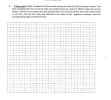
9. A damp sand sample is subjected to direct shear testing at its normal (in situ) water content. Two tests are performed. For one of the tests, the sample shears at a stress of 100 kPa when the normal stress is 135 kPa. In the second test, the sample shears at a stress of 145 kPa when the normal stress is 225 kPa. Plot the test data and determine the value of the "apparent cohesion" and the corresponding...
Geotechnical Engineering
9. A damp sand sample is subjected to direct shear testing at its normal (in situ) water content. Two tests are performed. For one of the tests, the sample shears at a stress of 100 kPa when the normal stress is 135 kPa. In the second test, the sample shears at a stress of 145 kPa when the normal stress is 225 kPa. Plot the test data and determine the value of the "apparent cohesion" and the corresponding...
Please help with this geotechnical engineering problem! I promise I'll rate your answer! (If needed, assume...
 Please help with this geotechnical engineering problem! I
promise I'll rate your answer!
(If needed, assume Gs = 2.7)
A falling-head permeability test was carried out on a clay of diameter 100 mm and length 150 mm. In 1 hour the head in the standpipe of diameter 6 mm dropped from 700 mm to 540 mm. Calculate the hydraulic conductivity of this clay. Assume a temperature of 20°C.
Please help with this geotechnical engineering problem! I
promise I'll rate your answer!
(If needed, assume Gs = 2.7)
A falling-head permeability test was carried out on a clay of diameter 100 mm and length 150 mm. In 1 hour the head in the standpipe of diameter 6 mm dropped from 700 mm to 540 mm. Calculate the hydraulic conductivity of this clay. Assume a temperature of 20°C.
Hello. Please this is a geotechnical engineering problem please help me solve this in a correct...
 Hello. Please this is a geotechnical engineering
problem please help me solve this in a correct way. Thank you.
2. (15 pts) A consolidation test has been performed on a soil sample obtained from Point H in the following figure. The measured preconsolidation stress was 109 kPa. A) Determine whether the soil is normally consolidated or overconsolidated, then B) compute the overconsolidation margin and C) the overconsolidation ratio at Point H. (Note: the fill has not been placed as it...
Hello. Please this is a geotechnical engineering
problem please help me solve this in a correct way. Thank you.
2. (15 pts) A consolidation test has been performed on a soil sample obtained from Point H in the following figure. The measured preconsolidation stress was 109 kPa. A) Determine whether the soil is normally consolidated or overconsolidated, then B) compute the overconsolidation margin and C) the overconsolidation ratio at Point H. (Note: the fill has not been placed as it...
for geotechnical engineering 1 3 (a) With neat sketches explain how the method of slices can...
 for geotechnical engineering 1
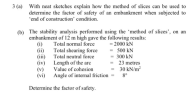
3 (a) With neat sketches explain how the method of slices can be used to determine the factor of safety of an embankment when subjected to ‘end of construction condition. (b) The stability analysis performed using the 'method of slices', on an embankment of 12 m high gave the following results: Total normal force = 2000 kN (ii) Total shearing force 500 kN Total neutral force = 300 kN (iv) Length of the arc = 23...
for geotechnical engineering 1
3 (a) With neat sketches explain how the method of slices can be used to determine the factor of safety of an embankment when subjected to ‘end of construction condition. (b) The stability analysis performed using the 'method of slices', on an embankment of 12 m high gave the following results: Total normal force = 2000 kN (ii) Total shearing force 500 kN Total neutral force = 300 kN (iv) Length of the arc = 23...
Please assist with Geotechnical engineering Question 3 (70) Design an isolated rectangular footing of dimension 4m...
 Please assist with Geotechnical engineering
Question 3 (70) Design an isolated rectangular footing of dimension 4m x 5m. The gross pressure acting at the base of the footing is 150 kN/m2. Choose the depth of foundation such that the factor of safety is exactly 3 against shear failure. Also check against the permissible settlement (75mm) to ensure that the design is safe from the settlement criterion too. If the design is not safe against settlement criterion, then choose the proper...
Please assist with Geotechnical engineering
Question 3 (70) Design an isolated rectangular footing of dimension 4m x 5m. The gross pressure acting at the base of the footing is 150 kN/m2. Choose the depth of foundation such that the factor of safety is exactly 3 against shear failure. Also check against the permissible settlement (75mm) to ensure that the design is safe from the settlement criterion too. If the design is not safe against settlement criterion, then choose the proper...
ANSWER ALL QUESO uestion 1: (10 marks) tate the correct answer (True or False) in your...
 ANSWER ALL QUESO uestion 1: (10 marks) tate the correct answer (True or False) in your ANSWER BOOK along with the Question number, lave all your answers for Question 1 at one place 1 The angle of internal friction of normally consolidated clay determined fromTF consolidated drained triaxial shear tests is higher in comparison to the angle of internal friction value determined from consolidated undrained tests without pore- water pressure measurements. 42%) is the same t F At liquid limit...
geotechnical engineering The soil profile at a site consists of a clay layer 10 m thick,...
 geotechnical engineering
The soil profile at a site consists of a clay layer 10 m thick, sandwich between two sand layers. The top sand layer has a density of 1.9 Mg/m² and is 5 m thick. Below this layer is a 10 m thick clay layer with a saturated density of 1.8 Mg/m' and a saturated water content 42%. The deeper sand layer has a saturated density of 1.9 Mg/m² and extend to the depth investigated at the site. The...
geotechnical engineering
The soil profile at a site consists of a clay layer 10 m thick, sandwich between two sand layers. The top sand layer has a density of 1.9 Mg/m² and is 5 m thick. Below this layer is a 10 m thick clay layer with a saturated density of 1.8 Mg/m' and a saturated water content 42%. The deeper sand layer has a saturated density of 1.9 Mg/m² and extend to the depth investigated at the site. The...
Question 4 A sample of soft silty clay from the Thames Estuary is taken from the...
 Question 4 A sample of soft silty clay from the Thames Estuary is taken from the ground, trimmed to a cylindrical specimen and then placed into a triaxial cell. The sample is compressed isotropically under drained conditions by increasing the cell pressure in the triaxial cell to 450 kN/m², with a back (pore) pressure of 200 kN/m2. At the end of the compression stage the sample is calculated to have dimensions of length = 74.03 mm and diameter = 37.17...
1) Undrained triaxial tests were conducted on clay specimens with diameter and height of 38 mm...
 1) Undrained triaxial tests were conducted on clay specimens with diameter and height of 38 mm and 76 mm respectively. The test results are shown in Table 1. Plot the typical stress- strain relationships, and determine the peak shear strength of the tested soil Table 1. Test results for soil tested in triaxial shear apparatus Cell Pressure (03)-150 kPa 03-225 kPa 03 300 kPa Time, min(t) Proving ring reading (R) Provi ng ring Proving ring reading (R) 0 2.6 reading...
 Geotechnical Engineering
4. A dry sand sample is subjected to direct shear testing at its normal (in situ) water content. Tw performed on this sand. For one of the tests, the sample shears at a stress of 100 kPa when the norma is 150 kPa. In the second test, the sample shears at a stress of 200 kPa when the normal stress is 300 Determine the cohesion and the angle of internal friction of this sand sample b
Geotechnical Engineering
4. A dry sand sample is subjected to direct shear testing at its normal (in situ) water content. Tw performed on this sand. For one of the tests, the sample shears at a stress of 100 kPa when the norma is 150 kPa. In the second test, the sample shears at a stress of 200 kPa when the normal stress is 300 Determine the cohesion and the angle of internal friction of this sand sample b
 Geotechnical Engineering
9. A damp sand sample is subjected to direct shear testing at its normal (in situ) water content. Two tests are performed. For one of the tests, the sample shears at a stress of 100 kPa when the normal stress is 135 kPa. In the second test, the sample shears at a stress of 145 kPa when the normal stress is 225 kPa. Plot the test data and determine the value of the "apparent cohesion" and the corresponding...
Geotechnical Engineering
9. A damp sand sample is subjected to direct shear testing at its normal (in situ) water content. Two tests are performed. For one of the tests, the sample shears at a stress of 100 kPa when the normal stress is 135 kPa. In the second test, the sample shears at a stress of 145 kPa when the normal stress is 225 kPa. Plot the test data and determine the value of the "apparent cohesion" and the corresponding...
 Please help with this geotechnical engineering problem! I
promise I'll rate your answer!
(If needed, assume Gs = 2.7)
A falling-head permeability test was carried out on a clay of diameter 100 mm and length 150 mm. In 1 hour the head in the standpipe of diameter 6 mm dropped from 700 mm to 540 mm. Calculate the hydraulic conductivity of this clay. Assume a temperature of 20°C.
Please help with this geotechnical engineering problem! I
promise I'll rate your answer!
(If needed, assume Gs = 2.7)
A falling-head permeability test was carried out on a clay of diameter 100 mm and length 150 mm. In 1 hour the head in the standpipe of diameter 6 mm dropped from 700 mm to 540 mm. Calculate the hydraulic conductivity of this clay. Assume a temperature of 20°C.
 Hello. Please this is a geotechnical engineering
problem please help me solve this in a correct way. Thank you.
2. (15 pts) A consolidation test has been performed on a soil sample obtained from Point H in the following figure. The measured preconsolidation stress was 109 kPa. A) Determine whether the soil is normally consolidated or overconsolidated, then B) compute the overconsolidation margin and C) the overconsolidation ratio at Point H. (Note: the fill has not been placed as it...
Hello. Please this is a geotechnical engineering
problem please help me solve this in a correct way. Thank you.
2. (15 pts) A consolidation test has been performed on a soil sample obtained from Point H in the following figure. The measured preconsolidation stress was 109 kPa. A) Determine whether the soil is normally consolidated or overconsolidated, then B) compute the overconsolidation margin and C) the overconsolidation ratio at Point H. (Note: the fill has not been placed as it...
 for geotechnical engineering 1
3 (a) With neat sketches explain how the method of slices can be used to determine the factor of safety of an embankment when subjected to ‘end of construction condition. (b) The stability analysis performed using the 'method of slices', on an embankment of 12 m high gave the following results: Total normal force = 2000 kN (ii) Total shearing force 500 kN Total neutral force = 300 kN (iv) Length of the arc = 23...
for geotechnical engineering 1
3 (a) With neat sketches explain how the method of slices can be used to determine the factor of safety of an embankment when subjected to ‘end of construction condition. (b) The stability analysis performed using the 'method of slices', on an embankment of 12 m high gave the following results: Total normal force = 2000 kN (ii) Total shearing force 500 kN Total neutral force = 300 kN (iv) Length of the arc = 23...
 Please assist with Geotechnical engineering
Question 3 (70) Design an isolated rectangular footing of dimension 4m x 5m. The gross pressure acting at the base of the footing is 150 kN/m2. Choose the depth of foundation such that the factor of safety is exactly 3 against shear failure. Also check against the permissible settlement (75mm) to ensure that the design is safe from the settlement criterion too. If the design is not safe against settlement criterion, then choose the proper...
Please assist with Geotechnical engineering
Question 3 (70) Design an isolated rectangular footing of dimension 4m x 5m. The gross pressure acting at the base of the footing is 150 kN/m2. Choose the depth of foundation such that the factor of safety is exactly 3 against shear failure. Also check against the permissible settlement (75mm) to ensure that the design is safe from the settlement criterion too. If the design is not safe against settlement criterion, then choose the proper...
 ANSWER ALL QUESO uestion 1: (10 marks) tate the correct answer (True or False) in your ANSWER BOOK along with the Question number, lave all your answers for Question 1 at one place 1 The angle of internal friction of normally consolidated clay determined fromTF consolidated drained triaxial shear tests is higher in comparison to the angle of internal friction value determined from consolidated undrained tests without pore- water pressure measurements. 42%) is the same t F At liquid limit...
 geotechnical engineering
The soil profile at a site consists of a clay layer 10 m thick, sandwich between two sand layers. The top sand layer has a density of 1.9 Mg/m² and is 5 m thick. Below this layer is a 10 m thick clay layer with a saturated density of 1.8 Mg/m' and a saturated water content 42%. The deeper sand layer has a saturated density of 1.9 Mg/m² and extend to the depth investigated at the site. The...
geotechnical engineering
The soil profile at a site consists of a clay layer 10 m thick, sandwich between two sand layers. The top sand layer has a density of 1.9 Mg/m² and is 5 m thick. Below this layer is a 10 m thick clay layer with a saturated density of 1.8 Mg/m' and a saturated water content 42%. The deeper sand layer has a saturated density of 1.9 Mg/m² and extend to the depth investigated at the site. The...
 Question 4 A sample of soft silty clay from the Thames Estuary is taken from the ground, trimmed to a cylindrical specimen and then placed into a triaxial cell. The sample is compressed isotropically under drained conditions by increasing the cell pressure in the triaxial cell to 450 kN/m², with a back (pore) pressure of 200 kN/m2. At the end of the compression stage the sample is calculated to have dimensions of length = 74.03 mm and diameter = 37.17...
 1) Undrained triaxial tests were conducted on clay specimens with diameter and height of 38 mm and 76 mm respectively. The test results are shown in Table 1. Plot the typical stress- strain relationships, and determine the peak shear strength of the tested soil Table 1. Test results for soil tested in triaxial shear apparatus Cell Pressure (03)-150 kPa 03-225 kPa 03 300 kPa Time, min(t) Proving ring reading (R) Provi ng ring Proving ring reading (R) 0 2.6 reading...
Most questions answered within 3 hours.
-
Where is the error in this code sequence?
String s1 = "Hello";
String s2 = "ello";...
asked 10 months ago -
Financial data for Joel de Paris, Inc., for last year
follow:
Joel de Paris, Inc.
Balance...
asked 10 months ago -
Consider this reaction:
Al2(SO4)3 (aq)+ BaCl3
(aq) Al2Cl6 (aq)- +
3BaSO4(s) . What is the...
asked 10 months ago -
Suppose that Savneet is considering increasing her
recent random sample from 20 car rentals to 40...
asked 10 months ago -
Trucks arrive at an unloading terminal at an average rate of 120
per hour.
Trucks arrive...
asked 10 months ago -
Why are methanol and ethanol completely soluble in water while
octanol is not very little soluble....
asked 10 months ago -
A facilities manager at a university reads in a research report
that the mean amount of...
asked 10 months ago -
When the CuSO4 is rehydrated by adding water to the anhydrous
compound, is this an endothermic...
asked 10 months ago -
A ray of sunlight is passing from diamond into crown glass; the
angle of incidence is...
asked 10 months ago -
A block of mass 0.249 kg is placed on top of a light, vertical
spring of...
asked 10 months ago -
how do the kidneys compensate in the presences of acidosis
a) trigger hyperventilate
b) reserve acid...
asked 10 months ago -
Question 501 pts
The rental rate of capital to the firm increases. Which of the
following...
asked 10 months ago